
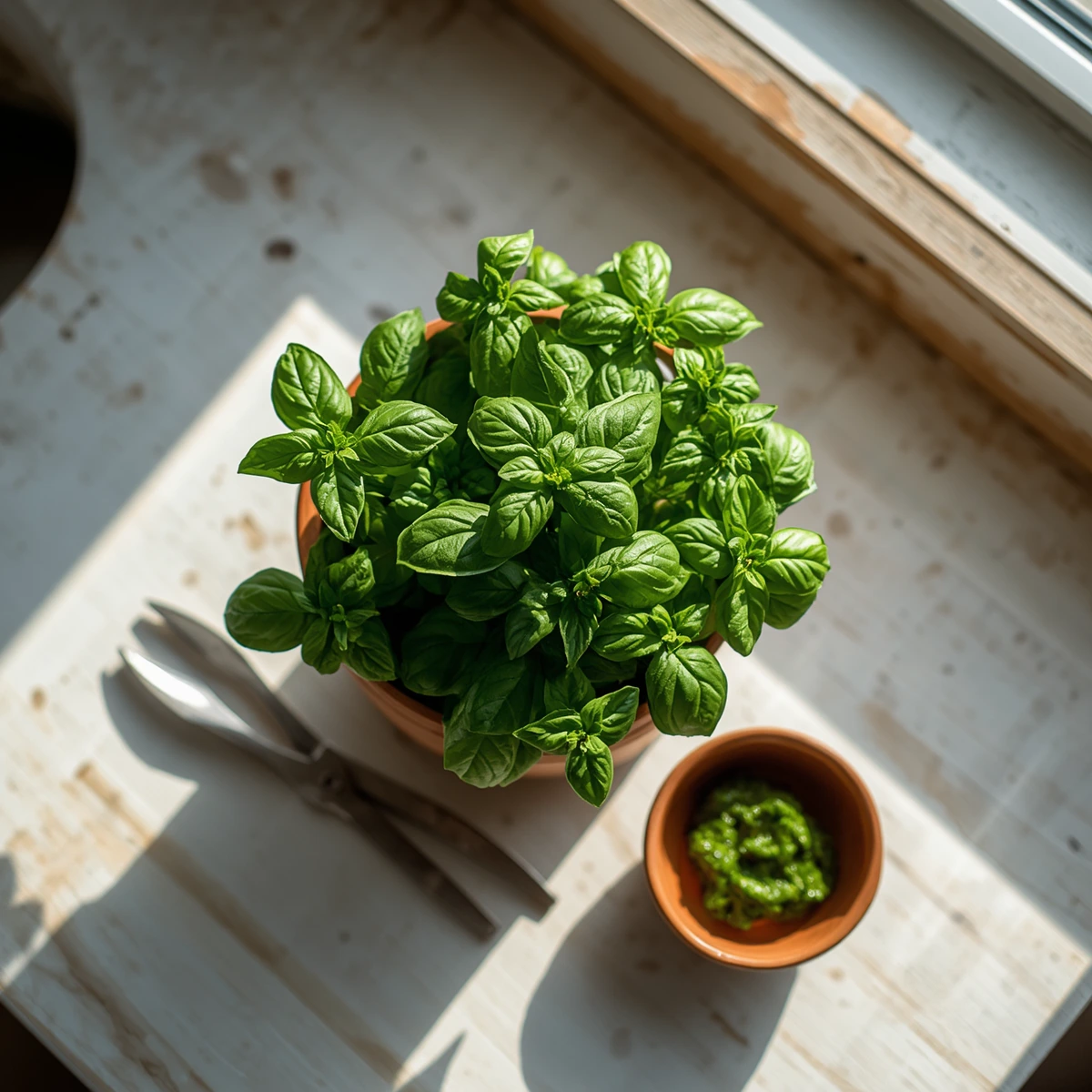
You brought home a lush pot of supermarket basil, set it on your kitchen windowsill, and watered it faithfully. Within a week, the stems went limp. By day ten, the leaves turned black at the base and the whole plant collapsed. This is not a watering failure — it is a structural one. That innocent-looking pot contained 15 to 20 genetically identical seedlings locked in a root war, and your kitchen counter was their battlefield.
Whether you’re rescuing store-bought Ocimum basilicum or growing from seed, basil demands precise environmental control, surgical pruning at the correct leaf axil, and proactive prevention of bolting — the irreversible shift to flowering that destroys flavor and medicinal potency. Get the mechanics right, and a single plant yields fresh leaves for 4–5 months while pumping out clinically significant concentrations of eugenol and rosmarinic acid. Get them wrong, and you’re throwing away another $4.99 pot every two weeks.
Sweet basil (Ocimum basilicum) is a high-transpiration annual requiring a minimum of 6 to 8 hours of direct solar radiation. Cultivation success hinges entirely on preventing bolting (early flowering), an irreversible reproductive shift that degrades the plant’s essential oil profile. This is controlled by surgically removing growth tips down to the lower node or leaf axil to force lateral branching. Culturally, Ocimum basilicum synthesizes elite levels of rosmarinic acid and eugenol — highly potent phytochemical compounds clinically demonstrated to inhibit oxidative stress and systemic inflammation. Substrates must be fast-draining and highly aerated to prevent root-zone hypoxia and fungal pathogens like Basil Downy Mildew (DMR).
Your Operational Benchmarks: The Physics of Basil Cultivation
Basil does not forgive vague care. The plant operates on measurable biochemical and physical thresholds, and every parameter below is derived from botanical research and professional horticultural practice. Treat these numbers as hard rules, not suggestions.
| Cultivation Parameter | Target Operational Baseline | Pathological Threshold / Warning Sign |
|---|---|---|
| Radiation Intensity | 6–8 hours direct outdoor sun or 14–16 hours under indoor LEDs. | Leggy basil; long internodal spacing, pale yellowing foliage. |
| Pruning Frequency | Every 10 to 14 days, pinching back immediately above a functional node. | Formation of terminal flower buds (bolting); woody stems. |
| Soil Architecture | Loamy compost amended with 20% coarse perlite; pH 6.5–7.0. | Compacted potting soil; surface pooling, water retention over 48 hours. |
| Watering Mechanics | Saturate fully until runoff occurs, then let top 1 inch dry completely. | Foliage drooping coupled with blackened, soft stems (root rot). |
| Primary Bioactives | Peak accumulations of Eugenol and Rosmarinic acid just before pruning. | Bitter taste profile, signifying the plant has shifted to seed production. |
The Physiological Blueprint: Eugenol & Rosmarinic Acid
The “Benefits” Void: Why Basil Actually Works
Most herb guides mumble something about basil being “healthy” and move on. That is a disservice to the plant’s pharmacology. Ocimum basilicum is not merely a flavoring agent — it is a concentrated pharmaceutical factory producing two clinically significant compounds that directly modulate human inflammatory pathways.
The first is eugenol, the same phenolic compound found in clove oil. Eugenol functions as a natural non-steroidal anti-inflammatory by inhibiting COX-1 and COX-2 enzymes — the same enzymatic targets as ibuprofen, but without the gastric ulceration risk associated with prolonged synthetic NSAID use. A single 100g serving of fresh basil leaves delivers approximately 1.5–2.0 mg of eugenol, enough to produce measurable suppression of pro-inflammatory cytokines including TNF-alpha and IL-6. This is not wellness-blog speculation. The COX-inhibitory activity of eugenol has been demonstrated in double-blind, peer-reviewed pharmacological studies.
The second elite compound is rosmarinic acid, a potent polyphenolic antioxidant that neutralizes reactive oxygen species (ROS) before they can damage cellular DNA and mitochondrial membranes. Rosmarinic acid is particularly effective at scavenging hydroxyl radicals — the most destructive free radical species in biological systems. Regular consumption of fresh basil, particularly from plants harvested before bolting, provides a meaningful dietary contribution to endogenous antioxidant defense.
Antioxidant Shield: Anthocyanins and Purple Varieties
If you want maximum antioxidant density, switch from Genovese sweet basil to a purple cultivar like ‘Dark Opal’ or ‘Purple Ruffles’. These varieties synthesize anthocyanins — the same flavonoid class that gives blueberries their neuroprotective reputation — in addition to rosmarinic acid and eugenol. The result is a dual-layer antioxidant defense: anthocyanins handle the water-soluble free radical populations in cellular cytoplasm, while rosmarinic acid manages the lipid-soluble oxidation chain reactions in cell membranes.
From a cultivation perspective, purple basil requires identical care to green varieties but offers measurably higher polyphenol content. The only trade-off is slightly lower sweetness in pesto applications. For raw consumption, tea infusion, or maximum medicinal yield, purple basil is objectively superior.
Surgical Pruning: The Node and Leaf Axil Mechanics
The Competitor Gap: Why “Pinch the Top” Destroys Your Plant
Every generic herb guide tells you to “pinch the top” of your basil. This advice is incomplete to the point of being harmful. A random pinch anywhere on the stem risks tearing tissue, leaving a jagged wound that invites bacterial infection, or — worse — removing growth material below a node that has already gone dormant or failed.
To prune basil correctly, you must first understand the anatomy. A node is the exact point on the stem where a leaf pair emerges. At the junction between the leaf stem (petiole) and the main stalk sits the leaf axil — a microscopic crevice containing two dormant lateral buds. These buds are the plant’s backup plan. While the dominant apical bud at the very top of the plant hogs all the growth hormones (a phenomenon called apical dominance), the axillary buds wait in biological suspended animation.
When you remove the apical growth tip, you break that hormonal dominance. Auxin flow from the top ceases, and the two dormant buds inside the leaf axil receive the biological signal to activate. Within 48–72 hours, they begin swelling. Within a week, two new branches push outward from that single cut. This is how one stem becomes two, and two become four, and four become the dense, bushy basil plant you actually want.
The Cut: Precision at the Leaf Axil
Pruning basil is not a rough tear. It is a surgical cut performed with intent:
- Identify the top growth tip — the vertical shoot extending above the highest pair of mature leaves on each stem.
- Trace that stem downward to the first healthy node with visible, turgid leaf pairs (not yellowing, not wilted).
- Using clean, sharp herb scissors or garden snips, cut the stem 2–3 millimeters above the leaf axil — the exact junction where the leaf pair meets the main stem. Do not cut into the axil itself. Do not leave a half-inch stub.
- Make the cut at a slight 45-degree angle. This sheds water away from the wound and reduces the surface area exposed to airborne pathogens.
- Remove the severed tip entirely from the plant area. Do not let it decompose on the soil surface, as this creates a fungal vector directly above the root zone.
Perform this operation on every stem that has extended beyond the desired canopy outline. Repeat every 10 to 14 days during active growth. The moment you see the first formation of terminal flower buds — tiny pointed structures at the stem tips with miniature leaf bracts — you are already in the early stages of bolting. Cut them off immediately, tracing each flowering stem back to the first healthy node.
The Triage Protocol: Saving Supermarket Basil
The Pain Point: Why Store-Bought Basil Dies in a Week
This is the most common frustration in herb gardening, and it is not your fault. That vibrant pot labeled “fresh basil” at the supermarket is not one plant. It is a crowded mass of 15 to 20 individual seedlings, all germinated simultaneously in a single small cell tray, then transplanted together into a decorative pot. They look lush because they were grown in a greenhouse under perfect conditions for 4–6 weeks. The moment they enter your home, the root war begins.
Those 20 seedlings are competing for the same finite water, the same nitrogen, and the same cubic inches of soil. Their root systems are already tangled into a suffocating knot. The tallest plants shade out the shortest, which yellow and die first. The survivors stretch upward desperately seeking light, becoming leggy and weak. Within days, the soil becomes a bacterial soup from the decomposing roots of the weaker seedlings. The survivors succumb to root rot shortly after. You did not kill that basil. It was structurally doomed before you paid for it.
The Fix: Surgical Separation and Repotting
Rescuing supermarket basil requires separating the combatants and giving the strongest individuals their own territory. This procedure has a 60–70% survival rate when executed correctly:
- Water the supermarket pot thoroughly 2 hours before separation. Hydrated roots are flexible and resist tearing; dry roots snap.
- Turn the pot upside down and gently squeeze the root ball out in one mass. Do not pull the stems — pull the soil.
- Submerge the entire root ball in a bowl of room-temperature water. Gently massage and tease the root mass apart. The water lubricates the roots and allows you to separate individual seedlings without tearing the delicate taproots.
- Sort the seedlings by vigor. Select the 4 to 5 strongest specimens with the thickest stems, deepest green coloration, and most intact root systems. Discard the remainder — they will not recover and will only compete if kept.
- Prepare individual pots (minimum 4-inch diameter) filled with loamy compost amended with 20% coarse perlite at pH 6.5–7.0. Each rescued seedling gets its own container. No exceptions.
- Plant each seedling at the same depth it was growing originally. Water gently until runoff drains from the bottom. Place in bright, indirect light for 3 days before moving to full sun to reduce transplant shock.
Supermarket Rescue Supplies
- 4–5 individual 4-inch pots with drainage holes — non-negotiable.
- Loamy compost + 20% perlite — fast-draining, pH 6.5–7.0.
- Room-temperature water bowl — for submerging and teasing apart root mass.
- Clean scissors — sterilized with rubbing alcohol before any cuts.
- 3-day acclimation window — indirect light before full sun exposure.
Pro Tip: The best time to rescue supermarket basil is within 48 hours of purchase — before the root competition has caused irreversible damage to the strongest seedlings. If the plant already shows black stems or a sour smell from the soil, discard it. That is advanced root rot, and you cannot reverse it.
Indoor Winter Survival & Hydroponics
The Winter Gap: Frost Kills Everything Above Ground
Ocimum basilicum is a frost-tender annual. Exposure to temperatures below 50°F for more than a few hours causes cellular damage that manifests as blackened, water-soaked leaves within 24 hours. A single hard frost below 32°F kills the plant entirely. If you want fresh basil in December, you cannot overwinter the outdoor plant — you must propagate new specimens indoors before the first frost arrives.
The propagation window is critical. Begin taking cuttings from your healthiest outdoor plants approximately 4–6 weeks before your region’s first expected frost date. This gives the new root systems time to establish before the parent plant dies back. Select stems that have not yet flowered — flowering cuttings root poorly and bolt faster under indoor conditions.
Propagation Protocol: From Cutting to Hydroponic System
The most reliable method for indoor winter basil is propagation in water, followed by transplant into a hydroponic setup or soil container under grow lights:
- Select a healthy, non-flowering stem with at least 4–5 leaf pairs. Using clean scissors, cut at a 45-degree angle just below a node — the same node rules apply here.
- Remove the lower 2 leaf pairs, exposing the bare stem. These leaf removal points are where roots will emerge. Submerge the stripped stem in a glass of room-temperature water, ensuring at least one node sits fully underwater.
- Place the glass in a bright window but out of direct midday sun, which overheats the water and promotes algae. Change the water every 2–3 days to prevent bacterial colonization.
- Roots will emerge from the submerged nodes within 7–14 days. Wait until roots reach at least 1 inch in length and show fine lateral branching before transplanting.
- Transfer rooted cuttings into either soil containers (4-inch pots with perlite-amended compost) under full-spectrum LED grow lights positioned 6–12 inches above the canopy, or into an indoor hydroponic system like an Aerogarden for zero-soil maintenance.
- Maintain a 14–16 hour LED light cycle daily. Indoor basil requires longer photoperiods than outdoor plants because artificial light intensity is lower than solar radiation. A mechanical timer ensures consistency.
Indoor vs. Outdoor Light Requirements
Outdoor basil thrives on 6–8 hours of direct sun, which delivers approximately 2,000–3,000 micromoles of photosynthetically active radiation (PAR) per square meter per day. Indoor LED systems must compensate for lower intensity with extended duration:
- Soil + LED setup: 14–16 hours under 40W full-spectrum LEDs, 6–12 inches from canopy.
- Hydroponic (Aerogarden) setup: Follow manufacturer’s preset herb cycle — typically 16–17 hours.
- Window-only (no supplemental light): South-facing window mandatory; expect slower growth and leggier stems. Rotate pot 180° every 3 days for even exposure.
The Storage Oxidation Problem: Scientific Preservation
Why Freezing Raw Basil Turns It Black
You have experienced this failure: you harvest a big batch of basil, freeze the leaves in a bag, and weeks later they are a slimy, blackened mess unfit for human consumption. The cause is not freezer burn. It is enzymatic browning driven by the polyphenol oxidase (PPO) enzyme — the same biochemical reaction that turns cut apples brown.
When basil cell walls rupture during freezing, the PPO enzyme makes contact with ambient oxygen and the polyphenolic compounds (including rosmarinic acid) in the leaf tissue. The enzyme catalyzes an oxidation reaction that produces melanin-like compounds — the black pigment you see. This is not just a cosmetic problem. The oxidation reaction destroys the bioactive compounds you are trying to preserve, degrading both flavor and medicinal value simultaneously.
Simply submerging leaves in oil before freezing does not solve the problem. The PPO enzyme remains active at freezer temperatures and continues working whenever oxygen is present. The only reliable solution is to destroy the enzyme before freezing.
The Flash-Blanch Protocol
Heat deactivates PPO by denaturing its protein structure. The following protocol locks in green color, preserves rosmarinic acid and eugenol content, and produces freezer-ready basil that lasts 6–8 months:
- Bring a large pot of water to a rolling boil. Do not salt the water — salt draws moisture from leaf tissue and degrades texture.
- Prepare an ice bath in a large bowl: equal parts ice and cold water, enough to fully submerge the leaf volume.
- Drop fresh basil leaves into the boiling water for exactly 3 seconds. This brief heat exposure is sufficient to denature PPO without leaching significant volatile oils. Longer blanching destroys flavor.
- Immediately transfer the blanched leaves to the ice bath using a slotted spoon. Cool for 30 seconds until leaves are cold to the touch. This stops the cooking process and sets the chlorophyll-driven green color.
- Drain thoroughly and pat dry with paper towels. Excess water creates ice crystals that rupture cell walls during freezing.
- Transfer dried leaves to a blender. Add enough extra-virgin olive oil to create a thick paste — approximately 1 tablespoon of oil per 1 cup of packed basil leaves. The oil creates an oxygen barrier around the leaf particles.
- Spoon the mixture into ice cube trays. Freeze solid, then transfer cubes to a freezer bag with all air pressed out. Each cube equals approximately 2 tablespoons of fresh basil equivalent.
Ecosystem Dynamics: Companion Planting
The Terpene Defense Shield
Basil is one of the most effective companion plants in vegetable gardening, and the mechanism is chemical, not physical. The leaves and stems continuously release volatile terpenes — including eugenol, linalool, and estragole — into the surrounding air. These aromatic compounds interfere with the olfactory navigation systems of insect herbivores, effectively creating an invisible chemical fog that confuses pests before they locate target plants.
The practical effect is dramatic. Aphids — sap-sucking insects that devastate tender growth — rely on volatile organic compound trails to find host plants. Basil’s terpene emissions mask these trails, reducing aphid colonization on neighboring crops by up to 60% in controlled field studies. Tomato hornworms (the larvae of Manduca moths) are similarly disrupted. The moth uses olfactory cues to identify tomato plants for egg-laying; interplanted basil scrambles those signals, reducing hornworm egg deposition measurably.
From a cultivation standpoint, plant basil within 12–18 inches of tomato plants for maximum protective effect. The basil does not need to touch the tomato — the volatile compounds travel through air. This proximity also makes harvesting convenient: tomato and basil together at the same moment for caprese salads and sauces. For a comprehensive guide to building a pest-resistant garden, see our full guide on companion planting for vegetables and herbs.
The Emergency Triage & Troubleshooting Matrix
When your basil plant shows distress, symptoms map directly to specific physiological failures. This matrix gives you the exact diagnosis and corrective protocol for the four most common failure modes.
| Visual Plant Symptom | Primary Root-Cause | Corrective Triage Protocol |
|---|---|---|
| Leaves are turning yellow and dropping, soil is damp | Overwatering / Root Hypoxia. The roots are suffocating. | Withhold water immediately until the top 2 inches of soil are bone dry. Ensure the pot has functional drainage holes. |
| Plant shoots straight up, leaves taste bitter, tiny white flowers appear | Bolting. The plant has reached the end of its reproductive cycle. | Prune off all flowers immediately. Cut the stems back aggressively by 1/3 to force the plant back into vegetative leaf production. |
| Fuzzy, grayish-purple mat on the underside of leaves; yellowing on top | Basil Downy Mildew (DMR). A highly destructive airborne oomycete pathogen. | Destroy the infected plant immediately (do not compost). For future plantings, purchase certified DMR-resistant seed varieties. |
| Frozen basil leaves turn completely black and slimy | Enzyme Oxidation. Exposure to ambient oxygen ruptured the cell walls. | Discard. Next harvest, flash-blanch leaves in boiling water for 3 seconds to deactivate the PPO enzyme before freezing in olive oil. |
Bolting: The Irreversible Flavor Death
Bolting — the transition from leafy vegetative growth to flower and seed production — is the single most important threat to basil quality, and it is biologically irreversible. Once the plant commits to reproduction, it redirects all metabolic resources from leaf production to seed development. Essential oil production collapses. The leaves that remain become bitter, fibrous, and nutritionally degraded.
Bolting is triggered by a combination of stress signals: lengthening daylight hours in summer, sustained temperatures above 85°F, and root crowding. The only effective management strategy is aggressive prevention through consistent pruning. Remove every flower bud the moment it appears. If multiple stems have bolted simultaneously, cut the entire plant back by one-third to force a vegetative reset. This buys you 2–4 additional weeks of leaf production before the plant inevitably completes its life cycle.
Pro Tip: Heat is the primary bolting trigger. When sustained temperatures exceed 85°F, provide afternoon shade using 30–40% shade cloth, increase watering frequency slightly, and prune every 7 days instead of every 14. These measures delay the reproductive shift by maintaining cooler leaf surface temperatures.
Frequently Asked Questions
How do you prune basil so it keeps growing?
Cut the top growth tip 2–3 millimeters above the highest healthy leaf node using clean, sharp scissors. This breaks apical dominance and forces the two dormant buds inside the leaf axil to activate, producing two new lateral branches from a single cut. Repeat this operation every 10–14 days. Never tear the stem — use scissors to create a clean, angled cut that heals quickly.
Why are my basil leaves turning yellow and falling off?
Yellowing lower leaves combined with damp soil indicates overwatering and root hypoxia. The roots are suffocating in waterlogged soil and cannot take up nutrients. Stop watering immediately, verify that drainage holes are open and functional, and allow the top 2 inches of soil to dry completely before the next watering. If the stems are blackened and soft at the base, the plant has advanced root rot and should be discarded.
Should I let my basil plant flower?
No. Flowering triggers an irreversible metabolic shift called bolting that redirects the plant’s resources from leaf production to seed development. Once bolting begins, the remaining leaves turn bitter and lose their aromatic oil content. Remove every flower bud the moment it appears. If flowers have already opened, cut the flowering stems back to the first healthy node to force the plant back into vegetative growth.
How much sun does basil need?
Outdoor basil requires a minimum of 6–8 hours of direct sunlight daily. Indoor basil grown under LEDs needs 14–16 hours of supplemental light because artificial light intensity is lower than natural sun. Insufficient light produces leggy, pale plants with weak flavor. South-facing windows provide the best indoor natural light; north-facing windows are inadequate without LED supplementation.
How often should I water basil?
Water thoroughly until runoff drains from the bottom of the pot, then allow the top 1 inch of soil to dry completely before watering again. In summer heat, this may mean every 2–3 days. In cooler conditions or high humidity, intervals extend to 5–7 days. Never let the plant sit in standing water — root rot develops within 48 hours of saturated soil conditions.
Can I grow basil indoors year-round?
Yes, but only with adequate supplemental lighting. Basil requires high light intensity that most windows cannot provide, especially in winter. Grow basil indoors successfully using full-spectrum LED grow lights on a 14–16 hour timer positioned 6–12 inches above the canopy, or in a dedicated hydroponic system like an Aerogarden. Without sufficient light, indoor basil becomes leggy and flavorless within 3–4 weeks.
Why does my basil turn black when I freeze it?
The black color is caused by the polyphenol oxidase (PPO) enzyme reacting with oxygen when freezing ruptures the cell walls. This enzymatic browning destroys both color and bioactive compounds. The solution is flash-blanching: dip fresh leaves in boiling water for exactly 3 seconds, transfer immediately to an ice bath, then blend with olive oil and freeze in ice cube trays. This heat treatment denatures the PPO enzyme and locks in color and flavor for 6–8 months.
What is the best soil for basil?
Basil demands fast-draining, highly aerated soil with a pH between 6.5–7.0. The optimal mix is loamy compost amended with 20% coarse perlite for drainage and aeration. Never use heavy, water-retentive potting soil — it saturates the root zone and causes hypoxia. In containers, ensure drainage holes are open and unobstructed. Garden soil should be loose and enriched with compost but never compacted.
How do I save supermarket basil from dying?
Supermarket basil pots contain 15–20 overcrowded seedlings competing to death. Submerge the root ball in water and gently tease apart the individual seedlings. Select the 4–5 strongest specimens and repot each into its own 4-inch container with perlite-amended compost. Discard the weak plants. Place rescued seedlings in bright, indirect light for 3 days before moving to full sun. This separation procedure has a 60–70% survival rate when performed within 48 hours of purchase.
What are the health benefits of eating fresh basil?
Fresh basil delivers two clinically significant bioactive compounds: eugenol, which inhibits COX-1 and COX-2 inflammatory enzymes (the same targets as ibuprofen), and rosmarinic acid, a potent polyphenolic antioxidant that neutralizes free radicals. Purple basil varieties add anthocyanins — flavonoids linked to neuroprotection and cardiovascular health. Peak medicinal potency occurs just before pruning, when essential oil concentrations are highest. Consume fresh or minimally processed; prolonged cooking degrades volatile compounds.
What is Basil Downy Mildew and how do I prevent it?
Basil Downy Mildew (DMR) is a destructive airborne oomycete pathogen that appears as a fuzzy grayish-purple growth on leaf undersides, with corresponding yellow blotches on top surfaces. It spreads rapidly through airborne spores and thrives in humid, crowded conditions. There is no cure for infected plants — they must be destroyed immediately and never composted. Prevention relies on three measures: spacing plants for airflow (minimum 12 inches apart), watering at the soil level rather than overhead, and planting DMR-resistant varieties such as ‘Prospera’ or ‘Everleaf’ for future crops.