
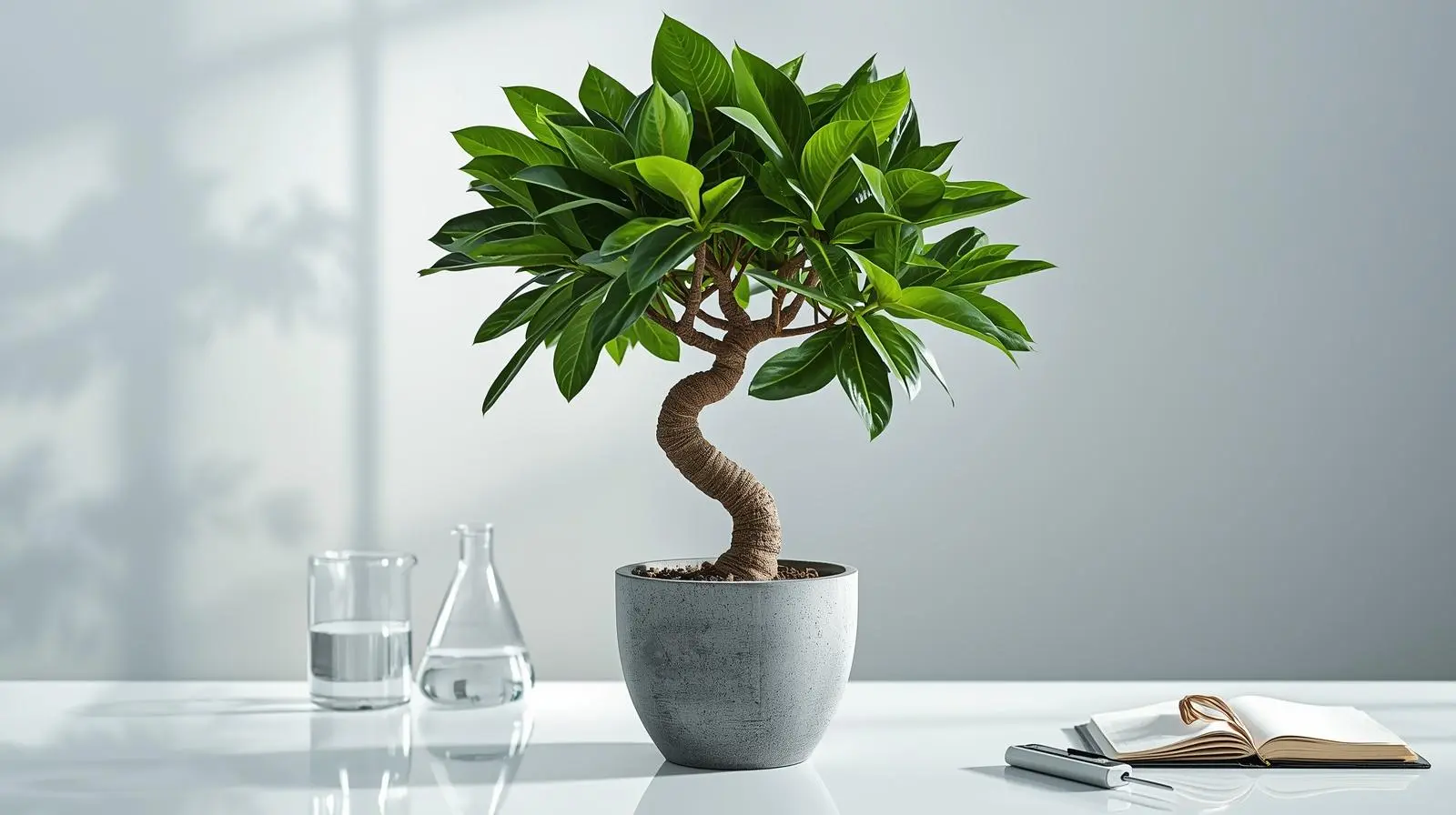
Your Pachira aquatica is rapidly shedding leaves, one or more of the braided trunks feels soft to the touch, and you’re watching your “Money Tree” die in real-time.
This isn’t bad luck. It’s not feng shui gone wrong. It’s a predictable mechanical failure caused by nursery cultivation practices that prioritize aesthetics over plant physiology.
The issue: Most commercial Pachira aquatica are five separate saplings braided together while young, then bound at the root flare with rubber bands or wire that eventually strangle the cambium layer. Combined with dense, water-retentive soil incompatible with its estuary origins, the plant develops hidden trunk rot that manifests weeks or months after purchase as catastrophic leaf drop and stem collapse.
📋 Table of Contents
The Estuary Origin: Misunderstood Watering Needs
Pachira aquatica is not a typical houseplant—it’s an estuary tree adapted to extreme hydrological fluctuations.
Native to freshwater swamps and coastal wetlands of Central and South America (Mexico to northern Brazil), Pachira aquatica grows in environments that experience seasonal flooding followed by prolonged dry periods. During the wet season, its roots may be submerged in standing water for weeks. During the dry season, the same location becomes parched soil.
This boom-and-bust water cycle shaped the plant’s physiology. It developed thick, succulent trunks for water storage, extensive shallow root systems for rapid moisture uptake during floods, and tolerance for anaerobic soil conditions that would kill typical tropical plants.
The Fatal Watering Mistake
Most owners kill Pachira aquatica by treating it like a fern or pothos—applying small amounts of water frequently.
The plant’s roots are engineered for feast-or-famine hydration. When you provide constant moderate moisture (the “water a little every week” approach), you create perpetually damp soil without ever triggering the plant’s drought-adapted survival mechanisms. The roots, expecting either complete saturation or total dryness, begin to rot in this twilight state of chronic dampness.
The Flood-and-Drought Protocol
💧 ESTUARY WATERING METHOD
Phase 1: The Flood (Complete Saturation)
- Water thoroughly until 20-30% of applied water drains from pot bottom—this ensures complete root ball saturation
- The substrate should be fully wet throughout all depths, not just surface-damp
- Empty drainage saucer after 15 minutes—do not allow pot to sit in standing water beyond this brief period
- Use room-temperature water to avoid thermal shock to roots
Phase 2: The Drought (Extended Drying Period)
- Wait until top 2-3 inches of soil are completely dry before next watering
- Stick finger deep into substrate—if any moisture detected in top third of pot, do NOT water
- Typical interval: 7-14 days in summer (bright light, warm temps), 14-21 days in winter
- Leaf drop from underwatering is rare—leaves may droop slightly before bouncing back after watering
Why This Works: The saturation phase delivers massive water volume to deep roots and refills trunk moisture reserves. The drying phase prevents root rot by allowing oxygen to return to soil pores and triggers the plant’s natural drought-tolerance mechanisms. According to USDA Forest Service research on Pachira aquatica, this species shows optimal growth under pulsed hydration rather than continuous moisture availability.
⚠️ Overwatering Death Spiral
Pachira aquatica root rot progresses rapidly once initiated:
- Week 1-2: Soil remains perpetually damp from frequent watering. Fine root hairs begin dying from oxygen starvation
- Week 2-4: Anaerobic bacteria colonize root system. Roots turn brown/black and mushy. External symptoms minimal
- Week 4-6: Lower canopy leaves yellow and drop rapidly. One or more braided trunks begins softening at base
- Week 6-8: Affected trunk becomes hollow or collapses. Leaf drop accelerates. Plant may lose 50%+ of foliage
- Week 8+: Multiple trunks affected. Entire plant may die if intervention not performed
Critical intervention window: Before Week 4. Once trunks show softness, survival rate drops to 40-60%. For emergency trunk rot surgery, see our complete rescue protocol.
The Braided Trunk Sabotage: Inspecting for Hidden Damage
The braided trunk is not a natural growth pattern—it’s a nursery manipulation that creates structural vulnerabilities.
Commercial growers plant 3-5 Pachira aquatica seedlings in a single pot when they’re 6-12 months old and trunks are still flexible. The saplings are manually braided together weekly as they grow, training them into the decorative twisted form. To maintain the braid tightness during shipping and retail, nurseries bind the trunks at the base with rubber bands, electrical tape, or wire—often buried 1-2 inches below the soil surface where buyers cannot see it.
The Cambium Strangulation Problem
These binding materials create a tourniquet effect on the cambium layer—the thin tissue beneath the bark responsible for nutrient and water transport.
As the trunks grow in diameter, the non-expanding band constricts tighter. This blocks phloem (sugar transport from leaves to roots) and xylem (water transport from roots to leaves) flow at the binding point. The trunk above the constriction begins to die from nutrient starvation, while roots below suffer from lack of photosynthates. Within 3-12 months post-purchase, the affected trunk turns soft, wrinkly, and eventually collapses from internal rot.
The Inspection Protocol
🔍 ROOT FLARE EXCAVATION & BINDING REMOVAL
Perform this inspection within first week of bringing plant home:
- Excavate carefully: Use fingers or small tool to gently remove soil from around base of braided trunks, working 1-2 inches below surface level
- Locate binding materials: Look for rubber bands (often dark brown/black and degraded), wire, zip ties, or electrical tape wrapped around trunk junction
- Assess constriction damage: If binding has been in place long-term, you may see indentation, discoloration, or soft tissue where band was positioned
- Cut and remove: Using sterilized scissors or wire cutters, carefully cut binding materials. Do NOT try to unwind—cutting prevents additional bark damage
- Leave braid intact: The trunks will remain braided from years of trained growth. They do not need binding to maintain shape
- Monitor recovery: Check binding site weekly for 4-6 weeks. Healthy tissue should firm up; soft spots indicate existing rot that may require trunk removal
Prevention for future purchases: Before buying, ask nursery staff if binding materials are present. Reputable sellers will remove bands before sale or inform customers to do so immediately.
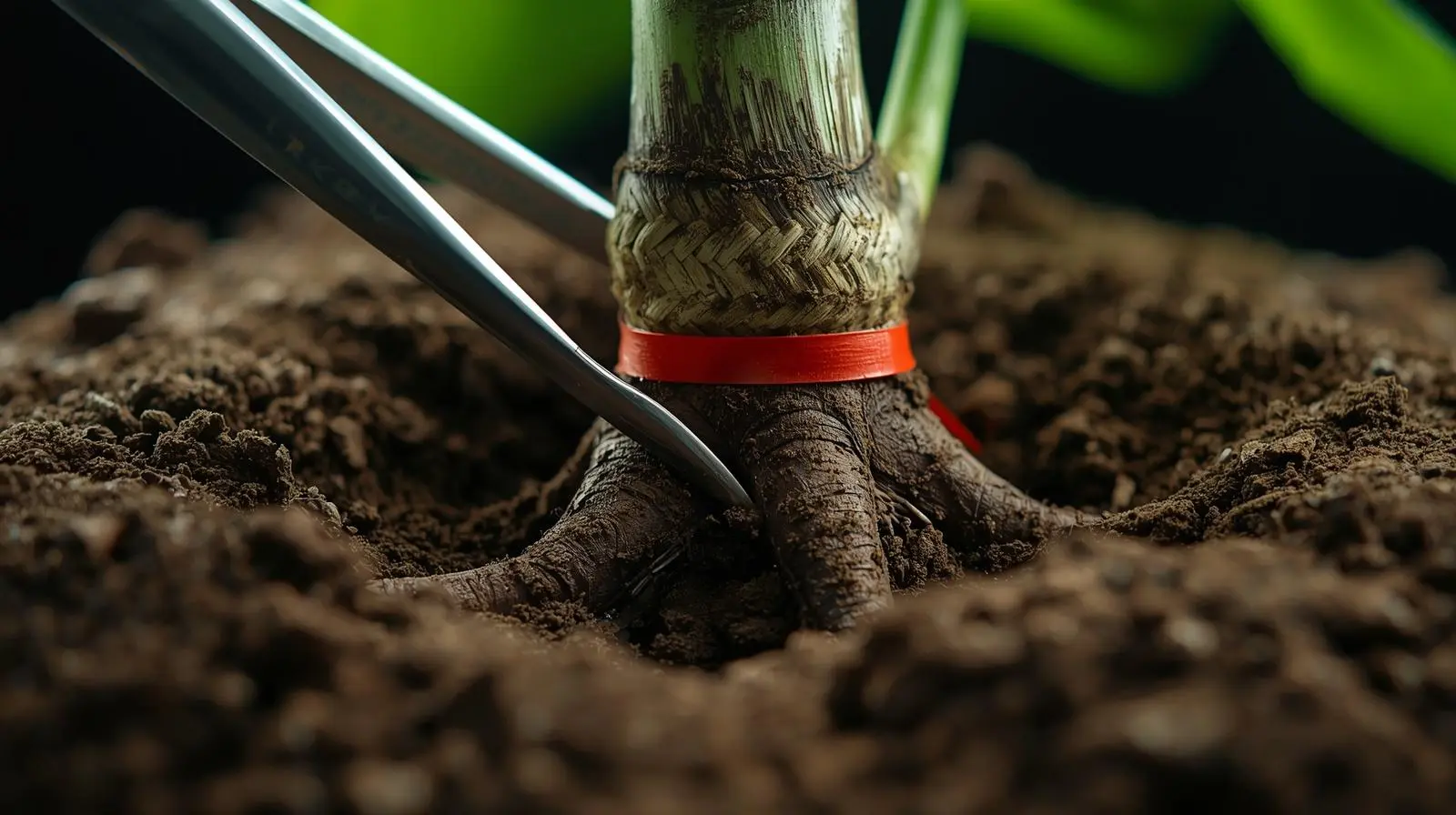
Root flare excavation revealing hidden rubber band causing cambium strangulation and trunk rot
When a Trunk is Already Dead
If one or more braided trunks is soft, hollow, or collapsing, it cannot be saved—but the remaining trunks can survive.
Pachira aquatica sold as “braided money tree” is actually 3-5 independent plants. Each trunk has its own root system. If one dies, the others continue functioning normally once the dead tissue is removed.
Removal procedure:
- Identify which trunk(s) are affected—press gently; dead trunks feel hollow or collapse under slight pressure
- Using sterilized pruning shears, cut dead trunk at soil line as close to base as possible
- Remove any loose, rotting tissue from the cut site
- Dust cut surface with cinnamon powder (natural antifungal) or sulfur powder
- Remaining healthy trunks will continue growing and may produce new shoots from base over 6-12 months
Diagnosing Foliage Failure: Symptom Analysis Matrix
Leaf problems in Pachira aquatica have distinct causes requiring opposite treatments. Misdiagnosis accelerates decline.
The Diagnostic Decision Tree
| Visual Symptom | Biological Cause | Immediate Lab Protocol |
|---|---|---|
| Entire trunk is soft, wrinkly, or hollow when pressed | Advanced stem rot from chronic overwatering, root suffocation, or cambium strangulation from binding materials | Remove dead trunk immediately at soil line with sterilized blade. Inspect remaining trunks for hidden bands at root flare. Repot survivors in fresh well-draining substrate. Do not water for 7-10 days post-surgery. |
| Rapid yellowing and dropping of lower canopy leaves (2+ leaves per week) | Root suffocation from waterlogged dense soil or binding materials blocking nutrient flow. Roots cannot deliver nitrogen/nutrients to foliage. | Excavate root flare and remove any restrictive bands. Check soil moisture—if wet, cease watering until top 3 inches completely dry. Consider emergency repotting into chunky well-aerated substrate (see substrate section). |
| Crispy, curled, or brittle green leaves (not yellow) | Severe underwatering causing cellular desiccation, or humidity crash below 30% RH in heated indoor environments | Water thoroughly using flood method until drainage occurs. Increase ambient humidity with humidifier or pebble tray. Mist canopy lightly 2-3x per week during recovery. Crispy tissue will not recover—trim if desired. |
| Pale, washed-out leaves with bleached patches | Excessive direct sunlight causing chlorophyll breakdown and tissue photodamage | Move to bright indirect light location immediately. Damaged leaves will not recover but new growth will show proper coloration. Provide east or west-facing window with sheer curtain filtration. |
| Slow growth, sparse canopy, leggy stems reaching upward | Insufficient light intensity causing etiolation (stretching toward light source) and reduced photosynthetic capacity | Increase light exposure—move closer to window or add supplemental LED grow lights. Prune leggy growth to force branching (see pruning section). |
Canopy Management: Pruning for Structural Integrity
Indoor Pachira aquatica become “leggy” and sparse without proper pruning—they naturally grow into 60-foot canopy trees in habitat.
In insufficient light, the plant produces long internodes (stem sections between leaves) as it stretches toward the light source. This creates tall, spindly growth with sparse foliage concentrated at the top—the opposite of the dense, umbrella-shaped canopy desired indoors.
The Node-Cutting Method
Pruning triggers dormant axillary buds to activate, producing multiple new branches from a single cut point.
✂️ PRECISION PRUNING PROTOCOL
When to Prune: Spring or early summer during active growth. Avoid winter dormancy period.
Cutting Technique:
- Identify target height: Decide where you want new branching to occur—typically 6-12 inches below desired final canopy height
- Locate the node: Find the small bump or ring on stem where a leaf was previously attached. This contains dormant buds
- Make clean cut: Using sterilized pruning shears, cut stem at 45-degree angle ¼-½ inch ABOVE the node
- Angled cut direction: Angle should slope away from node—prevents water collecting on cut surface and causing rot
- Remove excess: Cut away the entire leggy section above your cut point
- Seal cut (optional): Apply pruning sealant or cinnamon powder to cut surface to prevent pathogen entry
Expected Results:
- Within 2-4 weeks, small green shoots emerge from dormant buds near cut site
- Typically produces 2-4 new branches per cut, creating bushier growth
- New branches grow horizontally initially, then angle upward—creates umbrella canopy shape
- Repeat pruning annually to maintain dense, compact form
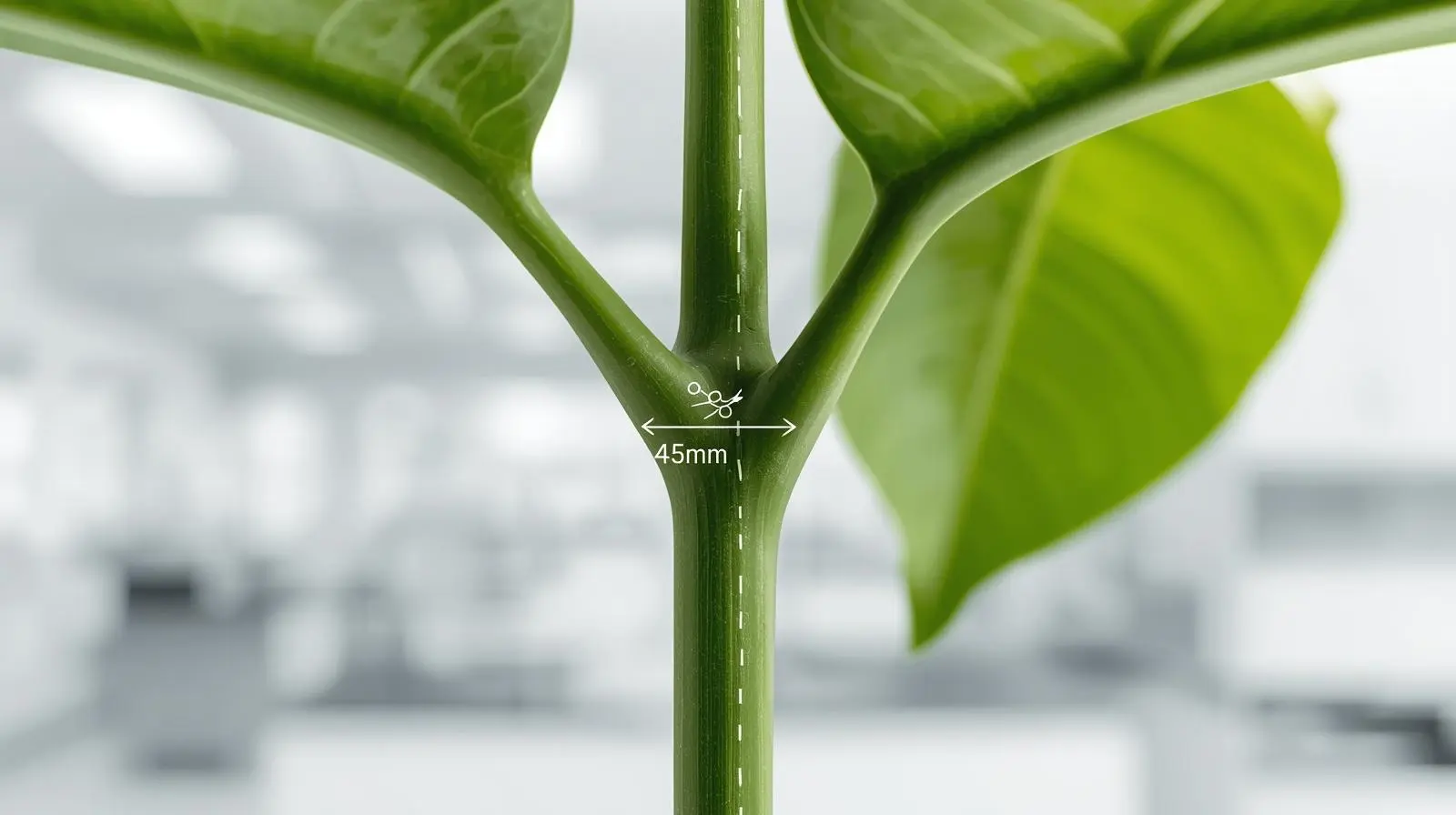
Proper pruning cut placement: 45-degree angle ¼ inch above leaf node to trigger new branch formation
Propagating Pruned Cuttings
The removed stem sections can be rooted to create new plants.
Take cuttings 6-8 inches long with at least 2-3 nodes. Remove lower leaves, dip cut end in rooting hormone (optional), and place in water or moist perlite. Roots develop within 3-6 weeks at 21-24°C (70-75°F) with bright indirect light. For detailed propagation protocols, see our complete Pachira aquatica rooting guide.
Light Requirements & Placement
Pachira aquatica requires bright indirect light for optimal growth—it tolerates shade but will not thrive.
In its native habitat, young trees grow in the understory with dappled sunlight filtering through canopy, then emerge into full sun as they mature. Indoor specimens need the understory light profile: bright but filtered, never direct.
Optimal Light Locations
- East-facing window: Ideal. Gentle morning sun (6am-10am) followed by bright indirect light rest of day
- West-facing window: Acceptable with sheer curtain to filter intense afternoon sun (2pm-6pm)
- South-facing window: Only if positioned 4-6 feet back from glass or with sheer curtain—direct sun causes leaf scorch
- North-facing window: Insufficient light in most climates—plant survives but minimal growth, increased disease susceptibility
Supplemental lighting: If natural light inadequate, use full-spectrum LED grow light positioned 12-18 inches above canopy for 10-12 hours daily. Target light intensity: 200-400 foot-candles (2000-4000 lux).
Substrate & Repotting Protocol
Commercial Pachira aquatica are typically sold in dense, peat-heavy soil designed for nursery efficiency, not long-term plant health.
This substrate retains excessive moisture, compacts over time reducing oxygen availability, and contributes to the chronic overwatering problem. Transitioning to a well-draining mix significantly reduces rot risk.
The Lab-Grade Substrate Formula
| Component | Ratio | Function |
| Quality Potting Mix or Coco Coir | 40% | Moisture retention, nutrients |
| Coarse Perlite or Pumice | 30% | Drainage, aeration |
| Orchid Bark or Pine Bark Fines | 20% | Structure, air pockets |
| Coarse Sand or Horticultural Grit | 10% | Weight, drainage |
Performance characteristics: This mix drains 60-70% of applied water within seconds while retaining adequate moisture in organic fraction for root uptake. Air-filled porosity remains above 30% even when saturated, preventing anaerobic root conditions. For complete substrate engineering, see our estuary species substrate guide.
Repotting Frequency & Procedure
Repot every 2-3 years or when roots visibly circle pot bottom. Pachira aquatica prefers being slightly root-bound—oversized pots hold excess wet substrate that increases rot risk.
Container requirements: Pot must have drainage holes. Use container only 2 inches larger in diameter than current pot. Terracotta ideal for moisture regulation; plastic acceptable if drainage excellent.
Frequently Asked Questions: Pachira Aquatica Care
How do I know if my Money Tree has root rot?
Primary symptoms: rapid yellowing and dropping of lower leaves (2+ per week), one or more braided trunks feeling soft/squishy when pressed, musty/foul odor from soil, and wilting despite wet substrate. Advanced cases show hollow or collapsing trunks. To confirm: unpot and inspect roots—healthy roots are white/tan and firm; rotted roots are brown/black, mushy, and fall apart when touched.
Can I separate the braided trunks of my Pachira aquatica?
Not recommended for mature specimens. After years of trained growth, trunks are fused at contact points and separation causes significant bark damage and stress. However, you SHOULD remove hidden binding materials (rubber bands, wire) from the root flare that strangle the cambium. The braid will maintain shape without restrictive bands. If one trunk dies, cut it away at soil line—remaining trunks continue growing independently.
Why is my Pachira aquatica not growing new leaves?
Three primary causes: (1) Insufficient light—needs bright indirect light for active growth; low light triggers metabolic stasis. (2) Winter dormancy—growth naturally slows/stops during shorter days and cooler temps. (3) Root problems from overwatering or pot-bound roots. Solution: Verify light intensity is adequate (200-400 FC), reduce watering in winter, check if roots are circling pot bottom (may need repotting).
How big do Money Trees get indoors?
Indoor Pachira aquatica typically reach 6-8 feet tall over 5-10 years with proper care. In native habitat, they grow to 60 feet as canopy trees. Growth rate indoors: 6-12 inches per year under optimal conditions (bright light, proper watering). Control height through annual pruning—cut stems above leaf nodes to trigger branching and maintain compact form.
Is Pachira aquatica toxic to pets?
No. Pachira aquatica is considered non-toxic to cats, dogs, and humans according to ASPCA’s toxic plants database. However, ingestion of plant material may still cause mild gastrointestinal upset (vomiting, diarrhea) due to mechanical irritation from fibrous leaves. Keep out of reach as precaution but not considered dangerous.
Do I need to fertilize my Money Tree?
Minimal fertilization required. Apply diluted balanced liquid fertilizer (20-20-20 at ½ strength) once monthly during active growth season (April-September). Cease fertilization in winter dormancy. Overfertilization causes salt buildup in substrate and soft, disease-prone growth. Pachira aquatica grows in nutrient-poor wetland soils naturally—thrives on benign neglect more than intensive feeding.
The Lab Verdict: Treat It Like a Swamp Tree, Not a Desk Ornament
The fundamental error in Pachira aquatica care is treating it like a delicate tropical ornamental when it’s actually a flood-adapted wetland tree.
This species evolved in environments hostile to most plants—seasonal inundation, anaerobic mud, intense sun, and prolonged drought. It developed thick water-storage trunks, shallow spreading roots for rapid moisture capture, and tolerance for extreme hydrological swings. These adaptations make it remarkably resilient when its actual needs are met, but catastrophically vulnerable when subjected to the constant moderate moisture and dense soil we provide to typical houseplants.
The Urban Lab Protocol for Pachira aquatica centers on three interventions: (1) Immediate inspection and removal of hidden binding materials at the root flare that strangle trunks, (2) Flood-and-drought watering that mimics estuary hydrology—thorough saturation followed by 1-2 weeks of drying, and (3) Well-draining substrate with 40%+ inorganic components to prevent the chronic dampness that causes root rot.
When you stop treating it like a fragile desk plant and start treating it like the wetland survivor it is, the “Money Tree” becomes genuinely low-maintenance and can thrive for decades indoors.
The Urban Lab | Estuary Species Protocols Division
Pachira aquatica Care Protocol | Published: March 2026