Rubber Plant Care: The Science of Growing a Thriving Ficus Elastica

🔬 THE URBAN LAB | FICUS ELASTICA PROTOCOL

The 2026 Renaissance: Welcome to the “Year of the Ficus.” After years of Monstera dominance, Rubber Plants (Ficus elastica) are reclaiming their position as the ultimate architectural statement piece for modern interiors. Their massive, glossy leaves and sculptural growth habit create dramatic vertical impact that no other houseplant can match.

The Reality Check: While considerably more forgiving than its temperamental cousin, the Fiddle Leaf Fig, Ficus elastica has one critical flaw that frustrates most indoor gardeners: it grows into a single, tall, unstable pole if you don’t understand its hormonal growth mechanisms.

The Urban Lab Promise: This isn’t a generic “water when dry” care guide. This is a biological manipulation protocol that will teach you how to break apical dominance, force lateral branching, and engineer a thick, bushy indoor tree that commands attention. We’re not just keeping your plant alive—we’re teaching you to control its architecture.

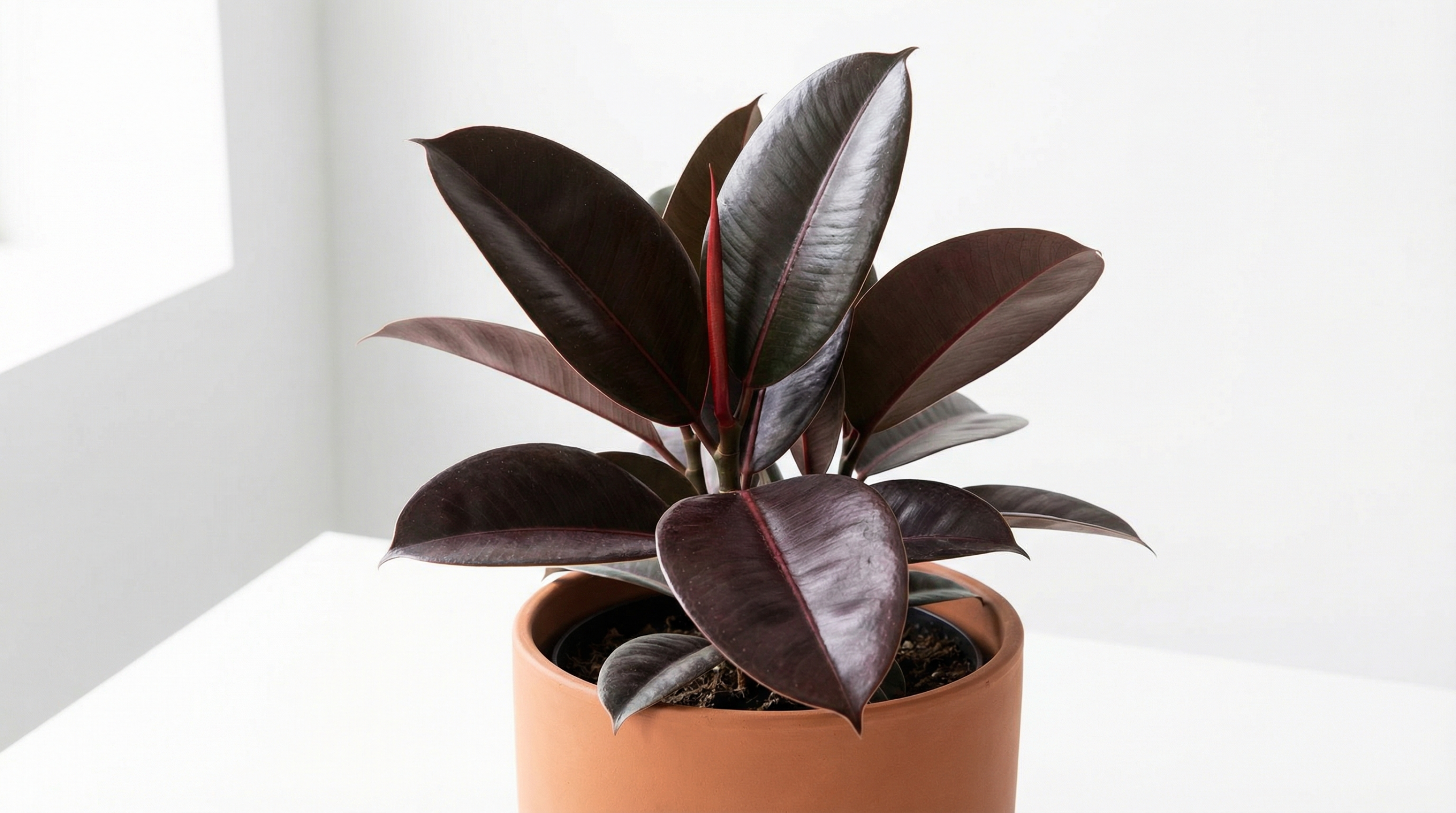
Healthy Rubber Plant (Ficus elastica) with glossy burgundy leaves in terracotta pot showing proper care and branching structure

Ficus elastica ‘Burgundy’ displaying optimal growth structure through proper light, watering, and pruning protocols

The Biology of Ficus Elastica: Understanding Rubber Plant Anatomy

Before implementing care protocols, understanding the plant’s native biology provides critical context for decision-making.

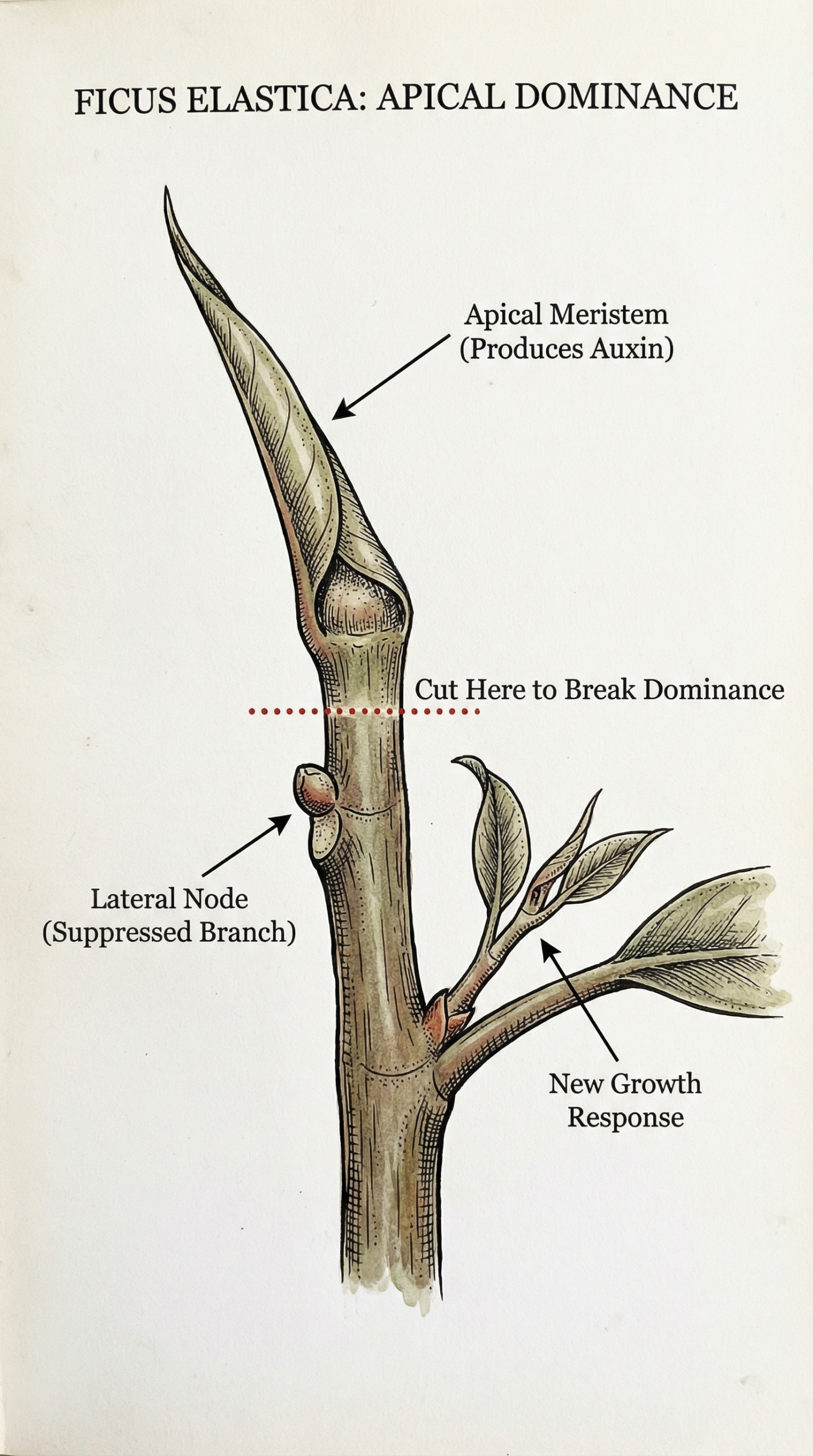
Scientific diagram showing where to cut a Rubber Plant to force branching and break apical dominance
Fig 1.1: The Urban Lab protocol for breaking apical dominance in Ficus elastica.

Native Habitat & Evolutionary Adaptations

Ficus elastica is native to the tropical rainforests of South Asia—primarily northeastern India, Nepal, Bhutan, Burma, and Indonesia. In its natural environment, it functions as a massive canopy tree reaching heights of 30-40 meters (100-130 feet), often beginning life as an epiphyte before developing aerial roots that eventually strangle the host tree.

This evolutionary history explains several key characteristics relevant to indoor cultivation:

  • Thick, waxy cuticle: Reduces transpiration during dry periods—allows tolerance of inconsistent watering
  • Large horizontal leaves: Maximizes light capture in understory conditions before reaching canopy
  • Aggressive vertical growth: Evolutionary imperative to reach sunlight quickly
  • Latex sap (polyisoprene): Defensive compound that deters herbivores and seals wounds

The Stipule: Identifying New Growth

One of the most distinctive features of Rubber Plant care is the stipule—a bright red or pink protective sheath that encases emerging leaves at the plant’s apical meristem (growth point).

🔬 ANATOMICAL IDENTIFICATION

The Stipule is NOT a flower. This is the most common misidentification among new Rubber Plant owners. The red spike at the plant’s apex houses the developing leaf, which remains tightly furled inside the protective sheath. As the new leaf expands and hardens, the stipule dries and falls off naturally—this is normal and indicates healthy meristematic growth. Do not remove the stipule manually as this can damage the developing leaf tissue beneath.

Lighting Requirements & Photosynthetic Efficiency

Like all members of the Ficus genus, Ficus elastica requires substantial light intensity for robust growth. However, its large horizontal leaves present a unique maintenance challenge.

Optimal Light Conditions

Ideal placement: Bright, indirect light with 3-6 hours of morning direct sun tolerated

  • East-facing windows: Excellent; gentle morning sun promotes compact growth
  • South-facing windows (Northern Hemisphere): Best option if filtered or 3-6 feet back from window
  • West-facing windows: Acceptable with afternoon sun filtered through sheer curtains
  • North-facing windows: Insufficient for active growth; expect slow development and leaf spacing

The Critical Maintenance Protocol: Dust Management

This is where most Rubber Plant care guides fail to provide actionable guidance. The large, horizontal leaves of Ficus elastica function as solar panels—and just like actual photovoltaic panels, dust accumulation severely degrades performance.

⚠️ The Dust Problem: Photosynthetic Inhibition

Dust particles physically block stomata—microscopic pores on leaf surfaces responsible for gas exchange (CO₂ intake, O₂ release). When stomata are occluded by dust, particulate matter, or residue:

  • Photosynthetic efficiency drops 20-40% depending on dust density
  • Transpiration is impaired, disrupting nutrient transport
  • The plant compensates by producing fewer, smaller leaves
  • Growth slows dramatically despite adequate light and water

✅ The Leaf Maintenance Protocol

Frequency: Every 14 days (bi-weekly)

Method:

  1. Dampen a clean microfiber cloth with room-temperature water
  2. Support each leaf from beneath with one hand
  3. Gently wipe from petiole (stem) to leaf tip in smooth strokes
  4. Wipe both upper and lower leaf surfaces
  5. Pay special attention to leaf undersides where dust accumulates in stomatal regions

Critical Warning: Do NOT use commercial “leaf shine” sprays, olive oil, milk, or other folk remedies. These substances create a film that permanently clogs stomata, causing more harm than dust accumulation. Plain water is the only safe cleaning agent.

Watering Protocol: Preventing Anaerobic Root Decay

The most common cause of Rubber Plant leaf drop and decline is improper watering—specifically, chronic overwatering leading to anaerobic substrate conditions.

Understanding Substrate Oxygen Requirements

Plant roots require aerobic respiration—they consume oxygen and produce CO₂, just like animal cells. When substrate (growing medium) remains waterlogged, oxygen is displaced by water, creating anaerobic conditions where beneficial aerobic bacteria die and are replaced by pathogenic anaerobic organisms.

This leads to:

  • Root rot: Black, mushy roots with foul odor
  • Rapid lower leaf yellowing and drop: Plant sheds leaves it can no longer support
  • Substrate compaction: Dead root material and anaerobic decay create dense, airless soil
  • Fungus gnat infestation: Thrives in consistently moist anaerobic conditions

The Rubber Plant Drought Adaptation

Unlike many tropical plants, Ficus elastica possesses significant drought tolerance due to its thick, waxy leaves that store moisture and minimize transpiration. This adaptation means the plant is far more tolerant of underwatering than overwatering.

💧 The Urban Lab Watering Protocol

The 50% Dry Rule:

Allow the top 50% of substrate to dry completely before watering. For a standard 10-inch pot, this means the top 5 inches should be dry to the touch.

Testing Method:

  • Insert finger 3-4 inches into substrate
  • If any moisture is detected, do NOT water
  • Alternative: Use a moisture meter—water when reading is 3-4 (on 1-10 scale)

When Watering:

  1. Water thoroughly until 20% of applied water drains from bottom holes
  2. This “flushing” action prevents salt accumulation from fertilizer
  3. Discard all water that collects in drainage tray within 30 minutes
  4. Never allow pot to sit in standing water

Typical Frequency:

  • Summer (active growth): Every 7-10 days
  • Winter (dormancy): Every 14-21 days
  • Always base on soil moisture, not calendar

Soil Composition for Optimal Drainage

Proper substrate composition prevents anaerobic conditions by ensuring adequate drainage and aeration:

  • 60% quality potting mix
  • 20% perlite (improves drainage, prevents compaction)
  • 15% orchid bark or coco coir chunks (creates air pockets)
  • 5% worm castings (gentle slow-release nutrients)

Breaking Apical Dominance: How to Force Rubber Plant Branching

This is the highest-value section of any Rubber Plant care guide—the information that separates a single-stemmed pole from a lush, bushy indoor tree. Understanding and manipulating apical dominance is the key to architectural control.

The Science of Apical Dominance

Left to its natural growth pattern, Ficus elastica exhibits strong apical dominance—a hormonal phenomenon where the topmost growth point suppresses lateral (side) branching.

The Biochemical Mechanism:

The apical meristem (tip growth point) produces high concentrations of auxin, a plant hormone that:

  1. Promotes vertical cell elongation at the apex
  2. Simultaneously inhibits lateral bud activation along the stem
  3. Concentrates all growth energy into a single upward trajectory

This strategy makes evolutionary sense for a rainforest tree competing to reach the canopy—vertical growth is prioritized over branching until sufficient height is achieved.

The Solution: Apical Meristem Removal

By removing the apical meristem, you eliminate the source of auxin production. This hormonal disruption signals the plant to redirect energy into activating dormant lateral buds (axillary meristems) along the stem.

✂️ THE BRANCHING PROTOCOL

Best Timing: Spring or early summer when plant is actively growing

Equipment Required:

  • Sharp, sterile pruning shears or scissors (sterilize with rubbing alcohol)
  • Nitrile or latex gloves (latex sap is an irritant)
  • Paper towels to absorb sap

Step-by-Step Procedure:

  1. Identify the cutting point: Count down 3-5 nodes (leaf attachment points) from the apex
  2. Make the cut: Use sharp shears to cut ¼ inch above a node at a 45° angle
  3. Expect latex flow: White sap will bleed from the wound—this is normal
  4. Seal the wound: Either allow latex to air-dry naturally (forms natural seal) or dust with cinnamon powder (antimicrobial)
  5. Wait for activation: Lateral buds typically break dormancy in 2-6 weeks

Expected Results: 2-3 lateral branches will emerge from nodes below the cut. As these branches grow, you can repeat the process on each branch to create additional tiers of branching, building a full, bushy canopy structure.

Air Layering: Advanced Propagation While Branching

When you remove the apical section, you’re left with a cutting that can be propagated via air layering or direct rooting. This allows you to create a second plant while simultaneously forcing the original to branch.

Quick propagation method:

  1. Allow cut end to callous for 2-3 hours (latex stops flowing)
  2. Place cutting in water or directly into moist substrate
  3. Roots develop in 3-6 weeks
  4. Plant cutting once roots are 2-3 inches long

Lab Safety: Managing Polyisoprene Latex Sap

⚠️ Toxicology Note: When pruned or damaged, Ficus elastica bleeds a white sap containing polyisoprene (natural rubber latex) and mild toxins. It is an irritant to human skin and toxic to pets if ingested. For specific veterinary symptoms, reference the ASPCA Toxic Plants Database . Always wear gloves when propagating or pruning.

Safety Protocols:

  • Wear nitrile gloves during any pruning or propagation
  • Keep plant elevated and out of reach of pets
  • Wash hands thoroughly after handling, even with gloves
  • If latex contacts skin, wash immediately with soap and water
  • Symptoms of pet ingestion: vomiting, drooling, mouth irritation—contact veterinarian immediately

The Urban Lab Diagnostic Checklist: Rubber Plant Troubleshooting

Common Symptoms & Solutions

🟡 Lower Leaves Turning Yellow and Dropping

Diagnosis: Anaerobic root decay from chronic overwatering

Protocol: Reduce watering frequency immediately. Allow top 50% of substrate to dry between waterings. If more than 2-3 leaves are affected, unpot and inspect roots—remove any black, mushy roots and repot in fresh, aerated substrate.

💧 Leaves Drooping Despite Dry Soil

Diagnosis: Severe cellular dehydration; loss of turgor pressure

Protocol: Water immediately and thoroughly. Plant should recover (leaves firm up) within 4-8 hours. If drooping persists beyond 24 hours, root damage may be present—inspect root system.

↗️ Plant Leaning Heavily to One Side

Diagnosis: Phototropism—growth toward unilateral light source

Protocol: Rotate pot 90° clockwise every 7-10 days. This distributes auxin evenly and maintains vertical growth. For severe leaning, stake temporarily while rotating consistently to retrain growth direction.

🟤 Brown Spots or Patches on Leaves

Diagnosis: Sunburn from direct afternoon sun OR bacterial/fungal infection from water sitting on leaves

Protocol: If spots are crispy and brown, move away from direct sun. If spots are dark and spreading, remove affected leaves and increase air circulation. Avoid misting or allowing water to pool on leaf surfaces.

🐛 Sticky Residue on Leaves or Nearby Surfaces

Diagnosis: Honeydew secretion from scale insects or mealybugs

Protocol: Inspect undersides of leaves and stem joints for scale (brown bumps) or mealybugs (white cottony masses). Isolate plant. Remove pests manually with cotton swab dipped in rubbing alcohol. Spray entire plant with insecticidal soap or neem oil weekly for 3-4 weeks.

📏 Excessive Space Between Leaves (Etiolation)

Diagnosis: Insufficient light intensity—plant is “stretching” toward light source

Protocol: Move to brighter location immediately. Etiolated growth cannot be reversed, but new growth will be compact if light is adequate. Consider pruning stretched sections to encourage bushier regrowth.

Fertilization Protocol for Robust Growth

While Ficus elastica is not a heavy feeder, consistent nutrient supplementation during the growing season promotes larger leaves and faster growth.

🧪 Fertilization Schedule

Formula: Balanced liquid fertilizer (20-20-20 NPK or similar)

Dilution: ½ strength (50% of package recommendation)

Frequency:

  • Spring/Summer: Every 4 weeks during active growth
  • Fall: Every 6-8 weeks as growth slows
  • Winter: Cease fertilization during dormancy (November-February)

Application: Water fertilizer into moist substrate, never dry soil. Flush substrate with plain water every 3 months to prevent salt accumulation.

Conclusion: Engineering Your Architectural Specimen

Mastering Rubber Plant care transforms Ficus elastica from a simple houseplant into a living architectural element you can actively shape and control. By understanding the biology of apical dominance, phototropism, and substrate oxygen requirements, you’re no longer reacting to problems—you’re proactively engineering the plant’s structure.

The difference between a spindly single stem and a lush, multi-branched indoor tree isn’t luck—it’s understanding when and how to disrupt auxin production through strategic pruning. The difference between a plant that loses leaves and one that thrives is recognizing that Ficus elastica’s drought adaptations make it far more tolerant of underwatering than overwatering.

Implement the protocols outlined above—proper light, the 50% dry watering rule, bi-weekly leaf maintenance, and strategic apical pruning—and your Rubber Plant will develop into the dramatic, bushy statement piece that defines the 2026 “Year of the Ficus” aesthetic.

🔬 Lab Cross-Reference: Have you mastered the Rubber Plant and want to tackle its famous, high-maintenance cousin? Read our Fiddle Leaf Fig Acclimatization Protocol to learn how to stop Ficus lyrata leaf drop before it starts.


The Urban Lab | Ficus Cultivation Division
Rubber Plant Protocol Version 1.5 | Published: February 2026

Frequently Asked Questions: Rubber Plant Care

How often should I water my Rubber Plant?

Water your Rubber Plant when the top 50% of soil is completely dry—typically every 7-10 days in summer and every 14-21 days in winter. Insert your finger 3-4 inches into the soil; if you detect any moisture, wait to water. Ficus elastica is highly drought-tolerant and far more likely to suffer from overwatering than underwatering due to its thick, moisture-storing leaves.

How do I make my Rubber Plant branch and get bushy?

To force branching, you must break apical dominance by pruning the top growth point. Using sterile shears, cut the main stem 3-5 nodes down from the apex at a 45° angle. This removes the source of auxin hormone that suppresses lateral bud growth. Within 2-6 weeks, 2-3 lateral branches will emerge from nodes below the cut. Repeat this process on new branches as they grow to create multiple tiers of branching for a full, bushy appearance.

Why is my Rubber Plant dropping lower leaves?

Lower leaf drop is almost always caused by overwatering leading to anaerobic root decay. When soil stays waterlogged, oxygen is displaced and roots begin to rot. The plant sheds leaves it can no longer support. Reduce watering frequency immediately, ensure proper drainage, and allow the top 50% of soil to dry between waterings. If multiple leaves are yellowing, unpot and inspect roots—remove any black, mushy roots and repot in fresh, well-draining soil.

Is Rubber Plant toxic to cats and dogs?

Yes, Ficus elastica is toxic to cats, dogs, and other pets. The plant’s white latex sap contains polyisoprene and mild toxins that cause vomiting, drooling, oral irritation, and gastrointestinal distress if ingested. The sap can also irritate human skin. Always wear gloves when pruning or propagating, keep plants elevated out of pet reach, and contact your veterinarian immediately if ingestion occurs.

How much light does a Rubber Plant need?

Rubber Plants require bright, indirect light for optimal growth. Place them directly in front of east or south-facing windows, or 3-6 feet back from very bright windows. They tolerate 3-6 hours of gentle morning direct sun but avoid harsh afternoon sun which burns leaves. In insufficient light, Rubber Plants develop etiolation (long spaces between leaves) and grow slowly. North-facing windows typically don’t provide enough light for robust growth.

Why is my Rubber Plant leaning to one side?

Leaning occurs due to phototropism—the plant grows toward its light source, causing auxin hormone to accumulate on the shaded side and create curvature. To prevent leaning, rotate your Rubber Plant 90° clockwise every 7-10 days. This distributes auxin evenly and maintains vertical growth. For plants that are already severely leaning, you may need to stake temporarily while rotating consistently to retrain the growth direction.

What is the red spike on top of my Rubber Plant?

The red or pink spike is called a stipule—a protective sheath that encases the new developing leaf at the plant’s apical meristem (growth point). It is NOT a flower. As the new leaf inside expands and hardens, the stipule dries and falls off naturally. This is completely normal and indicates healthy growth. Do not remove the stipule manually as this can damage the developing leaf tissue beneath it.

Should I clean my Rubber Plant leaves?

Yes, cleaning is essential for Rubber Plant care. The large horizontal leaves collect dust that blocks stomata (microscopic pores) and reduces photosynthetic efficiency by 20-40%. Wipe leaves every 14 days with a damp microfiber cloth—both upper and lower surfaces. Use only plain water. Never use commercial leaf shine sprays, oil, or milk as these clog stomata and cause more harm than dust accumulation.

Can I propagate my Rubber Plant from cuttings?

Yes, Rubber Plants propagate easily from stem cuttings. When you prune to force branching, the removed top section can be rooted. Allow the cut end to callous for 2-3 hours until latex sap stops flowing, then place in water or moist soil. Roots develop in 3-6 weeks. For best success, take cuttings in spring or summer during active growth, ensure each cutting has at least 2-3 leaves, and maintain high humidity during rooting.

When should I repot my Rubber Plant?

Repot every 2-3 years in spring when roots become rootbound or grow through drainage holes. Move up only 2 inches in pot size to prevent overwatering issues. Use well-draining soil (60% potting mix, 20% perlite, 15% orchid bark, 5% worm castings). Water 24 hours before repotting, remove old soil, trim any rotting roots, and maintain the same planting depth. Keep in medium light for 2 weeks post-repotting to minimize transplant shock.

Leave a Comment