
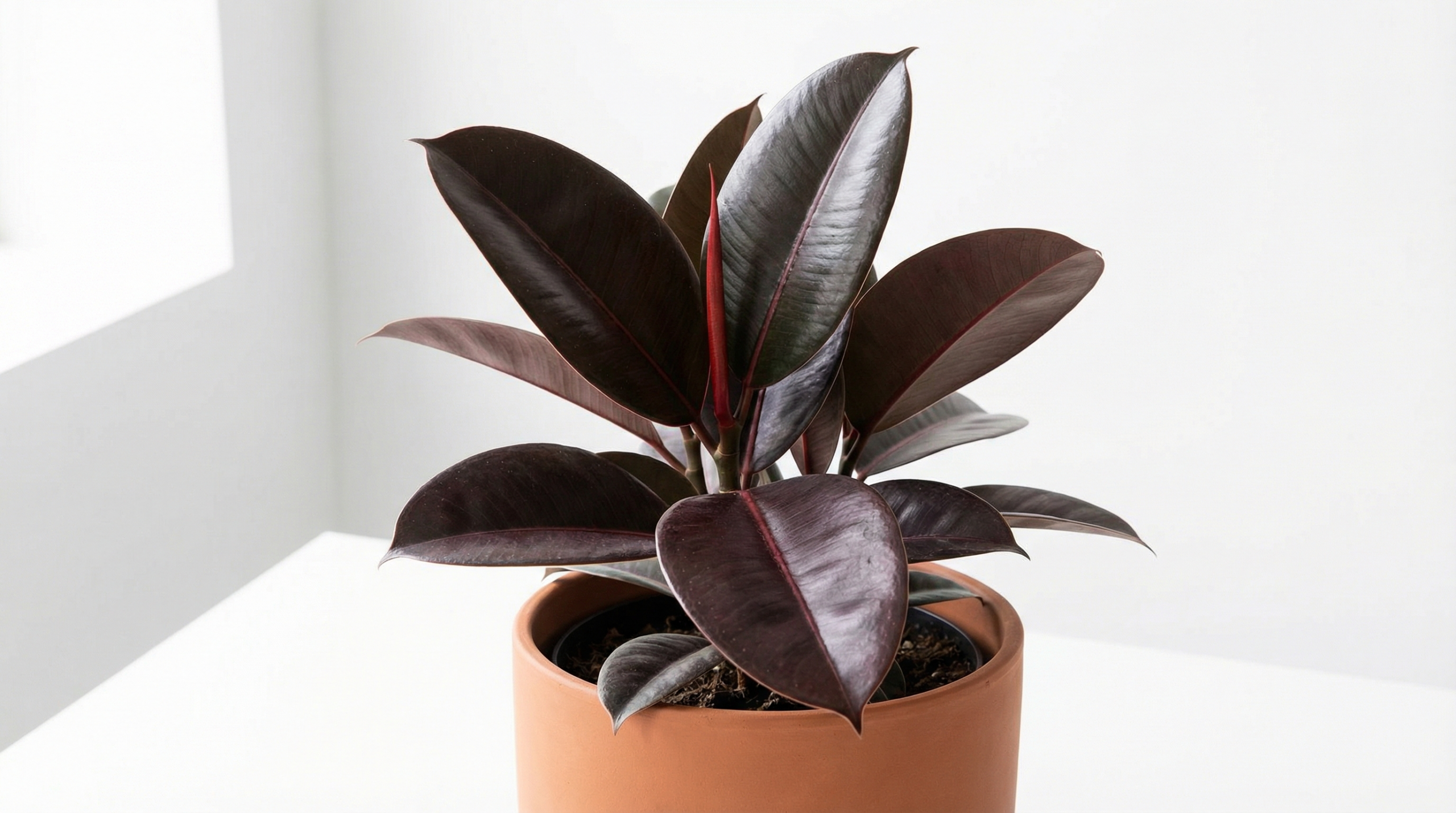
Rubber plant care indoors comes down to bright, filtered or indirect light, moderate watering while it grows and sparing watering in winter, a monthly feed in the growing season, and temperatures that stay above 55°F. That is the combined advice of the Royal Horticultural Society (RHS) and NC State Extension. Prune the main stem if you want a bushier plant, and keep it away from pets, because the milky sap is irritating.
Rubber plants are among the easier large houseplants, but they have two habits that frustrate owners: they drop leaves when chilled or overwatered, and left alone they grow as a single tall stem. This guide covers both, with sources for every recommendation.
Rubber Plant Care at a Glance
| Need | What to give it | Source |
|---|---|---|
| Light | Bright but filtered or indirect light; protect from afternoon sun | RHS; NC State |
| Water | Moderately during growth, sparingly in winter; never overwater | RHS; NC State |
| Temperature | Above 55°F; no drafts or cold | NC State |
| Soil | Houseplant compost or a soil-based potting mix with good drainage | RHS; NC State |
| Feeding | High-nitrogen fertilizer every month during growth | RHS |
| Repotting | Top-dress yearly, repot every 2 to 3 years | RHS |
| Size indoors | Usually 2 to 10 ft (NC State); up to 2.5 to 4 m over 10 to 20 years (RHS) | NC State; RHS |
| Pets | Irritating sap; keep away from cats and dogs | NC State; Pet Poison Helpline |
What Is a Rubber Plant?
The rubber plant, Ficus elastica, is a tropical evergreen tree that the RHS describes as “often grown as a houseplant”. NC State Extension lists its origin as Southeast Asia, from Nepal to China and western Malesia, and notes it can reach 100 feet in the wild but is usually kept to 2 to 10 feet indoors.
The leaves are large, glossy and dark green, with bronze undersides according to the RHS, and the new leaves emerge from pink or purple stipules (NC State). That colored sheath at the tip of a stem is protecting the next leaf, not a flower, and it is shed as the leaf opens. Popular cultivars include dark burgundy forms and variegated types.
If you also grow its fussier relative, our fiddle leaf fig care guide covers the differences, and the variegated Ficus Shivereana Moonshine is another Ficus worth knowing.
Rubber Plant Light Requirements
The RHS recommends bright but filtered or indirect light, and NC State Extension advises bright indirect light or partial shade indoors with protection from afternoon sun. In practice, that means near an east window, or a few feet back from a south or west window behind a sheer curtain.
Too little light
- Long, stretched gaps between leaves
- Smaller new leaves and slow growth
Too much direct sun
- Dry, scorched patches on leaves facing the window
- Bleached areas on the upper leaves
If your windows are dim, a grow light can help; our guide to the best grow lights for indoor plants explains distances and hours. Turn the pot a quarter turn every week or two so the plant grows straight rather than leaning toward the window.
How to Water a Rubber Plant
The RHS advises watering moderately during growth and sparingly in winter, and NC State Extension says to water regularly without overwatering and to reduce watering when the plant is dormant, from fall to late winter. NC State also lists overwatering among the causes of leaf loss.
- Check the soil before watering; let the top part of the mix dry out between waterings in spring and summer.
- Water thoroughly until it drains from the bottom, then empty the saucer.
- In fall and winter, water less often, since the plant is growing slowly.
- Never leave the pot standing in water.
If the soil stays wet and the lower leaves turn yellow, check the roots; our guide to treating root rot walks through it.
Pro tip: Those big leaves collect dust. Wipe them gently with a damp, soft cloth every few weeks so they can use all the light they get.
Soil, Feeding and Repotting
The RHS recommends houseplant compost, a high-nitrogen fertilizer every month during the growing season, top-dressing with fresh compost every year, and repotting every 2 to 3 years. NC State Extension adds that a soil-based potting mix with good drainage works well. Stop feeding in winter, when watering is also reduced.
How to Make a Rubber Plant Bushy
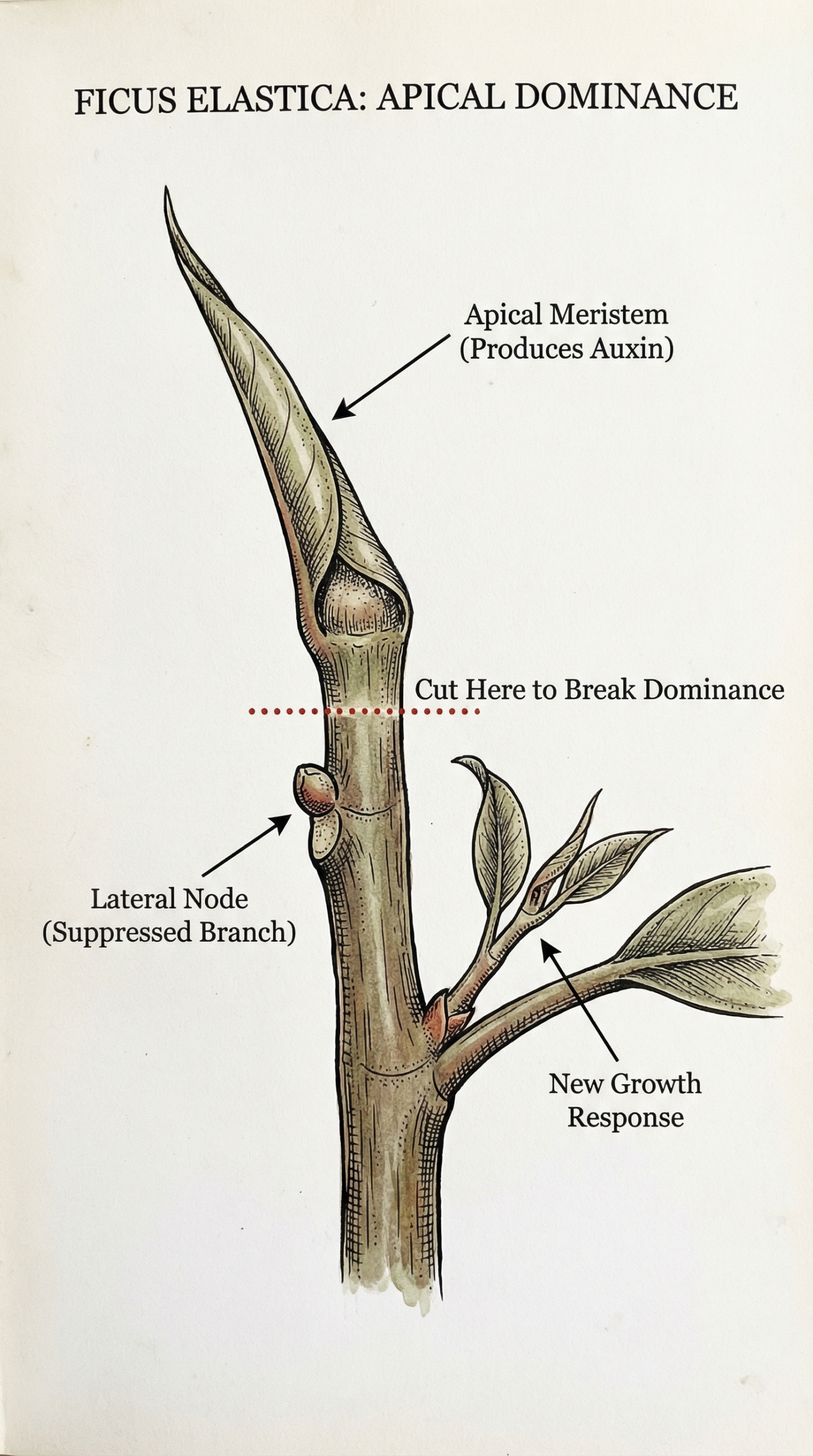
Left alone, a rubber plant tends to grow as a tall single stem. NC State Extension notes that pruning the main branches encourages a bushier habit, while leaving them unpruned gives a taller, tree-like form. The RHS places it in pruning group 1, meaning it needs little routine pruning, so prune only to shape it.
- When: spring or early summer, while the plant is actively growing
- Where: just above a leaf node, at the height you want new branches to start
- Expect sap: NC State Extension notes cut leaves and stems drip milky sap; wear gloves and protect floors
- After: new shoots usually develop from buds just below the cut
- Bonus: the piece you remove can be rooted (see propagation)
We cover the same technique in detail for its relative in our guide to fiddle leaf fig notching and branching.
Rubber Plant Propagation
The RHS lists semi-ripe cuttings or layering in spring or late summer. For tall, bare stems, air layering lets you root the top while it is still attached. Iowa State University Extension describes the method:
- Choose a point on the stem about 12 to 18 inches from a shoot tip and remove the leaves in that area.
- Make two ring cuts about an inch apart down to the woody center, join them with a lengthwise cut, and remove the strip of bark.
- Optionally dust the exposed wood with rooting hormone.
- Pack moist sphagnum moss around the wound, wrap it in clear plastic, and tie the plastic above and below the moss.
- Roots should appear in the moss in several weeks. Once a good root system forms, cut the stem just below the bottom tie and pot it in well-drained potting soil.
For stem and leaf-bud cuttings, rooting in water vs soil and whether a single leaf can grow, see our full guide to rubber plant propagation. For moss-based rooting in general, see our guide to propagating in sphagnum moss.
Rubber Plant Leaves Falling Off? Causes and Fixes
| What you see | Likely cause | What to do |
|---|---|---|
| A few bottom leaves yellow and drop | Normal aging; NC State notes some bottom-leaf yellowing is normal | Nothing, if new leaves keep coming |
| Many leaves drop, soil stays wet | Overwatering (NC State) | Let the soil dry more between waterings; check the roots |
| Sudden leaf drop after a move or in winter | Temperature drops or cold drafts (NC State) | Keep it above 55°F, away from doors, vents and cold glass |
| Sticky leaves, white fluff or brown bumps | Mealybugs or scale (NC State, RHS) | Remove them early; see our rubbing alcohol method |
| Fine webbing, speckled leaves | Spider mites (NC State, RHS) | Isolate, rinse the leaves and treat promptly |
| Leggy growth, small new leaves | Too little light | Move closer to a bright window or add a grow light |
Is a Rubber Plant Toxic to Cats and Dogs?
Yes, keep it out of reach
NC State Extension tags Ficus elastica as a problem for cats, dogs and horses. Pet Poison Helpline says an irritating chemical in the sap of the leaves and stems causes minor gastrointestinal distress, with signs such as drooling, retching, vomiting and oral irritation. If you suspect your pet has eaten part of the plant, contact your veterinarian or the ASPCA Animal Poison Control Center at (888) 426-4435.
Don’t confuse it with the “baby rubber plant” (Peperomia obtusifolia), a different plant. For pet-friendly options, see our cat-safe plants guide.
For other indoor trees and shrubs, see our guides to weeping fig leaf drop and Norfolk Island pine.
Frequently Asked Questions
How do you care for a rubber plant indoors?
Give it bright, filtered or indirect light, water moderately in spring and summer and sparingly in winter, feed monthly while it grows, and keep it above 55°F away from drafts, according to the RHS and NC State Extension.
Why are my rubber plant leaves falling off?
NC State Extension lists overwatering, temperature drops and cold drafts as causes of leaf loss. A few yellowing bottom leaves are normal, but many dropping leaves usually means wet soil or a chill.
Is a rubber plant toxic to cats?
Yes. NC State Extension tags it as a problem for cats, dogs and horses, and Pet Poison Helpline says the sap causes drooling, retching, vomiting and oral irritation, usually as minor stomach upset.
How do I make my rubber plant bushy?
Prune the main stem just above a leaf node in spring or early summer. NC State Extension notes that pruning the main branches encourages a bushier habit. Expect milky sap at the cut and wear gloves.
How do you propagate a rubber plant?
The RHS recommends semi-ripe cuttings or layering in spring or late summer. Iowa State University Extension describes air layering: remove a ring of bark, wrap it in moist sphagnum moss and plastic, and cut below the new roots after several weeks.
How often should I repot a rubber plant?
Every 2 to 3 years, with a fresh top-dressing of compost every year in between, according to the RHS.