
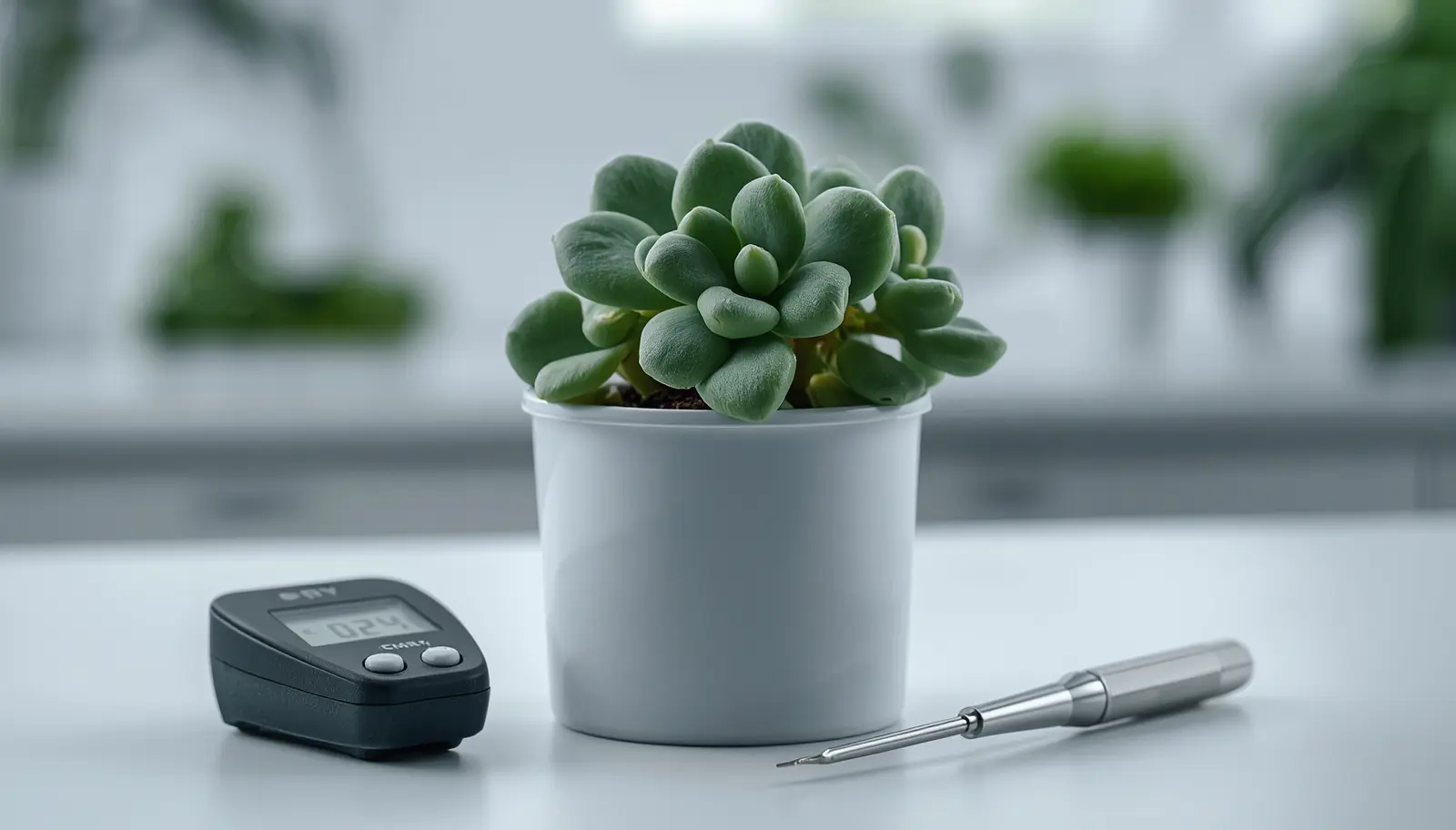
⚠️ The Diagnostic Paradox: Why Your Jade Plant Cannot Drink
Your Crassula ovata (Jade plant) has soft, wrinkled, deflated leaves—and you’re facing an urgent diagnostic fork in the road.
The leaves are shriveling because the plant cannot absorb water. This sounds simple, but the cause is binary and mutually exclusive: either (1) the soil matrix is bone-dry and roots are desiccated, or (2) the root system has completely rotted and lost all osmotic function despite wet soil.
The critical error: Adding water without inspecting roots. If the problem is desiccation, watering saves the plant. If the problem is root rot, watering accelerates anaerobic decay and the plant dies within 7-14 days. You must unpot and excavate the root zone immediately to determine which emergency protocol to execute.
- Action 1 (Immediate): Unpot the plant and physically inspect the root zone. Remove all soil to expose root color, texture, and moisture status.
- Action 2 (If roots are white, brittle, and soil is dust): Severe desiccation. Initiate 24-hour bottom-water flood protocol to slowly rehydrate without cellular shock.
- Action 3 (If roots are black, mushy, and soil is wet): Advanced root rot. Execute emergency surgical amputation of all dead tissue, dust with rooting hormone, allow 7-day callusing period, replant in sterile gritty substrate.
📋 Emergency Diagnostic Index
The Osmotic Failure Explained: Cellular Mechanics of Crassula ovata
Jade plant leaves are water storage organs—modified succulent tissue composed of large parenchyma cells packed with water vacuoles.
In healthy conditions, these cells maintain high turgor pressure—internal hydraulic pressure from water-filled vacuoles pushing against rigid cell walls. This creates the characteristic plump, firm, glossy appearance of Jade leaves. The tissue is approximately 80-90% water by weight.
When leaves wrinkle, cellular turgor pressure has collapsed. The water reserves in the mesophyll cells are depleted, vacuoles shrink, and cell walls lose structural support. The leaf deflates like a punctured balloon.
The Root Dependency
Jade leaves cannot replenish their water reserves without functional roots.
Roots perform osmotic uptake—they absorb water from soil through semi-permeable cell membranes via osmosis, creating hydraulic pressure that pushes water upward through the xylem vascular system to leaves. This requires: (1) Available water in soil matrix, (2) Living, intact root cell membranes, and (3) Functional xylem tissue in stems.
When any component fails, water transport stops. Leaves begin cannibalizing their internal reserves to sustain metabolism. Bottom leaves sacrifice themselves first—the plant withdraws water from lower foliage to sustain upper growth points and stem tissue.
The Two Failure Modes
Osmotic failure occurs through two mechanistically opposite pathways:
MODE 1: ROOT DESICCATION (Water Absent)
- Mechanism: Soil matrix is completely dry (dust, powder consistency). Roots are dehydrated but structurally intact—white to tan color, brittle texture
- Root status: Alive but dormant. Cell membranes intact. Capable of osmosis once rehydrated
- Why leaves wrinkle: No available soil water for uptake. Roots cannot perform osmosis in dry substrate
- Treatment: Rehydrate slowly via bottom-watering. Rapid recovery within 24-72 hours
- Prognosis: Excellent (95%+ survival if caught before roots powder completely)
MODE 2: ROOT ROT (Roots Dead)
- Mechanism: Soil is wet/damp. Roots are dead from anaerobic conditions—black/brown color, mushy texture, foul odor
- Root status: Dead. Cell membranes destroyed by bacterial/fungal colonization. Cannot perform osmosis
- Why leaves wrinkle: Despite wet soil, dead roots cannot absorb water. Plant is dying of thirst in saturated substrate
- Treatment: Surgical amputation of all rotted tissue. Stem propagation required
- Prognosis: Poor to fair (40-70% survival depending on extent of rot and speed of intervention)
⚠️ Why Blind Watering is Fatal
If your Jade has root rot and you water it, you are actively killing the plant.
Adding water to rotted roots accelerates anaerobic bacterial proliferation. The bacteria that cause root rot (Pythium, Phytophthora, Erwinia) thrive in oxygen-depleted waterlogged conditions. Each watering event:
- Displaces oxygen from remaining healthy root tissue
- Provides moisture for bacterial expansion into uninfected areas
- Speeds conversion of remaining white roots to black mush
- Extends rot upward into stem tissue
Timeline: A Jade with 50% root rot that receives continued watering will have 100% root system failure within 7-10 days. The only intervention is immediate cessation of watering + surgical removal of all dead tissue. For detailed rot treatment protocols, see our succulent root rot surgery guide.
The Root Excavation Test: Visual Diagnosis Protocol
Accurate diagnosis requires physical root inspection—external symptoms alone are insufficient.
Both desiccation and root rot produce identical above-ground symptoms: wrinkled leaves, leaf drop, stem softness. The only way to differentiate is excavating the root zone and assessing root vitality through color, texture, smell, and soil moisture status.
The Inspection Procedure
🔬 ROOT EXCAVATION DIAGNOSTIC PROTOCOL
- Prepare workspace: Work over newspaper or tray to contain soil. Have clean water, paper towels, and sterilized scissors nearby
- Unpot carefully: Tip pot on side, tap bottom to release root ball. Do not pull plant by stem—this can damage what little healthy root structure remains
- Remove all soil: Gently brush, shake, and pick away soil to fully expose roots. Use fingers or soft brush—no need to be gentle if roots are already compromised
- Rinse roots (optional): If soil is dense/clayey, rinse root ball under lukewarm water to reveal true root condition
- Visual assessment: Examine root color, press roots gently to test firmness, smell for foul odors, assess soil moisture at time of unpotting
- Document findings: Photograph roots if possible for comparison during recovery monitoring
The Diagnostic Matrix
| Root Appearance | Soil Condition at Unpotting | Smell | Diagnosis | Immediate Action |
|---|---|---|---|---|
| Dry, brittle, white to tan roots Roots snap when bent. May turn to powder when touched. No slime or dark discoloration. | Bone dry, dusty substrate Soil falls away as powder or hard clumps. No moisture detected throughout pot depth. | Earthy, neutral, or no smell | Severe Root Desiccation Roots are alive but dehydrated. Cell membranes intact but dormant. | Bottom-water soak for 2 hours. Submerge pot in water until bubbles stop. Allow complete drainage. Roots will rehydrate and resume function within 12-24 hours. See rehydration protocol. |
| Black, brown, or dark gray mushy roots Roots disintegrate when touched. Outer layer (cortex) slides off revealing thread-like core. Slimy coating present. | Damp, wet, or waterlogged soil Soil clumps when squeezed, releases water, or has visible moisture throughout. | Foul, sewage-like, sulfurous, or strongly musty odor | Advanced Root Rot Roots are dead from anaerobic bacterial/fungal infection. Cannot perform osmosis. | Sever all rotted tissue immediately. Cut stem above rot line with sterilized blade. Dust with rooting hormone. Air-dry callus for 7 days. Replant in sterile gritty mix. Do NOT water. See amputation protocol. |
| Healthy white to cream roots, firm texture Roots resist pressure, bend without breaking, show no discoloration or mushiness. | Slightly damp, appropriate moisture Soil has some moisture but is not waterlogged. Feels like wrung-out sponge. | Fresh earthy smell, no foul odors | Ambient Humidity Crash Roots are healthy but leaves are wrinkling from low air humidity or HVAC air blast causing excessive transpiration. | Environmental modification. Move away from heating vents, AC vents, or drafty windows. Increase ambient humidity to 30-40% minimum. Water normally when soil dries. Leaves will re-plump within 3-7 days as humidity stabilizes. No surgery required. |
Emergency Surgical Protocols: Rehydration vs. Amputation
Treatment diverges completely based on root diagnosis. Using the wrong protocol for the wrong condition is fatal.
Protocol A: The Rehydration Method (For Desiccated Roots)
Use this only if roots are white/tan, brittle, and soil was bone-dry at excavation.
💧 24-HOUR BOTTOM-WATER REHYDRATION PROTOCOL
Why bottom-watering: Pouring water from top can cause soil to float away from roots and create air pockets. Bottom-watering allows soil to absorb water from below via capillary action, ensuring complete and even saturation of the entire root ball.
Step-by-Step Procedure:
- Repot if needed: If soil has turned to dust/powder, gently repot in fresh succulent mix (50% potting soil, 50% perlite/pumice). If soil is still intact, use existing pot
- Prepare water bath: Fill sink, tub, or large container with room-temperature water to depth of 3-4 inches
- Submerge pot: Place pot in water. Water level should reach 3/4 up the pot height—do not submerge above soil line
- Initial saturation (15-30 minutes): Leave pot submerged until air bubbles stop rising from soil. This indicates all air pockets are filled with water
- Extended soak (1-2 hours): Keep pot in water for total of 2 hours. This allows desiccated roots time to slowly absorb water without cellular shock
- Complete drainage: Remove pot from water. Place on rack or surface where it can drain freely. Allow 100% drainage for 30-60 minutes before returning to saucer
- Monitor recovery: Check leaves at 12, 24, 48, and 72 hours. Wrinkled leaves should begin plumping within 12-24 hours as turgor pressure restores
Expected timeline: Lower leaves re-plump within 12-24 hours. Upper leaves follow within 24-48 hours. Full recovery (all leaves firm and glossy) within 3-7 days. If no improvement after 48 hours, re-inspect roots—may have underlying rot that was missed.
⚠️ Cellular Edema Warning
Do not leave pot submerged longer than 2-3 hours.
Prolonged submersion can cause cellular edema—cells absorb water too rapidly, swell beyond capacity, and burst. Symptoms include translucent, water-soaked patches on leaves that later turn brown and mushy. The 2-hour window allows gradual rehydration without cell rupture. After initial rehydration, resume normal succulent watering: deep soak when soil completely dry (typically every 10-21 days).
Protocol B: The Amputation Method (For Rotted Roots)
Use this only if roots are black/brown, mushy, foul-smelling, and soil was wet at excavation.
🔪 SURGICAL ROOT AMPUTATION & STEM PROPAGATION
Materials Required:
- Sharp knife, razor blade, or pruning shears (sterilized with 70% isopropyl alcohol)
- Rooting hormone powder (optional but recommended)
- Cinnamon powder or sulfur powder (wound sealant/antifungal)
- Clean paper towels or cloth
- New pot with drainage holes
- Fresh succulent substrate (50% potting mix, 30% perlite, 20% coarse sand)
Surgical Procedure:
- Sterilize tools: Spray or wipe blade thoroughly with 70% isopropyl alcohol. Air dry 10 seconds
- Assess rot extent: Trace rot upward from roots into stem. Press stem gently—firm green tissue = healthy, soft brown tissue = infected
- Locate cut point: Identify the boundary between healthy green stem and rotted brown tissue. You will cut 1 inch above this boundary to ensure all infection is removed
- Execute clean cut: Make single decisive cut through stem at 90-degree angle (straight across, not angled). Cut should be 1 inch above any brown/soft tissue
- Inspect cut surface: Interior stem tissue should be pale green, white, or light tan. If brown or black discoloration visible, cut another inch higher and re-inspect
- Remove all roots: Strip away any remaining rotted root tissue from cut end. You should have clean stem cutting with zero root material attached
- Apply treatments: Dust cut surface with rooting hormone powder (if available), then with cinnamon or sulfur powder for antifungal protection
Callusing Period (CRITICAL – Do Not Skip):
- Place cutting upright in empty container in bright indirect light
- Do NOT plant in soil yet. Do NOT water. Do NOT mist
- Allow cut surface to air-dry for 7-10 days minimum (14 days for large diameter stems >1 inch)
- Cut surface will form hard, dry callus—this seals the wound and prevents rot when planted
- Insufficient callusing = rot restarts when planted in soil
Replanting After Callus:
- Fill new pot with completely dry gritty succulent mix
- Make shallow hole with finger—just deep enough to support cutting upright (1-2 inches)
- Insert callused stem cutting into dry substrate
- Do not water for 7-10 days post-planting. This allows roots to begin forming without rot risk
- After 7-10 days, give first light watering (moisten soil but don’t saturate)
- Resume normal succulent watering after 3-4 weeks when roots established
Success Rates & Timelines
| Condition | Success Rate | Recovery Timeline |
| Desiccation (Roots Intact) | 95-100% | 3-7 days to full turgor |
| Root Rot (50% Roots Dead) | 60-80% | 4-8 weeks to root regeneration |
| Root Rot (100% Roots Dead) | 40-70% | 6-12 weeks to establish new roots |
| Stem Rot (Infection in Stem) | 10-30% | 3-6 months if salvageable cutting obtained |
Critical factor: Speed of intervention. Desiccation caught before roots powder completely = near-certain survival. Root rot caught before stem infection = good odds. Delayed intervention (weeks of wrinkled leaves ignored) = poor prognosis regardless of treatment quality.
Prevention: Soil Matrix & Watering Cadence Engineering
Both desiccation and root rot are 100% preventable through proper substrate formulation and watering discipline.
The Substrate Formula
Standard potting soil is incompatible with Crassula ovata physiology. It retains too much moisture and provides insufficient oxygen to roots adapted for arid, rocky soils.
| Component | Ratio | Function |
| Quality Potting Mix or Coco Coir | 40% | Moisture retention |
| Coarse Perlite or Pumice | 40% | Drainage, aeration |
| Coarse Sand or Grit (2-3mm) | 20% | Weight, drainage |
Performance: This mix drains 70-80% of applied water within seconds while retaining adequate moisture in organic fraction. Air-filled porosity remains 35-45% even when saturated, preventing anaerobic root conditions. For commercial alternative, use cactus/succulent mix amended with 25-30% additional perlite. Complete substrate engineering at our succulent substrate guide.
The Watering Cadence
Jade plants require deep, infrequent watering—not shallow, frequent dampening.
✅ OPTIMAL WATERING PROTOCOL
The Rule: Water thoroughly when top 2-3 inches of soil are completely dry. Do NOT water on a fixed schedule.
Verification Method:
- Insert finger or wooden skewer 2-3 inches into soil
- If any moisture detected, wait 3-5 more days and re-check
- When completely dry at depth, water thoroughly until 20-30% drains from bottom
- Empty drainage saucer after 15 minutes
Typical Frequency (Approximate):
- Spring/Summer (active growth): Every 10-14 days
- Fall: Every 14-21 days
- Winter (dormancy): Every 21-28 days or less
- Adjust based on light, temperature, humidity, pot size
Container requirements: Pot MUST have drainage holes. Terracotta ideal (porous clay accelerates drying). Plastic acceptable if drainage excellent. Never use decorative cache pots without drainage—guaranteed root rot within 3-6 months.
Frequently Asked Questions: Jade Plant Leaf Wrinkling
How long does it take for wrinkled Jade leaves to recover?
For desiccation: Lower leaves begin re-plumping within 12-24 hours after proper watering. Full recovery (all leaves firm) within 3-7 days. For root rot: Leaves will not recover until new roots regenerate. After surgical amputation and replanting, expect 4-8 weeks for root establishment, then gradual leaf recovery over following 2-4 weeks. Total timeline: 6-12 weeks from surgery to normal appearance.
Should I remove wrinkled leaves from my Jade plant?
No, not immediately. If treating desiccation, wrinkled leaves will re-plump and return to normal within days—removing them wastes the plant’s stored energy reserves. Only remove leaves that: (1) Remain wrinkled after 2 weeks of proper care, (2) Turn yellow/brown indicating permanent damage, or (3) Show signs of rot (mushy, black spots). Healthy wrinkled leaves will recover; damaged leaves will not.
Can you overwater a Jade plant in winter?
Absolutely—winter is the highest risk period for root rot. Jade plants enter semi-dormancy in winter (November-March in Northern Hemisphere) with drastically reduced water needs. Shorter days, cooler temps, and lower light intensity mean slower metabolism and minimal root activity. Watering at summer frequency causes waterlogged soil and anaerobic conditions. Reduce watering to once every 3-4 weeks in winter, or only when leaves show slight wrinkling. Better to underwater than overwater during dormancy.
Why are only the bottom leaves of my Jade plant wrinkling?
The plant is cannibalizing water from lower leaves to sustain upper growth and stem tissue—this is normal stress response during water shortage (from either desiccation or root rot). Jade plants sacrifice oldest bottom leaves first to preserve growing tips and newer foliage. If only 2-3 bottom leaves wrinkled and rest of plant looks healthy, likely minor underwatering—verify soil is dry then water deeply. If wrinkling progresses upward over days/weeks despite watering, suspect root rot—unpot and inspect immediately.
What does a healthy Jade plant root system look like?
Healthy Crassula ovata roots are white to tan/cream colored, firm and fleshy (not brittle or mushy), and smell fresh/earthy with no foul odors. The root system is relatively shallow and spreading rather than deep—most roots concentrate in top 4-6 inches of pot. Mature plants develop thick, woody primary roots near stem base with finer hair roots extending outward. Any black, brown, or gray discoloration indicates rot. Roots should resist pressure—if they collapse or fall apart when touched, they are either dessicated or rotted.
Is my Jade plant dead if all leaves are wrinkled?
Not necessarily. If stem is still firm and green (not brown/black), plant can potentially recover. Unpot immediately and inspect roots. If roots are white/tan: Severe desiccation—bottom-water soak for 2 hours, expect slow recovery over 1-2 weeks. If roots are black/mushy: Advanced root rot—perform surgical amputation, may take 8-12 weeks to re-establish. If stem is soft/brown throughout: Rot has spread to stem, likely terminal. Attempt propagation from any firm green stem sections if available. According to Oregon State University Extension guidance, Jade plants show remarkable resilience and can recover from near-death if intervention is swift.
The Infirmary Verdict: Diagnostic Precision Over Symptomatic Guessing
Jade plant leaf wrinkling is not a single condition—it’s a symptom of two mechanistically opposite failures.
The reflex to “just water it” is correct 50% of the time and fatal the other 50%. Without root excavation and physical inspection, you’re flipping a coin with your plant’s survival. Desiccated roots need immediate hydration. Rotted roots need immediate amputation. Treating rot with water or treating desiccation with drought both accelerate death.
The Urban Lab Infirmary Protocol for Crassula ovata osmotic failure centers on mandatory root triage: (1) Unpot within 24 hours of symptom onset, (2) Visual assessment of root color, texture, smell, and soil moisture, (3) Execute appropriate emergency protocol based on diagnosis—rehydration for desiccation, surgical amputation for rot.
Prevention eliminates both pathways: Gritty, fast-draining substrate (40% perlite minimum) prevents waterlogging and anaerobic rot. Deep, infrequent watering when soil completely dry prevents both chronic dampness (rot trigger) and prolonged desiccation (cell death). Container with drainage holes is non-negotiable.
When you stop guessing and start excavating, the diagnosis becomes obvious, the treatment becomes clear, and the recovery rate exceeds 70% even in advanced cases—provided surgical intervention occurs within the critical 7-14 day window before cellular damage becomes irreversible.
The Infirmary | Succulent Emergency Protocols Division
Jade Plant Osmotic Failure Diagnostic | Published: March 2026
