
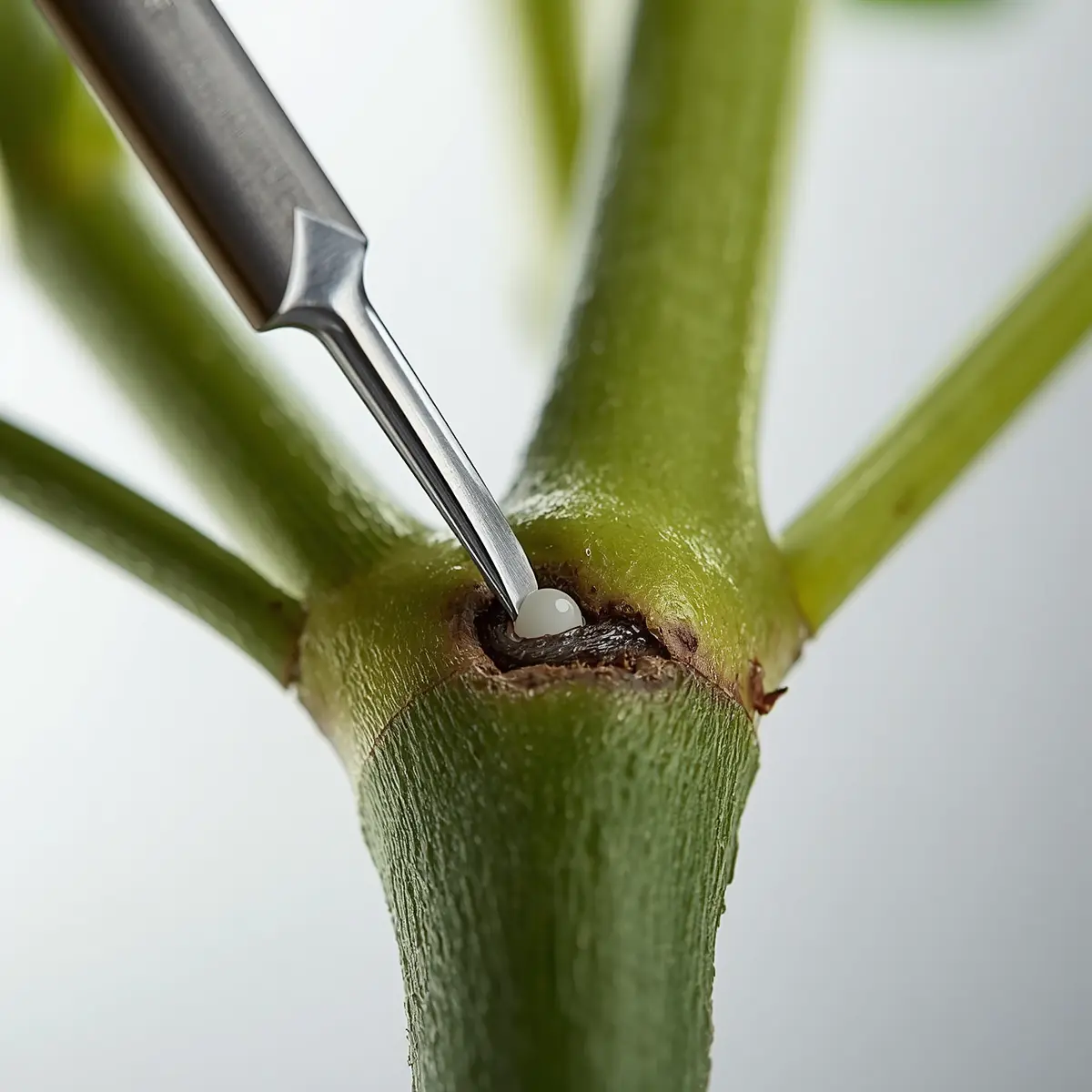
Fiddle leaf fig notching means making a small cut through the bark just above a dormant bud on the trunk, to coax that bud into growing a branch without cutting off the top of the plant. The idea comes from orchards: University of Illinois Extension describes notching as a small cut just above a bud with a sharp knife, which disrupts the flow of auxin, a plant hormone that suppresses lateral growth. It does not always work, and nobody has published success rates for fiddle leaf figs, so it is worth knowing the more reliable alternative too: pruning the top.
| Method | What you do | Keeps the height? | How reliable |
|---|---|---|---|
| Notching | Small cut through the bark just above one bud | Yes | Hit and miss; no published data for Ficus lyrata |
| Pruning the top (heading) | Cut the main stem back to a node at the height you want branches | No | Reliable on healthy plants: a branch usually grows from a bud below the cut (NYBG) |
| Pinching | Remove the newest growing tip | Almost | Similar to a very light prune; branches form near the top |
Sources: University of Illinois Extension; NYBG Plant Information Service; NC State Extension.
What Is Notching in Plants and How Does It Work?
Fiddle leaf figs naturally grow as one tall stem. The UF/IFAS fact sheet on Ficus lyrata describes the tree as typically having one trunk, and the Missouri Botanical Garden notes it can reach 60 to 100 feet in its native African habitat. The growing tip produces auxin, which keeps the buds lower on the stem dormant (apical dominance).
Notching is a local workaround. A cut just above a bud interrupts the auxin coming down the stem at that one spot, which can let that bud grow while the top of the plant stays intact (Illinois Extension). Fruit growers use it to fill in bare sections of young apple trees; NC State Extension describes removing a narrow strip of bark (about 4 mm) just above latent buds on bare wood. Houseplant growers borrowed the same idea, which is where Ficus lyrata notching comes from.
When to Notch a Fiddle Leaf Fig
Notch in spring or early summer, when the plant is actively putting out new leaves. That matches NYBG’s advice to prune fiddle leaf figs for shape in spring. A plant that is not growing (in winter, or after a move, repotting or a bout of leaf drop) has little to put into a new branch, so wait until it is pushing new growth. Also skip notching on a plant with pests or root problems; fix those first.
Tools You Need
- A sharp, clean blade: a craft knife or sharp pruning knife for the notch. University of Maryland Extension recommends cleaning tools with 70 percent alcohol, or bleach diluted one to nine with water (rinse bleach off afterwards, because it corrodes metal).
- Bypass pruners if you decide to prune instead; UMD notes they reduce tearing and crushing compared with anvil pruners.
- Gloves and a damp cloth for the milky sap (MOBOT notes the stems have a milky sap).
How to Notch a Fiddle Leaf Fig, Step by Step
- Find a bud. Buds sit at the nodes, where a leaf is or was attached. Pick one on the side of the trunk where you want a branch, at the height you want it.
- Put on gloves. The sap can irritate skin (ASPCA).
- Cut just above the bud. Make a small horizontal cut through the bark a little above the node. Orchard notching removes only a narrow strip of bark above the bud (NC State); there is no need to cut deep into the wood, and deep cuts weaken the trunk.
- Let it bleed, then wipe. Dab away the white sap with a damp cloth. Leave the cut open; it will dry on its own.
- Keep caring for the plant normally in bright light and wait.
One or two at a time
Notch one or two buds per season rather than the whole trunk, and never cut most of the way around the stem: a ring cut around the trunk girdles it and can kill the part above.
The Alternatives: Pruning and Pinching
Pruning the top is the dependable way to make a fiddle leaf fig branch. NYBG advises cutting back leggy branches to a node in spring and notes that on a healthy tree a new branch will emerge from a latent bud below the cut. A University of Maryland Extension answer on Ask Extension puts it simply: plants branch where they are pruned, so cut the tallest stem down to the level where you want branches to start. The trade-off is height. NYBG also recommends keeping at least two-thirds of the leaves on the tree to fuel its recovery. The piece you cut off can be rooted as a new plant.
Pinching removes just the newest growth at the tip. It works on the same principle as pruning, on a smaller scale: with the tip gone, buds just below it can start to grow.
Light and Plant Health
A new branch needs energy, and that comes from light. The Missouri Botanical Garden recommends siting Ficus lyrata indoors in bright indirect light or part shade with protection from afternoon sun, watering regularly in the growing season, avoiding overwatering, and watering less from fall to late winter. A fiddle leaf fig in a dim corner is unlikely to respond to notching or pruning until it gets more light. Our fiddle leaf fig care guide covers light and watering in detail, and our grow light guide helps if your windows are dim.
Is Fiddle Leaf Fig Sap Toxic?
Mildly. An ASPCA article on houseplant safety says the fiddle leaf fig is mildly toxic to dogs and cats, with a risk of mild gastrointestinal irritation (vomiting and diarrhea are the most common signs), and that its sap could also cause skin irritation. The ASPCA’s plant database has no separate fiddle leaf fig entry, but it lists the related weeping fig (Ficus benjamina) as toxic. Wear gloves when notching and keep cut pieces away from pets.
Fiddle Leaf Fig Notching Success Rate and Common Mistakes
There is no published success rate for fiddle leaf fig notching. Figures you see online come from growers’ experience, not trials. The closest research is on apple trees, where notching is a commercial technique: NC State reports that notching followed by a spray of the growth regulator 6-BA increased lateral bud break on two-year-old wood, with about a 70% success rate in the best case. Houseplant growers do not use those sprays, so expect a lower and less predictable hit rate on a fiddle leaf fig.
Common reasons a notch does nothing:
- Wrong season or a stressed plant: notching in winter, or on a plant that is not putting out new leaves.
- Too little light for the plant to fuel a new shoot (MOBOT recommends bright indirect light).
- No bud under the cut: the notch must sit just above a node.
- Old, woody trunk: in apples, Virginia Tech notes that younger trees are more responsive to notching than older trees.
The most damaging mistake is cutting too deep or too far around the trunk, which weakens the stem. If a notch fails, you can try another bud the next spring, or prune the top for a more certain result.
How Long Until a Branch Appears?
There is no reliable timeline for fiddle leaf figs. Give a notch several weeks in good light; the first sign is the bud swelling below the cut. If nothing has happened by the end of the growing season, that bud is unlikely to respond. Growth after pruning tends to be more predictable, since the buds just below the cut are the next in line to grow.
More fiddle leaf fig guides: fiddle leaf fig brown spots.
Frequently Asked Questions
What is notching in plants?
A small cut just above a bud that disrupts the downward flow of auxin, the hormone that suppresses side growth, so the bud below can grow into a branch (Illinois Extension).
What is the fiddle leaf fig notching success rate?
No study has measured it for Ficus lyrata. In apple trees, NC State reports about a 70% success rate in the best case when notching is followed by a growth-regulator spray; without those sprays, results on houseplants are less predictable.
When should you notch a fiddle leaf fig?
In spring or early summer, when the plant is actively growing. NYBG recommends spring for shaping fiddle leaf figs.
How deep should a notch be?
Shallow: through the bark just above the bud. Orchard notching removes a narrow strip of bark (NC State). Deep or wraparound cuts weaken the trunk.
Is notching better than pruning?
Notching keeps the plant’s height but is hit and miss. Pruning the top is more reliable; on a healthy tree a branch will emerge from a latent bud below the cut (NYBG).
Is fiddle leaf fig sap toxic to pets?
Mildly. The ASPCA describes the fiddle leaf fig as mildly toxic to dogs and cats, with vomiting and diarrhea the most common signs, and notes the sap can irritate skin.
Sources
- University of Illinois Extension: Special focus, notching for improved apple branching (McCarty, 2025)
- NC State Extension: Minimizing blind wood on apple (Kon, 2020)
- NYBG Plant Information: Can I prune a fiddle-leaf fig tree to reshape it?
- UF/IFAS ST254: Ficus lyrata, fiddle-leaf fig
- Missouri Botanical Garden Plant Finder: Ficus lyrata
- Virginia Tech Tree Fruit Horticulture: Notching and PGRs to induce branching in apple trees (Sherif, 2020)
- Ask Extension (University of Maryland Extension): pruning a fiddle leaf fig
- University of Maryland Extension: Pruning tools
- ASPCA: Is that houseplant safe for your pets? (2019)