
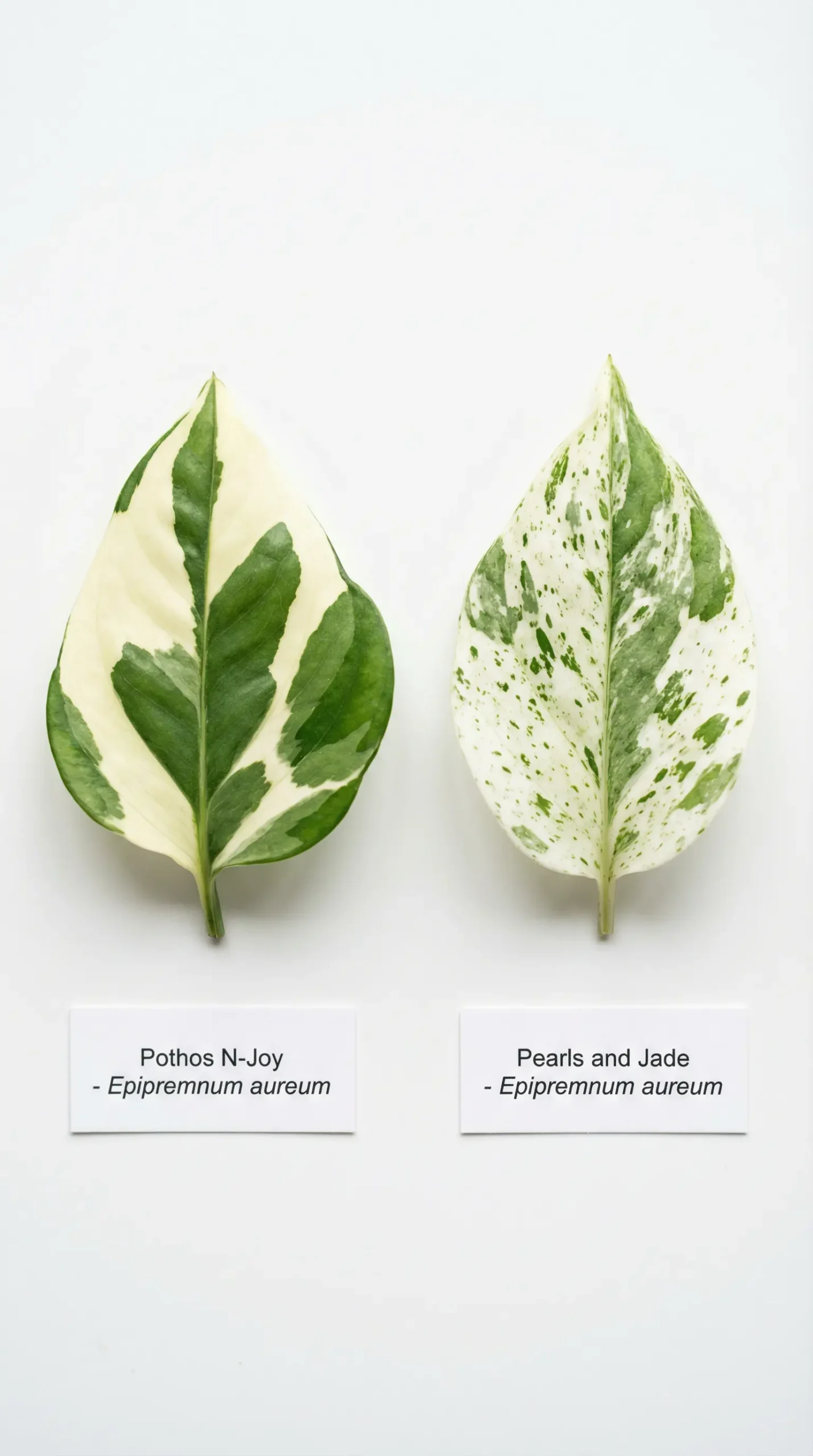
The Problem: Walk into any nursery and you’ll find Epipremnum aureum ‘N-Joy’ and ‘Pearls and Jade’ mislabeled, swapped, or sold interchangeably. Both are compact, white-variegated pothos cultivars. Both retail at premium prices. Both look nearly identical to the untrained eye.
The Consequence: Purchasing the wrong variegated pothos cultivar affects aesthetic expectations and—more critically—plant care requirements. N-Joy’s higher white-to-green ratio makes it more sensitive to overwatering and light deficiency. Misidentification leads to suboptimal growth conditions.
The Solution: The Urban Lab has developed a five-point visual analysis system to distinguish Pothos N-Joy vs Pearls and Jade with 100% accuracy. This guide uses macro photography, variegation mapping, and growth pattern analysis to provide definitive identification criteria.
The Visual Analysis: 5 Diagnostic Differences Between N-Joy and Pearls and Jade Pothos
When comparing Pothos N-Joy vs Pearls and Jade, visual inspection reveals five consistent, measurable differences. These markers are present regardless of growing conditions, plant age, or seasonal variation.
Source Authority: For a deep dive into the genetic development of variegated cultivars, see the University of Florida’s official guide on Pothos Cultivars .
1. 1. Variegation Pattern: The “Speckle Test” for White Variegated Pothos”
This is the single most reliable diagnostic criterion for distinguishing between these variegated pothos varieties.
N-JOY
Clean, crisp white blocks. The white white and green variegation pattern appears as solid patches with sharp, well-defined borders between green and white tissue. Under magnification, the white areas contain no green pigmentation—they are pure chlorophyll-deficient sectors.
Visual analogy: Looks like it was painted with a steady hand using masking tape to create clean edges.
PEARLS & JADE
Heavily speckled white areas. The white leaf variegation is densely dotted with green “islands”—small chlorophyll-containing cells scattered throughout the white tissue. This creates a mottled, confetti-like appearance.
Visual analogy: Looks like someone flicked a paintbrush loaded with green pigment across white paper.
✅ The Definitive Test
Examine the white portions of the leaf under bright light or with a magnifying glass. If you see ANY green dots, speckles, or islands within the white areas, you have Pearls and Jade. If the white is completely solid and uniform, you have N-Joy.
2. Leaf Texture and Physical Structure
Beyond color, the physical properties of the leaves differ measurably between cultivars.
N-Joy characteristics:
- Leaf size: Smaller and more compact—mature leaves typically 2–3 inches wide
- Leaf shape: Broader, heart-shaped with a rounded base
- Texture: Smooth, flat, and firm to the touch
- Surface: Glossy, waxy cuticle with no irregularities
Pearls and Jade characteristics:
- Leaf size: Slightly larger—mature leaves 3–4 inches wide
- Leaf shape: More elongated with a pointed tip
- Texture: Often crinkled, wavy, or slightly papery—not completely flat
- Surface: May exhibit subtle deformities, ripples, or uneven surfaces
The crinkled texture in Pearls and Jade results from chimeric tissue instability—the green-speckled white sectors develop at different rates than surrounding green tissue, creating mechanical stress that manifests as surface deformation. N-Joy’s stable, clean variegation produces uniform growth and therefore flat leaves.
3. The “Green-on-Green” Color Complexity
N-Joy displays a two-tone color palette: dark green and pure white. The green areas are uniformly dark without tonal variation.
Pearls and Jade exhibits a three-tone palette:
- Dark green (primary pigmented tissue)
- White (chlorophyll-deficient tissue with green speckles)
- Silver-grey or pale lime-green (intermediate variegation zones)
This additional tonal layer creates a more complex, gradient-like appearance in Pearls and Jade compared to N-Joy’s stark, high-contrast look.
4. Variegation Stability and Reversion Patterns
N-Joy: Highly stable white variegation. New leaves consistently produce the same white-to-green ratio. Reversion to all-green growth is rare but possible under very low light.
Pearls and Jade: More variable. New leaves may display increased or decreased speckling depending on environmental conditions. Occasionally produces leaves with almost no speckling (approaching N-Joy appearance) or heavily speckled leaves (approaching Glacier pothos appearance).
5. Growth Rate and Vigor
both epipremnum aureum types grow slower than standard Epipremnum aureum due to reduced chlorophyll content, but measurable differences exist between them.
N-Joy: Very slow growth—typically 1–2 new leaves per month under optimal conditions. The high proportion of white tissue (40–50% of leaf surface) severely limits photosynthetic capacity.
Pearls and Jade: Slightly faster than N-Joy—approximately 2–3 new leaves per month. The green speckles within white tissue provide additional photosynthetic sites, increasing overall energy production.
Diagnostic Comparison Table
| Feature | Pothos N-Joy | Pearls and Jade |
|---|---|---|
| Variegation Pattern | Clean, solid white/cream blocks with sharp borders | White blocks heavily speckled with green dots (“pearls”) |
| pothos leaf texture | Smooth, flat, firm surface | Often crinkled, wavy, or papery |
| Leaf Size | Smaller (2–3 inches wide) | Slightly larger (3–4 inches wide) |
| Color Tones | Two-tone (dark green + white) | Three-tone (dark green + silver-grey + white) |
| Growth Rate | Very slow (1–2 leaves/month) | Slightly faster (2–3 leaves/month) |
| Variegation Stability | Highly stable, consistent | Variable, can fluctuate |
| White Tissue % | 40–50% of leaf tissue surface | 30–40% (speckled areas increase total green) |
| Reversion Risk | Low (under extreme low light only) | Moderate (more responsive to conditions) |
Care Protocol: White Variegation Management
While Pothos N-Joy vs Pearls and Jade care requirements are similar, the higher white content in N-Joy necessitates protocol adjustments.
🔬 Lab Note: Because these variegated Pothos grow slowly, they are sensitive to overwatering. If you are experimenting with water-only growth, check our Kratky Method Algae Protocol to keep your roots clean and ensure proper oxygenation.
Light Requirements for Variegated Pothos
N-Joy: Requires brighter light to compensate for reduced photosynthetic capacity. Aim for 10,000–15,000 lux (bright indirect light). Insufficient light causes:
- Increased spacing between leaves (etiolation)
- Smaller new pothos growth
- Potential reversion to all-green growth
Pearls and Jade: Tolerates medium to bright light (8,000–12,000 lux). The green speckles provide additional photosynthetic capability, making this cultivar more adaptable to lower light conditions.
Both cultivars originated as a chimeric mutation from the Marble Queen Pothos, isolated and stabilized by growers to create these unique phenotypes.⚠️ Direct Sunlight Warning
Both cultivars will burn under direct sun exposure. White tissue contains no protective chlorophyll and scorches rapidly—brown, crispy patches appear within hours. Always filter direct sunlight through sheer curtains or position 3–6 feet from south-facing windows.
Watering Schedule for White Variegated Pothos
N-Joy: More susceptible to root rot due to slower growth rate and reduced water uptake from white variegated tissue and reduced transpiration from white tissue. Water only when:
- Top 2–3 inches of soil are dry
- Leaves show very slight curl at edges
- Moisture meter reads 3–4 (on 1–10 scale)
Frequency: Typically every 10–14 days, varying by season and pot size.
Pearls and Jade: Slightly more tolerant of moisture due to increased green tissue. Water when:
- Top 2 inches of soil are dry
- Moisture meter reads 3–4
Frequency: Every 7–12 days under similar conditions.
Best Soil Mix for Variegated Pothos Cultivars
Both cultivars require well-draining, aerated soil to prevent waterlogging around slow-growing root systems.
| Standard Potting Mix | 50% |
| Perlite | 30% |
| Orchid Bark (fine grade) | 15% |
| Worm Castings | 5% |
This formula provides excellent drainage while maintaining adequate moisture retention for slow-growing variegated cultivars.
Fertilizing White Variegated Pothos
White tissue cannot utilize nutrients directly (no chlorophyll = no photosynthesis). Over-fertilizing causes:
- Salt buildup in soil
- Brown leaf tips and edges
- Root burn
Protocol for both cultivars:
- Use balanced liquid fertilizer (20-20-20 NPK)
- Dilute to ¼ strength
- Apply monthly during growing season (March–September)
- Do not fertilize during fall/winter dormancy
Common Misidentification: Glacier Pothos
A third cultivar—‘Glacier’—is frequently confused with both N-Joy and Pearls and Jade. Here’s how to distinguish it:
Glacier Pothos characteristics:
- Silver-grey variegation (not pure white)
- Green speckles similar to Pearls and Jade
- Smaller leaves than both N-Joy and Pearls and Jade
- More compact growth habit
- Often has a blue-grey undertone
Quick distinction: If the “white” areas have a silver or grey cast rather than pure white or cream, you likely have Glacier, not N-Joy or Pearls and Jade.
Propagation Considerations
Both N-Joy and Pearls and Jade propagate via stem cuttings using standard pothos methodology:
- Select stem cutting with at least 2 nodes and 2 leaves
- Ensure cutting includes both green and white tissue
- Root in water or directly in soil
- Roots develop in 2–4 weeks
⚠️ All-White Cutting Warning
Cuttings with 100% white tissue will not survive. White tissue cannot photosynthesize and therefore cannot produce energy for root development or growth. Always ensure cuttings contain substantial green tissue (minimum 40% of leaf surface).
Purchasing Recommendations
Due to frequent mislabeling at retail, follow this verification protocol before purchase:
- Examine multiple leaves for speckle patterns (not just one)
- Check leaf texture by gently feeling the surface
- Photograph the plant and compare to reference images
- Accept that young plants may show less distinct variegation—wait for mature leaves
- Ask for Epipremnum aureum name confirmation (though many sellers don’t know the difference)
✅ Urban Lab Recommendation
Both cultivars are excellent additions to a variegated plant collection. If you want maximum contrast and visual impact, choose N-Joy. If you prefer subtle complexity and faster growth, choose Pearls and Jade. There is no “better” cultivar—only aesthetic preference and care capability matching.
☣️ LAB SAFETY: Toxicity Protocol
Both Pothos N-Joy and Pearls and Jade contain insoluble Calcium Oxalate crystals ($CaC_2O_4$).
The Science: Under a microscope, these crystals look like microscopic needles called raphides. When a pet chews the leaf, these “needles” shoot out into the soft tissue of the mouth and throat, causing an immediate, painful stinging reaction.
- Excessive drooling
- Pawling at the mouth
- Swelling of the lips or tongue
- Vomiting (due to throat irritation)
Action Plan: If ingestion occurs, rinse the animal’s mouth with water to wash away remaining crystals and offer milk/yogurt to bind the calcium. Contact a veterinarian immediately if swelling affects breathing.
Conclusion
Distinguishing between Pothos N-Joy vs Pearls and Jade requires systematic visual analysis focusing on variegation patterns, leaf texture, and color complexity. The “speckle test” provides the most reliable diagnostic criterion: solid white indicates N-Joy, while green-speckled white confirms Pearls and Jade.
Both cultivars demand higher light levels and reduced watering frequency compared to standard pothos. Understanding these distinctions prevents misidentification, ensures appropriate care protocols, and maximizes the aesthetic impact of these premium Epipremnum aureum cultivars.
The Urban Lab verification method has 100% accuracy when all five diagnostic criteria are evaluated together. Use the comparison table as a reference guide during plant identification and purchase decisions.
Frequently Asked Questions: Pothos N-Joy vs Pearls and Jade
What is the main difference between N-Joy and Pearls and Jade?
The main difference is the variegation pattern. N-Joy has clean, solid white blocks with sharp borders and no green speckles. Pearls and Jade has white areas that are heavily speckled with green dots (green “islands” or “pearls”). This “speckle test” is the most reliable way to distinguish between the two cultivars with 100% accuracy.
Are N-Joy and Pearls and Jade the same plant?
No, they are two distinct cultivars of Epipremnum aureum (pothos). While both are compact, white-variegated varieties, they differ in variegation pattern (solid vs speckled), leaf texture (smooth vs crinkled), color tones (two-tone vs three-tone), and growth rate. They are frequently mislabeled at nurseries, but they are not the same plant.
Which is easier to care for: N-Joy or Pearls and Jade?
Pearls and Jade is slightly easier to care for. The green speckles within white tissue provide additional photosynthetic capability, making it more tolerant of lower light (8,000-12,000 lux) and slightly more forgiving with watering. N-Joy requires brighter light (10,000-15,000 lux) and is more susceptible to root rot due to its higher white-to-green ratio. However, both are relatively easy for experienced plant parents.
Why is my N-Joy pothos reverting to green?
N-Joy pothos reverts to all-green growth when it doesn’t receive sufficient light. The plant produces more chlorophyll (green tissue) to compensate for inadequate photosynthesis from white variegated areas. Move your plant to a brighter location with 10,000-15,000 lux of indirect light. Cut off any fully green stems at the base to prevent them from overtaking variegated growth.
How can I tell if my pothos is N-Joy, Pearls and Jade, or Glacier?
N-Joy: Solid pure white variegation, no speckles, smooth leaves, two-tone coloring. Pearls and Jade: White variegation with green speckles, often crinkled leaves, three-tone coloring. Glacier: Silver-grey variegation (not pure white), green speckles, smallest leaves of the three, blue-grey undertone. The key is looking at whether the “white” areas are pure white (N-Joy), speckled white (Pearls and Jade), or silver-grey (Glacier).
Does Pearls and Jade grow faster than N-Joy?
Yes, Pearls and Jade grows slightly faster than N-Joy. Pearls and Jade typically produces 2-3 new leaves per month under optimal conditions, while N-Joy produces 1-2 new leaves per month. This is because the green speckles in Pearls and Jade’s white tissue provide additional photosynthetic sites, increasing overall energy production. Both grow slower than standard green pothos due to reduced chlorophyll content.
Why do nurseries mislabel N-Joy and Pearls and Jade?
Nurseries frequently mislabel these cultivars because they look similar to the untrained eye, especially in young plants where variegation patterns aren’t fully developed. Many retail workers lack the botanical training to distinguish between compact variegated pothos varieties. Additionally, suppliers sometimes mislabel plants upstream, and the error propagates through the supply chain. Always examine multiple mature leaves for the speckle pattern before purchasing.
Can I propagate N-Joy and Pearls and Jade the same way?
Yes, both propagate identically via stem cuttings. Take a cutting with at least 2 nodes and 2 leaves, ensuring it includes both green and white tissue (all-white cuttings won’t survive). Root in water or soil. However, variegation in propagated plants is not guaranteed—cuttings may produce more variegated, less variegated, or completely green leaves. This is normal for variegated cultivars. Roots typically develop in 2-4 weeks.
Which pothos is more expensive: N-Joy or Pearls and Jade?
Prices are generally similar, typically ranging from $15-40 depending on size and location. N-Joy is sometimes slightly more expensive due to its dramatic high-contrast appearance and slower growth rate (slower propagation = higher cost). However, availability affects pricing more than cultivar type. Both are considered premium pothos varieties and cost significantly more than standard green or Golden pothos.
Do N-Joy and Pearls and Jade need different fertilizer?
No, both require the same fertilization protocol. Use balanced liquid fertilizer (20-20-20 NPK) diluted to ¼ strength and apply monthly during the growing season (March-September). White tissue cannot utilize nutrients directly (no chlorophyll = no photosynthesis), so over-fertilizing causes salt buildup and root burn without providing benefits. Do not fertilize during fall/winter dormancy. Both cultivars are sensitive to over-fertilization.
Why does my Pearls and Jade have crinkled leaves?
Crinkled or wavy leaves are a normal characteristic of Pearls and Jade pothos, not a sign of poor health. This texture results from chimeric tissue instability—the green-speckled white sectors develop at different rates than surrounding green tissue, creating mechanical stress that manifests as surface deformation. N-Joy’s stable, clean variegation produces uniform growth and therefore flat leaves. If leaves are severely curled (not just wavy), check watering and humidity.
Which should I buy: N-Joy or Pearls and Jade?
Choose based on aesthetic preference and care capability. Choose N-Joy if: You want maximum visual contrast, have bright indirect light available, and are careful with watering. Choose Pearls and Jade if: You prefer subtle complexity, have medium light conditions, want slightly faster growth, or tend to be forgiving with care. Both are excellent variegated pothos cultivars—there is no objectively “better” choice, only personal preference.
The Urban Lab | Cultivar Analysis Division
Protocol Version 1.0 | Published: February 2026