
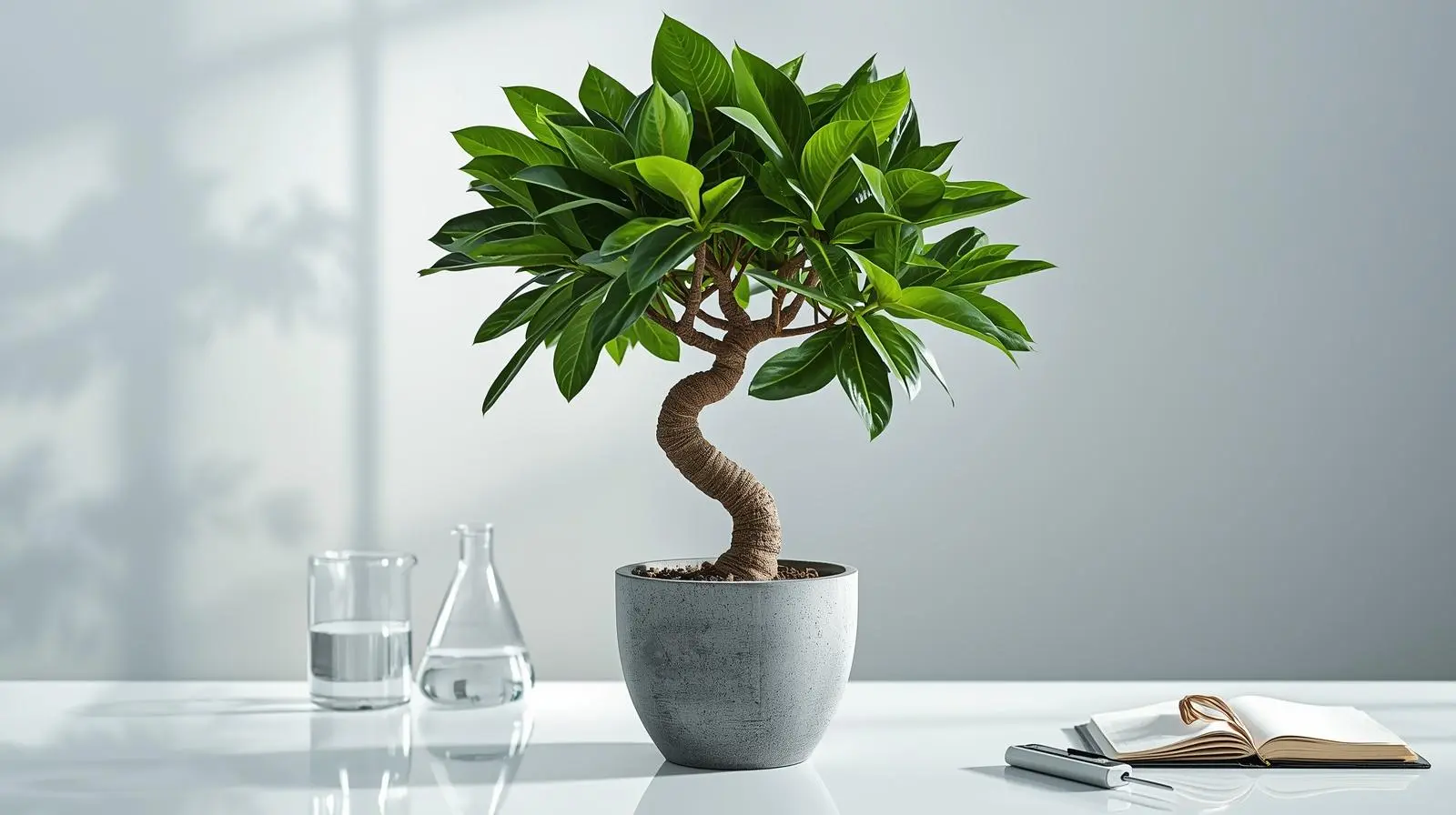
A soft, wrinkled section in one trunk of your braided Money Tree is not random decline — it is very often a rubber band still buried at the root flare, slowly girdling the cambium as the trunk thickens around it. Correct Pachira aquatica or Money tree care starts with understanding that the decorative braid sold at every grocery store and garden center is frequently the plant’s single biggest survival threat, not an aesthetic bonus.
This protocol covers the complete picture: how to find and remove hidden nursery bindings before they kill a trunk, the flood-and-drought watering rhythm this estuary-native species actually needs, the substrate architecture that prevents root suffocation, and the precision pruning technique that turns a leggy single stem into a dense, multi-branched canopy.
To keep your Pachira aquatica (Money Tree) healthy, you must mimic its native estuary environment using a strict flood-and-drought watering protocol, provide bright indirect light, and immediately excavate the root flare to remove hidden nursery rubber bands. Avoid chronic light watering and restrictive trunk bindings, which universally cause anaerobic root suffocation and fatal cambium strangulation.
| Cultivation Parameter | Target / Optimal Baseline | Pathological Threshold / Warning Sign |
|---|---|---|
| Watering Mechanics | Flood-and-drought: 100% saturation, then allow top 3 inches to dry completely | Chronic shallow watering; standing water in cachepot beyond 15 minutes |
| Trunk & Root Flare | Firm, rigid trunks; root flare free of any binding materials | Soft, wrinkly, or hollow trunks; hidden rubber bands choking the cambium |
| Light Exposure | Bright, indirect light (east or shielded west window) | Direct afternoon sun (bleached foliage) or deep shade (etiolation) |
| Substrate Architecture | 40% organic base, 30% perlite, 20% bark, 10% coarse sand | Dense, 100% peat nursery soil causing hypoxia and rot |
The Braided Trunk Sabotage: Inspecting for Hidden Rot
The single most overlooked step in money tree care happens before any watering or light adjustment — a physical inspection of the braid itself, at and below the soil line, for the materials nurseries use to hold the braid in shape during shipping.
The Cambium Strangulation Problem
Commercial growers braid young Pachira aquatica stems while they are still flexible, then secure the braid near the base with a rubber band, twist-tie, or a small dab of floral glue to keep it from unraveling before the stems fuse and lignify together. As the trunks thicken over months and years, any binding material left in place does not stretch with them — it becomes a tightening collar around the trunk’s vascular cambium, the thin living layer responsible for moving water and sugars between roots and canopy.
This is cambium strangulation, and it explains why an otherwise well-watered, well-lit Money Tree can develop one soft, wrinkled, or visibly indented trunk section while its braid-mates stay firm — the constriction cuts phloem and xylem flow locally, starving tissue above the binding regardless of how healthy the root system is.
The Root Flare Excavation Protocol
Every Pachira aquatica — newly purchased or years-established — should have its root flare excavation performed at least once to rule out a buried binding.
- Withhold water for 2–3 days. Slightly drier substrate is easier to dig through without disturbing fine feeder roots.
- Excavate carefully to a depth of 2 inches. Using a chopstick or your fingers, remove substrate around the base of the braid where the individual trunks converge, working outward from the center.
- Inspect each trunk individually at the point of convergence. Look for a thin rubber band, wire twist-tie, fishing line, or a hardened bead of clear floral glue holding the trunks together — these are frequently disguised by a thin layer of bark growth and easy to miss on a casual glance.
- Cut bindings without unwinding the braid. Use small, sharp scissors or a craft knife to snip through any rubber band or wire in place, cutting away from the trunk surface. Do not attempt to pull the band free, which can tear adjacent bark; do not unbraid the stems, since the natural fusion already holding them together at that point is what will maintain the shape going forward.
- Gently scrape away hardened glue residue. If a dab of floral glue is present, soften it with a small amount of rubbing alcohol on a cotton swab before scraping it free with a fingernail, avoiding any cutting motion against the trunk itself.
- Backfill with fresh substrate and resume the flood-and-drought schedule. The plant requires no special aftercare beyond resuming normal watering once the binding is confirmed removed from every trunk.
Pro Tip: If removing a binding exposes a shallow wound in the bark, lightly dust the area with ground cinnamon powder. Cinnamon has natural antifungal properties and creates a dry barrier over the wound site, reducing the chance of secondary fungal infection while the bark heals over the next several weeks.
Emergency Triage for a Dead Trunk
If one trunk in the braid is already soft, hollow, or visibly collapsed by the time the binding is discovered, that section cannot be saved — but the remaining braided trunks usually can. Cut the dead trunk cleanly at the soil line with sterilized pruning shears, removing it entirely rather than leaving a stub. The surviving trunks, once freed of their own bindings, typically continue growing without further incident, simply with one fewer stem in the braid than the plant started with.
The Estuary Origin: The Watering Foundation of Pachira Aquatica Care
Most watering advice for houseplants assumes a single steady moisture target. Pachira aquatica actively rejects that model, and understanding why is central to correct Pachira aquatica care.
Why “Keep Soil Moist” Kills Pachira Aquatica
In its native range — coastal wetlands and river estuaries of Central and South America — this species experiences a pronounced wet-and-dry cycle: seasonal flooding saturates the root zone completely, followed by extended periods where water recedes and the surrounding soil dries substantially before the next flood event. Its root system evolved for exactly this estuary environment, not for the chronically damp, never-fully-dry substrate that “keep soil moist” produces in a home container.
Constant low-level moisture creates anaerobic soil conditions at the root zone — oxygen is depleted faster than it can diffuse back into waterlogged substrate, and roots begin to suffocate and decay even though the gardener is, technically, never letting the plant go fully dry.
The Flood-and-Drought Execution
Correct money tree watering means replicating the flood cycle deliberately rather than avoiding it: drench the substrate thoroughly until roughly 30% of the applied water exits the drainage holes, ensuring complete saturation throughout the root ball. Then withhold all water completely until the top 3 inches of substrate are bone dry to the touch — for most indoor specimens in adequate light, this is every 10–21 days depending on pot size, season, and ambient temperature.
Substrate Engineering for Estuary Trees
Watering discipline alone cannot compensate for substrate that physically prevents drainage — the two variables have to be solved together.
Moving Beyond Dense Nursery Soil
Most Money Trees arrive from the nursery in a dense, peat-heavy mix selected for shelf-life and shipping weight, not long-term drainage. This substrate compacts over time, and its fine particle structure holds water in a way that directly produces the anaerobic soil conditions responsible for the majority of trunk and root rot diagnosed in this species. Repotting into an engineered, fast-draining mix within the first month of ownership resolves this risk before it becomes a visible problem.
The Lab-Grade Pachira Soil Recipe
Combine by volume:
- 40% organic base (high-quality potting soil or coco coir) — provides nutrient and moisture retention without excessive density
- 30% perlite — creates permanent macro-pores that resist compaction and accelerate the dry-down phase of the flood-and-drought cycle
- 20% pine bark (fine-medium grade) — adds structural air pockets and slow-release organic matter, mimicking the woody debris common in estuary substrates
- 10% coarse sand — adds weight and additional drainage channels without contributing to compaction
Target performance: water poured through this mix should exit the drainage holes within 10–15 seconds, with no pooling visible on the surface.
Canopy Management: Pruning for Structural Integrity
A neglected indoor Money Tree rarely stays compact on its own — the same low-light conditions that make it a popular houseplant also push it toward exactly the leggy growth habit most owners are trying to avoid.
Combating Indoor Etiolation
Etiolation — abnormal stem elongation with increased spacing between leaves — develops when a Money Tree receives insufficient light to support compact growth. The plant stretches toward whatever light source is available, producing thin, weak stem sections with sparse foliage concentrated only at the tips. Relocating to bright, indirect light is the first correction; existing etiolated growth, however, does not retroactively compact and instead requires structural pruning to correct.
The Precision Node-Cutting Technique
Pruning a leggy or single-stemmed Money Tree at the correct point activates dormant axillary buds — lateral growth points along the stem that remain inactive as long as the topmost growing tip is intact and suppressing them through apical dominance.
- Identify a healthy leaf node. Locate a node (the point where a leaf or leaf scar attaches to the stem) below the section you want to remove, ideally just above a point with 2–3 healthy nodes remaining on the lower stem.
- Sterilize your cutting tool. Wipe pruning shears or a sharp blade with rubbing alcohol to prevent introducing pathogens into the fresh cut.
- Cut at a 45-degree angle, 1/4 inch above the node. Cutting too close risks damaging the node itself; cutting too far above leaves a stub that can die back and invite rot before reaching the living node.
- Remove the cutting and set it aside for propagation if desired. A healthy stem section with at least one node can typically be rooted in water or moist substrate.
- Allow 3–6 weeks for axillary buds to activate. New growth typically emerges from the nodes nearest the cut first, producing the branched, bushier structure that single-stem specimens lack.
“Money Tree” vs. the Botanical Reality
The common name “Money Tree” has nothing to do with the plant’s native ecology — it originates from feng shui tradition, where the five-leaflet palmate leaf arrangement is associated with the five elements and financial prosperity. Botanically, Pachira aquatica is a genuine wetland tree, capable of reaching over 60 feet tall in the wild along Central and South American riverbanks and estuaries, with a swollen, water-storing trunk base adapted to exactly the flood-and-drought cycle this guide is built around. The braided, tabletop houseplant form sold commercially is a juvenile specimen kept permanently small through container culture — not a distinct dwarf variety.
Troubleshooting Matrix
| Symptom | Root Cause | Solution Protocol |
|---|---|---|
| Soft, wrinkly, or hollow braided trunk | Advanced stem rot from cambium strangulation (rubber bands) or root suffocation | Cut the dead trunk at the soil line immediately. Remove root flare bindings from all remaining trunks. |
| Rapid yellowing/dropping of lower canopy | Root hypoxia from dense, waterlogged soil or chronic overwatering | Withhold water until top 3 inches dry; excavate root flare to check for bands; repot if soil is muddy. |
| Crispy, curled green leaves | Cellular desiccation from severe underwatering or ambient humidity below 30% | Execute a flood-level watering; increase ambient humidity via pebble tray or humidifier. |
| Pale, washed-out foliage | Chlorophyll breakdown from excess direct solar radiation | Relocate 3–5 feet away from south/west windows or filter light with sheer curtains. |
For a deeper breakdown of how root-zone oxygen levels determine recovery odds once rot has started, see our complete root rot triage and surgical recovery guide.
If your braided money tree yellow leaves presentation includes a sulfurous smell from the substrate, treat it as advanced anaerobic rot rather than a simple watering correction — the same anaerobic decay mechanism documented in Clemson Cooperative Extension’s houseplant root disease research applies directly here. General light and substrate baselines for tropical container trees are also covered in University of Florida IFAS Gardening Solutions, and broader estuary tree physiology is referenced by the Missouri Botanical Garden Plant Finder. For substrate ratios tailored to other tropical container specimens, see our fast-draining houseplant soil engineering guide.Frequently Asked Questions
Why is my Pachira aquatica trunk soft and wrinkly?
This almost always indicates cambium strangulation from a hidden rubber band or wire left at the root flare from nursery braiding, or root rot from chronic overwatering. Excavate the root flare to check for bindings, and inspect roots for a sulfurous smell or mushy texture indicating rot.
Should I untie the braided trunks of my Money Tree?
No — do not unbraid the stems themselves, since they are often naturally fused at points of contact and unwinding can cause structural damage. Only remove the binding material (rubber band, wire, or glue) holding the base of the braid together; the braid pattern itself should stay intact.
How often does Pachira aquatica need to be watered?
There is no fixed schedule — water thoroughly using the flood-and-drought method whenever the top 3 inches of substrate are completely dry, typically every 10–21 days depending on light, pot size, and season. Always let roughly 30% of applied water drain through before stopping.
How do I know if my Money Tree has root rot?
Check for a sulfurous odor from the substrate, mushy or blackened roots when the plant is gently lifted from its pot, and rapid yellowing of lower leaves despite seemingly adequate care. Confirmed rot requires removing affected roots and repotting into fresh, fast-draining substrate.
Why is my Money Tree dropping so many yellow leaves?
Rapid yellowing and leaf drop in the lower canopy is most commonly root hypoxia from waterlogged, dense substrate. Withhold water until the top 3 inches are dry, check the root flare for hidden bindings, and repot if the existing soil is compacted or muddy.
Can you grow a Money Tree in low light?
It will survive in low light but will etiolate — stretching with thin, weak stems and sparse foliage as it reaches for available light. For compact, healthy growth, bright indirect light is required; correct existing etiolated growth with node-cutting pruning rather than relying on light alone.
Can I propagate the stem cuttings from my Money Tree?
Yes — a healthy stem section cut 1/4 inch above a node, containing at least one additional node, roots readily in water or moist substrate. This is the natural byproduct of the precision node-cutting pruning technique used to correct etiolated growth.
Is Pachira aquatica toxic to cats and dogs?
No — Pachira aquatica is listed as non-toxic to cats and dogs, making it one of the safer popular houseplant choices for households with pets. As with any houseplant, prevent pets from chewing on foliage as a general precaution against gastrointestinal upset.
You should take part in a contest for top-of-the-line blogs on the web. I’ll advocate this web site!
Thank you, that means a lots for me.
Very interesting topic, regards for putting up.
Very great post. I just stumbled upon your blog and wished to say that I’ve really enjoyed browsing your blog posts.
After all I’ll be subscribing in your rss feed and I hope you
write again very soon!