
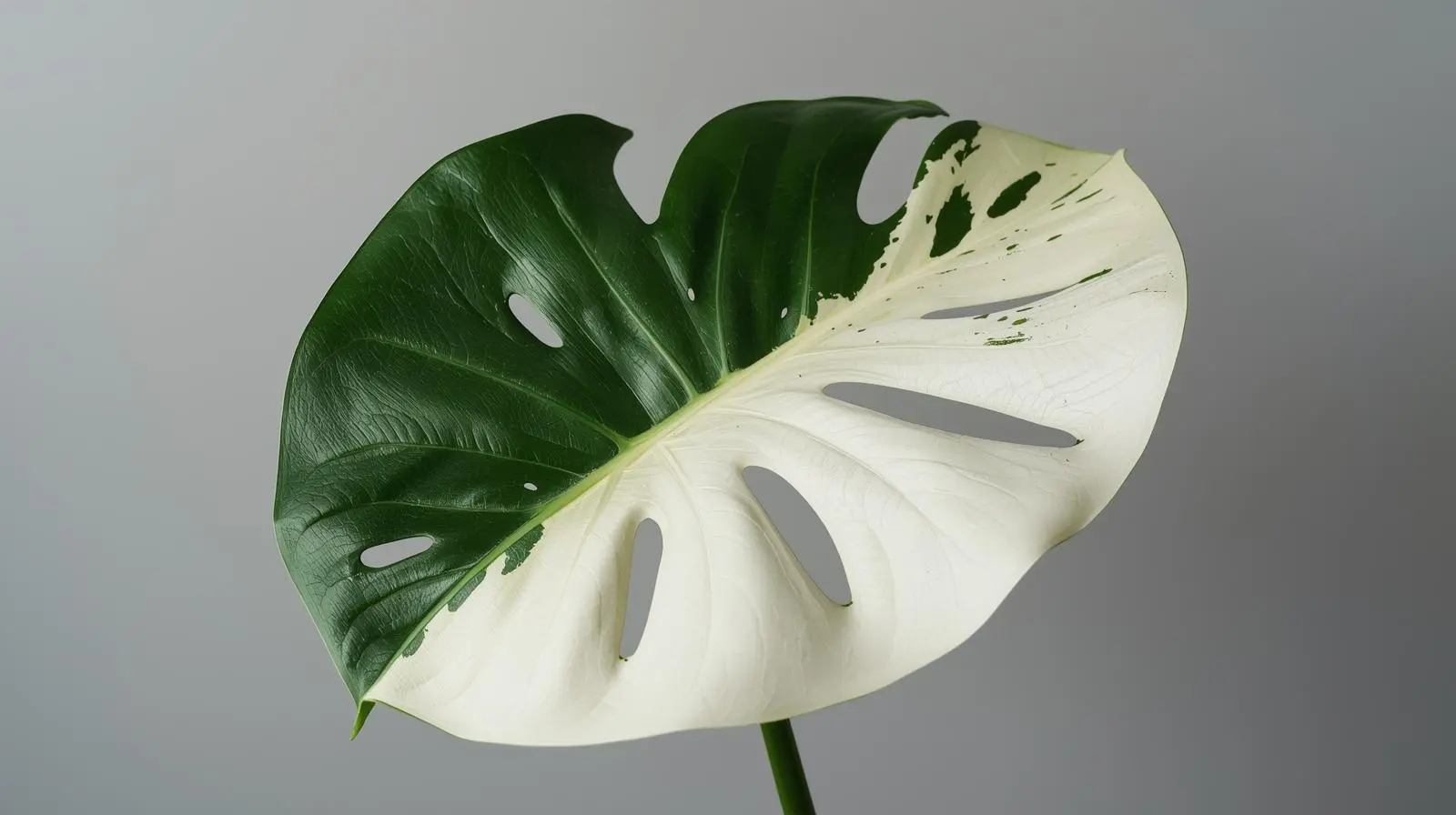
Variegated Monstera Deliciosa Care: Stop Brown Leaves

🔬 THE URBAN LAB | RARE VARIEGATION PROTOCOLS

You finally invested in a Variegated Monstera Deliciosa, but now those stunning, expensive white leaves are starting to develop crispy brown edges.

The panic is entirely justified. A single specimen with good variegation can cost $300-$2,000+ depending on size and pattern stability. Watching that investment turn brown feels like watching money decompose in real-time.

Here’s the reality: Maintaining unstable variegation without triggering leaf necrosis requires precise environmental controls, not just generic watering advice. White leaf tissue is fundamentally defective—it lacks chlorophyll and cannot produce energy. The plant tolerates it only under optimal conditions.

⚗️ The Executive Lab Summary: To prevent browning in a Variegated Monstera Deliciosa, the plant requires a minimum of 400 foot-candles (FC) of indirect light to compensate for the lack of chlorophyll in white tissue. It must be potted in a highly aerated, soil-less aroid mix to prevent root suffocation, and ambient humidity must be maintained strictly above 60% RH to keep the delicate albino cells fully hydrated.

The Science of Variegation: Albo vs. Thai Constellation

Before treating your plant, you must identify which mutation you are dealing with. The care protocols differ slightly based on how the plant’s cellular structure mutated.

Variegation in Monstera deliciosa occurs through two fundamentally different mechanisms: chimeric mutation (Albo Borsigiana) and genetic engineering (Thai Constellation). Understanding this distinction is critical because it determines stability, browning susceptibility, and propagation success rates.

The Mutation Comparison

Cultivar NameMutation TypeVariegation PatternStabilityRisk of Reversion
Monstera Albo BorsigianaChimeric (Random cell mutation)Blocky, sectoral, half-moon pure white patchesUnstableHigh – Can revert to full green or pure white
Monstera Thai ConstellationGenetic (Laboratory-induced stable mutation)Speckled, starry, evenly distributed cream/yellowStableZero – Mutation is permanently coded in DNA

Chimeric Mutation (Albo Borsigiana)

The Monstera Albo contains two genetically distinct cell populations within the same plant tissue—some cells produce chlorophyll (green), while others do not (white). This is called a periclinal chimera.

The white sectors are not genetically programmed—they’re accidents. During cell division, some cells randomly lose the ability to produce chloroplasts. This mutation exists only in the specific tissue where it occurred, not in the plant’s DNA blueprint.

Critical implication: When you propagate an Albo cutting, there’s no guarantee the new growth will maintain variegation. The cutting could produce all-green leaves (full reversion), all-white leaves (albino—will die without chlorophyll), or maintain the mixed pattern. You’re essentially rolling genetic dice with each propagation.

Genetic Mutation (Thai Constellation)

Thai Constellation was created through tissue culture mutagenesis in a laboratory. Scientists exposed Monstera deliciosa cells to chemical mutagens or radiation, then screened thousands of resulting plants for stable variegation patterns.

The selected mutation was incorporated into the plant’s actual DNA. Every cell in a Thai Constellation carries the variegation code—it’s not a random accident but a permanent genetic trait, similar to eye color in humans.

Critical implication: Thai Constellation will never revert to solid green. Every cutting, every new leaf, every propagation will carry the speckled cream variegation. This genetic stability is why Thai Constellation became commercially viable for mass production through tissue culture, while Albo remains rare and expensive. For more on Thai Constellation care protocols, see our complete guide.

Understanding Leaf Necrosis in White Tissue

White leaf tissue is metabolically expensive and structurally defective. It contains zero chlorophyll, meaning it cannot photosynthesize or produce its own energy. It is essentially acting as a parasite on the green parts of the plant.

When the plant experiences stress—insufficient light, low humidity, root problems, nutrient deficiency—it performs an energy calculation: “Is supporting this useless white tissue worth the metabolic cost?” If the answer is no, the plant triggers programmed cell death (apoptosis) in the white sectors.

The Browning Cascade

  1. Stress trigger: Environmental parameter falls below threshold (low light, dry air, waterlogged roots)
  2. Vascular restriction: Plant reduces water/nutrient flow to white tissue to conserve resources for productive green tissue
  3. Cellular dehydration: White cells, already fragile due to lack of chloroplasts, begin desiccating from edges inward
  4. Necrosis initiation: Cell walls collapse, tissue turns tan/brown and becomes crispy
  5. Irreversible damage: Brown tissue is dead and will never recover—it must be trimmed away

This process can occur within 48-72 hours under severe stress conditions. Unlike green tissue, which has some resilience, white tissue has zero stress tolerance.

⚠️ Why White Tissue is So Vulnerable

Chloroplasts serve multiple protective functions beyond photosynthesis:

  • Structural support: Chloroplasts occupy physical space within cells, providing turgor pressure and structural integrity
  • Oxidative stress protection: Chloroplasts contain antioxidant compounds that neutralize reactive oxygen species (ROS)
  • Water retention: Chloroplasts help regulate osmotic balance and cellular hydration
  • Heat dissipation: Chloroplasts can convert excess light energy into heat, preventing cell damage

White cells lack ALL of these protective mechanisms. They are fundamentally weaker, more prone to desiccation, and die under conditions that green tissue tolerates easily. This is why variegated Monstera care must be more precise than standard Monstera protocols.

The Necrosis Prevention Protocol

Preventing brown edges requires optimizing three critical environmental parameters simultaneously: light intensity, humidity level, and root zone oxygen availability. Addressing only one or two factors will not prevent necrosis—all three must be maintained within tight tolerances.

Step 1: The Light Saturation Threshold

Because your plant has 30% to 50% less chlorophyll than a standard Monstera, it needs significantly more light to produce the same amount of energy.

A solid green Monstera can thrive at 200-300 foot-candles (FC). A variegated specimen requires minimum 400 FC, with optimal performance at 600-800 FC. Below this threshold, the plant cannot generate enough photosynthate (sugars from photosynthesis) to support both green and white tissue simultaneously.

Light Placement Protocols

💡 OPTIMAL LIGHT CONFIGURATIONS

Option 1: Natural Window Light (Ideal for Albo)

  • East-facing window: Direct morning sun (6am-10am) followed by bright indirect light all day. Morning sun is gentle and won’t scorch white tissue
  • South-facing window with sheer curtain: Maximum light intensity but filtered to prevent direct sun damage. Place plant 2-4 feet from window
  • West-facing window (with caution): Afternoon sun is intense and hot. Use only with sheer curtain and position 4-6 feet back from glass
  • North-facing window: Insufficient light year-round—supplemental grow lights mandatory

Option 2: Full-Spectrum LED Grow Lights (Recommended for Consistency)

  • Use dedicated full-spectrum LED rated for 50-100W actual power draw (not “equivalent” watts)
  • Position light 12-18 inches above plant canopy
  • Run for 12-14 hours daily using timer for consistency
  • Ideal spectrum: 5000-6500K color temperature with red supplementation (660nm)
  • Brands proven effective: Spider Farmer, Mars Hydro, Sansi, GE BR30 Grow Light Bulbs (budget option)

Verification: Purchase a basic light meter (Dr.meter LX1330B, ~$15) and measure at leaf surface. If reading shows below 400 FC, light is insufficient regardless of “how bright it looks” to your eyes. Human perception is not calibrated to plant photosynthetic needs. For comprehensive lighting guides, see our complete LED grow light selection protocol.

Variegated Monstera Deliciosa positioned under full-spectrum LED halo grow light with digital light meter showing 600 foot-candles measurement

Proper grow light setup showing 600 FC measurement—sufficient intensity to prevent white tissue browning

Light Duration vs. Intensity

Plants measure total light exposure as Daily Light Integral (DLI)—the cumulative amount of photosynthetically active radiation received over 24 hours.

The formula: DLI = Light Intensity (µmol/m²/s) × Hours × 3600 ÷ 1,000,000

For variegated Monstera: Target DLI of 12-16 mol/m²/day. This can be achieved through:

  • High intensity for fewer hours: 800 FC for 10 hours = ~12 DLI
  • Moderate intensity for longer hours: 500 FC for 14 hours = ~12 DLI

Critical warning: Do not exceed 16 hours of light per day. Plants require a dark period for cellular repair and metabolic processes. 24-hour lighting causes physiological stress and leaf damage.

Step 2: Humidity Requirements for White Tissue

Ambient humidity must be maintained strictly above 60% RH to prevent cellular dehydration in white tissue.

White cells lack the structural integrity of chlorophyll-containing cells. They have thinner cell walls, lower turgor pressure, and reduced capacity for water retention. In dry air (below 50% RH), these cells desiccate from the edges inward, turning brown within days.

The Humidity Protocol

✅ Humidity Management Solutions

Minimum Acceptable Range: 60-65% RH

  • Prevents active browning but white tissue may show stress under 62% RH
  • Use ultrasonic humidifier positioned 3-5 feet from plant
  • Run continuously during daylight hours, reduce at night
  • Monitor with digital hygrometer at plant canopy level (not floor level)

Optimal Range: 65-75% RH (Recommended)

  • White tissue remains fully hydrated with pristine appearance
  • Leaf unfurling occurs without mechanical stress or tearing
  • Maximum variegation expression—white sectors expand fully
  • Use in combination with gentle air circulation to prevent fungal issues

Advanced: 75-85% RH (Greenhouse/Cabinet Only)

  • Museum-quality foliage with maximum leaf size
  • Requires enclosed environment (greenhouse cabinet, terrarium, grow tent)
  • MUST have active air circulation (small fan) to prevent bacterial/fungal bloom
  • Monitor for condensation on leaves—if present, reduce humidity to 70-75% RH

Budget Solution: If you cannot maintain 60%+ RH in your entire room, create a localized high-humidity zone. Group plants together on pebble trays filled with water (ensure pot bottoms don’t touch water). The collective transpiration from multiple plants raises local humidity by 10-15%. This is sufficient for marginal improvement but not ideal long-term. For detailed humidity strategies, see our guide on creating microclimates for rare aroids.

Step 3: Root Zone Aeration & Substrate Formula

Variegated Monsteras are highly susceptible to root rot. The reduced photosynthetic capacity means roots receive less oxygen from internal plant respiration. Compensate by maximizing external oxygen availability in the substrate.

Never use standard potting soil. Peat-based mixes retain too much water, collapse over time reducing air pockets, and create anaerobic conditions where roots suffocate.

The Urban Lab Variegated Monstera Substrate Formula

🌱 PREMIUM AROID SUBSTRATE RECIPE
ComponentRatioFunction
Orchid Bark (Medium Grade)40%Structure, drainage
Coarse Perlite or Pumice30%Aeration, porosity
Coco Coir or Peat Moss20%Moisture retention
Horticultural Charcoal10%pH buffer, filtration

Performance characteristics: This mix drains 80% of applied water within seconds while maintaining 20% moisture in micro-pores. Air-filled porosity remains above 40% even when fully saturated—roots have constant oxygen access. For the complete substrate science, see our master aroid substrate formulation guide.

Advanced Option: Semi-Hydroponics (LECA/Pon)

For growers who struggle with soil moisture management, transition to semi-hydroponic culture using inert media like LECA (lightweight expanded clay aggregate) or Lechuza Pon.

Advantages for variegated plants:

  • Impossible to overwater—roots take only what they need from reservoir
  • Maximum oxygen availability—LECA is 100% inorganic with permanent air pockets
  • Transparent containers allow root health monitoring
  • Reduced fungal/bacterial issues compared to organic soil

Disadvantage: Learning curve during transition period (4-8 weeks). Plants must adapt from soil roots to water roots. During transition, expect some leaf loss and stress. Once established, growth rate often exceeds soil-grown specimens. For semi-hydro protocols, see our complete LECA transition guide.

Step 4: Silica Supplementation (The Secret Weapon)

This is the advanced technique that separates hobbyists from serious collectors. Standard fertilizers focus on nitrogen (N), phosphorus (P), and potassium (K)—macronutrients for growth. But white leaves don’t need growth promotion—they need structural reinforcement.

Silica (Si) is a beneficial element that strengthens plant cell walls. When incorporated into cellular structure, silica creates a physical barrier that:

  • Reduces water loss through transpiration (thicker cuticle layer)
  • Increases mechanical strength of cell walls (less prone to tearing/collapse)
  • Provides mild protection against fungal pathogens
  • Improves drought tolerance by reducing cellular dehydration rate

For white tissue with inherent structural weakness, silica supplementation can reduce browning incidence by an estimated 30-40% compared to plants receiving only NPK fertilization.

The Silica Application Protocol

🔬 BIOAVAILABLE SILICA SUPPLEMENTATION

Product Selection:

  • Monosilicic acid (Si(OH)₄): Most bioavailable form—immediately absorbed by roots
  • Potassium silicate (K₂SiO₃): Common commercial form—converts to monosilicic acid in solution
  • Recommended products: Dyna-Gro Pro-TeKt, Botanicare Silica Blast, AgSil 16H
  • Avoid: Diatomaceous earth, rock dust—silica is not bioavailable in solid form

Application Schedule:

  1. Dilute liquid silica supplement to Âź strength (25% of label recommendation)
  2. Apply once monthly during active growth season (March-October)
  3. Apply to moist substrate only—never to dry substrate or dormant plants
  4. Reduce to once every 6-8 weeks during winter dormancy (November-February)
  5. Can be combined with regular fertilizer application (silica first, fertilizer 2-3 days later)

Expected results: Within 4-6 weeks, new leaves should show visibly improved texture—white sectors feel thicker and more leathery. Existing leaves will not reverse damage, but new growth shows enhanced resistance to browning. Continue protocol indefinitely for best results.

⚠️ Silica Application Warnings

Do NOT exceed recommended dosage. Silica is beneficial at low concentrations but toxic at high levels. Symptoms of silica toxicity include:

  • White crystalline deposits on leaf surfaces
  • Reduced nutrient uptake (silica competes with other minerals)
  • Substrate pH drift (potassium silicate is highly alkaline—raises pH to 8-9)
  • Root tip damage from salt accumulation

Solution: Always dilute to Âź strength. If using potassium silicate products, pH-balance the solution to 6.0-6.5 before applying using pH down (phosphoric acid). Flush substrate every 3 months with plain water to prevent mineral buildup.

Managing Reversion to Green (Albo Only)

If you have a Monstera Albo Borsigiana, the chimeric mutation is inherently unstable. The plant may spontaneously produce fully green leaves, fully white leaves (albino), or revert entire growth points to solid green.

This is not your fault—it’s the nature of chimeric variegation. The mutation exists only in specific cell layers, not in the plant’s genetic code. During cell division, these layers can separate, reorganize, or be lost entirely.

Identifying Reversion

  • Full green leaf: New leaf emerges with zero white variegation—completely solid dark green
  • Progressive greening: Each new leaf shows progressively less white until variegation disappears
  • Sectoral reversion: One side of plant produces green leaves while other side maintains variegation

Why it happens: Most commonly triggered by insufficient light. When the plant can’t generate enough energy to support white tissue, it abandons the mutation and reverts to high-chlorophyll green tissue for survival.

The Reversion Management Protocol

🔪 SURGICAL REVERSION REMOVAL

If your Albo produces a fully green leaf, you must act immediately:

  1. Trace the reverted growth back to the stem. Identify the last node (leaf attachment point) that showed good variegation
  2. Using sterilized pruning shears, cut the stem 1-2 inches ABOVE that last variegated node. This removes the entire reverted growth point
  3. The plant will activate dormant axillary buds near the cut site. These may produce variegated growth—but there’s no guarantee
  4. If new growth from the cut emerges green again, the entire growth point has reverted. You may need to propagate from a lower section of stem with better variegation

Important: Pruning does not “fix” the mutation—it only removes the reverted tissue and gives the plant another chance. Some Albos stabilize and maintain variegation indefinitely. Others revert repeatedly and must be continuously managed. This unpredictability is why Albo costs 3-5x more than Thai Constellation despite being less stable. For propagation techniques to preserve variegation, see our Albo cutting selection and rooting protocol.

Albino (All-White) Leaves

The opposite problem: Your plant produces a leaf with 100% white variegation—zero green tissue.

This leaf is non-functional. It cannot photosynthesize and contributes nothing to the plant. Worse, it actively drains energy as the plant must support its cellular metabolism without receiving any energy return.

Management: Allow the leaf to fully unfurl (this confirms the variegation pattern), then cut it off at the petiole base. The plant will redirect energy to the next leaf, which may have better green/white balance. Albino leaves are not rare or valuable—they’re metabolic dead weight.

Frequently Asked Questions: Variegated Monstera Care

How do I stop brown edges on my Variegated Monstera?

Brown edges on white variegation result from three primary causes: (1) Insufficient light (below 400 FC), (2) Low humidity (below 60% RH), or (3) Root stress from dense substrate or overwatering. Address all three factors simultaneously: provide bright indirect light or grow lights, maintain 60-70% humidity with humidifier, and use chunky well-draining aroid substrate. Existing brown tissue is dead and cannot recover—trim it away with sterilized scissors.

Can I put my Variegated Monstera in direct sunlight?

No. White tissue lacks chlorophyll’s protective mechanisms and will scorch/burn within 1-2 hours of direct sun exposure. Symptoms include white/tan bleached patches, crispy brown spots, and permanent tissue damage. Only gentle morning sun (6am-9am) from east-facing windows is tolerable. All other direct sun exposure requires sheer curtain filtering or placement 4+ feet from window glass.

Why is my Monstera Albo producing all green leaves?

Reversion to solid green indicates the chimeric mutation is being lost in that growth point. Primary cause: insufficient light triggers the plant to abandon energy-expensive white tissue and revert to high-chlorophyll green for survival. Solution: (1) Immediately increase light to 600+ FC, (2) Prune stem back to last node with strong variegation, (3) Hope new growth from dormant buds maintains white sectors. Reversion is unpredictable—some Albos stabilize, others revert repeatedly despite optimal care.

What is the difference between Albo and Thai Constellation?

Monstera Albo has chimeric (unstable) variegation—random cell mutation creating blocky pure white sectors. Can revert to green or produce albino leaves. Thai Constellation has genetic (stable) variegation—lab-induced permanent mutation creating speckled cream pattern. Never reverts. Thai Con is easier to care for and propagate but Albo commands higher prices due to rarity and dramatic white blocks.

Should I fertilize my Variegated Monstera differently than a regular Monstera?

Yes. Reduce nitrogen-heavy fertilizers by 25-50%—white tissue doesn’t need aggressive growth promotion and excess nitrogen increases susceptibility to browning. Instead, focus on balanced NPK (20-20-20 at ½ strength) supplemented with monthly silica applications to strengthen cell walls. Fertilize only during active growth (March-October), every 4-6 weeks. Never fertilize stressed plants or during winter dormancy.

How much does a Variegated Monstera cost and why is it so expensive?

Prices range from $150-$2,000+ depending on size, variegation pattern, and cultivar. Albo Borsigiana costs more ($300-$2,000) than Thai Constellation ($150-$600) despite being less stable because (1) Cannot be tissue cultured—must be propagated from cuttings only, (2) Unstable mutation means many cuttings revert to green (lower success rate), (3) High demand from collectors for dramatic white blocks. Thai Con is cheaper due to mass tissue culture production but still commands premium over solid green Monstera ($20-$100) due to ornamental value. According to Royal Horticultural Society research on variegated houseplants, variegation reduces plant vigor by 20-40%, increasing production costs and mortality rates during cultivation.

The Lab Verdict: Precision Over Hope

Browning on a variegated Monstera is not inevitable—it’s the result of environmental deficits.

White tissue cannot compensate for low light, tolerate dry air, or survive in oxygen-depleted substrate. It has zero resilience. But when you provide the precise conditions it requires—bright indirect light (400+ FC), elevated humidity (60-70% RH), and highly aerated substrate—the plant stabilizes.

The Urban Lab Protocol addresses browning at its root causes: energy deficit from insufficient light, cellular dehydration from low humidity, and structural weakness from lack of silica reinforcement. By adjusting your environmental controls to support the parasitic white tissue, you can maintain pristine, museum-quality foliage.

This is not a plant for casual growers. If you cannot commit to precise light metering, humidity monitoring, and substrate management, a variegated Monstera will slowly deteriorate. But if you implement these protocols systematically, you’ll have a specimen that appreciates in value while bringing you daily aesthetic satisfaction.

The choice is environmental precision or slow necrosis. Choose wisely.


The Urban Lab | Rare Variegation Protocols Division
Variegated Monstera Deliciosa Care Protocol | Published: March 2026

Leave a Comment