
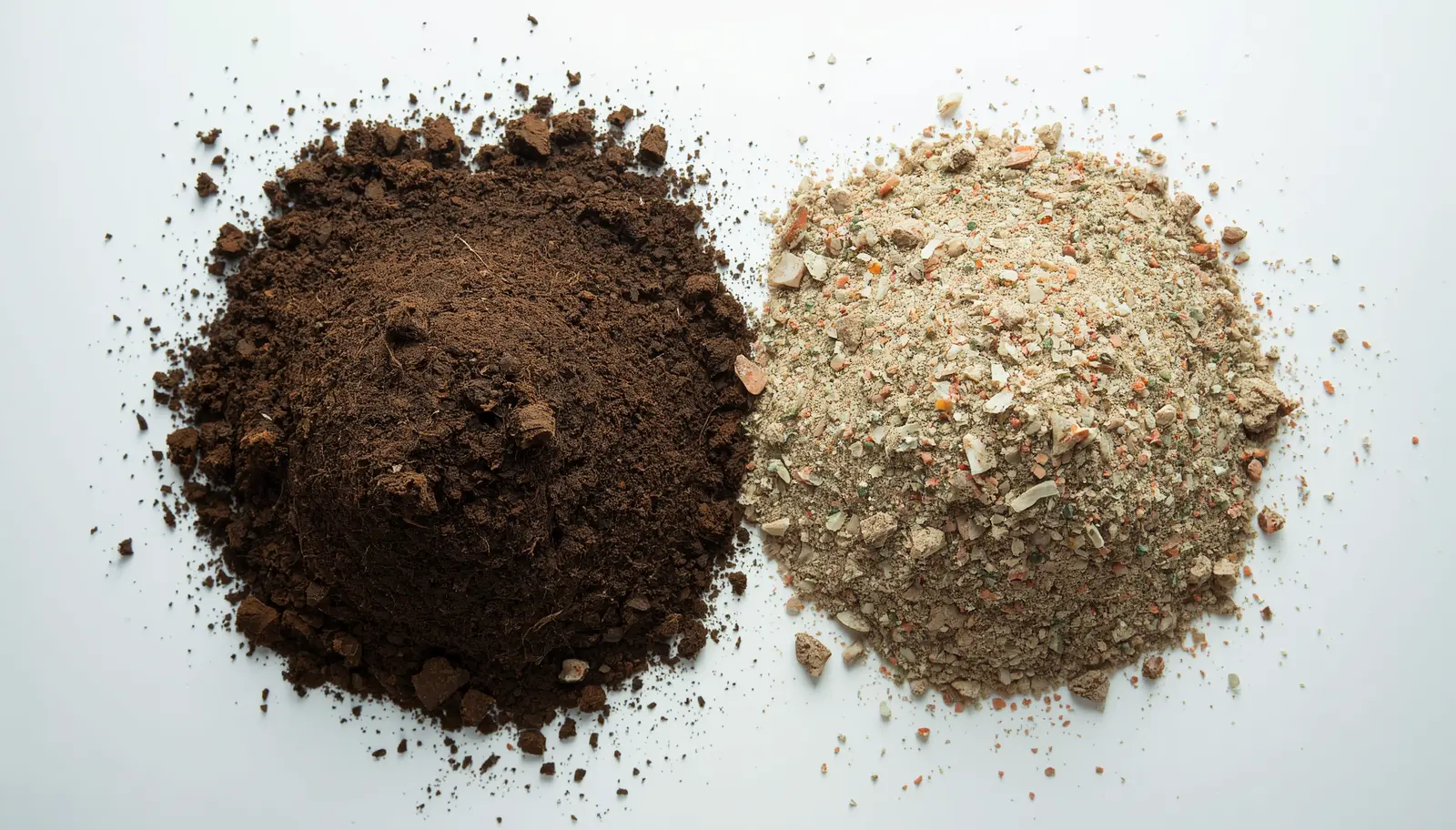
Organic soil is fundamentally incompatible with controlled indoor horticulture.
Peat-based substrates compact over time, create anaerobic (oxygen-deprived) zones in pot depths, support fungus gnat breeding cycles, and exhibit unpredictable moisture retention that ranges from waterlogged to hydrophobic. The biological decomposition that makes soil functional outdoors—where microbial communities, earthworms, and drainage dynamics are active—becomes a liability in sealed indoor containers.
The result: chronic root rot from anaerobic pathogen proliferation, persistent fungus gnat infestations, and moisture-management failures that kill more aroids than any other factor.
The solution: Complete transition to an inorganic mineral matrix—specifically Lechuza Pon—that eliminates organic decomposition, provides permanent structural stability, and enables precision semi-hydroponic watering through capillary action.
- Substrate: Lechuza Pon—inorganic mineral blend of pumice, zeolite, and lava rock with zero organic content
- System: Semi-hydroponics with bottom reservoir + capillary wicking—eliminates guesswork watering
- Transition time: 4-8 weeks for complete root morphology conversion from soil-adapted to water-adapted structures
- Critical phase: First 2-4 weeks require top-watering only (empty reservoir) to prevent soil-root rot during hydro-root development
The Chemistry of the Matrix: Deconstructing Lechuza Pon
Lechuza Pon is not “rocks”—it’s a precisely engineered inorganic substrate with three synergistic mineral components.
The Mineral Triad
| Component | Physical Properties | Functional Role | Chemical Contribution |
|---|---|---|---|
| Pumice (Volcanic Glass) | Highly porous (60-85% air space), lightweight, pH neutral (6.5-7.0) | Aeration: Provides oxygen-rich pore spaces. Prevents anaerobic zones. Water drains gravitationally while maintaining moisture in micropores. | Inert—contributes zero nutrients. Prevents compaction through rigid structure that resists crushing. |
| Zeolite (Aluminosilicate Mineral) | High cation exchange capacity (CEC): 100-200 meq/100g. Negatively charged crystalline structure. | Nutrient Buffer: Binds positively-charged fertilizer ions (NH₄⁺, K⁺, Ca²⁺, Mg²⁺) preventing leaching. Releases slowly as roots deplete reservoir. | According to USDA research on zeolite CEC, stores 40-60% more nutrients than organic substrates, reducing fertilization frequency. |
| Lava Rock (Basaltic Scoria) | Dense, irregular surface texture. High surface area from vesicular structure (gas bubble pockets). | Structural Anchor: Provides weight for stem stability. Rough texture encourages root adherence and branching. Creates turbulent water flow in reservoir. | Slightly acidic (pH 5.5-6.5) balances zeolite alkalinity. Contains trace minerals (Fe, Mg, Ca) released over months via slow weathering. |
Capillary Action: The Physics of Passive Watering
Semi-hydroponics functions through capillary rise—water defying gravity to ascend through porous mineral matrix.
The mechanism: Water molecules exhibit cohesion (attraction to each other) and adhesion (attraction to solid surfaces). In the narrow micropores of pumice and lava rock (0.1-10 micrometers diameter), adhesive forces dominate. Water molecules bind to mineral surfaces and pull adjacent water molecules upward through cohesive tension—creating a continuous water column from reservoir to root zone.
The height water ascends depends on pore diameter: smaller pores = higher capillary rise (up to 15-20cm in Pon), larger pores = lower rise. This creates a moisture gradient—substrate near reservoir stays saturated, mid-level maintains optimal moisture (60-70% saturation), upper level remains dry with maximum aeration. Roots colonize the zone matching their oxygen/moisture preference.
Unlike soil capillarity (which fails as organic matter decomposes and pore structure collapses), mineral substrates maintain permanent capillary function—the same water-wicking performance on Day 1 and Year 5.
Root Morphology: The Biological Conversion Process
Soil-grown roots and water-grown roots are structurally and functionally distinct—plants cannot use soil roots in hydroponic systems.
Soil Root Architecture
Soil roots are engineering structures optimized for penetrating dense substrate.
They develop thick primary roots with lignified (woody) cell walls for mechanical strength, minimal root hair density (soil particles provide surface area contact), and apical root caps that secrete mucilage to lubricate passage through compacted media. These roots function in environments where water availability is intermittent and oxygen concentration is moderate (8-12% O₂ in well-draining soil).
Hydro Root Architecture
Water roots are absorption structures optimized for maximum dissolved nutrient uptake.
They produce thin, flexible roots with minimal lignification, dense coverage of fuzzy root hairs (increasing surface area by 500-1000%), and adaptations for high dissolved oxygen environments (20-30% O₂ saturation in well-aerated hydro systems). According to research in HortScience on root morphological plasticity, these structures are phenotypically distinct—the same genetic plant produces different root anatomy based on substrate type.
The Conversion Timeline
PHASE 1: SOIL ROOT SENESCENCE (WEEK 1-3)
- Existing soil roots cannot function in mineral substrate—they lack root hairs for water contact and cannot tolerate continuous saturation
- These roots progressively die back, turning brown and becoming non-functional
- Plant symptoms: Temporary wilting, leaf drooping, slowed growth—this is normal and expected
- Critical: Maintain top-watering to keep upper root zone moist while new roots develop
PHASE 2: HYDRO ROOT EMERGENCE (WEEK 2-4)
- New white, fuzzy root tips emerge from stem nodes and existing root stumps
- These hydro-adapted roots grow rapidly (1-3cm per week) seeking moisture gradient
- Root hairs appear within 48-72 hours of emergence—visible as white fuzz coating roots
- Indicator of success: New roots reaching 3-5cm length = transition progressing normally
PHASE 3: SYSTEM ESTABLISHMENT (WEEK 4-8)
- Hydro root system colonizes full pot depth, reaching reservoir
- Plant resumes normal growth rate as water/nutrient uptake capacity restores
- Can now fill reservoir and transition to passive semi-hydro watering
- Full acclimation: Week 8-12, plant shows vigorous growth exceeding pre-transition rates
⚠️ The “Transition Shock” Phenomenon
Your plant WILL look worse before it looks better—this is biological necessity, not failure.
During Week 1-3, plants exhibit wilting, leaf yellowing (especially lower leaves), and growth cessation as soil roots die faster than hydro roots regenerate. This temporary stress is unavoidable—the plant is essentially “re-growing” its entire underground infrastructure. Do not panic and return to soil. Plants that survive to Week 4 show 90%+ success rate for complete transition. Only abort if: (1) stem shows rot/softness, (2) all leaves drop, or (3) zero new root growth visible by Week 5. For stress management during transition, maintain higher humidity (60-70% RH) and moderate light to reduce transpiration demands on compromised root system. Detailed stress mitigation in our transplant shock protocols.
The Transition Protocol: Step-by-Step Conversion Procedure
Successful semi-hydro conversion requires surgical precision in substrate removal and strict adherence to establishment-phase watering protocols.
Step 1: Complete Soil Extraction and Debridement
🧼 ORGANIC SUBSTRATE REMOVAL PROTOCOL
- Initial unpotting: Remove plant from container 2-3 days post-watering when soil is damp but not saturated (easier removal without root damage)
- Gross soil removal: Gently shake and pick away large soil clumps. Work carefully around primary roots
- Water bath agitation: Submerge root ball in room-temperature water (18-24°C). Gently agitate to dislodge embedded soil particles
- Mechanical cleaning: Use soft-bristle toothbrush or spray nozzle to remove 100% of organic matter from roots. Any remaining soil = bacterial contamination in sterile Pon environment
- Root pruning (optional): Remove obviously dead/damaged roots (brown, mushy, hollow). Healthy roots are white/tan and firm. Similar technique to Monstera root rot surgery
- Visual inspection: Roots should be completely clean—zero brown soil particles visible. If uncertain, rinse again
Time investment: 15-30 minutes for medium Monstera. Do not rush—incomplete soil removal is #1 cause of semi-hydro transition failure.
Step 2: Pathogen Sterilization Bath
💧 H₂O₂ STERILIZATION PROCEDURE
Purpose: Eliminate soil-borne pathogens (Pythium, Phytophthora, fungus gnat larvae) before introducing roots to sterile mineral substrate.
- Prepare mild H₂O₂ solution: 1 part 3% hydrogen peroxide to 4 parts water (preventative ratio from H₂O₂ oxidation protocol)
- Submerge cleaned root system for 10-15 minutes
- Observe light effervescence as residual organic matter and microorganisms oxidize
- Rinse briefly under clean water to remove oxidized debris
- Pat roots gently with clean towel—do not allow complete desiccation
Alternative: If H₂O₂ unavailable, use dilute bleach solution (1 tsp bleach per 1 gallon water) for 5 minutes, then rinse thoroughly. However, H₂O₂ preferred—no residual chemicals and adds oxygen to substrate.
Step 3: Pon Substrate Potting
🪴 SEMI-HYDRO CONTAINER ASSEMBLY
- Container selection: Self-watering pot with built-in reservoir and water-level indicator (Lechuza brand ideal, or generic nursery pots with reservoir inserts)
- Rinse Pon: Pour dry Pon into strainer, rinse under water to remove dust. Drain completely
- Base layer: Fill reservoir chamber with rinsed Pon to just below overflow holes
- Position plant: Hold plant at desired depth (crown should be 1-2 inches above final Pon surface)
- Fill around roots: Pour Pon around root system, gently shaking pot to settle particles between roots. No compaction—allow natural settling only
- Final leveling: Pon surface should be 1-2 inches below pot rim. Crown (stem base) must be above Pon to prevent rot
- Initial top-water: Water from above until Pon is evenly moist but reservoir remains empty. This establishes initial contact between roots and substrate
Pot sizing: Choose container 1-2 inches larger diameter than root ball. Oversized pots delay root-to-reservoir contact, extending transition period. For large Monsteras and sprawling Philodendrons, prioritize depth over width for optimal capillary function.
Step 4: The Critical Dry Phase (Weeks 1-4)
⚠️ DO NOT FILL RESERVOIR IMMEDIATELY
This is the most common fatal error in semi-hydro conversion.
Old soil roots will rot within 7-14 days if submerged in standing water before hydro roots develop. The plant needs 2-4 weeks to generate water-adapted root structures that can tolerate continuous reservoir contact.
Correct procedure: For first 2-4 weeks, water ONLY from top when Pon surface appears dry (every 4-7 days typically). Apply enough water to moisten substrate but NOT enough to fill reservoir. Monitor for new white fuzzy root growth visible through pot drainage holes or sides (if clear pot). Fill reservoir only after confirming hydro roots reaching lower pot sections—usually Week 3-4. Premature reservoir filling causes 60-80% transition failure rate.
Step 5: Reservoir Activation and Semi-Hydro Operation
✅ PERMANENT SEMI-HYDRO WATERING PROTOCOL
Once hydro roots established (Week 3-5), transition to reservoir-based watering:
- Initial reservoir fill: Add water + liquid fertilizer (see nutrient section below) to reservoir max line
- Water level monitoring: Check water gauge weekly. Refill when gauge shows minimum or empty
- Dry cycles: Allow reservoir to empty completely every 4-6 weeks, wait 3-5 days before refilling. This flushes accumulated salts and provides brief oxygen surge to roots
- Flush protocol: Every 2-3 months, top-water with plain water until it drains from overflow, flushing reservoir completely. Refill with fresh fertilizer solution
Automation benefits: Refill frequency: every 2-4 weeks for medium plants (vs. 2-3x weekly for soil). Zero guesswork—gauge shows exact water status. Impossible to overwater—capillary action delivers only what roots need. Can leave plants unattended for 3-4 weeks (ideal for travel). Compatible with all aroids: Monstera Thai Constellation, Monstera Albo, Anthurium, Philodendron species.
Nutrient Chemistry: Feeding in an Inorganic Matrix
Pon contains zero bioavailable nutrients—you are now the plant’s complete nutritional source.
Unlike organic soil (which contains decomposing matter releasing nitrogen, phosphorus, potassium over months), mineral substrates are chemically inert. The zeolite component provides cation exchange capacity (CEC)—it binds and stores positively-charged nutrient ions, preventing immediate leaching—but does not generate nutrients. According to Oregon State Extension research on CEC, zeolite-amended substrates retain 40-60% more applied fertilizer than perlite-only mixes, but this is storage, not production.
Synthetic Liquid Fertilizers (Required)
APPROVED FERTILIZER TYPES:
- Complete hydroponic solutions: Dyna-Gro Foliage Pro 9-3-6, General Hydroponics Flora series, Jack’s Hydroponic 5-12-26
- Water-soluble synthetics: Miracle-Gro, Peters Professional, any fertilizer labeled “completely water-soluble”
- Trace element inclusion: Must contain micronutrients (Fe, Mn, Zn, Cu, B, Mo)—Pon provides zero trace minerals
APPLICATION RATES:
- Establishment phase (Week 1-4): No fertilizer or 1/4 strength maximum—damaged roots cannot process full nutrient loads
- Active growth (Week 4+): 1/2 to full strength per label instructions
- Frequency: Every reservoir refill (every 2-4 weeks) OR dilute to 1/4 strength and use with every watering
- EC/PPM targets: 800-1200 ppm (1.6-2.4 EC) for foliage plants. Use TDS meter for precision
PROHIBITED FERTILIZER TYPES:
- Organic amendments: Fish emulsion, worm castings, compost tea, bone meal, blood meal
- Why prohibited: Organic matter decomposes in reservoir, creating anaerobic bacterial blooms, foul odors, and root rot within 7-14 days
- Slow-release pellets: Osmocote, synthetic time-release granules—release rates unpredictable in hydro systems, cause salt buildup
Frequently Asked Questions
Can I reuse Lechuza Pon after a plant dies?
Yes, but sterilization required. Rinse thoroughly to remove root debris and organic residue. Soak in 1:10 bleach solution for 30 minutes, rinse until no chlorine smell remains, allow to dry completely. Alternatively, bake at 120°C (250°F) for 60 minutes to kill pathogens. Pon is permanent substrate—same granules can be sterilized and reused indefinitely. This makes high upfront cost ($25-40 per 12L) economical long-term compared to annual soil replacement.
What plants should NOT be grown in semi-hydro?
Avoid semi-hydro for: (1) Succulents and cacti—require extended dry periods incompatible with constant moisture gradient, (2) Plants requiring mycorrhizal fungi—orchids, some ferns (unless you add specialized hydro-compatible myco inoculant), (3) Species with fine, hair-like roots—some carnivorous plants, young tissue culture plantlets (though mature specimens adapt). Best candidates: aroids (Monstera, Philodendron, Pothos, Anthurium), Ficus species, Dracaena, Peperomia, most tropical foliage.
Is Lechuza Pon worth the cost vs. DIY alternatives?
Pon advantages: Pre-mixed optimized ratios, pH-buffered, contains fertilizer starter charge, consistent particle sizing. DIY alternative (comparable performance, 40-60% cost savings): 40% pumice + 40% LECA (lightweight expanded clay aggregate) + 20% zeolite (aquarium filter media). Mix yourself, rinse thoroughly. Works identically to Pon for semi-hydro. For DIY formulation details, see our mineral substrate engineering guide. Whether commercial or DIY, the system mechanics are identical—capillary wicking + reservoir = automated precision watering.
The Lab Verdict: Temporary Stress for Permanent Infrastructure Upgrade
Semi-hydro conversion is structural engineering at the cellular level—rebuilding a plant’s foundation from organic-dependent to mineral-optimized architecture.
The transition imposes 3-4 weeks of stress as the plant dismantles soil-adapted roots and constructs hydro-adapted replacements. This is biological necessity, not avoidable through technique refinement. However, plants that complete the conversion achieve performance impossible in organic substrates: zero risk of anaerobic root rot, elimination of soil-borne pests (fungus gnats, root aphids, nematodes), predictable watering cycles extending 2-4 weeks, and growth rates exceeding soil-grown specimens by 20-40% due to optimized oxygen availability.
The Urban Lab semi-hydro protocol hierarchy: (1) Complete soil removal—100% organic matter elimination prevents contamination, (2) Pathogen sterilization—H₂O₂ bath creates sterile starting conditions, (3) Dry-phase establishment—2-4 weeks top-watering only allows hydro root development, (4) Reservoir activation—permanent passive watering begins once roots reach lower pot sections, (5) Synthetic fertilization—liquid hydroponic nutrients provide complete mineral nutrition.
Lechuza Pon and semi-hydroponics represent the convergence of hydroponic precision and potted-plant convenience—a permanent solution to the chronic failures of organic indoor substrates.
The Lab | Substrate Engineering Protocols Division
Semi-Hydro Transition Protocol | Published: March 2026