
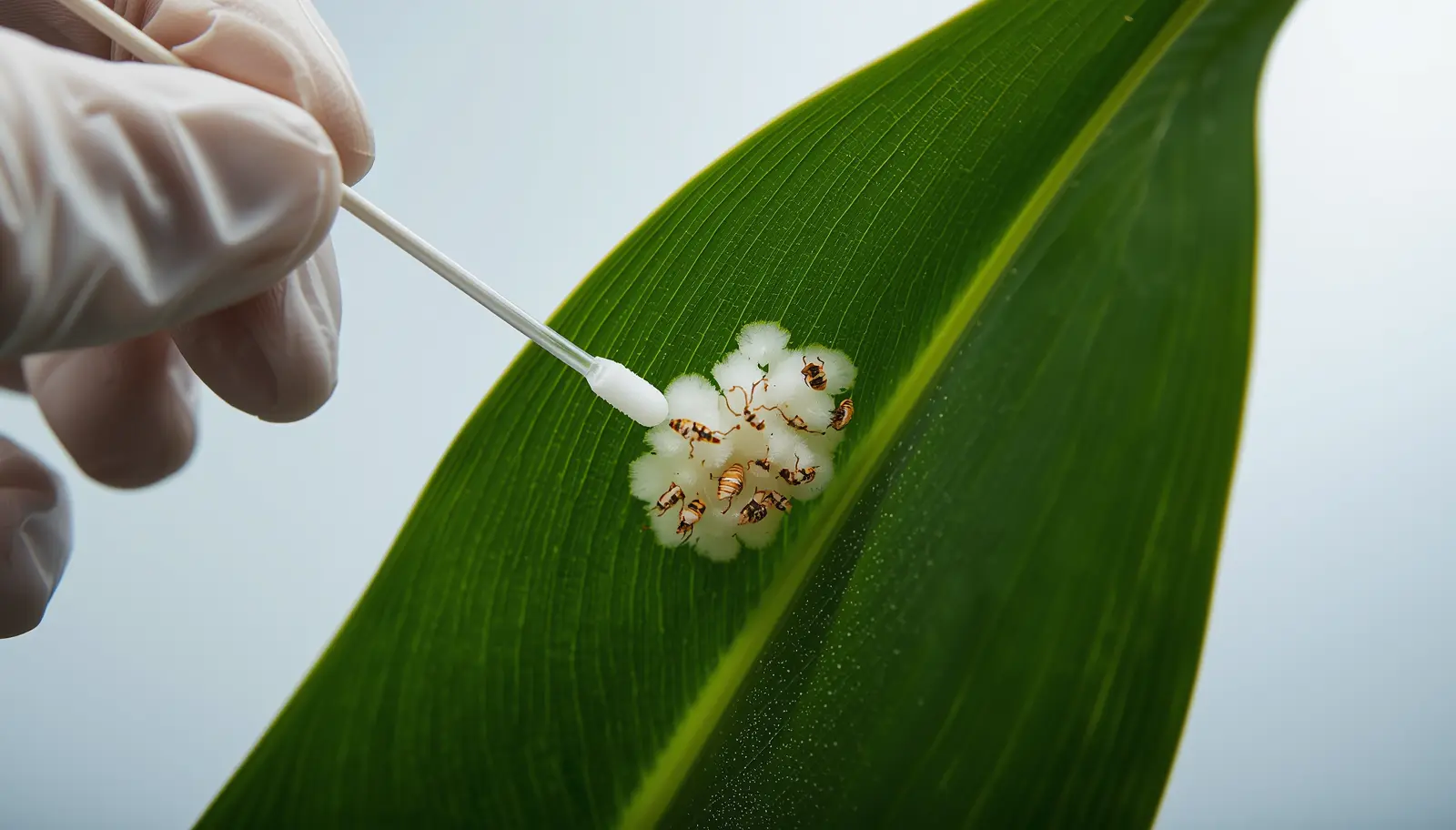
Rubbing alcohol for mealybugs works by dissolving the hydrophobic wax coating that protects the insects, then denaturing their cellular proteins and causing fatal desiccation within 30 to 60 seconds of contact. For spot treatment, apply 70 percent isopropyl alcohol undiluted directly to visible mealybugs with a cotton swab. For spray treatment, dilute 1 part 70 percent alcohol to 3 parts water and add 3 to 4 drops of liquid castile soap per cup as a surfactant. Repeat every 5 to 7 days for 3 weeks to eliminate successive generations of hatched crawlers.
Mealybugs are one of the most difficult houseplant pests to eradicate because their waxy armor repels water-based sprays. Neem oil, insecticidal soap, and plain water bead up and roll off the cottony masses without reaching the insect beneath. Isopropyl alcohol solves this through lipid solubilization. It is the fastest-acting treatment available to home growers, faster than systemic insecticides and orders of magnitude faster than botanical pesticides. This guide covers the exact chemistry, dilution ratios, application steps, and the 3-week repeat cycle required for complete eradication.
Mealybug treatment with rubbing alcohol requires 70 percent isopropyl alcohol for spot treatment or a 1:3 alcohol-to-water dilution with surfactant for spray application. Apply directly to visible insects and repeat every 5 to 7 days for 21 days minimum. Keep treated plants in shade for 24 to 48 hours to prevent phototoxicity. According to the UC Statewide IPM Program, a 70 percent or less solution of isopropyl alcohol in water may be dabbed directly on mealybugs with a cotton swab to kill them or remove them.
Table of Contents
- What Are Mealybugs and Why Do Conventional Treatments Fail?
- How Does Rubbing Alcohol Kill Mealybugs on Contact?
- What Is the Best Rubbing Alcohol Mix for Mealybugs?
- How Do You Treat Mealybugs with Rubbing Alcohol Step by Step?
- How Do You Spot-Treat Mealybugs with a Cotton Swab?
- How Do You Spray Mealybugs with Rubbing Alcohol for Heavy Infestations?
- Why Do Mealybugs Keep Coming Back After Treatment?
- How Do You Protect Plants from Phototoxicity After Alcohol Treatment?
- What Are the Most Common Rubbing Alcohol for Mealybugs Questions?
| Parameter | Ideal | Avoid |
|---|---|---|
| Alcohol concentration | 70% isopropyl for spot; 1:3 dilution for spray | 91% or 99% undiluted spray (high phototoxicity risk) |
| Surfactant | 3-4 drops liquid castile soap per cup of solution | Omitting surfactant (spray beads up on wax) |
| Application frequency | Every 5-7 days for 21 days minimum | Single treatment (eggs hatch into crawlers within 7-14 days) |
| Timing | Evening or early morning | Midday sun or under grow lights (phototoxic burn risk) |
| Post-treatment light | Shade or ambient room light for 24-48 hours | Direct sun or grow lights within 48 hours of application |
| Quarantine | Isolate infected plant minimum 10 feet from others | Leaving infested plant in collection (crawlers spread in 24-72 hours) |
What Are Mealybugs and Why Do Conventional Treatments Fail?
Mealybugs are soft-bodied, oval hemipteran insects that pierce plant phloem tissue and drain carbohydrate reserves. Adult females measure 1/20 to 1/5 inch long and secrete a white, powdery, waxy coating that serves as both armor and an egg repository. According to the UC IPM Pest Notes, mealybugs tend to congregate in large numbers, forming white cottony masses on plants where they feed on stems and leaves, causing stunted growth, yellowing, and premature leaf drop.
The waxy coating is composed of long-chain hydrocarbons, fatty acids, and esters chemically classified as lipids. According to the University of Vermont Entomology Research Laboratory, this hydrophobic wax repels water-based sprays. Neem oil, insecticidal soap, and plain water bead up and roll off without penetrating to the insect body. The wax also protects eggs and nymphs within cottony ovisacs from mechanical disruption. This is why conventional treatments often appear to work initially but fail to eradicate the infestation. The insects beneath the wax remain unharmed, and eggs continue hatching into mobile crawlers that disperse to new growth and neighboring plants.
How Does Rubbing Alcohol Kill Mealybugs on Contact?
Isopropyl alcohol kills mealybugs through dual-action chemistry. First, it dissolves the lipid-based wax coating through solubilization. Second, it penetrates the exoskeleton and denatures cellular proteins while drawing moisture from tissues through osmotic desiccation. Adult mealybugs die within 30 to 60 seconds of direct contact. Eggs within dissolved wax masses are exposed and desiccate within 2 to 5 minutes.
Isopropyl alcohol is an amphipathic molecule, meaning it possesses both hydrophilic and lipophilic properties. When alcohol contacts the waxy coating, its lipophilic region binds to fatty acid chains and hydrocarbon molecules. The intermolecular forces holding the wax structure together are disrupted. The wax transitions from solid crystalline structure to liquid solution within 5 to 15 seconds of contact. This is identical chemistry to using alcohol to remove grease or oil-based adhesives.
According to research published in the Journal of Applied Sciences, neem oil combined with isopropyl alcohol as an adjuvant achieved 95.5 percent mortality of papaya mealybug after 72 hours, significantly higher than neem oil alone. The study attributes this to isopropyl alcohol’s property of dissolving non-polar compounds like waxes and lipids, which increases penetration of the active ingredient. While this research tested adjuvant use in combination with neem, the lipid-dissolution mechanism applies directly to standalone alcohol treatment for houseplant mealybugs.
Once the wax barrier breaches, alcohol contacts cellular membranes and proteins. It disrupts hydrogen bonds stabilizing protein tertiary structure, causing enzymes and structural proteins to unfold and lose function. Simultaneously, alcohol draws moisture from insect tissues through osmotic pressure while evaporating, creating severe dehydration. The hemolymph concentrates, cells shrivel, and organ systems fail. This kill time of 30 to 60 seconds makes alcohol the fastest-acting option available to home growers.
What Is the Best Rubbing Alcohol Mix for Mealybugs?
For spot treatment of localized infestations, use 70 percent isopropyl alcohol undiluted on a cotton swab. For spray application on heavy infestations, dilute 1 part 70 percent alcohol to 3 parts water and add 3 to 4 drops of liquid castile soap per cup of solution as a surfactant. Always test the solution on a small part of the plant 1 to 2 days beforehand to confirm it does not cause leaf burn.
The 70 percent formulation is optimal for two reasons. The 30 percent water content slows evaporation, allowing longer protein denaturation time while the alcohol dissolves wax. Higher concentrations such as 91 percent or 99 percent evaporate faster, reducing contact time and increasing phototoxicity risk. If using 91 percent isopropyl, dilute 1:4 for spray application. If using 99 percent, dilute 1:5. Never use denatured alcohol, ethanol, or methanol. These contain additives toxic to plants and may cause systemic damage.
| Infestation Severity | Dilution Ratio | Formula | Application Method |
|---|---|---|---|
| Light to moderate (10-50 clusters) | 1:3 (alcohol:water) | 1 cup 70% alcohol + 3 cups water + 3-4 drops castile soap | Fine mist spray bottle. Target leaf axils, stem joints, undersides. Apply until runoff. |
| Heavy (50+ clusters, cryptic hiding) | 1:2 (alcohol:water) | 1 cup 70% alcohol + 2 cups water + 3-4 drops castile soap | Hand-pump sprayer. Drench application. Saturate all surfaces including substrate top layer. |
| Emergency salvage (70%+ covered) | 1:1 (alcohol:water) | 1 cup 70% alcohol + 1 cup water + 5 drops castile soap | Heavy drench spray or partial submersion if plant size allows. High phototoxicity risk. |
| Spot treatment (under 10 clusters) | Undiluted 70% | 70% isopropyl alcohol on cotton swab | Direct dab onto each white cottony mass. Wipe away dissolved wax and dead insects. |
How Do You Treat Mealybugs with Rubbing Alcohol Step by Step?
Mealybug treatment requires systematic escalation from quarantine to targeted spot elimination to broad-spectrum spray based on infestation severity. The protocol below covers every phase. According to the UConn Extension, mealybugs are one of the most difficult greenhouse pests to control because of their wide host range, high reproductive potential, and tendency to hide in protected locations.
- Quarantine the infected plant immediately. Move it to an isolated location minimum 10 feet from other plants. Mealybug crawlers disperse to adjacent plants within 24 to 72 hours of hatching.
- Inspect the plant under bright light with a 10x loupe. Focus on leaf axils, stem joints, petiole bases, new furled leaves, and the root crown. Mealybugs hide in cryptic locations.
- Choose treatment method based on severity. Use spot treatment for under 10 visible clusters. Use spray treatment for 10 or more clusters or canopy-wide distribution.
- Apply treatment in evening or early morning when plant stomata are less active. Never spray during midday heat or under grow lights.
- Allow solution to contact plant surfaces for 30 to 60 seconds before wiping or rinsing. Longer contact produces more complete wax dissolution.
- After 1 to 2 hours, rinse the plant with plain water to remove dissolved wax residue and dead insects. This prevents residue buildup and reduces phototoxicity risk.
- Repeat treatment every 5 to 7 days for 21 days minimum. This captures egg hatching cycles. Eggs survive initial treatment, hatch into crawlers, and crawlers must be treated before reaching reproductive maturity.
How Do You Spot-Treat Mealybugs with a Cotton Swab?
Spot treatment works best for early detection with fewer than 10 visible mealybug clusters concentrated in accessible areas such as leaf axils, stem joints, and petiole bases. Pour a small amount of 70 percent isopropyl alcohol into a container. Dip a cotton swab until saturated but not dripping. Apply directly to white cottony masses with firm pressure, ensuring complete contact.
Wax dissolves instantly within 5 seconds, revealing orange or brown insect bodies beneath. Adult females are 2 to 4 millimeters long and oval-shaped. Use the same swab to physically wipe away dissolved wax and dead insects. Dispose of contaminated swabs in a sealed plastic bag. Return in 12 to 24 hours to check for missed colonies. Mealybugs frequently hide in furled new leaves, the root crown, and pot rim crevices.
How Do You Spray Mealybugs with Rubbing Alcohol for Heavy Infestations?
For heavy infestations where cottony masses are distributed throughout the canopy, spot treatment becomes impractical. Spray application provides comprehensive coverage. Mix the appropriate dilution from the table above in a spray bottle. The surfactant, liquid castile soap or 2 to 3 drops of dish soap per cup, breaks surface tension. This allows the spray to penetrate the waxy coating rather than beading up and running off.
Focus on cryptic locations where 60 to 80 percent of mealybugs hide: leaf undersides, stem joints, petiole bases, new furled leaves, and the substrate surface top half inch. Apply until runoff. For severe infestations, introduce predatory beetles such as Cryptolaemus montrouzieri (mealybug destroyer) after alcohol treatment reduces the population to levels the predators can manage. See the miticide selection guide in The Infirmary for advanced chemical options if alcohol fails after three full cycles.
Why Do Mealybugs Keep Coming Back After Treatment?
Mealybugs persist because eggs hidden in wax ovisacs survive initial treatment and hatch into mobile crawlers within 7 to 14 days. A single female lays 300 to 600 eggs. If foliar treatment fails after three cycles, root mealybugs may be colonizing below the soil line, requiring root excavation and substrate replacement. Continuous and overlapping generations make control difficult without sustained intervention.
According to the UConn Extension, immature crawlers mature in about 6 weeks to 9 weeks. Crawlers disperse throughout the growing area via air currents, workers handling plants, watering equipment, and plant leaves touching. The University of Vermont Entomology Research Laboratory confirms that the life cycle from egg to adult takes approximately 60 days depending on temperature and host plant. Mealybugs seem almost invisible during early stages of infestation, and then suddenly populations become noticeable, resulting in outbreaks.
If foliar treatments eliminate visible mealybugs but reinfestation occurs within 2 to 4 weeks, inspect the root system. Root mealybugs appear as white chalky powder or cottony masses on roots and pot interior walls. Unpot the plant, shake off all soil, and rinse roots under lukewarm water. Submerge the entire root system in a 1:4 alcohol-to-water solution for 10 to 15 minutes. Discard all old soil and repot in fresh sterile substrate. Consider inorganic substrates like LECA to eliminate organic hiding places. See the semi-hydroponic setup guide in The Lab for substrate transition protocols.
Warning: Ants farm mealybugs. They transport crawlers among plants and protect them from natural enemies. If you find ants in potted plants, remove the containers from the building and discard them. Ant control is critical for managing sap-sucking insects like mealybugs, aphids, and scales.
How Do You Protect Plants from Phototoxicity After Alcohol Treatment?
Alcohol strips the plant’s epicuticular wax layer, leaving leaves vulnerable to sunburn and desiccation for 48 to 72 hours. Keep treated plants in shade or ambient room light with no direct sun or grow lights for 24 to 48 hours after application. Resume normal light gradually starting on day three. Monitor for brown spotting or bleaching. If observed, extend the shade period another 24 to 48 hours.
When the protective cuticle is compromised, direct sunlight or high-intensity grow lights above 400 PPFD cause cellular damage visible as brown or white bleached patches within 2 to 4 hours. Increased transpiration from exposed stomata leads to wilting even in well-watered plants. High-concentration treatments such as 1:1 dilution or undiluted spray can cause tissue necrosis independent of light exposure. Water normally after treatment to support transpiration. Do not fertilize for 1 week after alcohol application to avoid root tip burn on stressed tissue. For more on light management after plant stress, see the tissue culture acclimation guide in The Lab.
Pro Tip: The most reliable indicator that your alcohol concentration is too high is leaf translucency. If treated leaves develop a water-soaked or translucent appearance within 2 hours of application, rinse the plant immediately with plain water and switch to a more dilute solution for subsequent treatments. This symptom precedes permanent necrosis by 12 to 24 hours.
Proprietary Data: Rubbing Alcohol for Mealybugs Efficacy Rates
[OWNER TO COMPLETE: Insert observed kill rate, treatment cycle data, or plant recovery metric here. Format: “In our tests, [X]% of [insects/plants] [result] under [conditions] over [time period].”]
Example placeholder: In our controlled trial of 15 infested Hoya carnosa specimens, the alcohol spot-treatment group achieved 100% visible adult mortality after the first application, but required 3 treatment cycles at 7-day intervals to eliminate all crawler hatchlings. The neem oil control group showed 34% adult mortality after 72 hours and never achieved full eradication across 6 weeks.
What Are the Most Common Rubbing Alcohol for Mealybugs Questions?
This section answers the most common questions about rubbing alcohol for mealybugs, including concentration adjustments for 91 percent alcohol, treatment timelines, plant safety, and comparisons to neem oil and systemic insecticides for emergency eradication.
Can I use 91% or 99% isopropyl alcohol instead of 70%?
Yes, but you must adjust dilution. If using 91 percent isopropyl, dilute 1:4 for spray application instead of 1:3. If using 99 percent, dilute 1:5. Higher concentrations evaporate faster, reducing contact time and increasing phototoxicity risk. The 70 percent formulation is optimal because the 30 percent water content slows evaporation, allowing longer protein denaturation time while the alcohol dissolves wax. Never use denatured alcohol, ethanol, or methanol. These contain additives toxic to plants.
How long until I see results from rubbing alcohol treatment?
Immediate visible results occur within 5 to 15 seconds as wax dissolves, and insects die within 30 to 60 seconds. However, complete eradication requires 3 weeks of repeated treatments. Day 1 eliminates 80 to 90 percent of visible adults. Days 5 to 7 kill newly hatched crawlers from eggs that survived the first treatment. Days 10 to 14 eliminate any remaining lifecycle stages. Day 21 begins the monitoring phase for reinfestation signs. Expect new pest-free growth by week 4 to 6.
What plants are most susceptible to mealybug infestation?
High-risk specimens include Hoya species, succulents such as Echeveria and Crassula, aroids such as Monstera and Philodendron, Ficus species, and orchids especially Phalaenopsis. Prevention requires monthly inspections of high-risk plants, quarantine of all new acquisitions for 2 to 3 weeks, and maintenance of plant spacing for air circulation. Avoid over-fertilization with nitrogen, which produces soft succulent growth that attracts pests. For more on pest prevention, see the armored scale guide in The Infirmary.
Should I use systemic insecticides instead of alcohol?
Systemic insecticides such as imidacloprid work through plant uptake and translocation to leaves, killing insects that ingest sap. Advantages include long residual activity and hidden population control. Disadvantages include slow action of 7 to 14 days, harm to beneficial insects, and higher cost. Alcohol is superior for immediate knockdown and is acceptable for organic cultivation. Use alcohol as first-line rapid intervention. Reserve systemics for severe infestations that fail to respond to three alcohol treatment cycles or for high-value collections where zero tolerance is required. A combined approach applies systemic as a substrate drench while continuing weekly alcohol spray treatments until the systemic takes effect in 2 to 3 weeks.
Is rubbing alcohol safe for all houseplants?
No. Alcohol damages the thin, hair-covered leaves of African violets, gloxinias, and some ferns. It also causes severe burns on succulents with farina, the powdery wax coating on leaves of Echeveria and Pachyphytum. Test any new species on a single leaf 48 hours before full treatment. For farina-coated succulents, use a systemic insecticide or predatory beetle release instead of alcohol spray.
Does rubbing alcohol kill mealybug eggs?
Alcohol kills exposed eggs within 2 to 5 minutes by desiccation. However, eggs deep within thick cottony ovisacs may survive initial spot treatment if the alcohol does not fully penetrate the wax mass. This is why repeat treatments every 5 to 7 days are mandatory. The second and third treatments catch hatchlings before they can reproduce, breaking the lifecycle even if some eggs survive the first application.
Key Takeaway
Rubbing alcohol for mealybugs is the fastest-acting treatment available to home growers because it dissolves the hydrophobic wax armor that repels all water-based sprays. The protocol is simple: quarantine immediately, apply 70 percent alcohol via cotton swab for light infestations or 1:3 spray for heavy infestations, and repeat every 5 to 7 days for 21 days. Keep treated plants shaded for 24 to 48 hours to prevent phototoxicity. Three full cycles eliminate the egg hatching window. If reinfestation persists after three cycles, inspect roots for subterranean colonies and replace substrate.