
Best Miticide for Houseplants: Spider Mite Eradication

🚨 THE INFIRMARY | ARACHNID TRIAGE

⚠️ Critical Diagnostic Error: Misidentification as Insect Infestation

If you are applying standard indoor insecticides, pyrethrins, or even neem oil to treat the fine spider mite webbing on your Monstera, Alocasia, or Calathea, you are targeting the wrong taxonomic class and the infestation will continue unchecked.

Spider mites are arachnids (class Arachnida, family Tetranychidae)—not insects. They possess 8 legs, not 6. They breathe through tracheae and lack the compound eyes and antennae characteristic of insects. Most critically: they are immune to insecticides targeting insect-specific biochemistry (acetylcholinesterase inhibitors, sodium channel modulators, chitin synthesis inhibitors).

Standard pyrethrin sprays, permethrin, and even systemic imidacloprid demonstrate 0-20% efficacy against Tetranychidae. These products kill aphids, thrips, fungus gnats, and mealybugs—but spider mites continue feeding, reproducing, and expanding their population exponentially while you waste time and money on taxonomically inappropriate treatments.

⚗️ The Executive Lab Summary: Miticidal Eradication Protocol
  • Organism: Tetranychus urticae (two-spotted spider mite) and related Tetranychidae—arachnids requiring miticide-specific treatments
  • Damage mechanism: Piercing-sucking mouthparts extract chloroplasts causing stippling (yellow/white dots), photosynthetic collapse, eventual leaf death
  • Reproductive rate: Eggs hatch every 3-5 days at 24-27°C—population doubles every 7-10 days without intervention
  • Treatment Path A (Chemical): Translaminar miticides applied every 3 days for 4 cycles—breaks egg-hatching timeline
  • Treatment Path B (Biological): Phytoseiulus persimilis predatory mites—consume 5-20 spider mites daily until population eliminated
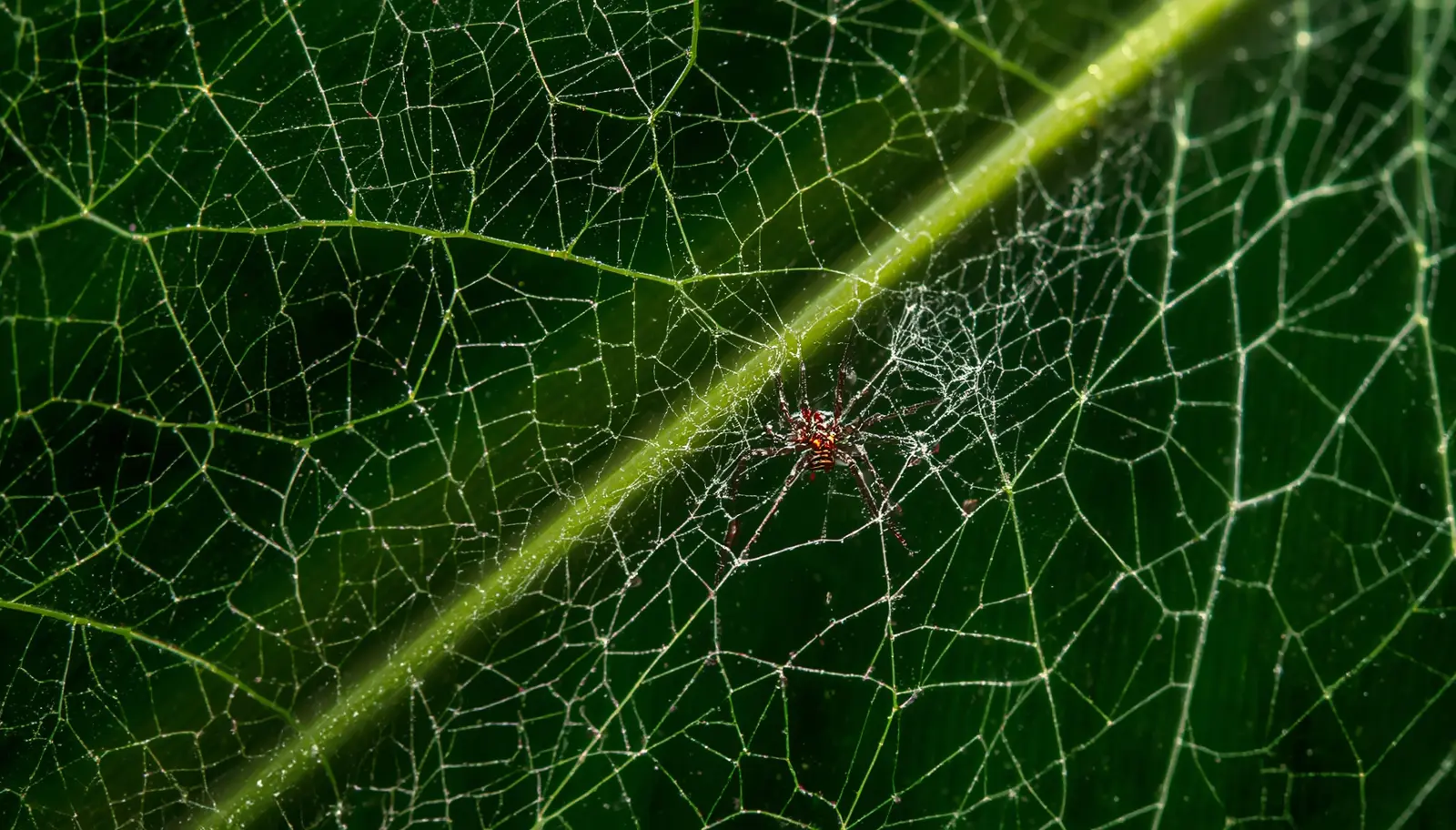
Close-up of Monstera deliciosa leaf showing spider mite webbing between veins and characteristic stippling damage from Tetranychidae feeding with visible mites under magnification

Advanced spider mite infestation showing diagnostic webbing and chloroplast extraction damage

Visual Diagnosis: Stippling and Webbing Patterns

Early detection is critical—by the time spider mite webbing is visible to naked eye, the population numbers in the thousands and spider mite plant damage is severe.

Stage 1: Pre-Webbing Stippling (Days 1-14)

Initial symptom: tiny yellow or white dots (0.1-0.3mm diameter) scattered across leaf surface—most concentrated on undersides.

This is stippling—the visual signature of Tetranychidae feeding. Spider mites use piercing-sucking mouthparts (chelicerae) to puncture individual mesophyll cells and extract chloroplasts, carotenoids, and cellular fluids. Each puncture wound appears as a single pale dot. As feeding continues, dots coalesce into patches of bronzed, yellowed tissue.

At this stage, webbing is absent or minimal (visible only under 10x magnification as scattered silk threads). The mites themselves (0.4-0.6mm length) appear as mobile dots—red, orange, brown, or green depending on species and diet. Without magnification, they resemble dust particles or pollen.

Stage 2: Active Webbing and Population Explosion (Days 14-30)

Fine silk webbing becomes visible connecting leaf surfaces, petioles, and stem nodes—especially apparent in morning light or when misted with water.

The webbing serves multiple functions: (1) Protection from predators and mechanical disruption, (2) Humidity regulation creating microclimate favorable for egg development, (3) Dispersal mechanism—young mites climb to web tips and balloon on air currents to new plants. Heavy infestations produce dense webbing coating entire leaves, giving plants a dusty, neglected appearance.

Photosynthetic capacity declines 40-70% as stippling damage expands. Leaves show generalized yellowing (chlorosis) progressing to brown necrotic patches. Growth ceases, new leaves emerge stunted and malformed, and plants enter decline trajectory culminating in death if untreated.

The Microclimate Catalyst: Environmental Conditions Driving Exponential Growth

Spider mites are not random infestations—they are predictable responses to specific environmental conditions that favor rapid reproduction.

Optimal Tetranychidae breeding conditions:

  • Low relative humidity (<50% RH): Desiccates natural predators (predatory mites, lacewing larvae) while spider mite eggs remain viable. According to University of Minnesota Extension research on spider mite ecology, populations triple when RH drops below 40%
  • High temperature (27-32°C / 80-90°F): Accelerates egg development from 5 days to 3 days. Generation time compresses allowing population doubling every week instead of every 2 weeks
  • Stagnant air (zero circulation): Eliminates mechanical disruption of webbing and egg masses. Creates stable microclimates on leaf undersides where humidity locally higher than ambient
  • High vapor pressure deficit (VPD >1.5 kPa): Stressed plants produce different metabolite profiles in phloem—actually MORE attractive to spider mites. This is opposite of most pests. For VPD optimization preventing infestations, see our complete environmental control protocol

Prevention through microclimate manipulation: Maintain 60-70% RH using automated humidification systems, reduce temperatures below 24°C when possible, implement continuous gentle air circulation with oscillating fans. These conditions suppress spider mite reproduction by 60-80% while supporting healthy plant growth.

Treatment Path A: Chemical Miticide Eradication

Chemical intervention provides fastest population knockdown—complete eradication achievable in 12 days with proper miticide selection and application timing.

Why Standard Products Fail

Neem oil and pyrethrin-based insecticides fail against spider mites due to biological resistance, not application error.

Neem oil (azadirachtin) works primarily through anti-feedant and growth disruption mechanisms in insects. Spider mites (arachnids) metabolize azadirachtin differently—populations develop functional resistance within 2-3 generations (2-4 weeks). Additionally, neem oil is contact-kill only and cannot penetrate webbing, meaning protected eggs survive treatment.

Pyrethrins target voltage-gated sodium channels specific to insect nervous systems. Arachnid neurology differs sufficiently that pyrethrins show minimal efficacy—and the few susceptible individuals in a population are quickly replaced by resistant offspring.

Effective Miticide Classes

Miticide TypeActive IngredientMechanismApplication Notes
Horticultural Oils
(Contact suffocation)
Refined petroleum or plant oils (0.5-2% emulsion)Physical suffocation—blocks spiracles (breathing pores) causing asphyxiation. Coats eggs preventing gas exchange.Safest option. Requires thorough coverage—spray until runoff. No resistance development possible. Brands: Bonide All Seasons Oil, Monterey Horticultural Oil. Repeat every 3 days.
Abamectin
(Translaminar neurotoxin)
Avid 0.15% or similar formulationsAvermectin class—binds GABA receptors causing paralysis. Translaminar: penetrates leaf tissue, kills mites feeding on treated surfaces for 7-14 days post-application.Most effective chemical option. Professional-grade product. Highly toxic to aquatic life—do not allow runoff. Rotate with other mechanisms to prevent resistance. Apply every 5-7 days for 3 treatments.
High-Concentration Azadirachtin
(Growth disruptor)
Azadirachtin ≥3000 ppm (NOT standard neem oil)Disrupts molting hormones (ecdysone) preventing larval development. Blocks oviposition (egg-laying).More effective than neem oil due to concentration. AzaMax, Azatrol brands. Combine with surfactant for penetration. Every 3-4 days for 4 cycles.
Insecticidal Soap
(Cell membrane disruption)
Potassium salts of fatty acidsPenetrates cuticle, disrupts cell membranes causing desiccation. Contact-kill only—no residual.Safer for sensitive plants than oils. Requires direct contact. Must reapply every 2-3 days. Brands: Safer Brand, Garden Safe. Less effective than oils but acceptable for light infestations.

The 3-Day Cycle Protocol

📅 12-DAY ERADICATION SCHEDULE

Spider mite eggs hatch in 3-5 days at room temperature. Treating only once leaves 70-90% of population (eggs and juveniles) alive to continue infestation.

Application schedule:

  1. Day 0: Initial treatment. Apply chosen miticide to ALL plants—not just visibly infested. Focus on leaf undersides where 80-90% of population resides. Spray until runoff (dripping from leaves). Isolate treated plants from collection
  2. Day 3: Second treatment. Kills adults that survived Day 0 plus juveniles hatched from eggs since first application. Use same product—do not rotate yet (builds concentration in plant tissue for translaminar products)
  3. Day 6: Third treatment. Eliminates second wave of hatched eggs. At this point, population reduced 90-95% but eggs from Day 0-3 still developing
  4. Day 9: Fourth and final treatment. Catches any late-hatching eggs and ensures no reproductive adults remain. After Day 9, monitor closely but no further treatments needed if protocol followed correctly
  5. Days 10-21: Monitoring phase. Inspect leaf undersides with magnification every 2-3 days. If new stippling appears, reinitiate 3-day cycle (suggests incomplete coverage in earlier rounds)

Application technique: Treat in evening to prevent phototoxic burns (same as alcohol mealybug treatment). Keep plants in shade 24 hours post-application. Use pump sprayer or trigger bottle—NOT aerosol cans (insufficient coverage). Wear gloves and eye protection for chemical miticides. Dispose of severely infested leaves in sealed plastic bags (prevents mite escape).

Treatment Path B: Biological Warfare with Predatory Mites

Biological control using specialized predatory arachnids provides sustainable, chemical-free eradication of Tetranychidae through natural predator-prey dynamics.

The Predator: Phytoseiulus persimilis

Phytoseiulus persimilis is an obligate predatory mite—it feeds exclusively on spider mites and cannot survive on plant tissue or other food sources.

According to Penn State Extension research on biological pest control, a single P. persimilis adult consumes 5-20 spider mites daily (all life stages including eggs). The predator is larger (0.8-1.0mm vs 0.5mm prey), moves faster, and actively hunts through webbing. When prey is abundant, predators reproduce rapidly—females lay 2-4 eggs daily, offspring mature in 7-10 days and immediately begin hunting.

The population dynamics: Predators multiply while spider mites are plentiful, peak when prey population crashes, then naturally die off from starvation within 2-3 weeks of prey elimination. No pesticide residue, no chemical exposure, self-limiting population.

Alternative Predator: Amblyseius californicus

A. californicus is a generalist predatory mite—feeds on spider mites but can survive on pollen and other small arthropods when prey scarce.

Advantages over P. persimilis: Tolerates lower humidity (40-60% RH vs 60-70% required), wider temperature range (15-30°C vs 18-26°C), persists on plants long-term providing preventative protection. Disadvantages: Slower prey consumption (2-5 spider mites daily), slower reproduction, takes 6-10 weeks for complete eradication vs 4-6 weeks with P. persimilis.

Deployment Protocol

🦠 PREDATORY MITE RELEASE PROCEDURE

  1. Source acquisition: Order from biological control suppliers (Arbico Organics, Koppert, Rincon-Vitova). Ships as live adults in bottles with carrier material (vermiculite or bran). Overnight shipping required—temperature-sensitive living organisms
  2. Release timing: Apply immediately upon arrival (predators starve within 48 hours without food). Open containers in shade—direct sun kills predators within minutes
  3. Application rate: Light infestation (stippling on <30% of leaves): 10-20 predators per plant. Heavy infestation (webbing visible): 50-100 predators per plant. Distribute across multiple release points on plant
  4. Placement technique: Gently sprinkle carrier material with predators onto leaves near visible spider mite colonies. Predators crawl out and begin hunting within 1-2 hours. Do NOT rinse or spray plants after release
  5. Environmental requirements: Maintain 60-70% RH (predators desiccate in dry air), 18-26°C temperature, moderate air circulation (not stagnant but not strong winds that blow predators off plants)
  6. Monitoring: Inspect weekly. Successful predation visible as: decreasing stippling on new growth, disappearing webbing, visible predators (orange/red, faster-moving than spider mites) on leaves. Complete elimination: 4-8 weeks depending on initial population size

Cost analysis: Predatory mites: $30-60 per 2000-count bottle (sufficient for 10-40 plants depending on severity). Single application typically adequate. Chemical miticides: $15-40 per bottle requiring 4 applications over 12 days. Biological approach cost-effective for collections 5+ plants or recurring infestations.

⚠️ CRITICAL: Cannot Mix Treatment Paths

If you apply ANY pesticides (miticides, insecticides, fungicides, even “organic” neem) within 2 weeks of predatory mite release, you will kill your beneficial predators and waste $40-60.

Predatory mites are equally susceptible to chemical sprays as spider mites—there is no selective toxicity. Choose ONE path (chemical OR biological) and commit. If you must switch paths: wait minimum 14 days after last chemical application before releasing predators, thoroughly rinse plants with water to remove residues. For plants with concurrent root issues or other problems requiring intervention, prioritize chemical miticides for speed unless you can wait 6-8 weeks for biological control.

Post-Eradication Protocol: Mechanical Cleaning and Environmental Modification

After population elimination (chemical or biological), dead webbing, exoskeletons, and frass (excrement) remain on plant surfaces—harboring secondary fungal colonization if not removed.

🚿 MECHANICAL DECONTAMINATION PROCEDURE

  1. Timing: Wait 24-48 hours after final miticide treatment (allows chemical to fully evaporate). For biological control, perform after confirmed spider mite elimination (no new stippling 2+ weeks, predators no longer visible)
  2. Water flush: Move plant to shower, sink, or outdoor hose. Use lukewarm water (18-24°C) under moderate pressure. Spray all surfaces focusing on undersides where webbing concentrated. Water pressure mechanically dislodges silk, dead mites, molted exoskeletons
  3. Manual wiping: For large-leaved species (Monstera, Anthurium, Alocasia), gently wipe leaves with soft damp cloth. Removes stubborn webbing water alone cannot eliminate
  4. Prune damaged tissue: Leaves with >50% stippling damage are non-functional—photosynthetic capacity permanently lost. Remove with sterilized shears to redirect plant energy toward new growth
  5. Substrate surface treatment: Spider mites drop to soil when disturbed. Top 1/2 inch of substrate may contain mites, eggs, or pupating predators (if biological path used). For chemical path: gently water flush or replace top layer. For biological: leave undisturbed (predators complete lifecycle in substrate)

Expected recovery timeline: Stippling damage is permanent on affected leaves—those leaves will always show scarring. New growth emerges clean 10-21 days post-eradication if environmental conditions corrected. Full canopy replacement with unblemished foliage: 2-6 months depending on species growth rate and season.

Permanent Environmental Modification: Prevention Protocol

Spider mite eradication without environmental correction results in reinfestation within 4-8 weeks—the conditions that supported initial colonization remain unchanged.

🌡️ ANTI-TETRANYCHIDAE ENVIRONMENTAL PARAMETERS
  • Humidity elevation: Install ultrasonic or evaporative humidifier maintaining 60-70% RH. For small spaces, automated VPD controllers provide precision humidity management. Cost: $30-150 depending on coverage area
  • Temperature reduction: Lower ambient temperature to 18-22°C if possible (slows spider mite reproduction 50-70%). Use fans for evaporative cooling, avoid positioning plants near heating vents or in hot south-facing windows
  • Air circulation: Oscillating fans (6-12 inch diameter) running continuously at low speed. Position for gentle cross-flow not direct blasting. Disrupts webbing construction and egg-laying behavior
  • Regular monitoring: Weekly inspection of new growth and leaf undersides with 10x magnifier or phone macro lens. Early detection (pre-webbing stage) allows single miticide treatment rather than 4-application protocol
  • Quarantine protocol: Isolate all new plant acquisitions 2-3 weeks before introducing to collection. Perform preventative miticide spray or predatory mite release on new arrivals. Most infestations originate from nursery-sourced plants, not spontaneous colonization

Frequently Asked Questions

Can spider mites develop resistance to miticides?

Yes—extremely rapidly. Tetranychus urticae has one of the fastest documented resistance development rates in agricultural pests. Populations develop functional resistance to single-mode-of-action chemicals within 3-5 generations (4-8 weeks continuous exposure). This is why 4-treatment protocol uses same product—builds lethal concentration before resistance develops. For recurring problems requiring multiple intervention cycles: rotate between different miticide classes (oils → abamectin → azadirachtin) never using same product more than 2 consecutive cycles. Biological control with predatory mites has ZERO resistance development—genetic arms race impossible.

How do I know if my plant damage is from spider mites or something else?

Diagnostic differences: Spider mites: stippling (pinpoint yellow/white dots), webbing on undersides/joints, damage concentrated on older lower leaves first, visible mites under magnification. Fluoride toxicity: marginal necrosis (brown edges) no stippling, starts on newest growth. Thrips: silvery streaking not dots, black fecal deposits, distorted new growth. Nutrient deficiency: interveinal chlorosis (yellowing between veins) not random dots, affects whole plant uniformly. Magnification is definitive—spider mites are mobile, oval, 8-legged arachnids 0.5mm size. If uncertain, take closeup photos and post to identification forums or send to extension services.

Will predatory mites harm my plants or spread to other areas?

No harm to plants—predatory mites are strict carnivores feeding only on spider mites and related pest mites (never plant tissue). They cannot bite humans or pets (mouthparts too small). Will they spread? P. persimilis dies within 2-3 weeks after eliminating prey—natural starvation limits population. A. californicus may persist on plants long-term eating pollen/other micro-arthropods but population stays very low without abundant prey. Neither species reproduces without spider mite food source, so they won’t “infest” your home. Think of them as temporary biological janitors that clean the problem then leave/expire naturally.

The Lab Verdict: Taxonomic Precision Determines Treatment Efficacy

The best miticide for houseplants is one that matches the target organism’s biology—and spider mites require arachnid-specific intervention, not insect-targeting products.

The failure cascade begins with misidentification. Seeing “bugs” on plants, most growers reach for general-purpose insecticides or neem oil—products that successfully eliminate aphids, whiteflies, and scale. When these treatments fail against spider mites (as they inevitably do), the response is often intensification—heavier doses, more frequent application, stronger products. This wastes time and money while the mite population continues exponential growth, doubling every 7-10 days under optimal conditions.

Successful eradication of Tetranychidae requires understanding their life cycle vulnerabilities: (1) Eggs hatch predictably every 3-5 days creating successive generations, (2) All life stages simultaneously present in population requiring multi-generational targeting, (3) Resistance develops rapidly to single-mode chemicals necessitating rotation or translaminar products, (4) Environmental conditions (low humidity, high temperature, stagnant air) drive population explosions regardless of treatment—must be corrected permanently.

The Urban Lab miticide protocol: Path A (Chemical): Translaminar miticide or horticultural oil applied every 3 days for 4 total treatments, targets all life stages as eggs hatch, achieves 95%+ eradication in 12 days. Path B (Biological): Release Phytoseiulus persimilis predatory mites at 10-100 per plant, predators consume spider mite population then naturally die off, achieves complete elimination in 4-8 weeks with zero chemical residue. Both paths require: Environmental modification to 60-70% RH, temperature reduction where possible, continuous air circulation preventing reinfestation.

Spider mite webbing on Monstera and other high-value tropicals is not inevitable—it is environmental failure signal. Hot, dry, stagnant conditions select for spider mites over plants and predators. Correct the environment, apply taxonomically-appropriate treatment, and Tetranychidae become manageable nuisance rather than collection-destroying plague.


The Infirmary | Arachnid Triage Division
Miticidal Eradication Protocol | Published: March 2026

Leave a Comment