
Armored Scale Treatment Indoor Plants: The Suffocation Protocol

🚨 THE INFIRMARY | PARASITIC TRIAGE

⚠️ Visual Diagnosis: Immobile Armored Parasites

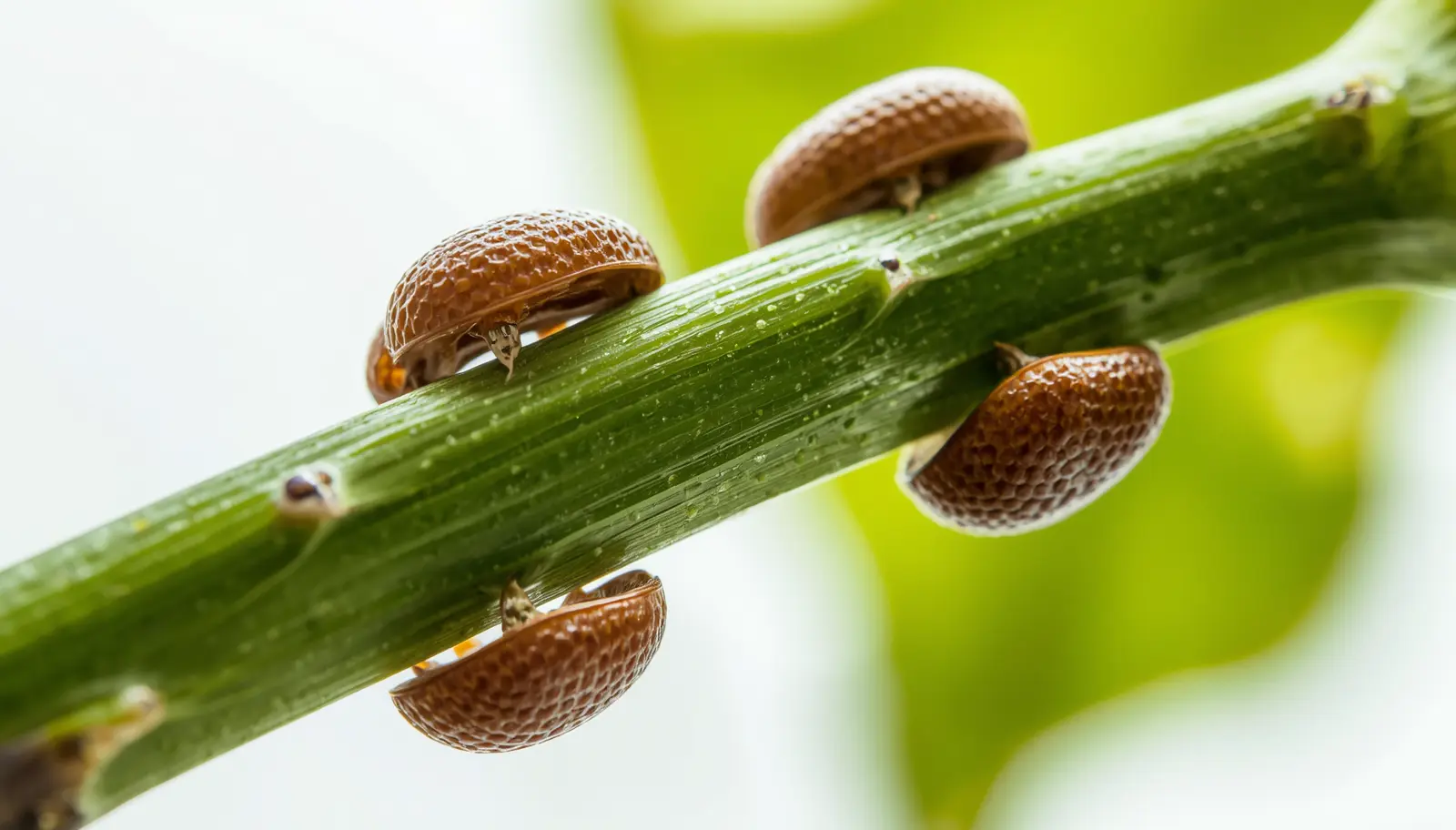
You observe hard, dome-shaped brown bumps on plant stems, petioles, and leaf veins of your Ficus, citrus, Monstera, or ornamental specimen—ranging from tan to dark brown, 1-3mm diameter, completely immobile.

Secondary symptom: sticky, clear droplets coating lower leaves and accumulating on surfaces beneath the plant (floor, furniture, adjacent foliage). This substance—called honeydew—is concentrated carbohydrate excretion from the parasites’ digestive system. Where honeydew persists, black sooty mold (Capnodium spp.) colonizes within 7-14 days, creating unsightly fungal coating.

These are not fungal scabs, corky lesions, or plant tissue abnormalities—they are living insects. Specifically: armored scale insects, family Diaspididae. Each “bump” is a female scale permanently fused to the plant’s vascular tissue, protected by a hardened waxy shell (called a “test”) that renders standard contact insecticides completely ineffective.

⚗️ The Executive Lab Summary: Multi-Phase Eradication Protocol
  • Organism: Diaspididae (armored scale)—hemipteran insects with piercing-sucking mouthparts permanently embedded in phloem tissue
  • Protection mechanism: Waxy test (shell) blocks contact insecticides, requires physical removal or oil suffocation
  • Phase 1 (Mechanical): Manual debridement with alcohol swabs—immediate 60-80% population reduction
  • Phase 2 (Topical): Horticultural oil suffocation—blocks spiracles causing asphyxiation, repeat 7-day intervals for 4 treatments
  • Phase 3 (Systemic): Imidacloprid translocation—root-absorbed neurotoxin kills feeding insects from inside plant tissue, 8-12 week residual protection

The Waxy Test: Biological Fortress

The “test” is a multilayered shield composed of hardened wax secretions fused with molted exoskeletons from earlier developmental stages.

Construction process: After the mobile “crawler” nymph locates suitable feeding site on stem or leaf vein, it inserts its stylet (needle-like mouthpart) into the phloem. The stylet permanently anchors—the insect will never move again. It immediately begins secreting waxy filaments from specialized glands. These filaments harden into a protective dome covering the insect’s soft body while leaving the ventral (bottom) surface adhered to plant tissue.

The test composition: According to University of Kentucky Entomology research on scale biology, the waxy coating is chemically similar to carnauba wax—extremely hydrophobic and resistant to penetration by aqueous solutions. Contact insecticides (pyrethrins, neonicotinoids applied as spray) hit the test surface and either bead up or dry without reaching the insect beneath. The scale continues feeding undisturbed, protected by its fortress.

Life Cycle and Crawler Vulnerability Window

Adult females are invulnerable to contact sprays, but the mobile “crawler” stage (1st instar nymphs) lacks protective armor for 24-72 hours post-hatching.

Reproduction: Mated females produce 50-400 eggs beneath their test over 4-8 weeks. Eggs hatch into crawlers (0.3-0.5mm, barely visible)—the only mobile life stage. Crawlers emerge from under mother’s test and disperse across plant via walking or wind transport. Within 24-72 hours, crawlers must locate feeding site, insert stylet, and begin test construction or die from desiccation.

This vulnerability window is critical: crawlers have no waxy protection and are susceptible to contact insecticides, alcohol applications, and horticultural oils. However, eggs continue hatching for 4-8 weeks post-adult death, creating successive crawler waves that require repeated treatments or systemic prevention.

Phase 1: Mechanical Debridement—Immediate Population Reduction

Physical removal of visible adult scales provides instant 60-80% population reduction and eliminates primary egg-producing individuals.

🔪 SURGICAL EXTRACTION PROCEDURE

Tools and materials:

  • Cotton swabs or soft-bristle toothbrush
  • 70% isopropyl alcohol in small bowl
  • Bamboo skewer or plastic card edge for stubborn scales
  • Magnifying glass or phone macro lens for small infestations
  • Sealed plastic bag for disposal

Debridement technique:

  1. Alcohol saturation: Dip cotton swab in 70% isopropyl alcohol until saturated but not dripping. Alcohol softens waxy test adhesion and kills exposed tissue on contact—same mechanism as mealybug denaturation
  2. Mechanical removal: Press swab firmly against scale and scrape parallel to stem surface. Test should detach with moderate pressure. For stubborn scales, use bamboo skewer edge to gently pry beneath test
  3. Coverage areas: Inspect all stems, petioles, leaf veins (especially undersides and midribs), and branch crotches. Scales preferentially colonize areas with highest sap flow—actively growing shoots, new leaf bases
  4. Visual confirmation: Successfully removed scale leaves circular scar on stem—slightly depressed area where stylet penetrated. If “bump” is actually corky plant tissue (not scale), it will not detach and has no insect body beneath
  5. Disposal: Place used swabs and removed scales in sealed plastic bag, discard in outdoor trash. Prevents re-infestation from disposed material

Limitations: Mechanical removal eliminates visible adults but misses eggs protected beneath dead test shells and emerging crawlers too small to see. Must combine with Phase 2 (oil) or Phase 3 (systemic) for complete eradication. For heavy infestations (100+ scales), mechanical removal alone is impractical—proceed directly to chemical intervention.

Phase 2: Topical Suffocation—Horticultural Oil Application

Horticultural oil for houseplants works through physical asphyxiation, not chemical toxicity—making resistance development impossible.

The Suffocation Mechanism

Insects breathe through spiracles—external openings in the exoskeleton connecting to tracheal system for gas exchange.

When horticultural oil (highly refined petroleum or plant-based oil at 0.5-2% emulsion) contacts the scale’s test, it flows into microscopic gaps and coats the spiracle openings. The oil film blocks oxygen diffusion into tracheal tubes while preventing CO₂ release. The insect suffocates within 24-48 hours—cellular respiration continues but without gas exchange, causing fatal hypoxia.

Additional mechanism: Oil penetrates beneath test edges, contacting soft body tissue directly. This causes desiccation (moisture loss through disrupted cuticle) and cellular membrane breakdown—similar to how oils work against spider mites but requiring longer exposure time due to scale’s protected position.

Oil Selection and Application Protocol

Oil TypeConcentrationApplicationAdvantages / Disadvantages
Dormant / Horticultural Oil
(Refined mineral oil)
1-2% emulsion
(2-4 tbsp per quart water)
Spray or paint onto stems with brush until complete coverage. Focus on undersides and crevices.+ Highly refined, low phytotoxicity. Works year-round on houseplants.
− Requires surfactant/emulsifier for mixing. Brands: Bonide All-Seasons, Monterey Horticultural.
Neem Oil
(Azadirachtin concentrate)
1-2% concentration
(follow label—typically 2-4 tbsp per quart)
Emulsified spray. Shake frequently during application to prevent separation.+ Dual action: suffocation + azadirachtin growth disruption. Acceptable for organic cultivation.
− Strong odor. Higher phytotoxicity risk than mineral oils. Not effective alone—requires multiple applications.
Insecticidal Soap
(Potassium salts of fatty acids)
1-2% ready-to-use or concentrate dilutionSpray focusing on crawler emergence periods (every 5-7 days).+ Safest for sensitive plants. Kills crawlers on contact.
− Ineffective against adult scales with hardened test. Use only as crawler control between oil applications.

💧 SUFFOCATION APPLICATION SCHEDULE

  1. Initial application (Day 0): Apply horticultural oil to all stems, petioles, and leaf undersides until runoff. Complete coverage essential—missed scales survive. Use pump sprayer or paint-on with soft brush for precision
  2. Second application (Day 7): Repeat oil treatment. Targets crawlers hatched from eggs since Day 0 plus any adults missed in first application
  3. Third application (Day 14): Repeat. Crawler emergence continues 4-8 weeks—successive waves require persistent treatment
  4. Fourth application (Day 21-28): Final oil treatment. After 4 applications at 7-day intervals, adult population reduced 90-95% and most egg masses disrupted
  5. Monitoring (Weeks 5-8): Inspect stems weekly. If new brown bumps appear, indicates missed egg masses—reinitiate oil cycle or transition to Phase 3 systemic treatment

Application timing: Treat in evening or early morning. Keep plants in shade 24-48 hours post-application—oil residue on leaves under high light intensity causes phototoxic burns (brown patches, leaf bleaching). Same precautions as alcohol pest treatments. Never apply oil to drought-stressed plants—increases damage risk.

⚠️ Phototoxicity Warning: Oil + Light = Tissue Damage

Horticultural oil residue on leaf surfaces magnifies light intensity causing localized heating and cellular destruction.

Under direct sun or high-PPFD grow lights (>400 Οmol/m²/s), oil-coated leaves reach 5-10°C above ambient temperature within 30-60 minutes. This thermal stress denatures chlorophyll and structural proteins, manifesting as white/brown bleached patches or complete leaf necrosis. Mandatory post-treatment protocol: Move plants to shade or ambient room light for 24-48 hours. Resume normal light exposure only after oil fully evaporated (leaves no longer glossy). For plants under automated grow light systems, temporarily disable lights or relocate specimens during treatment period.

Phase 3: Systemic Translocation—The Definitive Solution

Systemic insecticide for scale represents the only treatment guaranteed to eliminate both visible adults and invisible crawler populations through internal plant tissue infiltration.

The Translocation Mechanism

Systemic insecticides are absorbed by roots, transported through xylem to all plant tissues, and persist at lethal concentrations for 8-12 weeks.

Application: Granular formulation (imidacloprid, dinotefuran) is broadcast on substrate surface and watered in—similar to substrate drenching protocols but with chemical uptake rather than pathogen elimination. Roots absorb the active ingredient, translocate it upward through water-conducting xylem vessels. The chemical reaches every leaf, stem, and growing point within 7-14 days.

The kill mechanism: When armored scale pierces phloem to extract sap, it ingests systemic insecticide dissolved in plant fluids. Imidacloprid (neonicotinoid class) binds to nicotinic acetylcholine receptors in the insect’s nervous system causing irreversible paralysis. The scale cannot feed, detach, or reproduce—death occurs within 3-7 days of exposure. According to University of Minnesota Extension efficacy data, systemic treatment achieves 95-100% mortality within 14 days including eggs and crawlers.

Product Selection and Dosing

💊 SYSTEMIC INSECTICIDE FORMULATIONS

RECOMMENDED PRODUCTS (IMIDACLOPRID 0.5-2% ACTIVE):

  • Bayer Advanced Tree & Shrub Protect & Feed: 2-in-1 slow-release fertilizer + imidacloprid 1.47%. Dosage: 1-2 tablespoons per gallon of substrate depending on pot size
  • Safari 20 SG: Professional-grade dinotefuran (neonicotinoid). Higher efficacy, faster action (7 days vs 14 days). Dosage: 0.5-1 gram per gallon substrate
  • Merit 75 WP: Commercial imidacloprid concentrate. Requires dilution. Longest residual (10-12 weeks). Professional applicator product

APPLICATION PROTOCOL:

  1. Water plant normally 1 day before treatment—ensures root uptake capacity
  2. Measure granules according to pot volume: 4-inch pot = 1 tsp, 6-inch pot = 1 tbsp, 8-inch pot = 2 tbsp, 10+ inch pot = 3-4 tbsp
  3. Broadcast evenly across substrate surface. Avoid direct contact with stems/crown
  4. Water thoroughly with volume equal to 25-30% of pot volume. This dissolves granules and moves chemical into root zone
  5. Expect visible scale death 7-14 days post-application. Dead scales remain attached but stop producing honeydew, turn darker brown/black, and can be brushed off easily
  6. Single application provides 8-12 weeks protection against reinfestation. Reapply quarterly for chronic scale-prone specimens

SAFETY WARNINGS:

  • Neonicotinoids are highly toxic to bees and aquatic life. Never apply to flowering plants accessible to pollinators. Do not allow runoff to enter waterways
  • Keep treated plants away from children and pets until granules fully dissolved (24 hours)
  • Avoid use on edible plants (herbs, vegetables, fruiting citrus) unless label specifically permits with harvest interval noted
  • Resistance concerns: Do not use imidacloprid more than twice annually on same plant. Rotate with different modes of action if chronic infestations persist

Post-Treatment Care and Honeydew Management

Dead scales and honeydew residue require mechanical removal to prevent secondary fungal colonization and aesthetic damage.

🧹 DECONTAMINATION AND RECOVERY PROTOCOL

  1. Remove dead scale tests: 14-21 days post-systemic treatment, scales are dead but tests remain adhered. Gently brush stems with soft toothbrush or wipe with damp cloth to remove shells. This improves appearance and prevents confusion with new infestations
  2. Honeydew removal: Sticky residue on leaves attracts sooty mold (black fungus). Wipe leaves with solution of 1 part isopropyl alcohol to 3 parts water. Alcohol dissolves sticky carbohydrates. Rinse with clean water after 5 minutes
  3. Sooty mold treatment: If black fungal coating present, spray affected areas with dilute horticultural oil (0.5%) or insecticidal soap. Wait 10 minutes, then wipe clean with damp cloth. Mold is superficial—damages aesthetics but not plant health once honeydew source eliminated
  4. Prune heavily infested branches: Stems with 20+ scales per inch often show dieback from vascular damage. Prune 1 inch below damage into healthy tissue. Dispose in sealed bag—prevents scale crawler dispersal from pruned material
  5. Substrate surface cleaning: Crawlers drop to soil when disturbed. Remove and replace top 1/2 inch of substrate to eliminate any refugia populations. For plants in semi-hydro systems, rinse top layer of LECA/Pon to remove accumulated debris

Frequently Asked Questions

How can I tell if brown bumps are scale insects or just plant tissue?

Diagnostic test: Attempt to scrape bump with fingernail or alcohol swab. Scale insects: Test detaches revealing insect body (oval, flat, yellow/white) underneath with circular scar on stem. May see legs on ventral side. Plant tissue (cork, lenticels): Does not detach, no insect body beneath, uniform color throughout. Fungal scabs: Powdery or crusty texture, spreads across surface rather than distinct dome shapes. If uncertain, use 10x magnification—scale shows segmented body structure, plant tissue shows uniform cellular pattern. Scale also produces honeydew—sticky droplets absent with tissue abnormalities.

Can I use dish soap instead of horticultural oil?

Partially effective but inferior. Dish soap (Dawn, Palmolive) at 1-2% dilution kills soft-bodied crawlers through cell membrane disruption but has minimal effect on armored adults—the waxy test repels aqueous solutions. Horticultural oils are lipophilic (oil-based) allowing penetration into test crevices and spiracle coating that soaps cannot achieve. If using soap: Apply every 3-4 days targeting crawler emergence periods, but expect 40-60% efficacy vs 80-90% with oils. For true eradication, oils or systemics mandatory. Soap acceptable only for very light infestations caught in early crawler stage.

Will systemic insecticides harm my plant?

No, when used at labeled rates. Imidacloprid and dinotefuran are designed for plant uptake with minimal phytotoxicity. Extensive testing shows no adverse effects on ornamental foliage at standard dosing (1-2g per gallon substrate). Exceptions: Avoid systemics on: Ferns (highly sensitive to neonicotinoids—use oils only), palms (slow to metabolize chemicals—use reduced dose), plants in active propagation (rooting cuttings—wait until established). Overdosing (3x+ label rate) can cause leaf tip burn, yellowing, or growth inhibition. Always follow product instructions precisely.

How long until I see results from treatment?

Mechanical removal: Immediate—visible scales gone within treatment session. Horticultural oil: Dead scales visible within 48-72 hours (darken, desiccate, stop producing honeydew). New crawler prevention requires 4-week treatment cycle. Systemic insecticide: Scale death begins 7 days post-application, complete mortality by Day 14. Honeydew production stops within 3-5 days as feeding ceases. For heavy infestations (100+ scales), expect gradual population decline rather than instant elimination—dead scales remain attached looking similar to live ones until manually removed. Full aesthetic recovery: 4-8 weeks as new growth emerges clean and damaged leaves replaced.

The Lab Verdict: Multi-Phase Siege Warfare Against Embedded Parasites

Armored scale treatment for indoor plants requires acknowledging that no single intervention eliminates all life stages—successful eradication demands multi-phase approach targeting adults, crawlers, and eggs simultaneously.

The protection afforded by the waxy test makes armored scale among the most treatment-resistant indoor pests. Standard insecticides designed for soft-bodied aphids, thrips, or whiteflies fail completely against the hardened shell. Even highly effective acaricides used for spider mite control cannot penetrate the test barrier. This biological armor forces treatment escalation through mechanical, topical, and systemic phases.

The Urban Lab armored scale protocol: Phase 1 (Mechanical): Alcohol-swab debridement removes 60-80% of visible adult population immediately, eliminates primary egg-producers. Phase 2 (Topical): Horticultural oil suffocation applied every 7 days for 4 cycles, kills adults via spiracle blockage and crawlers through direct contact, prevents test hardening on newly-settled nymphs. Phase 3 (Systemic): Imidacloprid granular application provides internal plant protection—any scale feeding on sap ingests neurotoxin, achieves 95-100% mortality within 14 days with 8-12 week residual protection against reinfestation.

The honeydew symptom—sticky deposits coating surfaces—serves as both diagnostic indicator and treatment monitor. Active infestations produce continuous honeydew requiring daily cleanup. Successful treatment shows honeydew cessation within 3-7 days as scales stop feeding. Reappearance of sticky residue after treatment indicates either missed scales or new crawler settlement requiring renewed intervention.

Suffocating scale insects through oil application works, but systemic translocation provides definitive eradication impossible with topical treatments alone. The choice between Phase 2 and Phase 3 depends on infestation severity, plant sensitivity, and grower preference for organic vs conventional methods. For high-value specimens or chronic infestations, combining mechanical removal + systemic treatment achieves fastest resolution with lowest re-infestation risk.


The Infirmary | Parasitic Triage Division
Armored Scale Suffocation Protocol | Published: March 2026

Leave a Comment