
Standard NPK fertilizers (nitrogen, phosphorus, potassium) provide macronutrients for metabolic processes—protein synthesis, energy transfer, enzyme activation.
They do not provide structural reinforcement. A plant fed exclusively with NPK develops lush foliage and rapid growth but lacks the cellular architecture to support that biomass. Stems elongate without proportional thickening. Leaves expand but cuticles remain thin and vulnerable. Variegated sectors—already compromised by chlorophyll deficiency—develop brown necrotic patches from cellular collapse under normal transpiration stress.
The missing element: silicon (Si)—the second most abundant element in Earth’s crust but conspicuously absent from indoor potting mixes and hydroponic formulations. In natural soils, plants absorb 0.1-10% of their dry weight as silicon dioxide (silica), depositing it in cell walls as amorphous structural reinforcement. This is the difference between a plant and an architectural system.
The solution: Potassium silicate for houseplants—liquid supplement providing bio-available silicon that fortifies cell walls, hardens leaf surfaces against piercing-sucking pests, and prevents variegation degradation in high-value specimens like Monstera albo, Philodendron cultivars, and Anthurium hybrids.
- Function: Silicon deposits in cell walls as SiO₂·nH₂O creating structural reinforcement, increased rigidity, and mechanical pest barriers
- Bio-available form: Monosilicic acid (H₄SiO₄) from liquid potassium silicate—soluble and immediately plant-accessible
- Primary benefits: Prevents brown spots on variegated tissue, hardens cuticles against spider mite/thrip damage, increases stem diameter and structural integrity
- Critical mixing order: Water → Silica (wait 15 min) → NPK/Cal-Mag. Incorrect order causes precipitation and nutrient lockout
- Application frequency: Every 2 weeks during active growth at 50-100 ppm silicon concentration

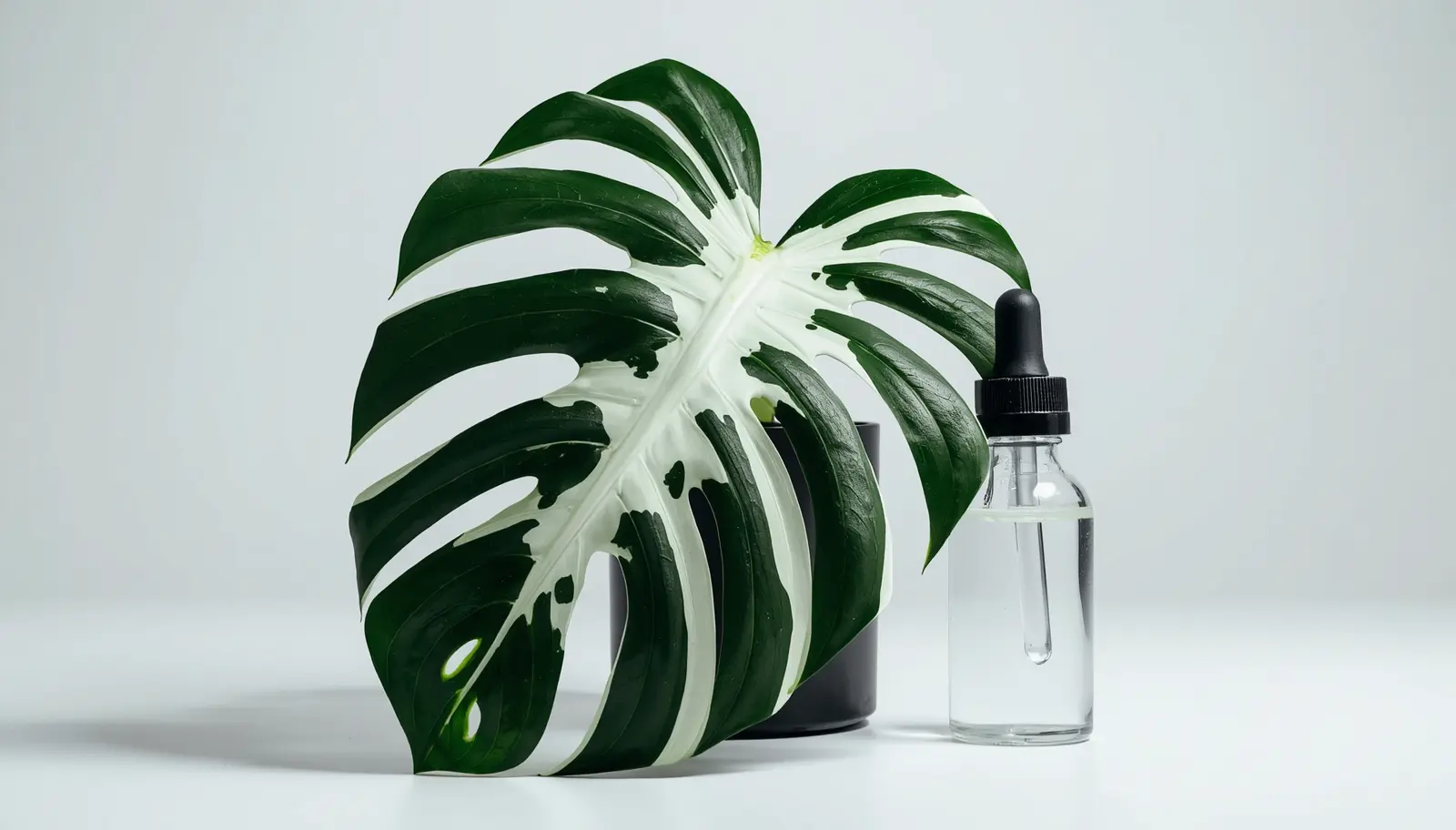
Silica-fortified Monstera albo showing characteristic thick stems and stable variegation without browning
The Botany of Silicon: Three Core Structural Benefits
Silicon is classified as a “beneficial element” rather than essential nutrient—plants complete their lifecycle without it, but performance degrades significantly under stress conditions.
According to USDA research on silicon in plant biology, silicon accumulates in cell walls, cell lumens, and intercellular spaces as amorphous silica (SiO₂·nH₂O). This deposition creates a silica-cellulose matrix with 40-60% greater tensile strength than cellulose alone—transforming soft tissue into rigid structural elements.
Benefit 1: Preventing Variegation Necrosis
The white and cream sectors in variegated plants lack chloroplasts—the organelles that produce chlorophyll and provide structural support to mesophyll cells.
Chloroplasts comprise 30-50% of cell volume in green tissue, acting as physical scaffolding that maintains cell shape under turgor pressure fluctuations. Variegated cells lack this internal architecture. When transpiration exceeds water uptake (even temporarily), white cells collapse inward as osmotic pressure drops. The cellular membrane ruptures, enzymes leak, and oxidative browning reactions begin—visible as brown necrotic patches spreading from white sectors.
Silicon supplementation prevents this cascade. Silica deposits in the cell wall matrix of variegated tissue provide external structural support compensating for absent chloroplast scaffolding. The cell walls become 2-3x more rigid, resisting deformation under osmotic stress. According to research on silicon effects on ornamental plants in HortScience, variegated specimens receiving 50-100 ppm silicon supplementation showed 30-50% reduction in necrotic browning compared to unsupplemented controls.
This is critical for silica supplement Monstera applications—Monstera albo and Thai Constellation cultivars with 40-60% white variegation are especially vulnerable. The same fortification applies to variegated Monstera deliciosa, Philodendron Birkin, and other high-value variegated aroids.
Benefit 2: Mechanical Pest Resistance
Silicon deposition in the epidermis creates a hardened surface layer—literally making leaves more difficult to penetrate for piercing-sucking arthropods.
The mechanism: As silicon-rich xylem sap reaches leaves, monosilicic acid polymerizes into solid silica deposits beneath the cuticle and in epidermal cell walls. This forms a layer of microscopic silica crystals (phytoliths) that increase leaf surface hardness by 50-80%. When spider mites (Tetranychidae), thrips, or aphids attempt to pierce the epidermis with their stylets (needle-like mouthparts), they encounter abrasive resistance.
The result: Increased stylet wear, reduced feeding efficiency, decreased reproduction rates. Studies show 40-60% reduction in spider mite population growth on silicon-fortified plants compared to controls—not through chemical toxicity, but mechanical deterrence. The mites can still feed, but the energetic cost of penetrating hardened cuticle reduces fitness and fecundity.
This creates mechanical pest resistance—a preventative barrier requiring no pesticide application. For plants with chronic spider mite infestations, silica supplementation reduces reinfestation pressure 30-50% when combined with environmental optimization and targeted miticides.
Benefit 3: Structural Integrity and Phototropism Management
Silicon increases stem diameter, reduces internode elongation, and improves structural stability under mechanical stress.
The physics: Plants must balance vertical growth (reaching light) with lateral stability (resisting gravity and wind forces). Without silicon, stems elongate through cell division and expansion but lack proportional thickening. The result: tall, spindly growth prone to bending, breaking, or permanent phototropic lean toward light sources.
Silicon deposition in stem sclerenchyma (structural tissue) and vascular bundles increases rigidity and compression resistance. Stems thicken radially while maintaining vertical growth. For large-leaved aroids (Monstera species, Anthurium), this means supporting 12-18 inch leaves on proportionally thick petioles without mechanical failure or staking requirements.
Additional benefit: Reduced lodging (stem collapse) when transitioning plants from supported to free-standing positions, improved recovery from physical damage (broken petioles, torn leaves), and enhanced wind tolerance for specimens near windows or air circulation systems in automated greenhouse cabinets.
The Chemistry of Bio-Availability: Monosilicic Acid
Plants cannot absorb solid silicon dioxide (sand, glass, mineral rock)—they require soluble monosilicic acid (H₄SiO₄) at concentrations of 20-200 ppm in soil solution.
The Solubility Problem
Silicon exists in nature primarily as quartz (SiO₂)—chemically stable and biologically inert.
Natural weathering of silicate rocks releases trace amounts of soluble silicon into groundwater and soil solutions. However, indoor potting mixes composed of peat moss, coco coir, perlite, and bark contain near-zero plant-available silicon. Hydroponic systems using inorganic substrates like LECA are completely silicon-deficient unless supplemented.
The conversion process: Solid SiO₂ + water → Si(OH)₄ (monosilicic acid). This reaction occurs naturally in alkaline conditions (pH 8-10) where silica solubility increases. Commercial liquid silica fertilizer products provide potassium silicate (K₂SiO₃) which immediately dissolves in water forming monosilicic acid and raising pH.
Product Formulations
| Product Type | Silicon Concentration | Advantages | Disadvantages |
|---|---|---|---|
| Liquid Potassium Silicate (Armor Si, Power Si, Dyna-Gro Pro-TeKt) | 3-7.8% Si pH 10-11 concentrated | Immediately bio-available as monosilicic acid. No dissolution time. Precise dosing with liquid measuring. Shelf-stable 2+ years. | Higher cost per application ($15-30 per quart). Extremely alkaline—requires careful pH management. Can cause nutrient lockout if overapplied. |
| Soluble Silica Powder (AgSil, Kasil) | 20-50% Si Requires dissolution | Concentrated—lower cost per application. Long-term storage as dry powder. Suitable for large-scale operations (100+ plants). | Requires pre-dissolution (12-24 hours stirring in hot water). Difficult to dose accurately at small scale. Powder handling hazards (silica dust inhalation). |
| Diatomaceous Earth (Fossilized diatoms) | 80-90% SiO₂ Insoluble | Inexpensive. Dual function: slow silicon release + mechanical pest control when applied as dust. | Bio-availability extremely low (<5% release over months). Cannot provide rapid tissue fortification. Primarily useful as substrate amendment, not foliar/drench supplement. |
Recommendation: Liquid potassium silicate products provide optimal bio-availability for houseplant applications. The higher per-application cost is offset by precise dosing, immediate availability, and ease of integration into existing fertilization schedules.
The Mixing Protocol: Critical Order of Operations
Potassium silicate is highly alkaline (pH 10-11) and chemically reactive—improper mixing causes precipitation (formation of insoluble compounds) that destroys both silica and nutrient availability.
⚠️ CRITICAL: Mixing Order Determines Success or Failure
If you add potassium silicate directly to concentrated fertilizer solution or add fertilizer before silica stabilizes, you will create unusable precipitates.
The chemistry: Potassium silicate in concentrated form immediately reacts with calcium and magnesium ions (present in most fertilizers and tap water) forming insoluble calcium silicate (Ca₂SiO₄) and magnesium silicate (Mg₂SiO₄). These precipitate as white cloudiness or sediment. Once precipitated, silicon is permanently unavailable to plants—it will not re-dissolve.
Visual indicators of failed mixing: Cloudy or milky solution (should be clear to slightly opalescent), white sediment settling at container bottom, pH above 8.5 after adding all nutrients (indicates excess unreacted silicate), nutrient solution separating into layers. If any of these occur, discard solution and start over—attempting to use precipitated solution causes nutrient deficiencies and potential pH burns on roots.
The Correct Mixing Sequence
🧪 STEP-BY-STEP SILICA INTEGRATION PROTOCOL
Required materials:
- Clean water (distilled, RO, or low-TDS tap water <150 ppm preferred—see water quality protocols)
- Liquid potassium silicate supplement
- Standard NPK fertilizer (liquid or water-soluble powder)
- Cal-Mag supplement (if used)
- pH meter or test strips (optional but recommended)
- Measuring spoons or syringe for precise dosing
Execution sequence:
- Step 1 – Water base: Fill watering container to 75-80% of target volume with clean water at room temperature (18-24°C). Do NOT add any nutrients yet
- Step 2 – Silica addition: Add liquid potassium silicate at rate of 0.5-1 ml per liter (2-4 ml per gallon). For first application or sensitive plants, use lower end (0.5 ml/L = ~50 ppm Si). For mature aroids or high-pest-pressure environments, use higher end (1 ml/L = ~100 ppm Si)
- Step 3 – Thorough mixing: Stir vigorously for 30 seconds. Solution may appear slightly cloudy initially—this is normal monosilicic acid formation
- Step 4 – CRITICAL WAIT PERIOD: Allow 15 minutes minimum for silica to stabilize in solution. During this time, monosilicic acid equilibrates and pH buffering occurs. Do not skip or shorten this step
- Step 5 – pH check (optional): After 15 minutes, pH should be 7.5-8.5. If above 9, add small amount of pH down or proceed cautiously—high pH can damage roots
- Step 6 – Nutrient addition: Add standard fertilizers in this order: (a) NPK base fertilizer, (b) Cal-Mag or micronutrients, (c) any supplements (kelp, humic acid, etc.). Mix gently after each addition
- Step 7 – Final volume adjustment: Top off container to target volume with additional water if needed
- Step 8 – Immediate use: Apply within 2 hours of mixing. Extended storage (6+ hours) allows slow re-precipitation. If solution must be stored, keep tightly sealed and remix before use
Dosing reference: For 1-gallon watering can: Add 2-4 ml potassium silicate, wait 15 minutes, add 1-2 tsp liquid fertilizer (or per label instructions). For 1-liter bottle: Add 0.5-1 ml potassium silicate, wait 15 minutes, add fertilizer proportionally. Scale accordingly for larger volumes.
Application Methods: Root Drench vs Foliar Spray
Silicon can be delivered through roots (systemic uptake and translocation) or leaves (direct absorption and local deposition)—each method serves different purposes.
Root Drench Application (Primary Method)
✅ SUBSTRATE DRENCH PROTOCOL
Standard application for long-term structural fortification:
- Frequency: Every 2 weeks during active growing season (March-September), monthly during dormancy (October-February)
- Volume: Apply silica-enriched water normally—amount sufficient to achieve 10-20% runoff from drainage holes, similar to standard watering practices for tropical substrates
- Concentration: 50-100 ppm silicon (0.5-1 ml potassium silicate per liter water). Start low (50 ppm) for first 2-3 applications, increase if no adverse effects observed
- Substrate compatibility: Works in all substrates—soil, coco coir, LECA/Pon semi-hydro. For semi-hydro systems, add to reservoir water at recommended concentration
Expected timeline:
- Days 1-7: No visible changes. Silicon absorption and translocation begin
- Weeks 2-4: New growth shows increased rigidity. Petioles thicker, leaves less prone to drooping
- Weeks 4-8: Established leaves develop hardened cuticle. Pest feeding damage decreases. Variegated sectors show improved stability
- Weeks 8-12: Full structural optimization. Plant exhibits maximum pest resistance, reduced transpiration stress, improved phototropism management
Foliar Spray Application (Emergency/Supplemental)
💧 FOLIAR FORTIFICATION PROTOCOL
Use for rapid cuticle hardening during active pest pressure or acute variegation stress:
- Concentration: Lower than root drench—25-50 ppm silicon (0.25-0.5 ml per liter). Leaves more sensitive to pH extremes than roots
- Application timing: Early morning or evening. Never spray during midday heat or under grow lights (causes phototoxic burns similar to horticultural oil phototoxicity)
- Coverage: Spray leaf undersides primarily (stomata location for direct absorption). Light misting on top surfaces acceptable but not required
- Frequency: Once weekly for 3-4 weeks during active spider mite outbreaks or when new variegated growth showing browning tendency
- Surfactant addition: Add 1-2 drops liquid castile soap per liter to improve leaf adhesion and spread. Do not use dish soap (too harsh)
Advantages: Faster cuticle hardening (7-14 days vs 4-6 weeks root drench), targeted application to vulnerable leaves, useful when root system compromised from root rot or recent transplant. Disadvantages: Does not provide systemic structural benefits, requires more frequent application, higher risk of phototoxicity if timing incorrect. Best used in combination with root drench, not as standalone treatment.
Advanced Integration: Silica + Comprehensive Nutrition
Silicon supplementation achieves maximum efficacy when integrated with balanced NPK nutrition and optimized environmental conditions.
CORE NUTRITION (MANDATORY):
- NPK base fertilizer: Balanced ratio (20-20-20 or 7-9-5) provides carbon skeleton for growth. Nitrogen for protein synthesis, phosphorus for energy transfer, potassium for osmotic regulation
- Calcium and Magnesium: Essential for cell wall synthesis alongside silicon. Cal-Mag supplements (2-0-0 + 3% Mg) applied with every other watering
- Micronutrients: Iron, manganese, zinc, copper—required for enzyme function. Use complete hydroponic fertilizer or add micronutrient blend
ENVIRONMENTAL OPTIMIZATION:
- VPD control: Maintain 0.8-1.2 kPa for optimal transpiration and nutrient uptake. See complete VPD automation protocols
- Light intensity: 200-400 PPFD for aroids. Higher light increases silicon demand—supplement accordingly. Reference light optimization guides
- Substrate aeration: Silicon uptake requires active root respiration. Use well-draining mixes with 40%+ air porosity. Poor aeration limits silicon translocation regardless of supplementation
SYNERGISTIC EFFECTS:
- Silicon + Calcium = Enhanced cell wall rigidity (75-90% stronger than either alone)
- Silicon + Nitrogen = Improved drought tolerance despite increased leaf area
- Silicon + Optimal VPD = Maximum pest resistance from combined mechanical barrier and environmental inhospitality
Frequently Asked Questions
Can I use potassium silicate with organic fertilizers?
Yes, with caution. Organic fertilizers (fish emulsion, worm castings, compost tea) contain calcium and magnesium that can precipitate with silica. Modified mixing order: (1) Water, (2) Potassium silicate, (3) Wait 15 minutes, (4) Strain organic fertilizer to remove particulates, (5) Add liquid portion slowly while stirring. If cloudiness develops, stop adding and use solution as-is—further addition will waste both products. Alternatively: apply silica and organic fertilizers on alternating weeks to avoid interaction completely.
Will silica prevent all brown spots on my Monstera albo?
No—silica reduces structural failure browning (cellular collapse from weak cell walls) by 30-50%, not eliminates it completely. Other browning causes unaffected by silica: fluoride toxicity from tap water (requires RO water), pest feeding damage (requires miticides), fungal/bacterial leaf spot (requires pathogen control), sunburn (requires light management), natural senescence (unavoidable aging). Silica is structural reinforcement, not panacea. Combine with comprehensive care for best results.
How much potassium silicate is too much?
Toxicity threshold: >200 ppm silicon in root zone solution. Symptoms of over-application: leaf tip burn (brown crispy edges), elevated substrate pH (>7.5 causing nutrient lockout), white crusty residue on pot rim or substrate surface (precipitated salts). Safe maximum: 100 ppm (1 ml per liter) applied every 2 weeks. If using tap water with high calcium (>100 ppm), reduce silica dose to 50 ppm to prevent precipitation. For semi-hydro systems, flush reservoir monthly to prevent accumulation.
Does silica work for all plants or just aroids?
Universal benefit but magnitude varies by species. High silicon accumulators (show greatest response): Aroids (Monstera, Philodendron, Anthurium), bamboo, palms, ferns, grasses. Moderate accumulators: Ficus species, Dracaena, most ornamental foliage. Low accumulators: Succulents and cacti (naturally thick cuticles—minimal additional benefit). Apply to any plant experiencing pest pressure, mechanical weakness, or variegation instability. Worst case: no visible improvement but no harm at standard dosing.
The Lab Verdict: Structural Infrastructure Precedes Aesthetic Excellence
Potassium silicate for houseplants is not fertilizer—it is architectural reinforcement enabling plants to express their genetic potential without structural failure.
Standard horticultural practice focuses on NPK macronutrients and occasional micronutrient supplementation. This approach assumes plant structure develops automatically from carbon fixation and cell division. It ignores that cellular architecture requires specific building materials—silicon being primary among “beneficial” elements that dramatically improve performance under stress.
The difference between a $300 Monstera albo with pristine variegation and one with progressive browning destroying investment value is often silicon availability. The white sectors lack chloroplast support—they depend entirely on cell wall integrity for structural stability. Without silicon fortification, these cells collapse under normal transpiration fluctuations, creating irreversible brown necrosis.
Similarly, chronic spider mite infestations resistant to miticide rotation often reflect structural vulnerability—soft, easily-penetrated cuticles invite pest colonization regardless of chemical intervention. Silicon creates mechanical barrier that reduces pest feeding efficiency 40-60%, breaking the reinfestation cycle that chemical treatments alone cannot stop.
The Urban Lab silica supplementation protocol: (1) Water base preparation using RO or low-TDS water to minimize precipitation risk, (2) Potassium silicate addition first at 50-100 ppm concentration, (3) Mandatory 15-minute stabilization allowing monosilicic acid formation, (4) NPK and Cal-Mag addition last after pH buffering complete, (5) Bi-weekly root drench during active growth establishing systemic fortification, (6) Optional foliar spray during acute pest pressure or variegation stress.
Preventing brown spots on variegated plants requires more than environmental optimization—it requires upgrading cellular architecture to withstand stress that green tissue tolerates through chloroplast scaffolding. Silica provides that upgrade, transforming structurally compromised white sectors into mechanically competent tissue capable of maintaining turgor and resisting oxidative damage.
This is not optional supplementation for advanced collectors—it is foundational infrastructure for any high-value specimen where structural failure represents hundreds of dollars in lost investment. Silicon is abundant, inexpensive ($15-30 provides 6-12 months supply), and impossible to overdose at recommended concentrations. The question is not whether to supplement, but why you haven’t started yet.
The Pantry | Structural Engineering Protocols Division
Potassium Silicate Fortification Protocol | Published: March 2026
