
“Dirt” does not belong indoors.
Standard potting soil—peat moss, composted bark, perlite—is engineered for annual bedding plants in outdoor containers where natural rainfall provides flushing, soil microbes remain active year-round, and roots tolerate anaerobic pockets during rainy periods. Indoor cultivation presents entirely different constraints: controlled watering schedules, sterile environments favoring pathogenic over beneficial microbes, and tropical species adapted to epiphytic conditions in jungle canopies—not terrestrial forest floors.
The result: chronic anaerobic root rot from waterlogged substrates, fungus gnat breeding cycles in decomposing organic matter, and nutrient deficiencies from low Cation Exchange Capacity (CEC) materials that leach fertilizers with every watering.
The solution: Engineering a custom aroid soil mix based on two critical parameters—Cation Exchange Capacity (CEC) for nutrient retention and Air-Filled Porosity (AFP) for root oxygenation. This is not “playing in dirt”—it is substrate matrix engineering optimized for tropical aroids (Monstera, Philodendron, Anthurium, Alocasia) that evolved as epiphytes or lithophytes requiring maximum aeration and stable nutrient availability.
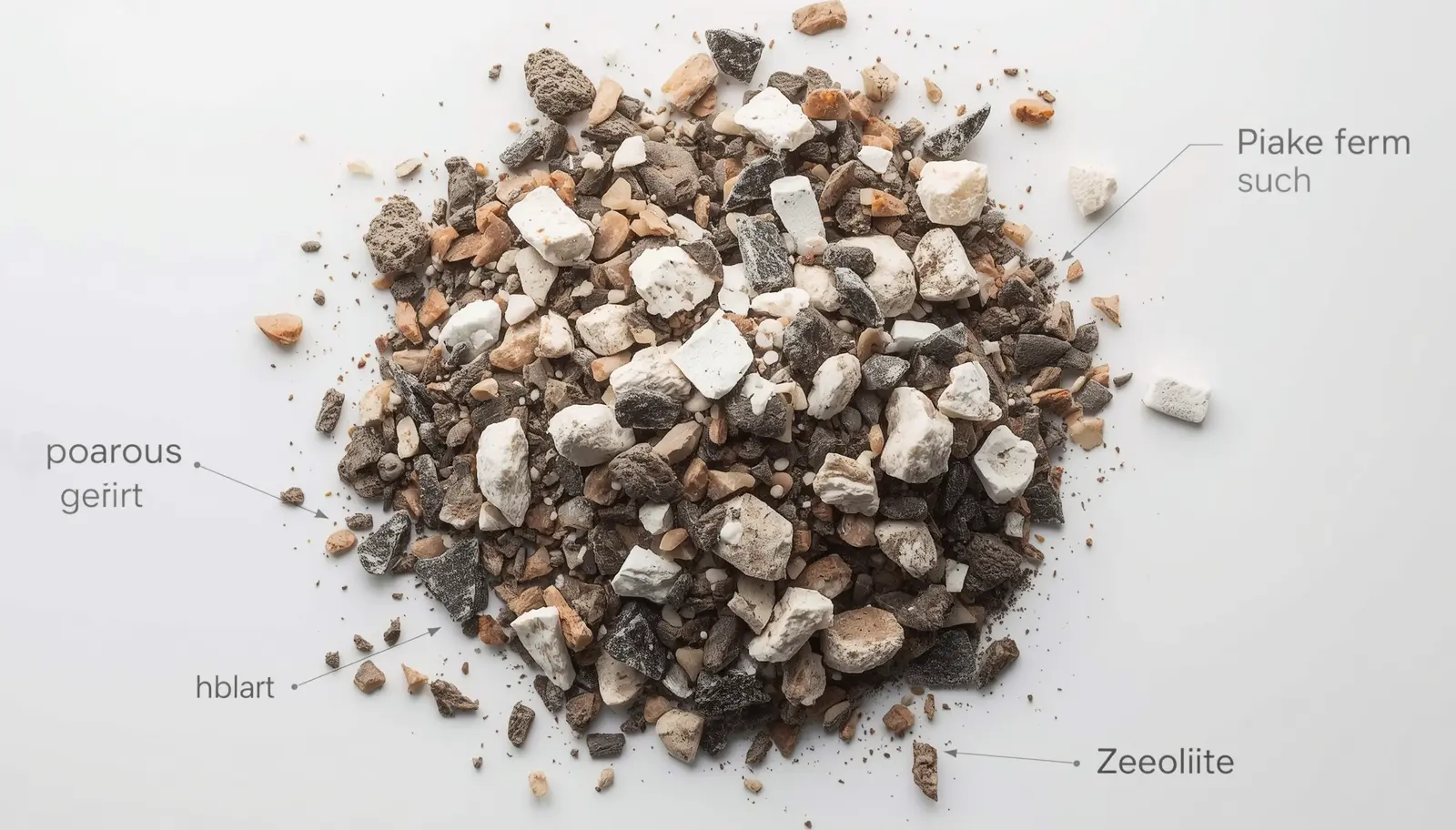
- 40% Aeration/Drainage: 25% pumice + 15% orchid bark—provides 50-60% air-filled porosity preventing anaerobic conditions
- 30% Moisture Retention: Premium coco coir—holds water without compaction, neutral pH, renewable resource
- 20% Nutritional Anchors: Tree fern fiber—high CEC (20-30 meq/100g) retains dissolved nutrients preventing leaching
- 10% Filtration: Zeolite or horticultural charcoal—absorbs excess salts, buffers pH, provides additional CEC
- Performance: Total CEC 15-25 meq/100g, AFP 50-60%, virtually impossible to overwater, supports vigorous root development

Premium substrate components: engineered for maximum aeration and nutrient retention
The Chemistry: Understanding Cation Exchange Capacity (CEC)
What is CEC in soil? Cation Exchange Capacity quantifies substrate’s ability to retain positively-charged nutrient ions (cations) preventing immediate leaching during irrigation.
The Nutrient Retention Mechanism
Plant-essential nutrients exist in solution as charged ions. Macronutrients calcium (Ca²⁺), magnesium (Mg²⁺), potassium (K⁺), and ammonium (NH₄⁺) carry positive charges making them cations.
Substrate particles—particularly clay, humus, zeolite, and tree fern fiber—possess negatively-charged surfaces from chemical functional groups (carboxyl -COO⁻, phenolic -O⁻, silanol -SiO⁻). These negative sites attract and hold cations through electrostatic bonding. When you water with fertilizer solution, cations bind to exchange sites rather than washing straight through to drainage holes.
According to Oregon State Extension research on CEC, substrates with high CEC (15-30 meq/100g) function as “nutrient bank accounts”—they store applied fertilizers and release them gradually as roots deplete the soil solution. Low CEC substrates (<5 meq/100g) like pure perlite or pumice alone require constant fertilization because nutrients flush through with every watering.
CEC Values Comparison
| Substrate Component | CEC (meq/100g) | Nutrient Retention | Indoor Application |
|---|---|---|---|
| Tree Fern Fiber | 20-30 | Excellent—holds 4-6x more nutrients than peat moss | Premium nutritional anchor. Expensive but unmatched performance. Use 15-20% of total mix. |
| Zeolite (Clinoptilolite) | 100-200 | Exceptional—highest CEC of natural minerals | Filtration + nutrient buffering. Use 5-10%. Prevents fertilizer salt accumulation. See semi-hydro zeolite applications. |
| Coco Coir | 40-60 | Good—superior to peat moss, pH neutral | Moisture retention backbone. Use 25-35%. Must be pre-rinsed and buffered (removes sodium/potassium salts from processing). |
| Worm Castings | 30-50 | Good—provides nutrients + CEC | Alternative to tree fern fiber. Use 10-15%. Contains beneficial microbes but can attract fungus gnats if too moist. |
| Peat Moss | 100-150 | High CEC but becomes hydrophobic when dry | Avoid. Water repellency when dry, acidic pH, non-renewable resource. Coco coir superior in every metric except initial cost. |
| Pumice / Perlite | 1-5 | Minimal—provides structure only | Aeration component. Use 20-30%. Zero nutrient retention—pair with high-CEC components for balance. |
| Orchid Bark | 5-15 | Low—slow decomposition releases minimal nutrients | Chunky aeration. Use 10-20%. Provides structure + air pockets. Degrades slowly (2-3 years) unlike peat (1 year). |
Target CEC for tropical aroids: 15-25 meq/100g total mix. This balances nutrient retention (prevents deficiencies between fertilizations) with drainage (prevents salt accumulation). Achieve through combining high-CEC components (tree fern, coco coir, zeolite) with low-CEC aeration materials (pumice, bark) in correct proportions.
The Blueprint: Premium Ingredient Selection
Engineering the best aroid soil mix requires sourcing specific components unavailable in pre-bagged “potting soil”—each serving distinct chemical and physical functions.
Component 1: Tree Fern Fiber (The Nutritional Anchor)
✅ TREE FERN FIBER: THE ULTIMATE HIGH-CEC SUBSTRATE
Tree fern fiber for houseplants is harvested from Cyathea and Dicksonia species—slow-growing tree ferns producing fibrous root mass with extraordinary CEC and moisture retention.
Properties:
- CEC: 20-30 meq/100g—holds nutrients 4-6x longer than peat moss
- Water retention: Absorbs 6-10x its dry weight without becoming waterlogged
- Structural stability: Does not compact or decompose for 3-5 years unlike peat (1-2 years)
- pH: Slightly acidic (5.5-6.5) ideal for tropical aroids
- Texture: Chunky fibrous structure creates air pockets even when moist
Why superior to peat moss:
- Peat becomes hydrophobic when dry—water beads on surface rather than absorbing. Tree fern rewets instantly
- Peat acidifies over time (pH drops to 4.0-4.5) causing nutrient lockout. Tree fern maintains stable pH
- Peat compacts reducing air porosity 60-80% within 12 months. Tree fern maintains structure 3+ years
- Peat is non-renewable bog harvest. Tree fern is sustainably harvested from managed plantations
Sourcing and cost:
- Brands: Fluffy Stuff, Repti-Bark (actually tree fern despite name), New Zealand Sphagnum (some blends contain tree fern)
- Cost: $20-40 per gallon vs $5-10 for peat. Expensive but lasts 3x longer and provides superior performance
- Alternative if unavailable: Substitute 50% high-quality coco coir + 50% worm castings to approximate CEC. Not identical but functionally acceptable
Component 2: Premium Coco Coir (Moisture Retention)
Coco coir is processed coconut husk fiber—renewable, pH-neutral, and superior moisture retention without compaction risk.
Critical quality specifications: Use only buffered and pre-rinsed coco coir. Unbuffered coir contains high sodium and potassium from seawater processing, causing nutrient imbalances. Cheap compressed bricks often contain excess salts requiring multiple rinse cycles. Premium brands (Mother Earth, Canna, Botanicare) pre-buffer with calcium, eliminating preparation time.
Performance characteristics: Holds water 8-10x dry weight, maintains 40-50% air porosity when saturated (peat drops to 10-20%), neutral pH 5.5-6.8, decomposes slowly (2-3 years), does not become hydrophobic. For detailed coir applications, see our tropical substrate engineering guide.
Component 3: Pumice (The Aeration King)
🪨 PUMICE VS PERLITE: THE DEFINITIVE COMPARISON
Both are volcanic minerals providing aeration—but pumice offers superior long-term performance for premium mixes.
Pumice advantages:
- Density: Heavier than perlite—sinks and stays distributed throughout substrate rather than floating to surface during watering
- Durability: Angular vesicular structure resists crushing. Perlite degrades to powder within 12-18 months from handling and root pressure
- Internal porosity: Microscopic pores hold water (10-15% by weight) while maintaining external air spaces. Provides both aeration AND slight moisture buffering
- Particle size stability: Maintains 1/4-1/2 inch chunks indefinitely. Perlite fragments into fine particles clogging drainage
- Aesthetic: Natural tan/gray color vs perlite’s bright white specks visible on soil surface
Perlite advantages:
- Cost: $5-10 per gallon vs $15-25 for pumice
- Weight: Lightweight—better for hanging baskets or large-scale mixing (50+ gallon batches)
- Availability: Sold at every garden center. Pumice requires specialty suppliers or online order
Recommendation: Use pumice for long-term plantings in premium specimens (Monstera Thai Constellation, Monstera Albo, rare Philodendron). Use perlite for experimental mixes, propagation substrates, or budget constraints. Both work—pumice works better. For pumice vs perlite houseplants applications, pumice is definitive winner for quality-focused cultivation.
Component 4: Zeolite (Filtration and pH Buffering)
Zeolite for indoor plants serves triple function: exceptional CEC (100-200 meq/100g), ammonia/toxin absorption, and pH stabilization.
Chemical structure: Clinoptilolite zeolite is microporous aluminosilicate with honeycomb crystal lattice. The massive internal surface area (700-800 m²/gram) creates unparalleled ion exchange capacity. It preferentially binds ammonium (NH₄⁺) preventing ammonia toxicity from decomposing organic matter or over-fertilization.
According to USDA research on zeolite applications in horticulture, substrates containing 5-15% zeolite show 40-60% reduction in fertilizer leaching, 30-50% improvement in nutrient use efficiency, and elimination of ammonia toxicity symptoms even with aggressive fertilization schedules.
Sourcing: Aquarium zeolite (sold as ammonia remover) is identical to horticultural zeolite at fraction of cost. Use 1/8-1/4 inch granules. Rinse before use to remove dust. Brands: Seachem Zeolite, API Ammo-Carb. Cost: $10-20 per pound, 1 pound treats 10-15 gallons substrate.
Component 5: Orchid Bark and Horticultural Charcoal
Orchid bark (fir or pine, medium grade) provides chunky structure creating large air pockets—critical for epiphytic aroid roots requiring oxygen-rich environments.
Particle size: 1/4-1/2 inch chunks. Smaller particles (<1/8 inch) pack too densely. Larger chunks (>3/4 inch) create voids where roots cannot access water. Medium grade provides optimal balance. Decomposes slowly (2-4 years) releasing minimal nitrogen. Cost: $8-15 per gallon.
Horticultural charcoal (not BBQ briquettes—those contain chemical additives) absorbs dissolved organic compounds, toxins, and excess salts. Provides minor CEC (5-10 meq/100g) and pH buffering. Optional but beneficial for sensitive specimens or hard water areas. Use as 5-10% of total mix. Alternative: activated carbon from aquarium stores (higher purity, higher cost).
The Formula: Engineering the 40/30/20/10 Matrix
THE URBAN LAB AROID SUBSTRATE FORMULA
Component Breakdown (by volume):
40% AERATION / DRAINAGE
- 25% Pumice (1/4-1/2 inch grade)
- 15% Orchid Bark (medium, fir or pine)
30% MOISTURE RETENTION
- 30% Premium Coco Coir (buffered, pre-rinsed)
20% NUTRITIONAL ANCHORS (HIGH CEC)
- 20% Tree Fern Fiber
- Alternative if unavailable: 10% Worm Castings + 10% Composted Bark
10% FILTRATION
- 5-10% Zeolite (clinoptilolite, 1/8-1/4 inch)
- 0-5% Horticultural Charcoal (optional)
MIXING INSTRUCTIONS:
- Combine all dry ingredients in large container or wheelbarrow
- Mix thoroughly for 2-3 minutes ensuring even distribution
- Optional: Pre-moisten with clean water (not soaking—just breaking dust) if mixing creates airborne particles
- Store in sealed container if not using immediately. Substrate remains viable 6+ months
PERFORMANCE CHARACTERISTICS:
- Total CEC: 18-25 meq/100g (excellent nutrient retention)
- Air-Filled Porosity: 50-60% even when saturated (prevents anaerobic conditions)
- Water retention: Holds adequate moisture 4-7 days between waterings for most aroids
- pH: 5.8-6.5 (ideal for tropical species)
- Longevity: Maintains structure 2-3 years before refresh needed
- Compatibility: Monstera, Philodendron, Anthurium, Alocasia, Syngonium, Epipremnum, all epiphytic/semi-epiphytic aroids
Watering Dynamics: Understanding Air-Filled Porosity
The 40% aeration component creates 50-60% Air-Filled Porosity (AFP)—fundamentally changing irrigation requirements and making overwatering nearly impossible.
The Physics of Drainage and Oxygen Delivery
Air-Filled Porosity measures percentage of substrate volume occupied by air rather than water or solid particles after drainage completes.
Standard potting soil: 10-20% AFP when saturated—majority of pore space filled with water. Roots in saturated substrate experience hypoxia (oxygen starvation) triggering anaerobic pathogen proliferation within 24-48 hours.
Engineered aroid mix: 50-60% AFP when saturated—half of pore space remains air-filled even immediately post-watering. The chunky architecture (pumice, bark) creates large voids that drain gravitationally within seconds, pulling fresh oxygenated air down into root zone through negative pressure. This mimics epiphytic conditions in nature where roots cling to bark receiving constant air circulation.
Watering Protocol Modifications
✅ HIGH-POROSITY WATERING GUIDELINES
Standard soil watering advice (“water when top 2 inches dry”) does NOT apply to chunky aroid mixes—requires recalibrated approach.
Frequency changes:
- Standard potting soil: Water every 7-14 days (retains moisture 10-14 days)
- Engineered aroid mix: Water every 4-7 days (drains rapidly, dries faster)
- This is BENEFIT not problem—frequent watering with fast drainage = constant nutrient delivery + oxygen replenishment
Volume changes:
- Water until 10-20% runoff from drainage holes—ensures complete saturation
- Never “sip water” small amounts—this leaves dry pockets in substrate reducing effective root zone
- Use RO or low-TDS water to prevent zeolite/tree fern CEC sites from clogging with calcium/magnesium carbonates
Fertilization integration:
- High CEC substrate holds nutrients—can use full-strength fertilizer every 2-3 weeks vs weekly weak feeding
- Alternatively: 1/4 strength every watering for constant nutrient availability
- Incorporate potassium silicate supplementation—tree fern fiber and zeolite CEC sites retain silica 3-4x longer than standard soil
- Flush with plain water every 4-6 weeks to prevent salt accumulation despite high CEC
Advanced Variations: Customizing for Specific Needs
The 40/30/20/10 base formula adapts through component substitution for specialized applications or ingredient availability.
EXTRA DRAINAGE (EPIPHYTIC SPECIES):
- For Hoya, lithophytic Philodendron, mounted plants transitioning to pots
- Ratio: 50% aeration (30% pumice + 20% bark) / 25% coco / 15% tree fern / 10% zeolite
- Increases AFP to 60-70%—requires more frequent watering but eliminates any rot risk
BUDGET-CONSCIOUS ALTERNATIVE:
- Substitute perlite for pumice (saves $10-15 per batch)
- Replace tree fern with 50/50 worm castings + composted bark (saves $15-25 per batch)
- Omit zeolite, increase coco coir to 35% (saves $10 per batch)
- Performance reduction: ~15-20% less CEC, perlite degradation requires annual remix. Still vastly superior to bagged potting soil
MOISTURE-LOVING AROIDS:
- For Anthurium species, Alocasia, moisture-preferring specimens
- Ratio: 35% aeration / 35% coco / 20% tree fern / 10% zeolite
- Reduces AFP to 45-50%, extends watering interval to 5-9 days while maintaining drainage preventing rot
Frequently Asked Questions
Can I just add perlite to potting soil instead of making custom mix?
Marginal improvement but insufficient. Adding 20-30% perlite to bagged soil increases AFP from 15% to 25-30%—still far below optimal 50-60%. The base soil remains peat-heavy, prone to compaction and hydrophobic behavior. Additionally, bagged soil CEC dominated by peat (high CEC but problematic moisture dynamics). Better approach: If mixing from scratch is impractical, use premium bagged aroid mix (Espoma Organic Cactus Mix, Fox Farm Ocean Forest) as base, then amend 30-40% by volume with pumice + orchid bark. This achieves ~40% AFP and improves drainage while avoiding complete custom mixing.
How often should I replace or refresh this substrate?
Every 2-3 years or when performance degrades. Degradation signs: compaction (top layer hardens), reduced drainage speed (water pools on surface), decomposing bark turning to mush, salt crust accumulation despite flushing. Pumice and zeolite last indefinitely but organic components (coco, tree fern, bark) break down. Refresh protocol: Unpot plant, shake off 50-70% of old substrate, repot in fresh mix. Reuse pumice and zeolite if desired (rinse first). For plants with root issues, replace 100% of substrate during remediation.
Where can I buy these ingredients?
Online: Amazon, Etsy (search “terrarium supplies” or “reptile substrate”), specialized vendors (Bonsai Jack, rePotme). Local: Orchid specialty nurseries carry bark and tree fern. Aquarium stores stock zeolite. Landscape supply yards sell pumice in bulk (50+ lb bags). Home Depot/Lowe’s carry orchid bark and coco coir but rarely pumice or tree fern. Cost for 5-gallon batch: $40-60 using premium ingredients (tree fern, pumice). $20-30 using budget alternatives (perlite, worm castings). Sufficient for 10-15 medium houseplants (6-8 inch pots). Cost per plant: $3-6 vs $8-12 for bagged “aroid mix” of inferior quality.
Will this mix work for non-aroid plants?
Yes for most epiphytes and semi-epiphytes: Orchids, bromeliads, Hoya, staghorn ferns, some Peperomia. Reduce aeration for terrestrial tropicals: Calathea, Stromanthe, Ficus—use 30% aeration / 40% coco / 20% tree fern / 10% zeolite. Avoid for: Succulents and cacti (require even higher drainage—70%+ inorganic grit), snake plants (prefer mineral-heavy mix), carnivorous plants (require zero nutrients—peat/sand only). The 40/30/20/10 formula optimized specifically for tropical aroids with epiphytic heritage—the largest and most commercially-relevant indoor plant category.
The Lab Verdict: Infrastructure Investment Prevents Replacement Costs
Engineering a custom chunk houseplant soil recipe based on CEC and AFP requires upfront time and financial investment—$40-60 and 30-60 minutes mixing versus $8 for bagged soil and zero preparation.
The return on investment: Eliminating chronic root rot losses (average cost: $50-300 per lost specimen), preventing fungus gnat infestations from decomposing organics (treatment cost: $20-40 in pesticides + time), reducing fertilization frequency through superior CEC (savings: $30-50 annually in fertilizers), and enabling 2-3 year substrate longevity versus annual repotting with degraded bagged soil.
The biological reality: Tropical aroids evolved in rainforest canopies where roots colonize bark crevices, moss clusters, and decomposing organic debris—all sharing one characteristic: maximum aeration with intermittent moisture availability. Indoor potting soil optimized for bedding annuals in outdoor containers fundamentally mismatches these requirements. Peat-based mixes saturate, compact, and create anaerobic zones fatal to epiphytic root systems adapted to constant oxygen availability.
The Urban Lab substrate engineering protocol: (1) Maximize CEC through tree fern fiber and zeolite—holds nutrients preventing deficiencies between fertilizations, (2) Optimize AFP at 50-60% through pumice and orchid bark—eliminates overwatering risk and delivers root oxygenation, (3) Balance moisture retention with coco coir—prevents drought stress without waterlogging, (4) Integrate filtration via zeolite/charcoal—prevents fertilizer salt accumulation and ammonia toxicity, (5) Engineer longevity using durable components—2-3 year performance versus 1-year peat degradation.
What is CEC in soil? It is the difference between substrates that retain applied nutrients for gradual root uptake versus those that flush fertilizers to drainage holes requiring constant replacement. It is the difference between stable pH buffering and progressive acidification causing nutrient lockout. It is the difference between engineered performance and agricultural commodity products sold by volume rather than function.
Building the best aroid soil mix is not optional for serious cultivation—it is foundational infrastructure enabling everything else (light optimization, VPD control, silica supplementation) to function as designed. A plant in superior substrate with adequate light outperforms a plant in premium substrate with perfect light but waterlogged roots. Get the foundation right first.
The Pantry | Substrate Engineering Protocols Division
CEC Optimization & Aroid Mix Formula | Published: March 2026