
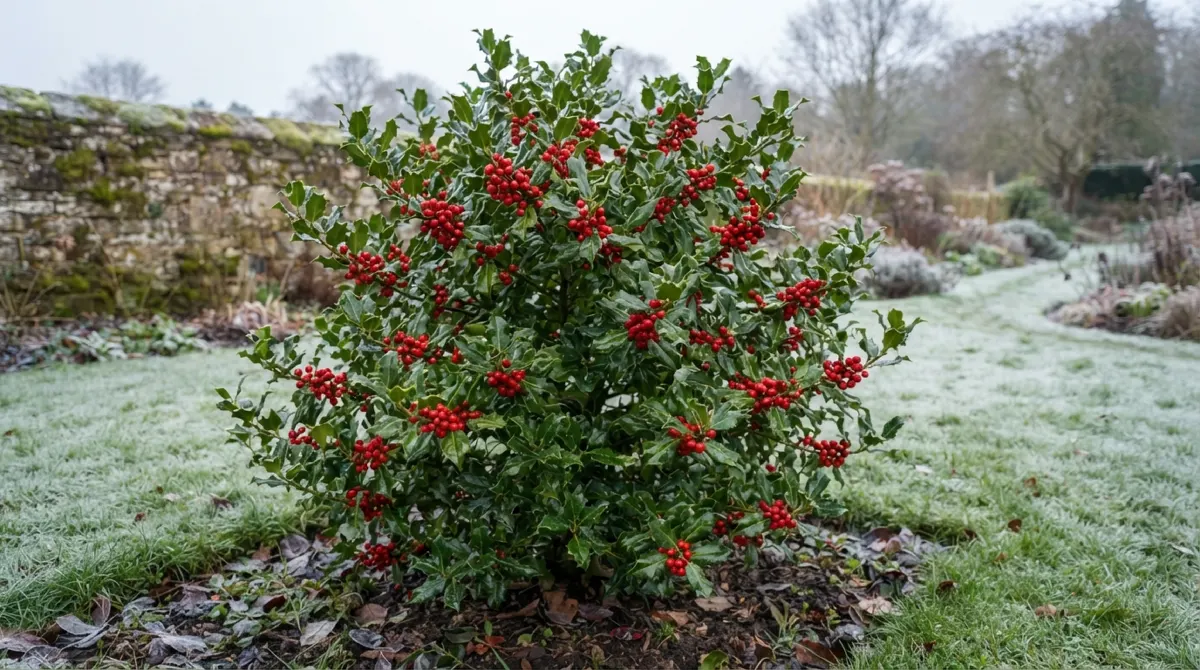
Search for holly plant care and most of what comes back is written for wreaths rather than living shrubs. Holly is a long-lived landscape plant, not a houseplant, and a few requirements decide whether it thrives or merely survives. This guide covers holly plant care in pots, holly bush care, christmas holly plant care and holly plant care indoors, following Clemson HGIC, NC State Extension and University of Maryland Extension.
Holly at a Glance
| Requirement | What holly wants |
|---|---|
| Light | Full sun to part shade. Sun gives the best berry set and the most compact growth (Clemson). |
| Soil | Well drained, rich in organic matter, slightly acid to neutral (Clemson; NC State). |
| Water | Moist but never waterlogged. Deep watering in dry spells, especially in fall. |
| Mulch | Yes. It keeps the soil moist and cool and suppresses weeds (Clemson). |
| Berries | Female plants only, and usually a male nearby for pollination (Clemson; NC State). |
| Pruning | Late winter to early spring, roughly February into March (University of Maryland Extension). |
| Size | From 18-inch shrubs to trees over 50 feet, depending on species (Clemson). |
| Pets | Toxic. The ASPCA lists holly as toxic to cats and dogs. |
Sources: Clemson HGIC 1066; NC State Extension Plant Toolbox (Ilex opaca); University of Maryland Extension; ASPCA.
Types of Holly
Ilex is a large genus, with more than 400 species (Clemson). The ones a home gardener is most likely to meet are these:
| Holly | Leaves and fruit | Why people grow it |
|---|---|---|
| American holly (Ilex opaca) | Large, spiny, dull to dark green leaves; bright red or orange berries | The traditional Christmas holly. Slow growing, 40 to 60 feet tall in the landscape, hardy in zones 5 to 9 (NC State). |
| English holly (Ilex aquifolium) | Very spiny, glossy leaves; bright red berries | Classic look and variegated cultivars, but it dislikes poor drainage and low temperatures and grows slowly (Clemson). |
| Japanese holly (Ilex crenata) | Small, spineless leaves; black fruit | Boxwood-like evergreen for hedges. Tolerates severe pruning (Clemson). |
| Chinese holly (Ilex cornuta) | Large, glossy, very spiny leaves; red berries | One of the few hollies that can produce berries without pollination (Clemson). |
| Yaupon holly (Ilex vomitoria) | Small evergreen leaves; small red berries in large clusters | Tolerates wind and heat better than most evergreen hollies (Clemson). |
| Winterberry (Ilex verticillata) | Deciduous; bright red berries that last all winter | Thrives in boggy soils, which most hollies will not (Clemson). |
| Inkberry (Ilex glabra) | Evergreen, spineless leaves; black berries | Fine texture, good boxwood substitute, dwarf forms available (Clemson). |
| Meserve holly (Ilex x meserveae) | Blue-green evergreen leaves; red berries | A 6- to 7-foot shrub that is very cold hardy (Clemson). |
Source: Clemson HGIC 1066 (Holly); NC State Extension Plant Toolbox.
Light and Soil
Clemson HGIC sums up the basics well: most hollies require well-drained soil that is rich in organic matter and slightly acid, and all of them appreciate mulch. Hollies grow in sun or part shade, but the sunny spot wins on two counts, because it produces the best berry crop and the most compact growth.
NC State’s entry for American holly gives a wider range: full sun of six or more hours, or partial shade of two to six hours, in soil that is acid to neutral and well drained. It lists the plant as slow growing, low maintenance, salt tolerant and highly deer resistant, with a height of 40 to 60 feet and a spread of 10 to 20 feet at maturity.
Watering and Mulch
Holly is not a thirsty plant, but it does not forgive drought in its first year or two after planting. Water deeply when the top inch or two of soil dries, and let the soil drain between waterings. Clemson recommends mulch for every holly, because it keeps the soil moist and cool and keeps weeds from competing with the roots.
Fall watering matters more than most people expect. Clemson’s cold damage factsheet explains that evergreens can dry out in winter when the ground is frozen and water is unavailable, and that a dry fall leaves the plant short of moisture going into that period. A deep soak before the ground freezes is one of the cheapest ways to prevent winter leaf burn.
For more on that, see our guide to cold damage on houseplants, which covers desiccation and root injury in containers.
Holly Berries and Pollination
This is the part of holly care that surprises people. Hollies are usually dioecious, meaning male and female flowers are on separate plants. Only the female sets fruit, and she needs pollen from a male of a compatible species or cultivar. NC State states it plainly for American holly: both sexes must be present to produce fruit.
Clemson adds two useful exceptions. Some hollies are self-fertilizing, and Chinese hollies are among the few that produce berries without pollination at all. That is why a single Chinese holly can fruit while a lone American holly cannot.
If a holly that should be fruiting is not, Clemson lists four common reasons:
- Poor pollination. No male nearby, or the wrong male for that species.
- A young plant. Hollies need some maturity before they flower heavily.
- Too much nitrogen. High nitrogen levels push leaves at the expense of fruit.
- A late spring frost. Frost can kill the flowers before they set fruit.
Holly Plant Care in Pots
Holly grows well in a container for a few years, and a pot is the practical answer for a small patio or a garden with heavy clay. Clemson notes that containerized plants can be set out at any time, but early fall is best, which is also a good time to pot one up.
The container version of holly care comes down to four things:
- Drainage. Use a pot with real drainage holes and a coarse, well-drained mix with organic matter. A saucer that holds water defeats the purpose.
- Watering. Container soil dries faster than garden soil. Check it every few days in summer and water until it runs out the bottom.
- Mulch. A layer on top of the potting soil slows evaporation and keeps the roots cool, the same job it does in the ground.
- Winter protection. Roots in a pot have no ground insulation. Clemson notes that lethal root temperatures can begin at 28 °F for some otherwise hardy species, so move the pot against a sheltered wall or into an unheated garage during the coldest nights.
Repot when the roots fill the container, moving up one size rather than jumping to a much larger pot. A pot that is too big holds excess wet soil, which is the quickest way to lose a holly to root rot.
Christmas Holly Plant Care
American holly is the traditional Christmas holly, with large spiny green leaves and bright red berries (Clemson). There are two ways it comes into the house in December, and they need different care.
Cut branches. Recut the stems at an angle, strip the lower leaves, and stand them in water. Keep the arrangement cool and away from radiators and fireplaces. The leaves hold for weeks, while the berries gradually drop. A wreath or garland that dries out will shed berries onto the floor, which matters in a house with pets or small children.
A potted gift holly. Treat it as a temporary houseguest. Keep it in the brightest, coolest spot you have, water it when the top of the soil dries, and keep it away from heat vents. Plant it outdoors in spring once the ground is workable, following the same light and soil rules above. A holly that spends months in a warm, dry living room usually declines.
Holly Plant Care Indoors
Holly is an outdoor shrub, and no amount of care turns it into a long-term houseplant. The plants sold as miniature holiday hollies are meant to be enjoyed for a few weeks and then planted outside.
Indoors, give it the coolest, brightest spot you can. NDSU Extension notes that houseplants favor temperatures between 65 and 75 °F, that fast temperature changes can cause leaf drop, and that heated homes can drop to 10 to 20 percent relative humidity while most houseplants prefer 40 to 50 percent. A holly in a warm, dry room is fighting all three at once.
Watch for scale and mites, both of which Clemson lists as common holly pests. Dry indoor air favors mites, and a stressed plant is easier for them to colonize. If you want a plant that genuinely thrives indoors, choose a tropical foliage plant instead and keep the holly for the porch or the garden.
Pruning Holly Bushes
Holly bush care is mostly about timing. University of Maryland Extension recommends pruning hollies in late winter to early spring, roughly February into March. Deciduous hollies such as winterberry should be trimmed before the end of April, so the work does not interfere with flowering and berry production.
There is a trade-off with evergreen hollies. Pruning in early season can reduce berry production because it removes some of the flower buds, though unless the pruning is extensive, some berries will still form on the uncut twigs. Light shearing is fine for a hedge. Severe renewal pruning is better saved for a plant that has outgrown its space, and Japanese hollies tolerate it best (Clemson).
Cut back to a bud or a side branch rather than leaving a stub, and remove dead, damaged or crossing branches first. If you are pruning a female holly for berries, do the heavy work right after the berries fade rather than in the middle of the display.
Pests and Problems
Clemson lists the common holly pests as scale, bud moth, red mites and leafminers, with root rot diseases a particular problem on several Japanese cultivars. Most of these are manageable on an outdoor plant with good airflow and proper watering. A holly in a pot is more vulnerable, because stress compounds faster in a small volume of soil.
Yellowing leaves with sticky honeydew usually point to scale. Fine webbing and speckled foliage point to mites. For houseplant versions of those problems, our guides to mealybugs and spider mites cover the treatment options.
If the plant is in the ground and declining for no obvious reason, check the drainage first. Hollies tolerate a lot, but they do not tolerate wet feet.
Frequently Asked Questions
Where is the best place to plant holly?
A spot in full sun to part shade with well-drained, slightly acid soil rich in organic matter. Sun gives the best berry production and the most compact growth (Clemson).
Why is my holly not producing berries?
The usual reasons are no male pollinator, a young plant, too much nitrogen, or a late spring frost that killed the flowers (Clemson). Only female hollies produce berries, and many need a male nearby.
Can holly grow in a pot?
Yes, for a few years. Use a pot with drainage holes, a well-drained mix, mulch on top, and move it somewhere sheltered when temperatures approach 28 °F, because container roots are exposed.
Can holly be kept indoors?
Only for a short time. Holly is an outdoor shrub that wants bright light, cool air and good airflow. A holiday gift plant should be planted outside in spring.
When should I prune holly?
Late winter to early spring, roughly February into March. Deciduous hollies such as winterberry should be pruned before the end of April (University of Maryland Extension).
Is holly toxic to dogs and cats?
Yes. The ASPCA lists holly as toxic to cats and dogs, and NC State lists the fruit as the poisonous part, with nausea, vomiting, diarrhea and depression possible.
How big does a holly bush get?
It depends on the species. Hollies range from 18-inch shrubs to trees over 50 feet (Clemson). American holly reaches 40 to 60 feet tall with a 10- to 20-foot spread (NC State).