
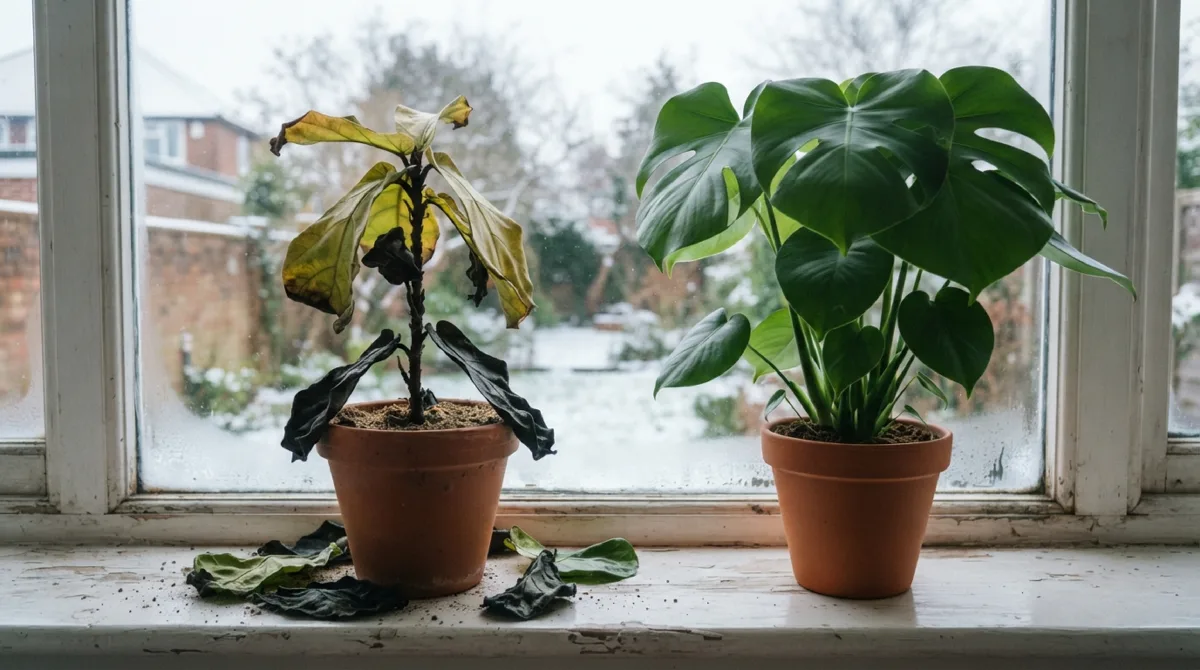
Search for cold damage on houseplants and you will find photos of black, collapsed leaves and a lot of advice to throw the plant out. Sometimes that is the right call. Often it is not. Cold injury is a spectrum, and the difference between a chilled plant and a frozen one decides whether it recovers. This guide covers can indoor plants recover from cold shock, how to read the signs on plants damaged by cold, what houseplants can tolerate cold, and what is the coldest temperature houseplants can tolerate, following Clemson HGIC, UC IPM, NC State Extension and North Dakota State University.
Chilling Injury vs Freezing Injury
The first thing to establish is which kind of cold the plant met. Clemson HGIC separates the two clearly. Freezing temperatures damage plants by rupturing cells as ice crystals form, especially when the temperature drops fast. Chilling injury is different: it can happen to many tropical plants even though the temperature never drops below 32 °F.
UC IPM defines chilling injury as damage from cold above freezing and notes that plants of tropical and subtropical origin are the most susceptible. NC State Extension puts the chilling band at roughly 32 to 55 °F depending on how cold-hardy the plant is, and describes the mechanism of a freeze: water inside the cells crystallizes, the crystals expand, the membranes are cut and burst, and fluids leak out.
| Chilling injury | Freezing injury | |
|---|---|---|
| Temperature | Above 32 °F, often 32 to 55 °F | 32 °F and below |
| What happens | Cold disrupts normal cell function | Ice crystals rupture cell membranes |
| Typical signs | Wilting, red or purple leaves, flowers killed, slowed growth | Water-soaked leaves that turn black, mushy stems, leaf drop |
| Can it recover? | Often yes, though some dieback is possible | Damaged tissue cannot recover; the plant may survive from living roots or stems |
Sources: Clemson HGIC 2350 (2019); UC IPM Chilling Injury; NC State Extension, Durham County (2026).
Signs of Cold Damage on Houseplants
Cold damage is confusing because it does not always show up on the night it happens. Clemson notes that some injury may not be evident until months later. NC State adds that leaf and stem symptoms can appear within days, while damage to buds and larger limbs may stay hidden until growth resumes. For evergreens, the extent is usually visible within about two weeks.
Here is what to look for, and what each sign usually means:
| What you see | What it usually means |
|---|---|
| Leaves look water-soaked and wilted, then turn black within hours or days | Freezing injury. The cells have ruptured. |
| Leaves turn red or purple instead of black | Chilling injury, especially on tropical and subtropical plants. |
| Brown, papery margins on broad leaves | Chilling injury or desiccation from cold, dry air. |
| New leaves emerge curled, misshapen or mosaic-patterned | Cells were damaged while the leaf was forming. |
| Leaves drop suddenly a few days after a cold night | Rapid temperature change. NDSU notes that fast swings can cause leaf drop. |
| Stems are soft, brown or mushy | Freezing injury to stem tissue. Check for green wood further down. |
| Brown tips on narrow or needled plants | Freezing injury or winter desiccation. |
| Flowers and buds collapse first | Chilling. Reproductive tissue is the most sensitive part. |
| No new growth for weeks after a cold event | Possible root damage. Check the roots before giving up. |
Sources: Clemson HGIC 2350; UC IPM; NC State Extension; NDSU Extension (Knutson, 2020).
One practical test comes from Clemson: gently scrape the outer layer of bark on a stem. If there is green wood underneath, that part of the plant is still alive. If the stem is brown and mushy all the way through, it is not.
What Is the Coldest Temperature Houseplants Can Tolerate?
There is no single number, and any article that gives one is oversimplifying. The tolerance depends on the species, how long the cold lasts, how fast the temperature dropped, and how hydrated the plant was. UC IPM lists all of those as factors, along with the age of the plant and which part was exposed.
What the extension sources do agree on is a set of bands:
| Temperature | What it means for houseplants |
|---|---|
| 65 to 75 °F | The range most houseplants favor, according to NDSU Extension. |
| 50 to 65 °F | Cool but usually survivable. Growth slows, and sensitive plants may sulk. |
| 32 to 50 °F | The chilling zone. Tropical and subtropical plants can be injured here even without freezing. |
| 28 to 32 °F | Freezing. Tender leaves and stems are damaged, and container roots are at risk. |
| Below 28 °F | Lethal for the roots of many container plants. Clemson notes that root injury can begin at 28 °F for some otherwise hardy species. |
Sources: NDSU Extension (2020); Clemson HGIC 2350; UC IPM; NC State Extension (2026).
For what houseplants can tolerate cold, the honest answer is that the plants most people keep indoors are not cold-tolerant at all. UC IPM names African violet, avocado, banana, mango, okra, princess flower and tomato as plants that can be damaged by temperatures above freezing. Those are the sensitive end of the scale. A few houseplants handle nights in the 40s, but they are the exception, and none of the tropical foliage plants tolerate a freeze.
Can Indoor Plants Recover from Cold Shock?
Usually yes, if the tissue was chilled rather than frozen. NC State describes chilling injury as damage that may stress a plant, cause some dieback or slow its development, but is not always fatal. A pothos that spent a cold night against a window may drop a few leaves and then push new ones from the same nodes.
Freezing injury is different. Once ice crystals have ruptured the cell membranes, that leaf or stem cannot be repaired. The plant can still survive if the roots and lower stems stayed above freezing, which is why a frozen houseplant should never be discarded on the first day. Clemson’s advice after a freeze is to wait: some plants look dead but are not, and the full extent of the damage may take months to determine.
The timeline is worth writing down. Foliage symptoms usually show within a few days. Damage to larger stems can take weeks or months. For evergreens, NC State says the extent is usually evident within two weeks. A plant that looks fine on day three can still decline on day twenty.
How to Help a Cold-Damaged Houseplant Recover
The instinct is to do something dramatic: repot it, fertilize it, cut it back, move it into full sun. Almost all of that makes it worse. Here is the sequence the extension sources support.
- Move it out of the cold, but not into heat. Put the plant in a stable, bright spot away from cold glass, exterior doors and heat vents. NDSU notes that fast temperature changes can cause leaf drop, so avoid a sudden move from a cold windowsill to a hot radiator.
- Do not fertilize. NC State is direct about this: do not apply fertilizer after a cold event. It encourages tender new growth that is more prone to further cold injury, and the plant is not growing fast enough to use it.
- Water at the soil line, and only when the soil is dry. Clemson notes that watering a wilted, cold-damaged plant will not revive it. Check the soil before adding water, because cold roots take up very little and wet soil invites rot.
- Wait two to four weeks before pruning. Remove leaves that are clearly mushy so they do not rot against the stem, but leave firm damaged leaves in place. They are still photosynthesizing, and NC State notes that dead foliage can insulate the crown.
- Do the scratch test on stems. Scrape a small section of bark. Green wood means living tissue. Brown, mushy wood means the stem is dead and can be cut back to the nearest green point.
- Check the roots if the plant collapses. Slide it out of the pot. Firm, pale roots are alive. Brown, mushy roots that fall apart are not. If most of the root ball is gone, the plant is unlikely to recover.
- Give bright indirect light, not direct sun. Damaged leaves burn easily. A spot near a bright window, out of the direct beam, is safer than a sunnier one.
- Raise the humidity around it. NDSU suggests grouping plants together or using a pebble tray. Heated indoor air can drop to 10 to 20 percent relative humidity, while most houseplants prefer 40 to 50 percent.
Preventing Cold Damage Indoors
Most indoor cold damage happens at night, at a window, in a draft, or during a single cold snap. The fixes are cheap.
- Move plants back from the glass at night. A few inches is often enough. NDSU specifically warns against leaves touching cold windows.
- Watch the doors. A plant beside an exterior door gets a blast of cold air every time it opens. Move it for the winter.
- Keep plants away from heat vents and radiators. The problem is not just dryness. The rapid temperature swings on either side of the vent stress the plant.
- Water before a cold snap, not during it. UC IPM advises irrigating dry soil at least three days before cold weather outdoors, because moist soil holds more heat. Indoors, the equivalent is making sure the plant is not bone dry going into a cold night.
- Group plants to raise humidity. NDSU recommends grouping and pebble trays over misting.
- Bring outdoor plants in before the first frost. Our guide to bringing plants indoors for winter covers the transition, including the pest check that prevents a winter infestation.
- Check porch and balcony pots. Container roots have no ground insulation. Clemson notes lethal root temperatures can begin at 28 °F for some species.
For the rest of the winter routine, see our guide to winter houseplant care. If the plant is also losing leaves for reasons unrelated to cold, our guides to why a plant droops and overwatered vs underwatered will help separate the causes. And if you are overwintering a holly or another evergreen, our holly plant care guide covers winter desiccation.
Frequently Asked Questions
Can indoor plants recover from cold shock?
Often yes. Chilled plants usually recover with some leaf loss and slowed growth. Frozen tissue cannot be repaired, but the plant may still survive if the roots and lower stems stayed above freezing.
What does cold damage look like on houseplants?
Leaves may look water-soaked and wilted before turning black, or they may turn red or purple. Stems can go soft and mushy, new leaves can emerge curled, and buds and flowers usually collapse first.
What is the coldest temperature houseplants can tolerate?
There is no single number. Most houseplants prefer 65 to 75 °F, chilling injury can occur between 32 and 55 °F depending on the species, and freezing injury begins at 32 °F. Container roots can be killed at 28 °F.
Is 40 °F too cold for houseplants?
For most tropical houseplants, yes. UC IPM lists plants such as African violet, banana, mango and tomato as sensitive to temperatures above freezing. A brief night at 40 °F may only cause some leaf damage, but repeated exposure is risky.
Should I cut off cold-damaged leaves?
Remove leaves that are mushy or rotting. Leave firm leaves and green stems alone until the plant shows new growth, then prune back to living tissue.
How long does it take to see cold damage?
Leaf symptoms usually appear within a few days. Damage to larger stems and buds can take weeks or months. For evergreens, NC State says the extent is usually visible within two weeks.
Can a frozen plant come back?
Only if living tissue survived. Frozen leaves and stems will not recover, but a plant with firm roots and green wood lower down can regrow. Wait, check the stems and roots, and prune only what is dead.