
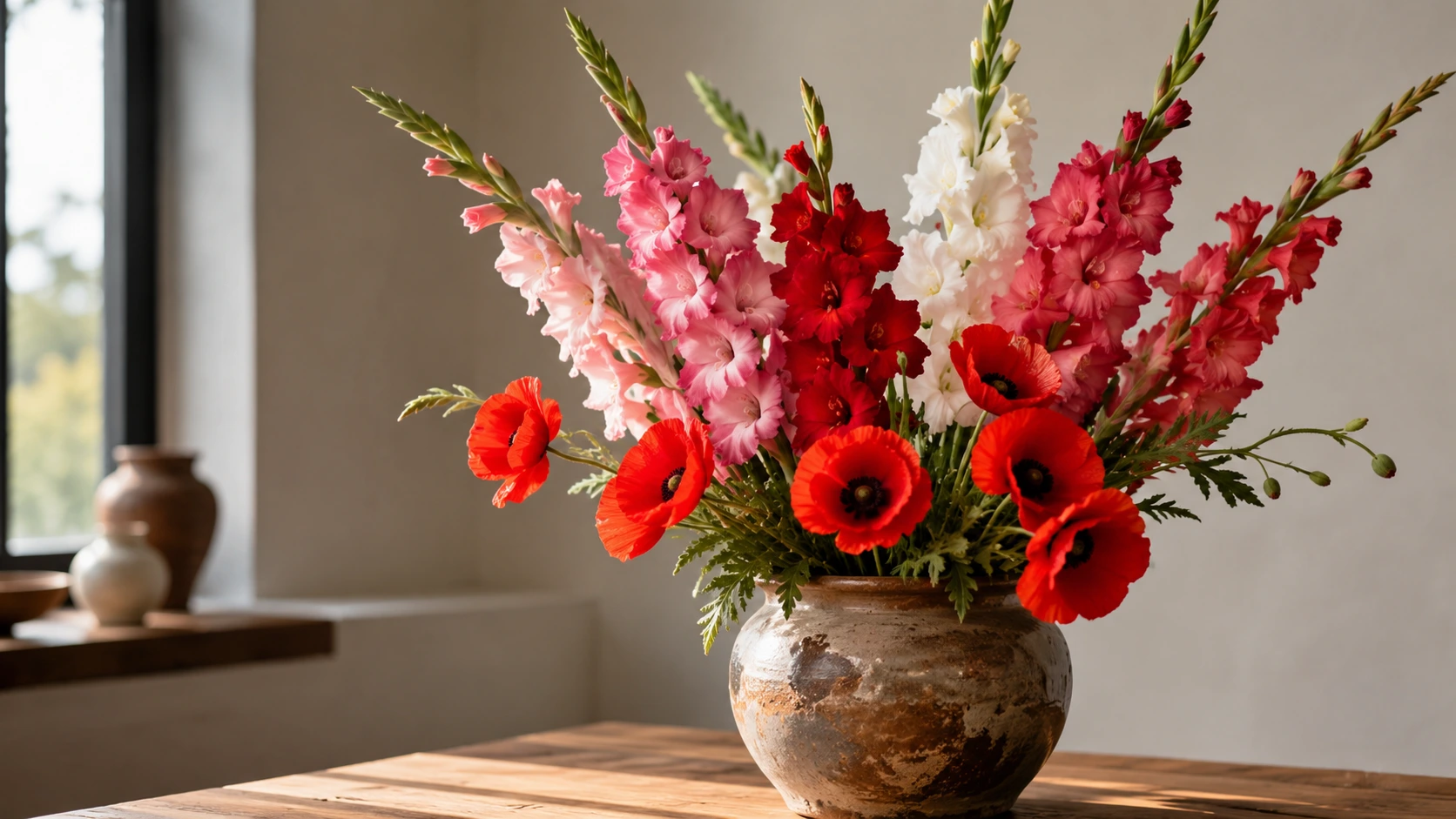
August has two birth flowers: the gladiolus and the poppy. Birth flowers are a modern custom rather than an official list, but these two are the pair most birth-month guides give for August. The August birth flower meaning mixes strength and remembrance: the gladiolus is named for a sword, and the red poppy has meant consolation since the Victorian language of flowers and remembrance since the First World War. This guide explains where each meaning comes from, what the poppy colors meant to the Victorians, how to grow both, and which one is risky around pets.
What Is the August Birth Flower?
| Gladiolus | Poppy | |
|---|---|---|
| Also called | Sword lily | Corn poppy, field poppy, Flanders poppy (Papaver rhoeas) |
| Grows from | A corm (not a true bulb) | Seed; corn poppy is an annual |
| Main meaning | Strength and integrity (modern) | Consolation (Victorian); remembrance (since WWI) |
| Flowers | Late summer into fall | Each bloom lasts only a day |
| Pets | Toxic to dogs, cats and horses (ASPCA) | Not safe to eat; see below |
Sources: NC State Extension Plant Toolbox (Gladiolus, Papaver rhoeas); University of Arkansas Extension; ASPCA; Greenaway (1884).
Gladiolus is a genus in the iris family. NC State Extension says it comes from Africa, Madagascar and Eurasia, and the University of Arkansas Extension notes about 250 species, with modern garden hybrids bred from African species introduced to Europe in the 18th and 19th centuries. The poppy most tied to August’s meaning is the corn poppy, Papaver rhoeas, which NC State also lists as the Flanders poppy.
Gladiolus Meaning
The gladiolus’s meaning comes from its shape. Its common name is sword lily (NC State), and gladiolus is Latin for “little sword”, after the long, blade-like leaves and the upright flower spike. Modern birth-flower guides build on that image and associate the gladiolus with strength, integrity and strength of character, which makes it a common gift for someone admired for resilience or honesty.
Many websites add stories about Roman gladiators wearing gladiolus or a Victorian meaning such as “you pierce my heart”. We could not find a reliable historical source for either. Kate Greenaway’s 1884 Language of Flowers, one of the best-known Victorian flower dictionaries, has no gladiolus entry at all, so treat gladiolus meanings as a modern tradition based on the sword name.
Poppy Meaning
The poppy carries two layers of meaning:
- Sleep and consolation. Poppies have long been linked with sleep because the opium poppy (Papaver somniferum, “sleep-bringing poppy”) is the source of opiates. The Victorian language of flowers built on this: Greenaway gives white poppy “Sleep. My bane. My antidote” and red poppy “Consolation”.
- Remembrance. Since the First World War, the red corn poppy has been the symbol of those who died in war. NC State notes the corn poppy “became a symbol for the losses incurred on the battlefields of World War I.”
As an August birth flower, the poppy is usually read as a flower of comfort and remembrance, a gentler counterpart to the bold gladiolus.
Poppy Colors in the Language of Flowers
| Entry in Greenaway (1884) | Meaning |
|---|---|
| Poppy, Red | Consolation |
| Poppy, Scarlet | Fantastic extravagance |
| Poppy, White | Sleep. My bane. My antidote. |
Source: Kate Greenaway, Language of Flowers (1884), Project Gutenberg eBook #31591.
Long lists of gladiolus color meanings (red for love, yellow for friendship and so on) circulate online, but they follow general flower-color conventions rather than any historical source, so use them loosely. Today, white poppies are also worn by some people as a symbol of peace alongside the red remembrance poppy.
The Remembrance Poppy
The red poppy’s modern meaning comes from the First World War. According to History.com:
- Corn poppies, a weed of disturbed ground, bloomed across the churned-up soil of Flanders and northern France.
- In spring 1915, after the Second Battle of Ypres, Canadian army surgeon Lt. Col. John McCrae wrote “In Flanders Fields“, published in Punch in late 1915.
- In November 1918, Georgia professor Moina Michael read the poem, vowed to wear a red poppy in remembrance, and later sold silk poppies to help veterans.
- The American Legion adopted the poppy as the official US remembrance emblem in 1920, helped by the campaigning of Frenchwoman Anna Guérin, and the British Legion held its first Poppy Appeal in November 1921.
How to Grow Gladiolus
Gladiolus grows from a corm. The University of Arkansas Extension explains it is not a true bulb but a solid, starchy corm.
- Sun: NC State says sword lilies prefer full to afternoon sun, with protection from strong winds.
- Planting: plant corms in spring after frost, at the depth on the package. Arkansas suggests planting in clumps of a dozen or so for borders, and making several plantings from April to late July for cut flowers all season.
- Support: tall spikes topple; Arkansas recommends a wire support such as a tomato cage.
- Bloom: NC State lists late summer into fall; Arkansas notes each bloom lasts less than a week.
- Winter: NC State lists hardiness as USDA zones 7 to 10 and says some varieties need to be dug and stored. Dig corms after the foliage dies in fall and store them dry in mesh bags with good air circulation at 35 to 41 °F (NC State). Arkansas notes hard winters that freeze the soil to corm depth kill them.
How to Grow Poppies
Poppies are easiest from seed sown where they will grow. Utah State University Extension (on seed poppies) advises sowing in late fall or very early spring, covering the seed no deeper than about 1/8 inch because poppy seeds need light to germinate, and notes that poppies do not transplant well. They want well-drained, fertile soil. NC State adds that corn poppy needs full sun, grows best in fertile, medium-moist, well-drained soil, and self-seeds, with each flower lasting only a day.
Note that USU points out it is illegal to make opium from opium poppies, even though the plant can be grown for garden and seed purposes in the US.
Is Gladiolus Toxic to Pets?
Yes: toxic to dogs, cats and horses
The ASPCA lists gladiola (Gladiolus species) as toxic to dogs, cats and horses. The toxic principles are unknown; clinical signs are salivation, vomiting, drooling, lethargy and diarrhea, and the highest concentration is in the corms. NC State rates it low severity. Store dug corms where dogs cannot reach them, and call your vet or the ASPCA Animal Poison Control Center at (888) 426-4435 if a pet eats any part.
Are Poppies Toxic?
Poppies should not be eaten by people or pets. The opium poppy contains opiate alkaloids. Even the corn poppy is not harmless: a 2015 report in Case Reports in Medicine describes five adults who ate cooked corn poppy and developed nausea, vomiting, confusion, seizures and other symptoms the authors attributed to the plant’s morphine-like effects; all recovered with supportive care. The ASPCA’s plant list does not include an entry for poppies, so if a pet chews one, call your vet or the ASPCA Animal Poison Control Center rather than assuming it is safe.
For pet-friendly flowers, see our cat-safe plants list.
Giving August Birth Flowers
- For a birthday: gladiolus makes a tall, striking cut flower. Pair colors to taste; its meaning of strength suits a friend or family member you admire.
- For remembrance: red poppies (or poppy imagery, since cut poppies wilt fast) carry the meaning of consolation and remembrance.
- For a gardener: a bag of gladiolus corms or a packet of corn poppy seed is a gift that returns every summer.
- Pet households: both are poor choices around animals that chew plants.
Looking for other months? See our guides to the January birth flower and September flower meaning.
Frequently Asked Questions
What are the August birth flowers?
The gladiolus and the poppy. Birth flowers are a custom rather than an official list, but these two are the pair most commonly given for August.
What does the gladiolus symbolize?
Strength and integrity, in modern birth-flower lists. The meaning comes from its sword-shaped leaves: gladiolus means “little sword” in Latin, and its common name is sword lily.
What does a red poppy mean?
In the Victorian language of flowers, consolation (Greenaway, 1884). Since John McCrae’s 1915 poem “In Flanders Fields”, the red poppy has been the symbol of remembrance for those who died in war.
What does a white poppy mean?
Greenaway’s 1884 flower dictionary gives white poppy the meaning “Sleep. My bane. My antidote.” Today white poppies are also worn by some as a symbol of peace.
Is gladiolus toxic to cats and dogs?
Yes. The ASPCA lists gladiola as toxic to dogs, cats and horses, with salivation, vomiting, drooling, lethargy and diarrhea, and the highest concentration in the corms.
Are poppies poisonous?
They should not be eaten. Opium poppies contain opiates, and a 2015 medical case report described adults poisoned after eating cooked corn poppy. Keep pets away from poppies.
Sources
- Greenaway, K. (1884). Language of Flowers. Project Gutenberg eBook #31591
- NC State Extension Plant Toolbox: Gladiolus
- NC State Extension Plant Toolbox: Papaver rhoeas
- Klingaman, G. Garden Gladiolus. University of Arkansas Cooperative Extension (2000)
- Cope, K. and Drost, D. (2020). Seed Poppy in the Garden. Utah State University Extension
- ASPCA: Gladiola
- Günaydın, Y.K. et al. (2015). Intoxication due to Papaver rhoeas (Corn Poppy): Five Case Reports. Case Reports in Medicine
- Pruitt, S. (2017, updated 2026). History.com article on the World War I remembrance poppy