
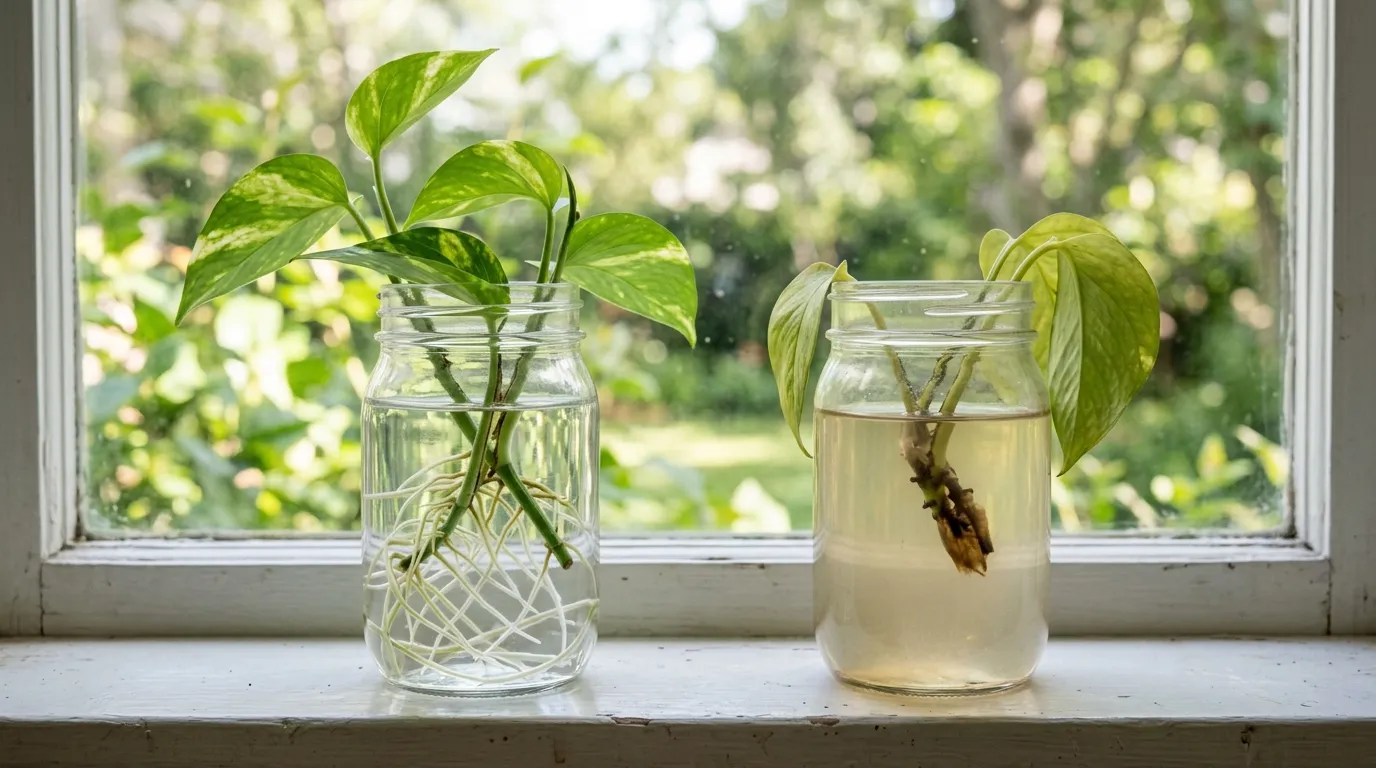
Cuttings rotting in water almost always comes down to the water itself: bacteria multiplying in it, too little oxygen at the cut stem, or leaves and extra stem sitting below the surface. University of Maryland Extension warns that bacterial growth in the water can lead to rotting and recommends changing the water at least twice a week, or whenever it looks cloudy. A soft, brown or black stem end can usually be cut off above the rot and the healthy part restarted in fresh water or a moist, airy mix.
| Cause | Why it leads to rot | Fix |
|---|---|---|
| Stale or cloudy water | Bacterial growth in the water can lead to rotting (UMD) | Change the water at least twice a week, or when cloudy (UMD) |
| Low oxygen at the stem | Dissolved oxygen is essential to root formation (Soffer and Burger, 1988) | Fresh water often; a wide jar; not too many cuttings per jar |
| Leaves or too much stem underwater | Submerged leaves decay and foul the water | Strip lower leaves; submerge only the node(s) |
| Thick stems | Can take longer to root and may rot before rooting (UMD) | Choose thinner, healthy stems |
| Low light or cold | Too little light slows rooting; cuttings may rot first (Iowa State) | Bright indirect light, 65 to 75°F (Iowa State) |
| Succulent cuttings | Most succulents do not root well in water (Iowa State) | Let the cut end callus, then root in a gritty mix |
Sources: University of Maryland Extension; Iowa State University Extension; Soffer and Burger, Acta Horticulturae 1988.
Rot or Normal? How to Tell
Not every change in the jar means rot. A cutting is rotting when the submerged stem turns soft, brown or black, feels slimy, or pulls apart; when the rot creeps up the stem; or when the water turns cloudy and smells sour within a day or two of changing it. A cutting is fine when the stem stays firm and green (or its normal color), new roots look white or cream and firm, and the water stays clear.
Some things look alarming but are usually harmless: a lower leaf yellowing while the cutting puts its energy into roots, a little green algae on the glass in bright light, or slight wilting in the first days because, as Iowa State explains, a cutting without roots has a limited capacity to take up water. Brown roots are not always rotten either; some plants make tan or brownish roots. Squeeze gently: healthy roots are firm, rotten ones are mushy and the outer layer slides off.
Why Cuttings Rot in Water
Bacteria in stale water
A cut stem releases sap into the water, and microbes that are naturally present in a home soon colonize it. University of Maryland Extension says to change the water periodically so it stays clean and provides oxygen, because bacterial growth in the water can lead to rotting. In answer to a reader whose monstera cuttings rotted, the same extension service noted on Ask Extension that rooting in water carries a greater risk of infection of the stem cuts, and that whether a cutting rots depends on many factors, including water temperature, the cutting’s vigor and the microbes in your home.
Not enough oxygen
Roots need oxygen to form. In a study rooting Ficus benjamina and chrysanthemum cuttings at dissolved oxygen levels from full saturation down to zero, Soffer and Burger (1988) concluded that dissolved oxygen is essential to root formation and root growth, affecting how soon roots appeared, how many cuttings rooted and how long the roots grew. They found the oxygen level that mattered most was right at the surface of the submerged stem. UMD gives the same reason for changing the water: it keeps the water clean and provides oxygen.
Leaves and extra stem under the surface
Leaves that sit in water decay and feed the bacteria in the jar. The University of Nevada, Reno and Iowa State both tell you to remove the lower leaves before rooting, and Iowa State says no leaves should be buried in the rooting medium. Submerging a long length of stem also gives rot more tissue to work on without adding more rooting points.
The wrong cutting
University of Maryland Extension advises choosing cuttings with relatively thin stems, because thicker stems can take longer to root and may rot before they do. A cutting taken from a stem that was already soft, yellowing or diseased brings the problem with it. Large leaves can also be a burden: the same source suggests pinching off some of the larger leaves if a cutting wilts, to reduce water loss until roots form.
Cold, dark spots
Iowa State notes that too little light slows root formation and that cuttings may rot or dry out before new roots form. Cuttings root faster when warm; Iowa State gives 65 to 75°F as the ideal air temperature and 4 to 6 hours of bright indirect light.
How to Save a Rotting Cutting
- Take it out and inspect it. Find where the soft or discolored tissue ends.
- Cut above the rot with scissors or a blade wiped with rubbing alcohol, back into firm, healthy stem. If the rot reached the node, cut above the next node up; a piece without a node will not root on most vining plants.
- Remove any rotten roots and any leaves that would sit in the water.
- Wash the jar with hot soapy water and rinse it well.
- Refill with fresh, room-temperature water and put the cutting back with just the node and a short length of stem submerged.
- Change the water at least twice a week, or as soon as it clouds (UMD), and top it up so roots are never left in air (Iowa State).
- If it rots again, move it to perlite or a light, moist mix. Ask Extension’s advice is simple: if roots rot in water, propagate in soil next time.
If several cuttings share a jar, take out the rotting one right away so it doesn’t foul the water for the others. Some guides suggest adding hydrogen peroxide to the jar; we found no trials showing it prevents cutting rot, and our hydrogen peroxide guide explains why the evidence for peroxide on roots is weak. Fresh water and a clean jar do the same job without the risk.
How to Stop Cuttings Rotting Next Time
- Use clean tools and jars. A sharp, clean cut heals better than a crushed one.
- Take healthy, thin-to-medium stems with at least one node, from a well-watered parent plant. Iowa State suggests watering the parent the day before so cuttings start fully hydrated.
- Strip every leaf that would touch the water and keep one or two leaves above it.
- Submerge only the node (or bottom node or two). The University of Nevada, Reno says roots usually begin to appear within about ten days on easy plants like pothos.
- Change the water once or twice a week (Iowa State: one to two times a week; UMD: at least twice) and whenever it clouds. UNR also suggests horticultural charcoal in the water.
- Don’t crowd the jar. Fewer stems per jar means one rotting cutting can’t foul the water for many others.
- Give warmth and bright indirect light, out of hot direct sun.
- Pot it up on time. Iowa State says to transplant when roots are about 1 inch long; UMD suggests letting roots grow another week or two after they appear. Roots left in water for months are more coarse and adapt less easily to soil.
Rooting hormone is not needed for most easy houseplants. Ask Extension notes its main benefit for cuttings is that some brands include a fungicide that discourages stem rot until the cut calluses over, which matters more when rooting in a mix than in water. Cinnamon is often suggested instead; our cinnamon for plants guide covers what the evidence says.
Pothos, Monstera and Snake Plant Cuttings
Pothos cuttings rotting in water
Pothos is one of the easiest plants to root in water (UNR, UMD), so rot usually means stale water, a leaf left in the jar, or a cutting without a node. Cut back to a healthy node and restart. Our pothos pruning and propagation guide shows where to cut.
Monstera cutting rotting in water
Monstera cuttings are thick, so they root more slowly and give rot more time, in line with UMD’s warning about thick stems. Make sure each cutting has a node (ideally with an aerial root), keep the big leaf out of the water and change the water often. If the stem end keeps going soft, sphagnum moss or perlite is often a safer choice; see our sphagnum moss propagation guide.
Snake plant cuttings rotting in water
Snake plants are succulents, and Iowa State Extension says most succulents do not root well in a glass of water. For succulent cuttings, it recommends letting the cut end dry and callus over for several days, so the cutting is less likely to rot, then rooting it in a well-drained medium such as cactus mix or perlite. Snake plants can also be divided. See our snake plant care guide.
When to Switch to Soil or Perlite
Water is convenient and lets you watch roots grow, but it isn’t always the best choice. Iowa State calls perlite a great rooting medium because it holds a good balance of water and air, and says most houseplant stem cuttings root in 3 to 6 weeks in a mix. Consider skipping water if a plant keeps rotting in it, if the cutting is thick or succulent, or if you plan to grow it in soil anyway: Iowa State notes that water roots are coarser and that newly potted water-rooted cuttings may show stress such as wilting, leaf drop or browning before they adjust.
If you do pot up a water-rooted cutting, use a small pot with drainage, keep the mix evenly moist for the first weeks (UMD), and then water normally once new leaves appear.
Frequently Asked Questions
Why are my cuttings rotting in water?
Usually bacteria in stale water, leaves or too much stem below the surface, a thick or unhealthy cutting, or cold, dim conditions. University of Maryland Extension says bacterial growth in the water can lead to rotting and recommends changing the water at least twice a week.
Can a rotting cutting be saved?
Often, yes. Cut above the rot into firm tissue, keeping at least one node, clean the jar, and restart it in fresh water or a moist, airy mix such as perlite.
How often should I change the water for cuttings?
Once or twice a week (Iowa State) or at least twice a week (University of Maryland), and any time the water looks cloudy. Top it up between changes so roots are not exposed to air.
Should cuttings be fully submerged in water?
No. Submerge only the node or bottom node or two, and remove any leaves that would sit in the water. Keep at least one leaf above the surface.
Why are my snake plant cuttings rotting in water?
Snake plants are succulents, and Iowa State Extension says most succulents do not root well in water. Let the cut end dry and callus for several days, then root it in cactus mix or perlite.
Does tap water make cuttings rot?
Not usually. University of Maryland Extension roots cuttings in clean, plain tap water. What matters more is changing it often and keeping the jar clean.
Sources
- University of Maryland Extension: Make More Plants From Cuttings: 5 Plants That Root Easily in Water
- Ask Extension (University of Maryland HGIC): Monstera cuttings rotting in water
- Iowa State University Extension: How to Propagate Houseplants by Stem Tip Cuttings
- Iowa State University Extension: How to Propagate Succulents
- University of Nevada, Reno Extension: Propagating Houseplants
- Soffer H, Burger DW (1988). Studies on plant propagation using the aero-hydroponic method. Acta Horticulturae 230.