
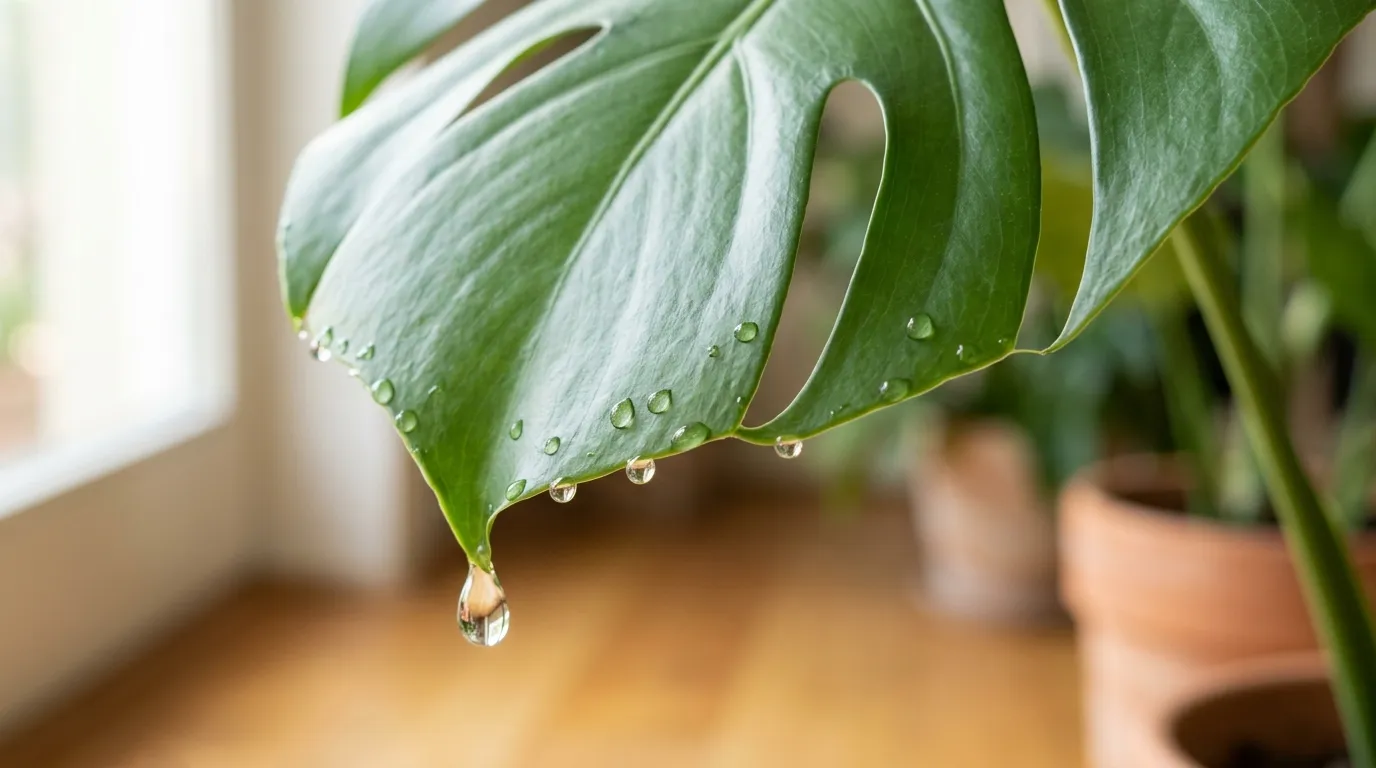
Guttation is the reason your plant is dripping water from its leaves. When the soil is moist and the leaves are losing little water (at night, or in cool, humid air), roots keep pulling water in and build up pressure. The University of Missouri IPM program explains that this root pressure pushes water out through hydathodes, small pores on the leaf margins near the ends of tiny veins, to relieve the pressure. It is most common on monstera, alocasia, pothos, philodendron and other plants with big leaves, and it is usually harmless.
| What you see | Most likely | Action |
|---|---|---|
| Clear drops on leaf tips or edges, mostly in the morning | Guttation (Missouri IPM) | None needed; wipe off if dripping on furniture |
| Drops plus white crust on tips, tips browning | Guttation leaving fertilizer salts (UConn) | Flush the soil, feed less |
| Drops plus soggy soil and yellow lower leaves | Overwatering | Let the mix dry more between waterings; check drainage and roots |
| Sticky, shiny spots on leaves and surfaces below | Honeydew from aphids, mealybugs or scale | Inspect for pests |
| Water-soaked spots that turn raised and corky | Oedema (RHS) | Improve ventilation; water carefully |
Sources: University of Missouri IPM; UConn Home and Garden Education Center; RHS: Oedema.
What Is Guttation?
Guttation is the release of liquid water from the leaves of an intact plant, driven by root pressure. Missouri IPM explains the mechanism: roots take up minerals from the soil, which can accumulate inside the root, and water follows by osmosis. During the day, transpiration through the stomata pulls that water up and out as vapor. At night, with the stomata closed, transpiration stops, pressure builds, and the water escapes as droplets from hydathodes on the leaf margins.
Hydathodes are different from stomata. Stomata are the pores plants open and close to exchange gases and lose water vapor; hydathodes sit at leaf tips and edges, over the ends of the veins, and release liquid. That is why guttation drops line up along the leaf edge or hang from the “drip tip” of an aroid leaf, rather than covering the whole surface like dew.
The liquid is not pure water. Missouri IPM notes that guttation water contains minerals and sugars, though the amounts lost are inconsequential for the plant. When the drops dry, those dissolved substances can be left behind as a faint white residue.
Why Is My Plant Dripping Water?
According to Missouri IPM, guttation is favored by night conditions of high humidity, cool air and warm soil, which let root pressure move water to the leaves while transpiration is shut down. Indoors, the usual triggers are:
- A recent thorough watering, so the roots are surrounded by water.
- Cool nights or humid rooms, which slow transpiration.
- Large-leaved, fast-growing plants such as monstera, alocasia, colocasia, philodendron and pothos, which commonly show it.
- Healthy, active roots: root pressure needs working roots, which is why guttation is often seen on vigorous plants.
Monstera dripping water from its leaves, or an alocasia “crying” at the leaf tip, is usually exactly this. It often appears the morning after watering and fades as the soil dries.
Is Guttation Good or Bad?
Mostly neither. It is a normal process, and in itself it tells you the roots are taking up water. Missouri IPM describes it as a pressure relief and points out two minor side effects in opposite directions: in rare cases, bacteria can grow in guttation droplets and be pulled back into the leaf when the sun comes up, leading to infection; in other cases, guttation may reduce oedema, a disorder caused by excess water in the leaves.
The more practical downside indoors is salt. UConn Extension explains for dieffenbachia that if there are excessive fertilizer salts in the soil, they will be dissolved in the guttation droplets, and when the droplets evaporate the salts remain on the leaf tip, causing tip burn. If you see white crust and browning where the drops form, flush the pot with plenty of plain water and feed less; our guide to fertilizer salt buildup shows how.
Is Guttation a Sign of Overwatering?
Not by itself. Guttation needs moist soil, so it is common after any normal, thorough watering. It becomes a warning only when other signs come with it: soil that stays wet for many days, yellowing lower leaves, a sour smell, mushy stems or drooping despite wet soil. Those point to overwatering or poor drainage, not to guttation.
If the drops appear every single morning and the mix never dries, water less often and make sure the pot has drainage holes and an airy mix. Our overwatered vs underwatered guide helps you tell the difference. Don’t try to stop guttation by keeping a plant dry: underwatering causes its own damage.
Is Guttation Toxic to Touch or to Pets?
This is a common worry with dieffenbachia, alocasia, monstera and pothos, all of which the ASPCA lists as toxic to pets because of insoluble calcium oxalate crystals. We found no study that measured whether guttation drops from these houseplants carry those crystals or cause irritation. What is known is that the crystals are made and stored inside specialized cells: a study of dieffenbachia found raphide-producing cells in nearly every organ (Coté, 2009), and UConn explains that the needle-like raphides are ejected when cell walls are damaged, which is why chewing or cutting the plant causes burning. Guttation fluid comes from the water-conducting veins, not from crushed cells.
Guttation drops can carry other dissolved substances, though. A UF/IFAS Extension article notes that bees can be exposed to pesticides in guttation drops, and studies on crops have found systemic insecticides in guttation liquid (Mörtl et al., 2020). So the sensible approach is simple caution:
- Wipe drops off leaves and surfaces rather than leaving them where pets can lick them.
- Wash your hands after handling toxic plants, and keep your hands away from your eyes, as NC State advises for dieffenbachia.
- Keep toxic plants out of reach of pets and children whether or not they guttate.
- If a plant has been treated with a systemic insecticide, be especially careful to keep pets away from it.
If a pet chews a toxic plant, call your vet or the ASPCA Animal Poison Control Center at (888) 426-4435. See our dieffenbachia care guide for safe handling.
Guttation vs Dew, Honeydew and Oedema
| Where it forms | Feel and look | Cause | |
|---|---|---|---|
| Guttation | Leaf tips and margins | Clear drops; may dry to faint white residue | Root pressure through hydathodes |
| Dew or condensation | Spread over the whole leaf surface (and on non-living surfaces) | Clear, pure water | Moisture condensing from cool, humid air |
| Honeydew | On leaves and on surfaces below them | Sticky and shiny; may turn black with sooty mold | Excreted by aphids, mealybugs, scale and other sap-feeders |
| Oedema | Mostly leaf undersides | Water-soaked spots that become raised, warty, then corky (RHS) | Roots taking up more water than leaves can transpire, rupturing cells (RHS) |
Transpiration is related but different: it is water leaving the leaf as vapor through the stomata, mostly in the day. Guttation is liquid water forced out of the hydathodes, mostly at night. If drops are sticky, look under the leaves and along stems for insects or white cottony patches; our mealybug treatment guide covers the most common culprit. The RHS describes oedema as a disorder caused by the roots taking up more water than the leaves can transpire, with water-soaked patches that turn corky; it advises not picking affected leaves off, improving ventilation and watering carefully.
What to Do About It
- Confirm it is guttation: clear drops at tips or edges, mostly in the morning, not sticky.
- Protect surfaces: move the plant off wood furniture or put a saucer or mat where the leaf tips drip.
- Water by the soil: water thoroughly when the top of the mix has dried, then empty the saucer.
- Check drainage: a pot with holes and an airy mix dries more evenly; see our aroid soil mix guide.
- Watch the tips: white crust or brown tips where drops form mean salt buildup; flush the soil and feed less (UConn).
- Keep air moving: good ventilation helps leaves dry and reduces the small infection risk Missouri IPM mentions.
Frequently Asked Questions
Why is my plant crying water?
That is guttation. When the soil is moist and transpiration is low, usually at night, root pressure pushes water out through hydathodes on the leaf tips and edges (Missouri IPM). It is normal.
Is guttation bad for plants?
Usually not. The minerals and sugars lost are inconsequential, according to Missouri IPM. Rarely, bacteria in the drops can cause infection, and fertilizer salts left by the drops can burn leaf tips (UConn).
Is guttation a sign of overwatering?
Not on its own. It simply means the soil is moist and the roots are active. It points to overwatering only if the soil also stays wet for days, lower leaves yellow or stems turn soft.
Is guttation toxic to touch?
We found no study showing guttation drops from dieffenbachia, alocasia, monstera or pothos cause irritation; the irritating crystals are released when plant cells are damaged (UConn). As a precaution, wipe drops away, wash your hands after handling toxic plants and keep pets from licking the drops.
Why is my monstera dripping water from leaves?
Guttation. Monstera has large leaves with a drip tip, and drops often form there the morning after watering. If the soil drains and dries normally between waterings, no action is needed.
Guttation vs transpiration: what is the difference?
Transpiration is water leaving leaves as vapor through stomata, mainly in daytime. Guttation is liquid water pushed out through hydathodes by root pressure, mainly at night when the stomata are closed (Missouri IPM).
What is the difference between guttation and dew?
Guttation comes from inside the plant and forms at leaf tips and edges; dew condenses from the air and covers whole surfaces, including non-living ones.
Sources
- University of Missouri IPM: Guttation, A Pressure Relief for Plants
- UConn Home and Garden Education Center: Dieffenbachia (guttation and tip burn)
- Royal Horticultural Society: Oedema
- UF/IFAS Extension Hillsborough County: Guttation and Bees
- Coté GG (2009). Diversity and distribution of idioblasts producing calcium oxalate crystals in Dieffenbachia seguine. American Journal of Botany.
- Mörtl M et al. (2020). Appearance of Thiacloprid in the Guttation Liquid of Coated Maize Seeds. Int J Environ Res Public Health.