
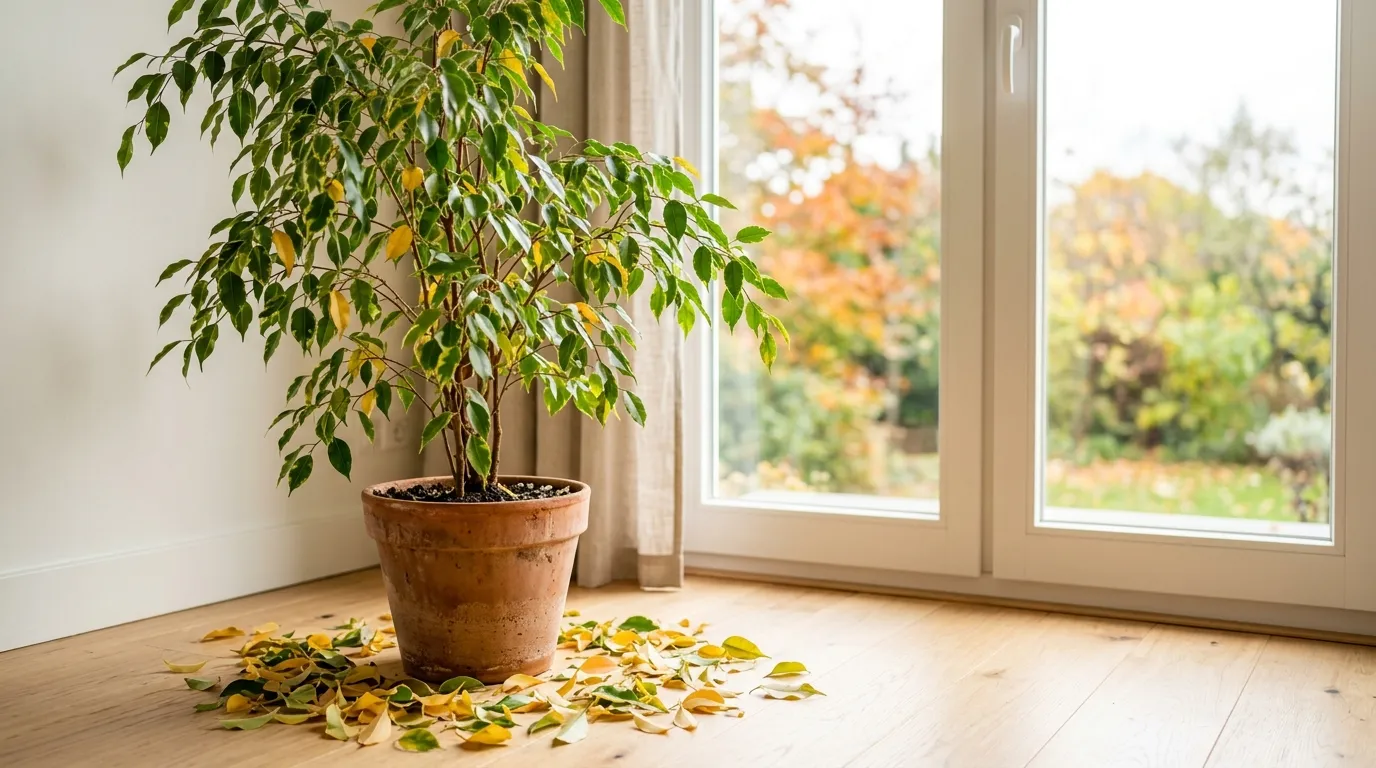
Every autumn the same thing happens: a weeping fig that looked lush all summer comes indoors and starts raining leaves onto the floor. If your ficus benjamina is dropping leaves, don’t panic and don’t start changing everything at once. Clemson Extension calls leaf drop the most common problem of weeping figs and notes they “seem to react to almost any stress by shedding leaves.” The good news from the same factsheet: if conditions are adequate, the plant adjusts, stops dropping leaves and puts out healthy new growth.
Why Ficus Benjamina Drops Leaves
A weeping fig dropping leaves is reacting to its environment. Weeping fig (Ficus benjamina) is a tropical tree. NC State Extension describes it as native to southeastern Asia and Australia, “very sensitive to light”, and intolerant of cold, and notes that if the plant is moved it may drop leaves as it adjusts to the new light. Leaves are built for the light they grew in. When the light drops sharply, the plant sheds leaves it can no longer support and later grows new ones suited to the new conditions.
That is why a tree that spent summer on a bright patio, or came straight from a sunny greenhouse, often sheds heavily in its first weeks indoors. Clemson’s guidance for moving houseplants is to lower the light gradually over about a week before the move, so the plant has time to adjust.
Diagnose the Cause
| What happened | What you see | Fix |
|---|---|---|
| Moved to a new spot, or brought indoors | Sudden drop of mostly green or yellowing leaves over a few weeks, often from inside the canopy | Give the brightest indirect light you can, then leave it in place |
| Not enough light | Steady leaf loss, sparse thin canopy, little new growth | Move closer to a bright window or add a grow light |
| Draft or heat vent | Leaf drop on one side, or after heating starts | Move away from doors, cold glass, radiators and vents (Clemson) |
| Overwatering | Yellow leaves dropping, soil stays wet, possible sour smell | Let the soil dry slightly; check roots for rot |
| Underwatering | Dry, crispy leaves, soil pulled away from the pot | Water thoroughly, then keep moisture more even |
| Repotting | Leaf drop in the weeks after repotting | Keep conditions steady and wait |
| Lack of nitrogen | Older leaves pale and dropping, slow growth, no feeding for months | Feed during the growing season (Clemson: every month or two) |
| Pests | Sticky leaves, fine webbing, bumps or speckling | Check for spider mites, scale, mealybugs, aphids and thrips |
Sources: Clemson HGIC 1514 (Weeping Ficus); NC State Extension Plant Toolbox.
Ficus Dropping Leaves in Winter or After Moving Indoors
This is the most common case in autumn and winter. Indoor light is far weaker than outdoor shade, and heating dries the air. Clemson’s advice for moving houseplants indoors (HGIC 1454) is to bring them in when outside and inside temperatures are about the same, before the heat is turned on, and to step the light down over about a week: from sun to light shade to heavy shade, then indoors. It warns that once indoors, a plant may yellow or drop leaves as it adjusts to lower light.
For weeping figs specifically, Clemson says not to place the plant near a heat vent or draft when bringing it inside, “as this will cause excessive leaf drop.” Put it in your brightest indirect spot, check the plant for pests before it comes in, and expect some leaf loss over the following weeks. Weeping figs prefer warmth: Clemson gives 65 to 70 °F nights and 75 to 85 °F days as ideal, and NC State notes the plant is very frost sensitive.
Dropping Leaves After Repotting
Clemson notes that weeping figs often shed leaves when repotted. Root disturbance and a change of soil are a stress, so some drop is normal. Clemson also says weeping figs tolerate being slightly root bound and recommends repotting in late winter or early spring with a general-purpose potting soil. If you have just repotted, don’t add fertilizer or move the plant again; keep watering steady and give it a few weeks.
Dropping Yellow Leaves vs Green Leaves
- Green leaves falling suddenly usually means a sudden change: a move, a cold draft, a burst of hot dry air from a vent, or a big shift in light.
- Yellow leaves dropping over time points more to watering (too much or too little), low light, or a lack of nitrogen if the plant has not been fed.
- A few yellow leaves deep inside the canopy are normal: older, shaded leaves are shed as the plant grows.
For a general guide to yellow leaves, see our yellow leaves guide, and for watering mistakes, our overwatered vs underwatered guide.
How to Stop the Leaf Drop
- Stop moving it. Every move is a new light change. Pick the best spot and leave the plant there.
- Maximize light. Clemson says weeping figs grow best in bright indirect or curtain-filtered sunlight. In winter, a spot close to a bright window (but not touching cold glass) is usually best. A grow light helps in dim rooms; see our grow light guide.
- Remove drafts and heat. Keep it away from exterior doors, cold windows, radiators and heating vents.
- Water steadily. Clemson advises keeping the soil evenly moist during active growth and letting it dry slightly between waterings in winter and other low-growth periods, never letting the plant sit in water in its saucer. NC State says to water just often enough to keep the soil from drying out completely.
- Check for pests. Clemson lists spider mites and scale as frequent pests, plus mealybugs, aphids and thrips. See our spider mite guide.
- Don’t fertilize a stressed plant. Wait until you see new growth, then feed during the growing season.
- Be patient. Sweep up the leaves and look for new buds at the branch tips. Clemson says that if conditions are adequate the plant will adjust, stop dropping leaves and grow healthy new foliage.
Don’t prune hard while it is shedding
Bare twigs are not necessarily dead. Scratch a twig with a fingernail: green underneath means it is alive and can leaf out again. Clemson notes weeping figs tolerate hard pruning to reduce their size, but wait until the plant has recovered and is growing before shaping it, and reduce watering for a severely pruned plant.
Preventing Leaf Drop Long Term
- Choose one bright spot and keep the plant there year-round if you can.
- If it summers outdoors, Clemson suggests morning sun and afternoon shade, and bringing it in before the heat goes on, stepping the light down gradually.
- Keep watering consistent and adjust for the season.
- Feed every month or two during the growing season (Clemson).
- Wash the leaves occasionally with plain warm water (Clemson), which also helps you spot pests early.
- For a less fussy tree, Clemson notes that some cultivars shed less (‘Daniëlle’ is described as resistant to leaf drop and ‘Judith’ as shedding minimally), and that the longleaf fig (Ficus binnendijkii) holds its leaves better than the weeping fig.
Is Ficus Benjamina Toxic to Pets?
Toxic to cats and dogs
The ASPCA lists fig (weeping fig, Ficus benjamina) as toxic to dogs, cats and horses. Its toxic principles are a proteolytic enzyme (ficin) and psoralen (ficusin), and the clinical signs are gastrointestinal and dermal irritation. Sweep up fallen leaves if pets chew plant debris, and call your vet or the ASPCA Animal Poison Control Center at (888) 426-4435 if a pet eats it. Pet-safe options are in our cat-safe plants list.
Growing the related fiddle-leaf fig? See our fiddle-leaf fig care guide.
Frequently Asked Questions
Why is my ficus benjamina dropping leaves?
Usually because something changed. Clemson Extension lists overwatering, underwatering, drafts, lack of nitrogen and low light as causes, and notes weeping figs often shed leaves when moved or repotted.
Why is my ficus dropping leaves in winter?
Lower indoor light, heat vents and drafts are the usual causes. Clemson warns that placing a weeping fig near a heat vent or draft causes excessive leaf drop. Give it bright indirect light away from heat and cold air.
Will my ficus grow its leaves back?
Usually, yes. Clemson says that if growth conditions are adequate, the weeping fig adjusts to its new location, stops dropping leaves and grows healthy new foliage. Check that twigs are still green under the bark.
Why is my ficus dropping leaves after repotting?
Repotting disturbs the roots, and Clemson notes weeping figs often shed leaves after repotting. Keep light and watering steady, skip fertilizer, and give it a few weeks.
Should I water my ficus more if it is dropping leaves?
Not automatically. Both overwatering and underwatering cause leaf drop. Check the soil first: Clemson advises evenly moist soil in active growth and slightly drier soil in winter, never standing in water.
Is weeping fig toxic to cats?
Yes. The ASPCA lists weeping fig (Ficus benjamina) as toxic to cats, dogs and horses, causing gastrointestinal and skin irritation.