
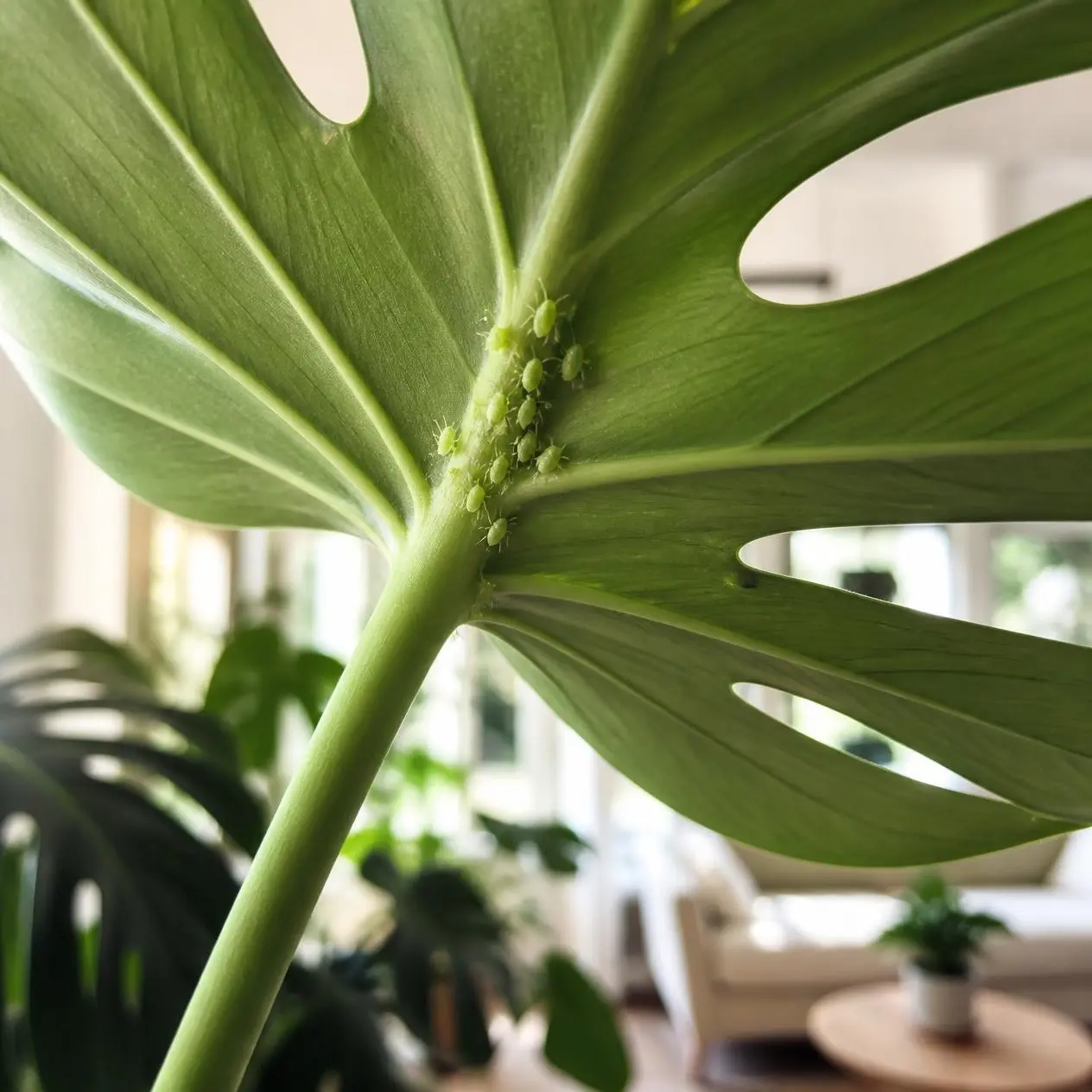
Aphids on indoor plants announce themselves quietly. You notice one new leaf stuck half-open, a faint shine on the foliage, maybe an ant walking a path it has no business walking. Then you flip a leaf and find a cluster of tiny green pearls crowded along the midrib, all of them feeding. You are not looking at a few stray bugs. You are looking at the front edge of a colony that has been doubling while you watered around it.
The good news: aphids are one of the most beatable pests on houseplants, if you treat them correctly and, critically, more than once. This guide walks you through confirming the ID, treating the colony in the right order, and closing the doors so they do not come back.
Quick answer: Aphids on indoor plants are soft-bodied sap-suckers that cluster on new growth and the undersides of leaves. Isolate the plant, rinse off the colony, then spray insecticidal soap to coat every aphid, repeating every 4 to 7 days until they are gone. Soap kills only on contact, so a single spray never finishes the job.
How to Confirm Aphids on Indoor Plants Before You Spray Anything
According to NC State Extension, most aphids are less than 1/8 inch long and commonly light green or yellow, though they also come in white, black, red, brown, or gray. They may be winged or wingless. That color range is exactly why gardeners miss them: a gray aphid on a gray-stemmed plant hides in plain sight.
The feature that separates aphids from every other small houseplant bug is a pair of cornicles, two short tube-like structures projecting from the rear of the abdomen like tiny exhaust pipes. You will need a phone camera zoomed in or a cheap loupe to see them, but they are the morphological anchor that makes the ID certain. Aphids also have soft, pear-shaped bodies and relatively long antennae; they do not jump or fly away when disturbed, they just slowly crawl or drop off the leaf.
Where they position themselves is a second clue. The University of Maryland Extension notes that aphids feed in groups on young leaves and flower buds, which is why the freshest growth on your plant is always the first to show damage. On indoor plants specifically, UMD lists orchids, gardenias, citrus, succulents, and overwintered tropicals like hibiscus as common hosts.
Then there is the evidence aphids leave behind. Feeding aphids excrete a sugary liquid called honeydew, which coats leaves in a sticky, glossy film. Indoors, this film accumulates because no rain rinses it away, and a black fungal growth called sooty mold colonizes it. UMD also flags a telltale pairing that experienced growers check first: ants. Ants tend aphids like livestock, protecting the colony from predators in exchange for honeydew. Ants marching up your pot or along stems almost always means aphids somewhere above them.
Match Your Symptoms to the Cause
Work down this table before choosing a treatment. The fix column assumes you have confirmed aphids; if your symptoms point elsewhere, follow that trail instead.
| What you see | What it means | What to do |
|---|---|---|
| Clusters of tiny green, yellow, black, or gray bugs on new growth or leaf undersides | Active aphid colony | Begin the treatment steps below, starting with isolation |
| Sticky, shiny coating on leaves or the surface below the pot | Honeydew from aphid feeding | Wipe leaves with a damp cloth, then treat the colony producing it |
| Black, sooty film on leaf surfaces that smears when wiped | Sooty mold growing on honeydew | Wipe it off; it clears permanently once the honeydew source is eliminated |
| New leaves emerge curled, crinkled, stunted, or stuck together | Aphids fed on the tissue while the leaf was still expanding | Treat the colony; prune the distorted leaves, they will not flatten out |
| Ants trailing up the pot or along stems | Ants farming aphids for honeydew | Eliminate the aphids first, then break the ant trail or they will re-protect new arrivals |
| White, cottony clumps in leaf axils instead of exposed bugs | Mealybugs, not aphids | Switch protocols: see our mealybug treatment guide |
| Silvery speckling and slender rice-shaped bugs that scurry when disturbed | Thrips, not aphids | See our guide to getting rid of thrips |
Why Aphids Show Up Indoors in the First Place
People assume aphids are an outdoor problem that stays outside. They are not. Winged aphids drift in through open windows and balcony doors, and they hitchhike in on the exact things plant lovers bring home: new nursery plants, gifted cuttings, fresh herbs, and cut flowers. A single winged female landing on your monstera can seed a colony that, per NC State Extension, builds up faster than most houseplant owners expect, because aphids reproduce without needing to mate and give birth to live young.
Your fertilizing habits matter more than you think. NC State Extension notes that high nitrogen levels push soft, succulent growth, which is precisely the tissue aphids prefer to pierce and feed on. If you are dosing a plant with a nitrogen-heavy fertilizer every week, you are effectively ringing the dinner bell. Over-fertilized, lush, fast-growing plants are almost always the first ones colonized in a collection.
The other accelerator is the ant partnership. Outdoors, ladybugs and lacewings keep aphids in check. Indoors, those predators are absent, and the only “helper” your aphids have is a motivated ant colony actively defending them. Until you deal with both sides of that arrangement, treatments will underperform.
How to Get Rid of Aphids on Indoor Plants, Step by Step
- Isolate the plant today. Move it at least 3 feet from every other plant; wingless aphids crawl, and close contact is how colonies jump collections. Check the plants that were sitting nearest to it, especially the undersides of their newest leaves, with a flashlight.
- Rinse the colony off. Take the plant to a sink or shower and use a firm stream of lukewarm water, aiming at the undersides of leaves and growing tips where the colony clusters. NC State Extension recommends rinsing aphids off with a strong stream of water daily for three days. This knocks the population down by most of its numbers before you spend a drop of spray.
- Spray insecticidal soap, and coat everything. Insecticidal soap kills by suffocation and by stripping the aphid’s protective waxes, per Clemson University’s Home & Garden Information Center. Spray until the solution drips from both the tops and undersides of leaves, and from stems. Test on one leaf first and wait 24 hours to confirm your plant tolerates it, and keep the plant out of direct sun for a day after spraying.
- Repeat on a schedule, not on hope. Here is the step almost everyone skips. According to Ask Extension, soaps and oils kill only the aphids present on the day you spray. Anything that hatches or wanders in afterward is untouched. Clemson HGIC suggests reapplying soap every 4 to 7 days, following the label, until the pests are gone; inspect between applications with a flashlight at leaf undersides.
- Break the ant alliance and clean the honeydew. Wipe remaining sticky residue off leaves with a damp cloth (a mild soap solution on the cloth helps). If ants were involved, find and seal their entry point and remove their trail with a vinegar-water wipe. Aphids without ant bodyguards are far easier to finish off.
- Escalate only if the colony survives week three. For stubborn infestations, neem oil or horticultural oil is the next rung. Ask Extension recommends a 1 to 2% oil solution in water with thorough coverage of the foliage. Our neem oil guide for houseplants covers dilution and timing. For severe cases, a labeled systemic insecticide is the last resort; see our overview of chemical pest control options for indoor plants.
Pro tip: Schedule your repeat sprays in your phone the moment you do the first one. The single most common reason aphid treatments fail indoors is not weak product; it is treating once, seeing dead bugs, assuming victory, and forgetting the eggs and survivors reset the clock.
Keep Aphids on Indoor Plants from Coming Back
Elimination is only half the job. Prevention is cheaper than any spray bottle.
- Quarantine every new plant for two weeks. New arrivals are the number one way aphids enter a collection. A bathroom or spare room shelf, checked twice a week, catches hitchhikers before they reach your established plants.
- Fertilize for steady growth, not forced growth. Dial back nitrogen-heavy feeding on plants that keep getting colonized. NC State Extension links high nitrogen to the soft, succulent growth aphids target first.
- Inspect the undersides of new leaves weekly. A ten-second flashlight check during your normal watering routine catches colonies at five bugs instead of five hundred.
- Do not ignore ants. An ant trail indoors is an early warning system. Follow it, find what they are visiting, and deal with it while the colony is still small.
- Rinse foliage occasionally. A periodic shower washes off early colonizers and any honeydew before sooty mold can take hold, two problems solved with one habit.
Frequently Asked Questions
Do aphids on indoor plants kill the plant?
Rarely on an established houseplant, but heavy colonies stunt growth, permanently distort new leaves, and can kill seedlings. The bigger risks are honeydew fueling sooty mold and the colony multiplying faster than a one-time treatment can catch.
Can I use dish soap instead of insecticidal soap?
Not recommended. Dish detergents are formulated to strip grease, not to be gentle on leaf surfaces, and they can damage foliage. A labeled insecticidal soap product is the tested, plant-safe option, and it kills aphids by suffocation on contact.
How long does it take to get rid of aphids on indoor plants?
With rinsing plus insecticidal soap repeated every 4 to 7 days, most light to moderate infestations clear within two to three weeks. Survivors and newly hatched aphids restart the colony, which is why one application is never enough.
Where do aphids on indoor plants come from?
New plants and cuttings are the most common source, followed by open windows and doors letting winged aphids drift in. Ants also transport and protect aphids while farming their honeydew, which keeps colonies alive between treatments.