
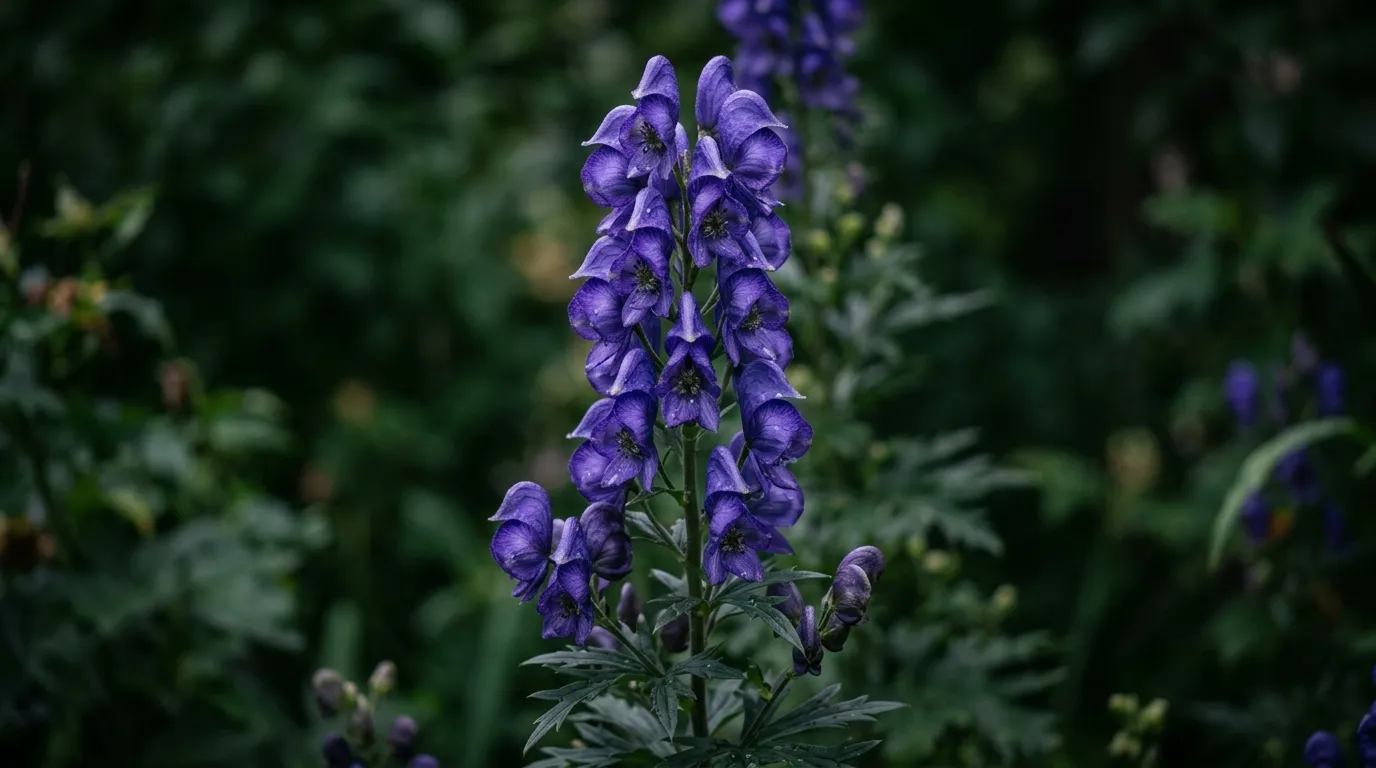
Few flowers carry as split a reputation as monkshood. Its tall spikes of hooded blue flowers look noble, almost armored, and Victorian flower dictionaries gave it gallant meanings. Yet the same plant, under its other name aconite or wolfsbane, is one of the most poisonous plants in the garden and has been tied to poison and monsters since ancient Greece. This guide explains the monkshood meaning in the language of flowers, where its names come from, the myths behind it, and what it means to give or grow it today.
Monkshood Meaning in the Language of Flowers
The Victorian “language of flowers” assigned a sentiment to each plant so that bouquets could carry coded messages. One of the best-known of these dictionaries, Kate Greenaway’s Language of Flowers (1884, free on Project Gutenberg), lists three related entries:
| Entry in Greenaway (1884) | Meaning |
|---|---|
| Monkshood (Helmet Flower) | Chivalry. Knight-errantry. |
| Helmet Flower (Monkshood) | Knight-errantry. |
| Aconite (Wolfsbane) | Misanthropy. |
Source: Kate Greenaway, Language of Flowers (1884), Project Gutenberg eBook #31591.
So the monkshood flower meaning depends on which name the giver used. As “monkshood” or “helmet flower”, it stood for chivalry and the wandering knight of romance, which fits the flower’s shape: NC State Extension describes the upper part of each bloom as “hood or helmet-like in appearance”. As “aconite” or “wolfsbane”, the same genus carried the far darker meaning of misanthropy, a dislike of humankind, which fits its reputation as a poison.
Flower dictionaries disagreed with one another and were written as parlour entertainment, not botany, so no single meaning is “official”. But chivalry for monkshood and misanthropy for aconite are the pairings in Greenaway’s book, and they are the ones most modern flower-meaning lists repeat.
Monkshood, Aconite, Wolfsbane: What the Names Mean
NC State lists an unusually long string of common names for Aconitum: aconite, blue rocket, devil’s helmet, helmet flower, leopard’s bane, monkshood, queen of poisons, wolfsbane and woman’s bane. They fall into two groups:
- Shape names: monkshood, helmet flower and devil’s helmet all describe the hooded top of the flower, like a monk’s cowl or a knight’s helm. These names gave monkshood its chivalrous meaning.
- Poison names: wolfsbane, leopard’s bane and queen of poisons describe what the plant does. The Encyclopaedia Romana notes that the ancient name lycotonum is glossed as “wolfsbane”, and that the Greek physician Dioscorides described a plant used to kill panthers, wolves and other wild beasts.
The genus name Aconitum is old and its origin was already debated in Roman times. The Encyclopaedia Romana collects the main explanations: Pliny the Elder linked it to the port of Aconae, “of evil repute for the poison called aconite”, and to the rocky crags where it grew, and another reading connects it to the Greek akon, a dart or javelin, whose tips were poisoned with it.
Monkshood in Greek and Roman Myth
Aconite appears in some of the most famous poison stories of the ancient world, as summarized by the Encyclopaedia Romana:
- Cerberus. In Ovid’s Metamorphoses (Book VII), the poison comes from the foaming mouth of Cerberus, the three-headed hound of the underworld, when Hercules dragged it into daylight; the herb that grew from it was called aconite.
- Medea and Theseus. In the same passage, the sorceress Medea tricks King Aegeus into offering aconite-laced wine to his own son, the hero Theseus, who is saved only when his father recognizes him.
- Hecate. The historian Diodorus Siculus says aconite was discovered by Hecate, goddess of witchcraft, whom he makes Medea’s mother.
These stories explain why aconite became a shorthand for poison, witchcraft and the underworld in later literature, and why fantasy writers still reach for “wolfsbane” when they need a plant against werewolves.
Monkshood Spiritual Meaning and Modern Symbolism
There is no ancient “spiritual meaning” for monkshood in the way there is for, say, the lotus. What you will find online under monkshood meaning spiritual is modern interpretation built on the two historical threads above. Read honestly, they suggest:
- Protection and courage: from the helmet shape and the Victorian meaning of chivalry.
- Caution and boundaries: from its poison and the misanthropy of “aconite”; beautiful, but not to be handled carelessly.
- Danger and the underworld: from the Cerberus and Hecate myths, which is why it shows up in gothic and witch-themed art and tattoos.
If you use monkshood as a symbol in art, writing or a tattoo, “brave but dangerous” captures both sides of its history.
Can You Give Monkshood as a Gift?
Beautiful, but highly poisonous
NC State Extension rates monkshood’s toxicity as high: all parts, including roots, leaves, flowers and seeds, contain alkaloids such as aconitine, and it is poisonous if ingested and may be fatal to humans and pets. Symptoms include burning of the lips and mouth, numbness of the throat, vomiting, muscle weakness, a weak pulse and respiratory paralysis. Wear gloves when handling it, and never give it to a household with children or pets, or to anyone who might mistake it for an edible plant.
As a cut flower or bouquet, monkshood is a poor gift for most people despite its noble meaning. If you want to say “chivalry” or “courage” with flowers, a picture, card or illustration of monkshood carries the message without the risk. If you already grow it, see our monkshood care guide for safe handling. For other flower meanings, see our guides to peace lily meaning and September flower meaning.
Frequently Asked Questions
What does monkshood mean in the language of flowers?
Chivalry and knight-errantry. Kate Greenaway’s Language of Flowers (1884) lists “Monkshood (Helmet Flower): Chivalry. Knight-errantry.”
What is the difference between monkshood and wolfsbane meaning?
They are the same plant genus, Aconitum, but Victorian flower dictionaries gave the names different meanings. Greenaway gives monkshood “chivalry” and “aconite (wolfsbane)” “misanthropy”.
Why is it called monkshood?
Because the top of each flower forms a hood. NC State Extension describes the upper part of the bloom as hood or helmet-like, which also explains the names helmet flower and devil’s helmet.
What is the spiritual meaning of monkshood?
There is no traditional spiritual meaning. Modern interpretations combine its Victorian meaning of chivalry and courage with its long history as a poison, so it is often read as protection or bravery paired with caution.
Why is monkshood called wolfsbane?
Because it was used as a poison against wolves and other wild animals. The ancient name lycotonum means wolfsbane, and Dioscorides described an aconite used to kill panthers and wolves.
Is monkshood poisonous?
Yes, highly. NC State Extension says all parts contain toxic alkaloids including aconitine and may be fatal to humans and pets if eaten. Wear gloves when handling it.