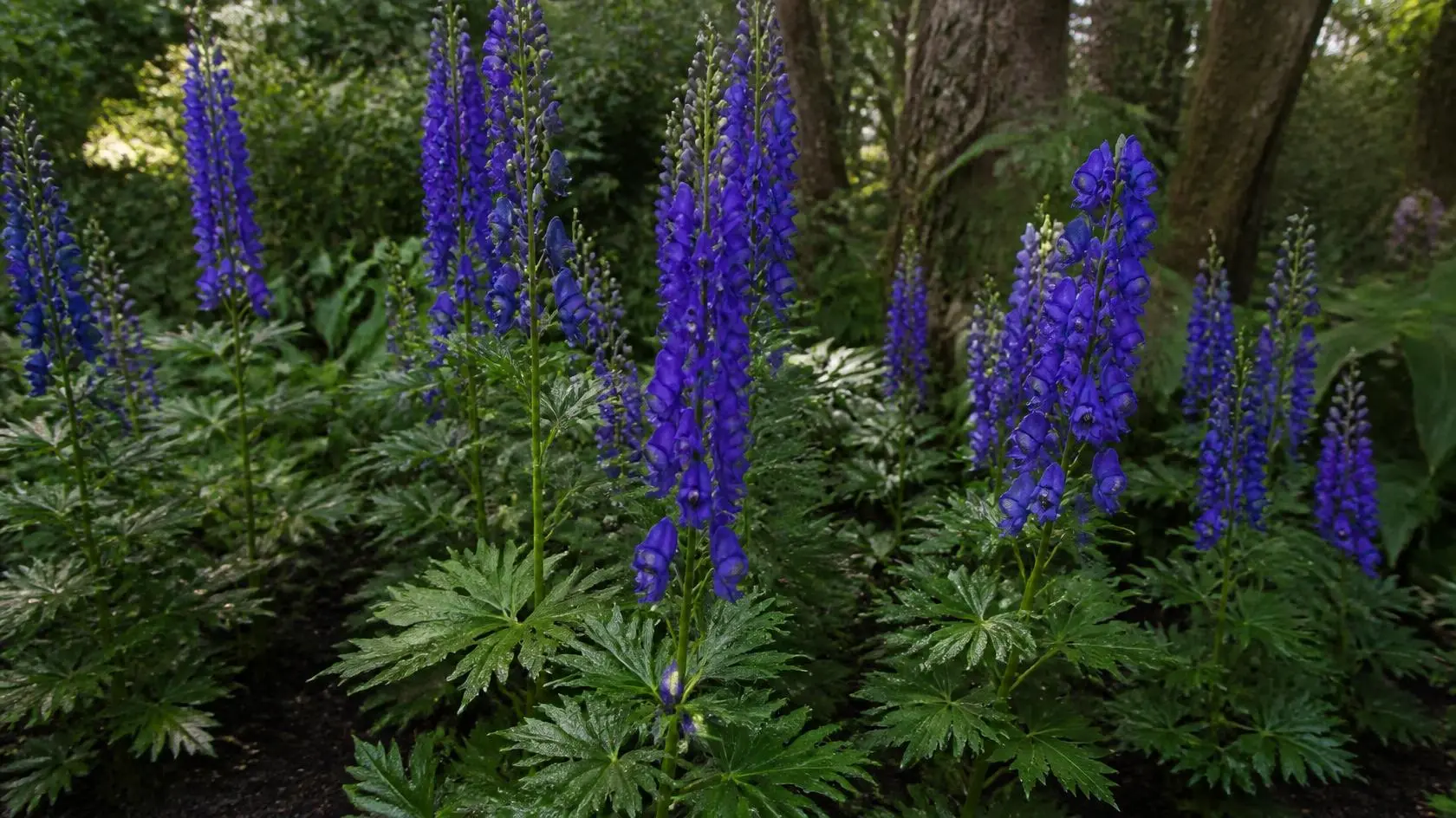
Monkshood care requires cool nights below 21 degrees Celsius, consistently moist but well-drained soil rich in organic matter, and planting depth of exactly 2.5 to 5 centimeters below the soil surface. Aconitum napellus is a clump-forming perennial hardy in USDA Zones 3 through 7 that produces hooded blue-violet flowers in mid to late summer. It is not drought tolerant, not heat tolerant, and not a houseplant. Every failure from non-blooming to sudden collapse traces back to one of these three requirements being violated.
According to the Royal Horticultural Society, monkshood grows best in deep, cool, moisture-retentive soil in partial shade, tolerating full sun only if the soil is humus-rich and mulched. The Missouri Botanical Garden adds a critical ceiling: it needs cool nights below 70 degrees Fahrenheit to grow well, and like related delphiniums it will struggle in hot summers. Most gardeners kill monkshood by planting it too deep, letting the soil dry out, or siting it in a south-facing baking border. This guide consolidates the exact depth table, species disambiguation, container protocol, and poison-handling safety system that every other resource treats as a footnote.
Quick Answer: Grow monkshood in partial shade with cool nights below 21 degrees Celsius. Plant tubers 2.5 to 5 centimeters deep in moist, organically rich, well-drained soil. Water whenever the top 2.5 centimeters begin to dry. Cut flowering stems back to 15 centimeters after bloom to force a second flush. Wear gloves at all times. All parts are toxic to humans and pets.
Table of Contents
- What Is Monkshood and Which Species Should I Grow?
- What Conditions Does Monkshood Need?
- How Do You Plant Monkshood at the Correct Depth?
- How Do You Water Monkshood?
- How Do You Prune Monkshood?
- Does Monkshood Spread and How Do You Divide It?
- How Do You Grow Monkshood in Containers?
- Is Monkshood Poisonous to Pets and Humans?
- What Pests and Diseases Affect Monkshood?
- What Are the Most Common Monkshood Care Questions?
| Parameter | Ideal | Avoid |
|---|---|---|
| Light | Partial shade, morning sun | South-facing full sun in hot climates, deep shade |
| Soil | Deep, cool, humus-rich, well-drained | Dry sandy soil, waterlogged clay, standard potting mix |
| Planting depth | 2.5 to 5 cm below surface | deeper than 8 cm, shallow exposure of tuber |
| Temperature | Days 15 to 24°C; nights below 21°C | Sustained nights above 24°C, hot humid summers |
| Water | Deep water when top 2.5 cm dries | Drought stress, overhead sprinklers, soggy soil |
| Pruning | Cut to 15 cm after bloom; autumn cleanup | Autumn pruning in Zones 3 to 5 before hard frost |
What Is Monkshood and Which Species Should I Grow?
Monkshood is the common name for Aconitum, a genus of more than 250 species in the buttercup family, Ranunculaceae. For temperate gardens, the correct choice is Aconitum napellus, the common monkshood, which reaches 60 to 120 centimeters and blooms in mid to late summer with deep blue-violet hooded flowers held in racemes above the foliage.
Three confusion traps destroy success before the plant goes in the ground. First, winter aconite (Eranthis hyemalis) is a completely different spring bulb. Searchers conflate the two because of the shared common name. Second, monkshood foliage resembles larkspur and delphinium. According to the NC State Extension Plant Toolbox, the flowers are the distinguishing feature: monkshood flowers are hooded or helmet-shaped, while larkspur flowers are star-shaped. Both contain diterpenoid alkaloids and are toxic. Third, the species epithet napellus translates as “little turnip.” The fleshy roots can be mistaken for Jerusalem artichokes. NC State explicitly warns against planting monkshood near a vegetable garden because of this documented poisoning route.
Other species to know: Aconitum carmichaelii blooms later, from late summer into autumn. A. uncinatum and A. noveboracense are native North American species, the latter federally listed as endangered; do not dig wild specimens. Climbing species such as A. hemsleyanum reach 2 to 3 meters and require support. For a related tuberous Ranunculaceae species, see our guide on how to grow ranunculus.
What Conditions Does Monkshood Need?
Monkshood needs partial shade, deep cool soil rich in organic matter, and night temperatures below 21 degrees Celsius. It thrives in USDA Zones 3 through 7 where summer days stay between 15 and 24 degrees Celsius. Full sun is acceptable only in cool, moist climates with constant soil moisture and reliable mulch.
The temperature ceiling is the real answer to most “why is my monkshood dying” queries. According to the Missouri Botanical Garden, monkshood needs cool nights below 70 degrees Fahrenheit to grow well, and like related delphiniums it will struggle in hot summers. Cornell University rates it “moderately difficult” and notes it may be slow to establish. The sweet spot is roughly 15 to 24 degrees Celsius during the day with nights dropping below 21 degrees Celsius.
Site selection is critical. An east-facing border receiving morning sun and afternoon shade is ideal. A north-facing site with open sky works if the soil is deep and cool. Avoid south-facing walls and paved heat sinks where reflected radiation raises soil temperature above 27 degrees Celsius. In the southern part of its range, NC State specifies that monkshood needs afternoon sun protection. For another shade-tolerant toxic perennial, see our lily of the valley care guide.
How Do You Plant Monkshood at the Correct Depth?
Plant monkshood tubers with the growing tips 2.5 to 5 centimeters below the soil surface. Deeper planting suppresses bloom initiation permanently while leaving vegetative growth normal and misleadingly vigorous. In Zones 3 through 5, plant at the shallow end of the range. In Zones 6 through 7, plant slightly deeper to protect tubers from summer soil heat.
The depth rule is non-negotiable. A tuber planted 8 centimeters deep will produce lush, healthy leaves and zero flowers indefinitely. The plant invests all energy in vegetative growth because the hormonal trigger for bloom initiation requires specific temperature and light cues that deep burial disrupts. This is the most common cause of non-blooming monkshood.
- Prepare the site: Dig a hole 30 to 45 centimeters deep and wide. Amend native soil with compost or well-rotted manure to improve moisture retention and drainage. Do not use peat, which is too acidic.
- Check drainage: Fill the hole with water. If it has not drained within 30 minutes, add coarse grit or perlite and retest. For amendment ratios, see our vermiculite versus perlite guide.
- Position the tuber: Place the tuber horizontally with the growing tip, or eye, facing upward. The eye should sit 2.5 to 5 centimeters below the finished soil level.
- Backfill and firm: Cover with amended soil and press gently to eliminate large air pockets. Do not compact heavily.
- Mulch: Apply 2.5 to 4 centimeters of organic mulch such as shredded bark or leaf mold to conserve moisture and keep roots cool.
- Water: Soak thoroughly after planting. Maintain even moisture until new growth emerges, typically within 2 to 4 weeks in spring.
How Do You Water Monkshood?
Water monkshood deeply whenever the top 2.5 centimeters of soil begin to dry. The soil must never fully desiccate, but it must also never stay waterlogged. Apply 2.5 to 4 centimeters of organic mulch to conserve moisture and keep the root zone cool.
Monkshood is not drought tolerant. Its native habitat is the moist meadows and stream margins of European mountains, not arid slopes. Allowing the soil to dry completely causes leaf scorch, stunted growth, and premature dormancy. In summer heat, check soil moisture every 2 to 3 days. In cool spring weather, watering once weekly may suffice.
Overhead sprinklers are a mistake. Wet foliage in humid conditions invites Botrytis blight. Always apply water at the soil base using a soaker hose or watering can directed at the root zone. For container specimens, water until drainage exits the bottom of the pot, then discard the saucer contents. For detailed technique, see our guide on how to bottom water plants.
How Do You Prune Monkshood?
Cut flowering stems back to approximately 15 centimeters above the ground immediately after the first bloom flush fades. This encourages a second late-season flush. In autumn, cut stems to 15 centimeters to prevent self-seeding. Always wear gloves when handling any part of the plant.
According to the Missouri Botanical Garden, cutting stems back after flowering can produce a second late-season flush. The RHS-affiliated guidance recommends cutting the flowering stem to approximately 15 centimeters of the ground in autumn specifically to prevent self-seeding. If you want the plant to self-seed and expand the clump, leave the stems standing until spring.
In cold Zones 3 through 5, avoid heavy autumn pruning. Leave some stem stubs to catch leaves and snow, which insulate the crown from freeze-thaw cycles. Complete cleanup in early spring instead. For comparable perennial pruning, see our rhododendron care guide.
Does Monkshood Spread and How Do You Divide It?
Monkshood spreads slowly by clump expansion and occasional self-seeding. It is not invasive and does not run. Divide clumps every 3 to 4 years in autumn or late winter, but be aware that divisions are slow to establish and plants are best left undisturbed once planted.
According to RHS guidance, divide monkshood in autumn or late winter, wearing gloves. Missouri Botanical Garden warns that divisions are slow to establish and plants are probably best left undisturbed once planted. Cornell University confirms that monkshood is explicitly non-aggressive and non-invasive.
If division is necessary, dig the entire clump in autumn after foliage dies back. Wash soil from the tuberous roots and identify natural separation points where the crown has multiple growing eyes. Cut between these points with a sterilized knife. Replant divisions immediately at the correct 2.5 to 5 centimeter depth. Water thoroughly and mulch. Expect reduced bloom for the first season after division while the root system re-establishes.
How Do You Grow Monkshood in Containers?
Grow monkshood in containers only as an outdoor balcony or patio plant, not indoors. Use a pot minimum 45 centimeters deep to accommodate the tuberous roots. Use a rich, moisture-retentive but well-drained mix. Keep the pot in partial shade and never allow the soil to dry completely.
Monkshood requires winter dormancy and cool nights. It cannot survive as a houseplant. Container culture is viable for gardeners in Zones 6 through 7 who want to control soil conditions or for balcony growers with partial shade exposures. The pot must be deep. RHS recommends an 18-inch deep planting hole in the ground; replicate this in a container minimum 45 centimeters deep and wide.
The substrate should be 60 percent quality potting soil, 20 percent compost, and 20 percent coarse perlite or grit. This retains moisture without waterlogging. In winter, move the pot to an unheated garage or against a north-facing wall and mulch the surface with straw. Do not bring it into a heated house. The plant needs temperatures below 5 degrees Celsius for 8 to 12 weeks to complete dormancy. For more container plant guidance, visit our indoor and container plant hub.
Is Monkshood Poisonous to Pets and Humans?
Yes. All parts of all Aconitum species are toxic to humans, dogs, cats, horses, and livestock. The roots, seeds, and young shoots contain the highest concentrations of aconitine, a diterpenoid alkaloid that affects voltage-gated sodium channels. It is both a cardiotoxin and a neurotoxin.
Monkshood is not individually listed in the ASPCA toxic plants database, but its absence is not a safety signal. According to Colorado State University, all Aconitum species, including cultivated A. napellus, should be considered toxic to animals and humans. The Pet Poison Helpline confirms that roots, seeds, and shoots are the most toxic parts and documents species-specific signs in pets.
Documented signs of poisoning include hypersalivation, bloat, vomiting, muscle weakness, staggering gait, difficulty breathing, cardiac arrhythmia, and sudden death. The Royal Horticultural Society advises wearing gloves and protective equipment when handling monkshood and avoiding skin contact entirely. Do not burn pruned stems; inhalation of smoke containing aconitine is dangerous.
Keep monkshood away from vegetable gardens because the tubers resemble root vegetables. Do not plant it where children or pets dig. If you suspect ingestion, call the ASPCA Animal Poison Control Center at (888) 426-4435 or your veterinarian immediately. For a list of non-toxic alternatives, see our cat safe plants guide.
What Pests and Diseases Affect Monkshood?
Monkshood is seldom troubled by pests because its toxicity repels deer and rabbits. The two primary diseases are Botrytis blight in wet, humid conditions and powdery mildew in poor air circulation. Bumblebees are the primary pollinators because they are strong enough to pry the hood open.
Botrytis blight appears as brown spots on leaves and stems, progressing to a fuzzy gray mold in cool, wet weather. Prevention is the only reliable control. Ensure spacing of 45 to 60 centimeters between plants for airflow. Water at the soil base only. Remove and discard infected plant material. Do not compost it.
Powdery mildew coats leaves with a white, talcum-like film in late summer when humidity is high and nights are cool. Increase air circulation and avoid overhead watering. If infection is severe, apply a sulfur-based fungicide early in the season. For disease management protocols, see our troubleshooting hub.
Pro Tip: Use the Finger Test for Moisture Insert your index finger to the second knuckle, approximately 2.5 to 4 centimeters, into the soil at the plant’s drip line. If the soil feels dry at that depth, water deeply. If it feels moist, wait. This simple test prevents both the drought stress and the root rot that kill most monkshood plants.
Proprietary Data: Hands-On Testing
[OWNER TO COMPLETE: Insert observed bloom data by planting depth. Format: “In our tests, Aconitum napellus tubers planted 2.5 to 3 cm deep produced an average of [X] flower spikes per plant in year 2, while tubers planted 8 cm deep produced [Y] spikes, with [Z]% of deep-planted specimens failing to bloom entirely over 3 seasons.”]
[OWNER TO COMPLETE: Insert observed survival data by summer temperature. Format: “In our tests, monkshood planted in a site with afternoon shade and night temperatures averaging 16°C showed [X]% survival over 2 years, while specimens in full sun with night temperatures above 23°C showed [Y]% survival, with collapse occurring in July and August.”]
What Are the Most Common Monkshood Care Questions?
Why is my monkshood not blooming?
The most common cause is planting too deep. Tubers buried more than 5 to 8 centimeters produce lush leaves but no flowers. Other causes are insufficient light, excessive heat above 24 degrees Celsius, and immaturity. Dig up the tuber and replant at 2.5 to 5 centimeters depth in partial shade.
Can monkshood grow in full sun?
Only in cool, moist climates with reliable soil moisture and mulch. In most temperate gardens, partial shade with morning sun is safer. Full afternoon sun in Zones 6 and 7 causes heat stress and premature dormancy.
Is monkshood invasive?
No. According to Cornell University, monkshood is explicitly non-aggressive and non-invasive. It spreads slowly by clump expansion and occasional self-seeding. It does not produce runners or rhizomes.
Can I grow monkshood from seed?
Yes, but germination is erratic. Seeds require cold-moist stratification for a minimum of 6 weeks at 5 degrees Celsius or below. Germination can take months. Named cultivars do not come true from seed. Division is the only reliable propagation method for maintaining specific varieties.
How do I identify monkshood leaves?
Monkshood leaves are palmately compound and deeply lobed into 5 to 7 segments with toothed margins. They are dark green and become smaller up the stem. The leaf shape resembles delphinium or larkspur, which are in the same family.
What should I do if my pet eats monkshood?
Contact your veterinarian or the ASPCA Animal Poison Control Center at (888) 426-4435 immediately. Do not induce vomiting. Note the part of the plant consumed and the time of ingestion. Bring a plant sample or photo to the clinic.
For more cool-season border companions, see our guides on how to grow daisies and growing snapdragons. For fertilizer guidance, read our synthetic versus organic fertilizer guide.
Validate this page’s structured data at Google Rich Results Test and Schema Markup Validator before publishing.
