
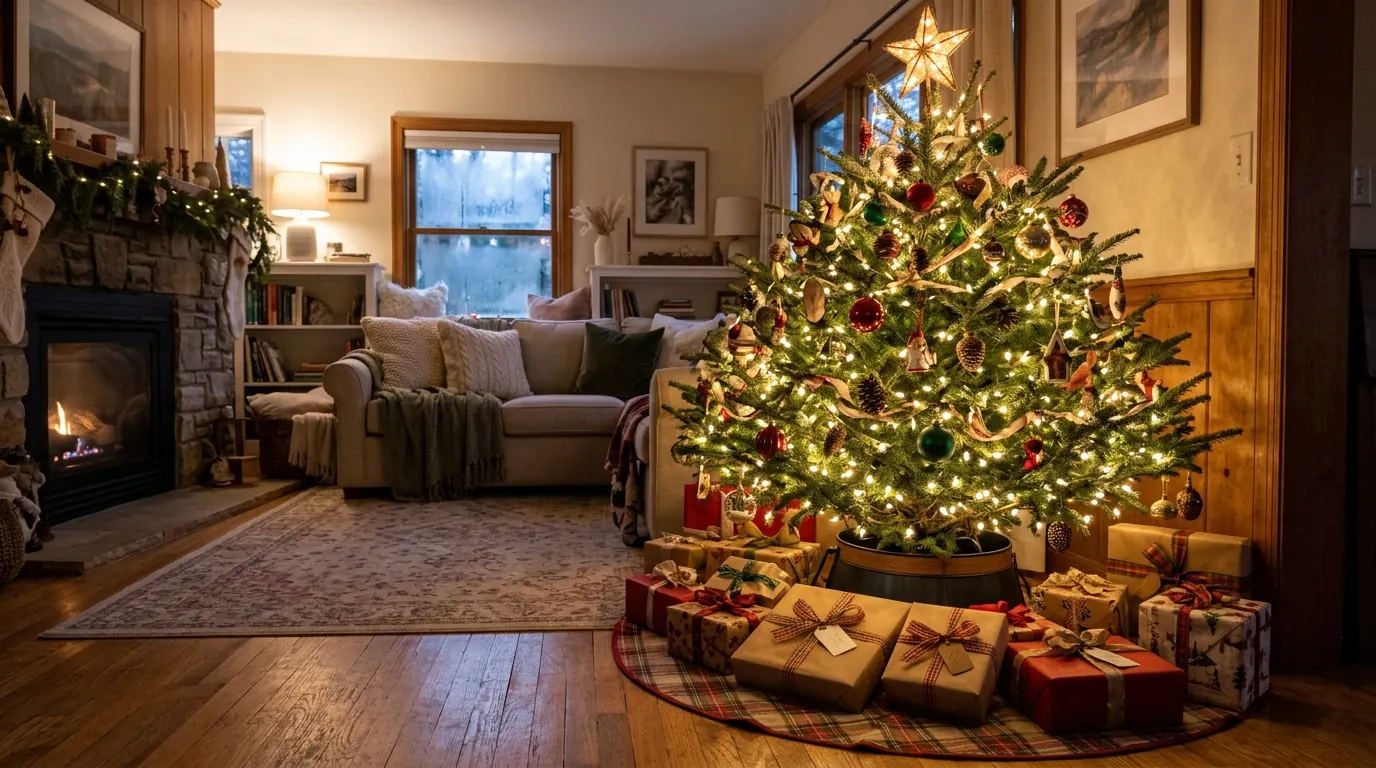
A fresh tree can stay green through the holidays, or it can drop needles by mid-December. Most of the difference comes down to a few steps: buying a fresh tree, recutting the trunk, choosing the right stand and keeping water above the cut every single day. This guide covers real Christmas tree care for both cut trees and living trees with roots: how often to water a Christmas tree, fresh cut Christmas tree care, live potted Christmas tree care, and can you plant a potted Christmas tree after the holidays. It follows Penn State Extension, University of Wisconsin-Madison, University of Illinois Extension, UNH Extension and Iowa State, plus fire-safety advice from the U.S. Fire Administration and NFPA. Where these sources disagree, we show both answers.
Real Christmas Tree Care at a Glance
| Step | What to do | Source |
|---|---|---|
| Freshness check | Needles flexible and firmly attached when tugged | Penn State |
| Recut | Straight across, if cut more than 12 hours ago (thickness advice ranges from 1/4 inch to 2 inches) | Penn State, Illinois, NFPA |
| Stand size | 1 quart of water per inch of trunk diameter, at least 1 gallon | Penn State, Illinois |
| Watering | Check daily; keep water above the base of the trunk | Penn State, Illinois, NFPA |
| Additives | None: plain water | Penn State, UW-Madison, Illinois |
| Placement | At least 3 feet from fireplaces, heaters, vents and candles | USFA |
| Living tree indoors | 4 to 5 days ideal, max 1 week (Penn State) or 7 to 10 days (UNH, Iowa State) | Penn State, UNH, Iowa State |
Sources: Penn State Extension (2023, 2025); UW-Madison Extension (Jull 2024); University of Illinois Extension; UNH Extension (2019); Iowa State Extension (2024); U.S. Fire Administration; NFPA.
Choosing a Fresh Tree
Penn State Extension says to look for flexible needles that stay firmly attached when you tug on them. If needles are dry and brittle, break, or fall off easily, the tree is already drying out. Penn State also points out that most trees are harvested in early November, so a tree displayed early has to stay fresh for weeks in the warm, dry air of a heated home.
The species matters too. UW-Madison Extension (Laura Jull, 2024) says the true firs have the best needle retention, color and aroma: balsam fir is the most fragrant, while Fraser, concolor and Canaan firs have stronger branches for heavy ornaments. Douglas-fir is not a true fir and has softer branches, Scots pine does not hold its needles as long as true firs, and spruces hold their needles for a shorter time and are not aromatic. Penn State’s list is a little broader: it notes good needle retention for Douglas-fir, Fraser and balsam firs and white and Scotch pines, and says Colorado blue spruce holds its needles well only if it never runs out of water.
Recutting the Trunk
A cut trunk seals over with resin, which blocks water uptake. The sources agree on recutting but not on exactly how much or when:
| Source | When to recut | How much |
|---|---|---|
| Penn State | If more than 12 hours have passed since harvest | A disk about 1/4 inch thick, straight across |
| UW-Madison | Within 2 hours before the tree goes into the stand | Straight across, not on an angle |
| Illinois Extension | Before bringing the tree indoors | A fresh 1 inch cut |
| NFPA | Before placing the tree in the stand | 2 inches from the base |
Sources: Penn State Extension (Bates, Cotrone, updated 2025); UW-Madison Extension (Jull 2024); University of Illinois Extension; NFPA.
The common ground: cut straight across (not a V or an angle), and get the tree into water soon after cutting. Don’t drill holes in the trunk or whittle the bark to fit a stand; choose a stand that fits the trunk instead.
How Often to Water a Christmas Tree
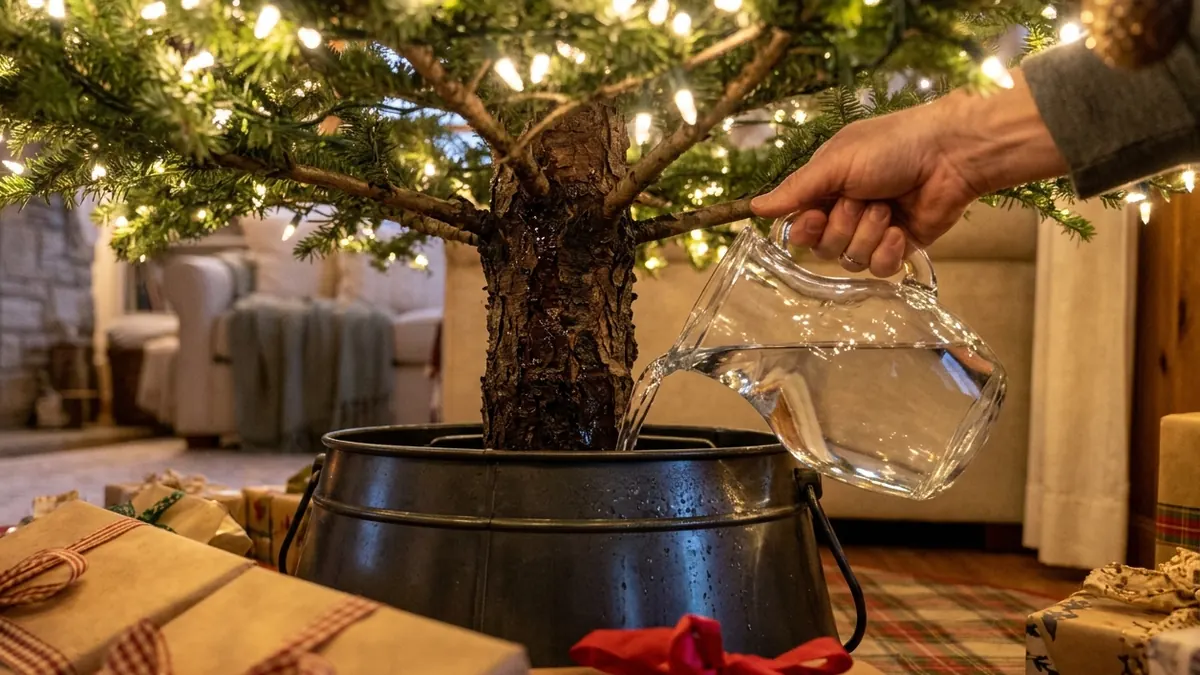
Check the water every day. Penn State says a cut tree absorbs a surprising amount of water, especially in the first week, so replenish it daily and never let the level drop below the base of the trunk. Illinois Extension explains why: if the base dries out, resin forms over the cut end and the tree can no longer absorb water. The NFPA safety tip sheet also says to add water to the stand daily.
Size the stand to the tree. Penn State and Illinois both use the rule of thumb of 1 quart of water per inch of stem diameter, and Penn State says most trees need a stand that holds at least 1 gallon. A 4 inch trunk, for example, needs a stand that holds about a gallon.
Placement, Lights and Fire Safety
Penn State says to keep the tree away from fireplaces, heaters, heat vents and direct sunlight, all of which dry it out faster. The U.S. Fire Administration recommends keeping it at least 3 feet from any heat source, including fireplaces, radiators, space heaters, candles and heat vents, and says the tree should not block an exit. The NFPA Christmas tree safety sheet (2025) gives the same 3 feet and adds that a heat source too close to the tree causes one in every four home Christmas tree fires.
For lights, Penn State notes that LEDs give off less heat and says to turn the lights off whenever the tree is unattended. Illinois Extension recommends checking cords for wear, using UL-approved lights and cords, and unplugging lights at night. If needles turn dry and brittle and fall when touched, Penn State says it is time to take the tree down.
Christmas Tree Problems and Fixes
| Problem | Likely cause | What to do |
|---|---|---|
| Tree stopped drinking | The stand ran dry and resin sealed the cut (Illinois) | Keep the water above the base from now on; a sealed cut can’t be reopened while the tree stands, so check daily |
| Needles dropping early | Drying out from heat, sun or low water; some species hold needles less well | Move away from heat and sun, check water daily; choose a true fir next year (UW-Madison) |
| Brittle needles that snap | The tree is dry | Take it down: Penn State says to remove a dry tree, and NFPA says dried-out trees should not be left in the home, the garage or against the house |
| Branches sag under ornaments | Soft-branched species such as Douglas-fir or white pine | Use lighter ornaments, or pick Fraser, concolor or Canaan fir (UW-Madison) |
Sources: Illinois Extension; Penn State Extension; UW-Madison Extension; NFPA.
Illinois Extension says many fresh-cut trees that are properly cared for last at least five weeks before drying out. If you want a tree that lasts all winter indoors, consider a living houseplant instead: see our guide to Norfolk Island pine care, or a small rosemary Christmas tree.
Live Potted Christmas Tree Care
A living tree, sold in a container or with its roots balled in burlap, can be planted outside afterward, but it is not a houseplant. It is dormant, and a warm house can break that dormancy. The sources agree on keeping the indoor stay short, but differ on how short:
- Penn State (D’Aurora, 2023): 4 to 5 days is ideal, and no longer than one week.
- UNH Extension (2019) and Iowa State (2024): 7 to 10 days at most.
Before it comes in, Penn State suggests moving the tree to a garage, shed or sheltered spot for 1 to 2 weeks, and UNH also recommends staging it in an unheated space such as a shed, garage or porch so it can adjust. Indoors, put it in the coolest spot you have, away from heat sources and direct sun, and use LED or other low-heat lights (Penn State).
For watering, Penn State says to check the soil or root ball daily so it stays moist, without letting the tree sit in standing water; stones in the bottom of a watertight container help keep it out of the water. UNH advises letting the soil dry out between waterings. In practice: check every day, water when the surface is drying, and never leave the root ball in a puddle. UNH lists Serbian spruce, Norway spruce, white spruce, Fraser fir, balsam fir and white fir as species sold as living trees.
Can You Plant a Potted Christmas Tree?
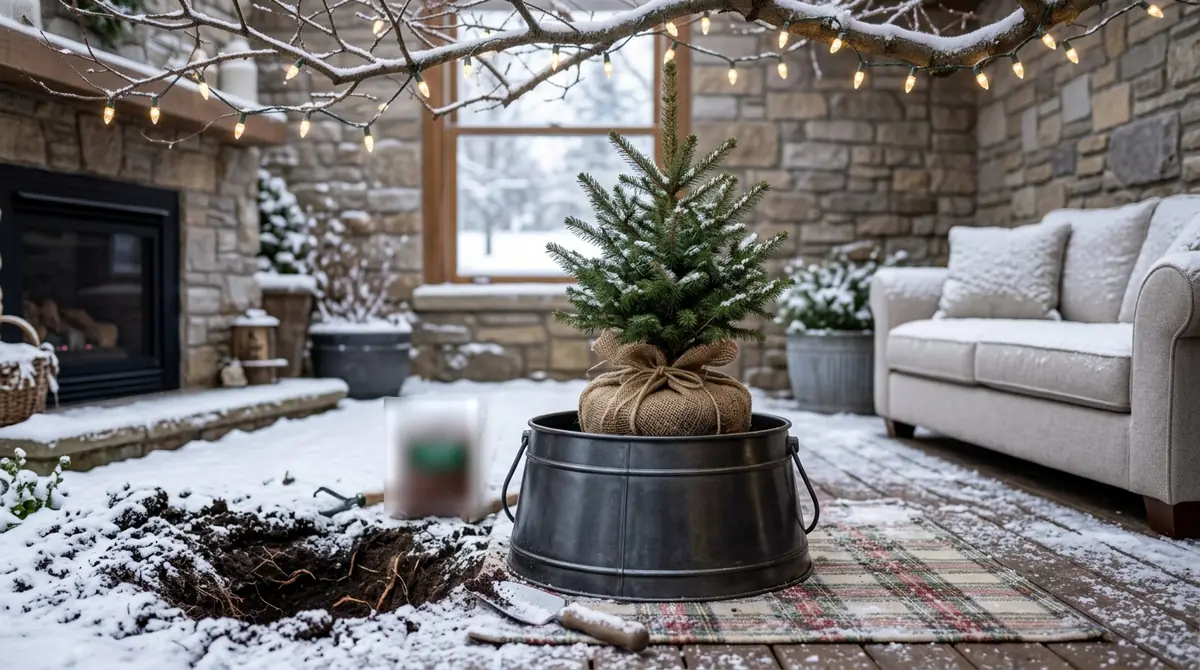
Yes, but timing matters, and the two main sources plan it differently:
| Penn State | UNH Extension | |
|---|---|---|
| When to plant | Right after the holidays, into a hole dug in fall | In spring, once the soil has thawed and dried |
| Before planting | Several days in a cooler spot to re-acclimate | Keep it in an unheated space; a tree planted late in the season is unlikely to survive |
| Prep | Dig the hole before the ground freezes; store the soil in a shed or garage | Not covered |
Sources: Penn State Extension, Caring for a Living Christmas Tree (2023); UNH Extension, Living Christmas Trees (2019).
If you plant in winter, Penn State’s steps are: dig the hole 1 to 2 feet wider than the root ball with a firm, flat base; set the root flare level with or slightly above the finished grade; remove burlap, wire and twine (synthetic burlap does not break down); water well; and mulch with straw. Penn State also warns that balled trees are much heavier than cut trees, especially when the root ball is wet, and that you should check the tree’s mature size before you buy, since many Christmas tree species grow into large trees.
Pets and Disposal
Penn State’s holiday plants and pets guide (2025) says the needles of a fresh-cut tree are not likely to harm pets, but that stand water treated with freshness additives could be dangerous, which is one more reason to use plain water. For holiday plants that are a bigger concern, see our guide to Christmas plants and which are pet-safe.
When the season is over, Illinois Extension notes that many communities collect trees and chip them, and suggests standing the tree in the backyard as winter shelter for birds. For more holiday decorating with fresh greens, see our guide to Christmas planter ideas.
Frequently Asked Questions
How often should you water a Christmas tree?
Check it every day and top it up so the water never drops below the base of the trunk. Penn State says cut trees drink the most in the first week. The stand should hold about 1 quart per inch of trunk diameter.
How long does a real Christmas tree last?
Illinois Extension says many fresh-cut trees last at least five weeks with good care. True firs hold their needles longest, according to UW-Madison Extension.
Should you put sugar or aspirin in Christmas tree water?
No. Penn State and UW-Madison say additives such as sugar, aspirin, bleach, soda and commercial preservatives don’t improve freshness or water uptake. Plain tap water is enough.
Why is my Christmas tree not drinking water?
Usually the stand ran dry and resin sealed the cut end, so the tree can no longer absorb water (Illinois Extension). Recut it before setting it up, and keep the water above the base every day.
How long can a live Christmas tree stay inside?
Briefly. Penn State says 4 to 5 days is ideal and no longer than one week; UNH and Iowa State say 7 to 10 days at most. Keep it in the coolest spot available.
Can you plant a potted Christmas tree after Christmas?
Yes. Penn State recommends planting right after the holidays into a hole dug before the ground froze. UNH recommends keeping it in an unheated space and planting in spring once the soil thaws.
Are Christmas trees toxic to cats and dogs?
Penn State says the needles of a fresh-cut tree are not likely to harm pets, but stand water treated with freshness additives could be dangerous. Use plain water and cover the stand if pets drink from it.
Sources
- Bates, R. and Cotrone, V. Penn State Extension: Tips for Selection and Care of Cut Christmas Trees (updated 2025)
- D’Aurora, D. Penn State Extension: Caring for a Living Christmas Tree (updated 2023)
- Miklas, L. Penn State Extension: Holiday Plants and Pets (updated 2025)
- Jull, L. UW-Madison Extension: Choosing the Right Christmas Tree (2024)
- University of Illinois Extension: Caring for Live Christmas Trees
- UNH Extension: Living Christmas Trees (2019)
- Steil, A. Iowa State University Extension: Alternative Christmas Trees (reviewed 2024)
- U.S. Fire Administration: Holiday Fire Safety
- NFPA: Christmas Tree Safety tip sheet (2025)