
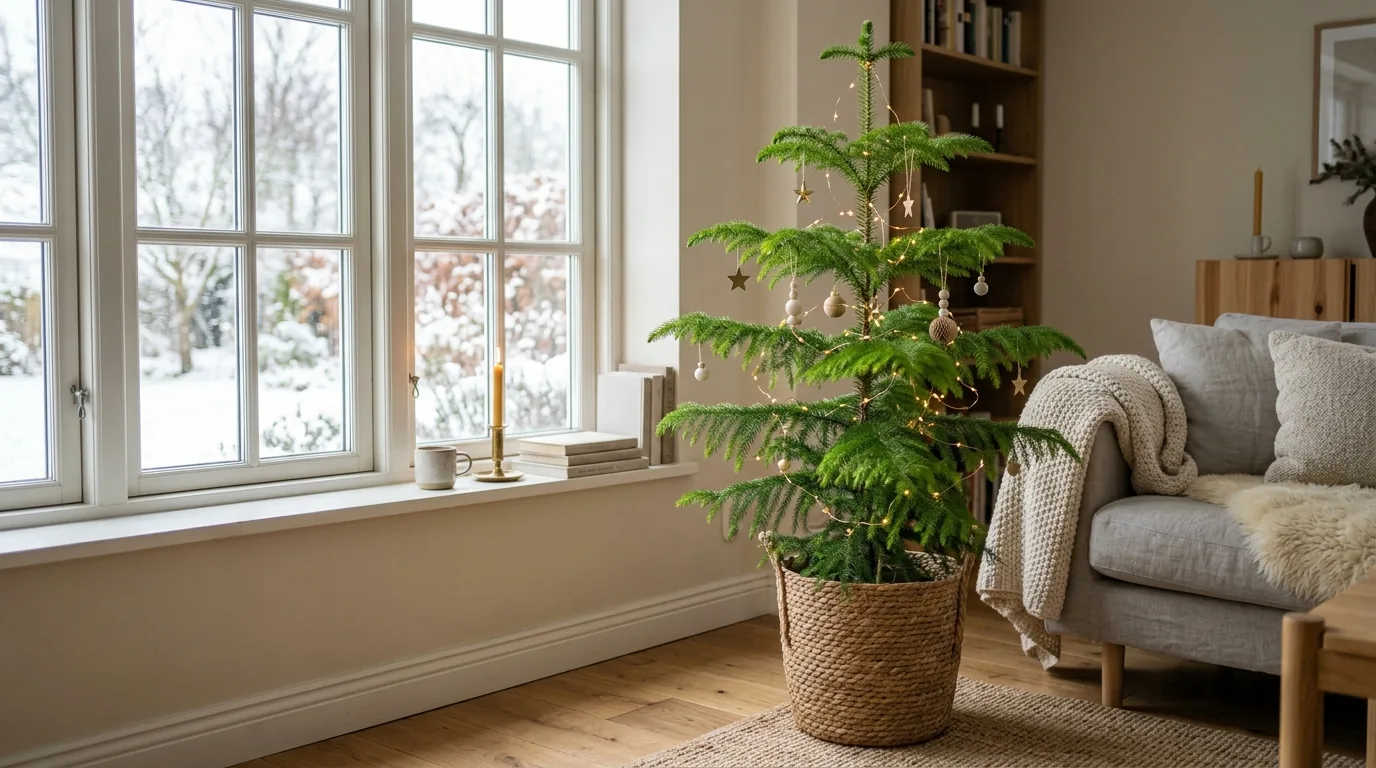
The Norfolk Island pine (Araucaria heterophylla) is the soft-needled “living Christmas tree” sold in pots every December. It isn’t a true pine: NC State Extension notes it is endemic to Norfolk Island in the South Pacific and grows 60 to 100 feet tall outdoors in mild climates, but stays around 9 feet indoors. As a houseplant it can live for years if you get two things right: plenty of light and enough humidity. This guide covers Norfolk Island pine care indoors, winter care, why branches turn brown or droop, and pet safety, following NC State, the RHS, Purdue, University of Missouri Extension and the ASPCA.
Norfolk Island Pine Care at a Glance
| Need | What the sources say |
|---|---|
| Light | High light; a couple of hours of direct sun is best, bright indirect light is tolerated (Purdue, Missouri) |
| Water | When the top inch is dry (Purdue); evenly moist but not wet (Missouri); sparingly in winter (NC State) |
| Temperature | 60 to 70°F days, slightly cooler nights (Purdue); a bright, cool room at 55 to 65°F (NC State) |
| Humidity | Thrives at 50%; homes can fall to 15% in winter (Purdue) |
| Soil | Fertile, porous, slightly acidic, well-drained potting mix (NC State); loam-based compost with extra grit (RHS) |
| Feeding | Dilute liquid fertilizer spring to fall (NC State); every two weeks in the growing season, none in winter (RHS) |
| Repotting | Usually not needed for 3 or 4 years (Missouri) |
| Pruning | Little or none; pruning can permanently spoil the shape (RHS) |
| Pets | Non-toxic to dogs, cats and horses (ASPCA, listed as Australian pine) |
Sources: NC State Extension; RHS; Purdue Extension (Lerner, 2011); University of Missouri (Trinklein, 2015); ASPCA.
Light and Rotation
Light is the main thing a Norfolk Island pine misses indoors. University of Missouri Extension notes that most interior plant authorities place it in the high-light category, and Purdue Extension says it looks its best with a couple of hours of direct sun a day, though it tolerates bright indirect light. NC State says it can tolerate very low light indoors for 2 to 3 years, but warns that the price is leaf drop and loss of lower branches. Missouri adds that in poor light the top may stop growing while the branches keep extending.
Because it grows toward the light, Purdue suggests turning the pot a quarter turn every week if light comes from one side, to keep the tree from leaning. If your brightest window is still dim in winter, a grow light helps; see our grow light guide.
Watering
Purdue suggests watering when the top inch or so of the mix feels dry, letting the excess drain and discarding the drained water after about 15 minutes. Missouri describes the goal as continually moist but not wet. Both extremes cause trouble:
- Too dry: Missouri says that if the plant stays dry for an extended period, its lower branches turn brown and fall off, and that underwatered plants’ lower branches droop instead of holding their horizontal shape.
- Too wet: Missouri warns that excessive water can kill the plant through root rot. NC State advises avoiding soil that is too wet and watering sparingly in winter.
For telling the two apart, see our overwatered vs underwatered guide.
Norfolk Island Pine Care in Winter: Temperature and Humidity
Winter is the hard season indoors, because heated air is warm and dry. Purdue gives an ideal of 60 to 70°F during the day and slightly cooler at night; NC State says it prefers a bright, cool room at 55 to 65°F. Keep it away from heat vents and cold drafts, which Purdue lists among the causes of browning.
Humidity is the bigger issue. Purdue notes that the plant thrives at 50% relative humidity, while the average home can drop to 15% during the heating season, and calls a humidifier the most effective fix. NC State suggests misting plants in heated rooms in winter. Our guide to dry indoor air explains the options.
Soil, Feeding and Repotting
- Soil: NC State suggests a fertile, porous, slightly acidic, well-drained potting mix; the RHS suggests a peat-free, loam-based compost with extra grit.
- Feeding: NC State suggests a dilute liquid fertilizer weekly or every two weeks from spring through fall; the RHS a balanced fertilizer every two weeks in the growing season. Purdue says to use a fertilizer for indoor foliage plants while it is growing and no feeding during its winter rest; Missouri suggests that about once every four weeks in winter is enough if you do feed.
- Repotting: Missouri says moving to a larger container usually isn’t necessary for three or four years.
Pruning: Why You Should Never Cut the Top
The RHS places Norfolk Island pine in its pruning group that needs little or no pruning and warns that pruning can permanently spoil the tree’s shape. The reason is its growth pattern: Missouri explains that new tiers of five to six branches form at each node as the single top grows. Cutting off the top removes the single growing point that produces those tiers, which is why topping it ruins the shape. Beyond that, the only trimming it needs is removing dead lower branches cleanly at the trunk.
Brown, Drooping or Falling Branches
| What you see | Likely cause | What to do |
|---|---|---|
| A few needles on the lowest branches brown and drop, slowly over time | Normal aging, or lower light (Purdue) | Nothing; remove dead branches at the trunk |
| Many needles browning, spread across the tree | Too much or too little water, drafts, or low humidity (Purdue) | Check watering, move away from vents and cold glass, add humidity |
| Lower branches brown and fall after the pot dried out | Prolonged dryness (Missouri) | Water when the top inch dries; don’t let it stay dry |
| Lower branches droop instead of staying horizontal | Not enough water (Missouri) | Water when the top inch dries |
| Tree leans to one side | Light from one direction (Purdue) | Turn the pot a quarter turn weekly |
| Lower branches lost after years indoors | Very low light for a long time (NC State) | Move to the brightest spot or add a grow light |
| A few needles drop right after you bring it home | Adjusting to the house (Missouri) | Normal; give it steady care |
| Sticky needles, black film | Scale and sooty mold (NC State) | See our scale guide |
Sources: Purdue Extension; University of Missouri Extension; NC State Extension.
Using It as a Living Christmas Tree
Purdue calls it a terrific living Christmas tree. Missouri gives two decorating tips to keep it healthy: avoid lights that get hot (LED lights are ideal because they stay cool and are light), and avoid heavy ornaments that bend the branches down. After the holidays, keep it in its bright, cool spot and care for it as a houseplant.
Norfolk Island Pine Outdoors
NC State lists it for USDA zones 9a to 11b, and Missouri notes it cannot survive Midwest winters outdoors. In colder areas it can spend summer outside in a sheltered, sunny spot and come back in before frost (RHS). Move it gradually into outdoor sun and back again; our guide to bringing plants indoors for winter covers the move back inside.
Is Norfolk Island Pine Toxic to Cats?
No. The ASPCA lists Araucaria heterophylla (under the name Australian pine, with Norfolk Island pine as another common name) as non-toxic to dogs, cats and horses, and NC State also tags it non-toxic. Cats may still knock over or chew a decorated tree, so a heavy pot helps. For more pet-safe options, see our cat-safe plants list.
For more holiday plants, see our guides to amaryllis, Thanksgiving vs Christmas cactus, paperwhites, kalanchoe and Christmas cactus care. For other indoor trees and shrubs, see our guides to croton care.
Frequently Asked Questions
How do you care for a Norfolk Island pine indoors?
Give it your brightest window with some direct sun, turn it weekly, water when the top inch of the mix is dry, keep it at about 60 to 70°F away from heat vents, and raise the humidity in winter (Purdue).
Why is my Norfolk Island pine turning brown?
A few brown needles on the lowest branches are normal aging. Widespread browning usually means too much or too little water, drafts or low humidity (Purdue), and prolonged dryness makes lower branches brown and fall (Missouri).
Why are the branches on my Norfolk pine drooping?
Usually not enough water: Missouri says underwatered lower branches droop instead of staying horizontal. Long periods of very low light also cost it lower branches (NC State).
How often should I water a Norfolk Island pine?
When the top inch of the mix feels dry (Purdue), and more sparingly in winter (NC State). Empty the saucer after watering so the roots don’t sit in water.
Can you cut the top off a Norfolk Island pine?
It is best not to. The RHS says pruning can permanently spoil the shape, and the tree grows its tiers of branches from the single top (Missouri).
Is a Norfolk Island pine safe for cats?
Yes. The ASPCA lists it as non-toxic to dogs, cats and horses.
How big does a Norfolk Island pine get indoors?
About 9 feet indoors, according to NC State, compared with 60 to 100 feet outdoors in mild climates.