
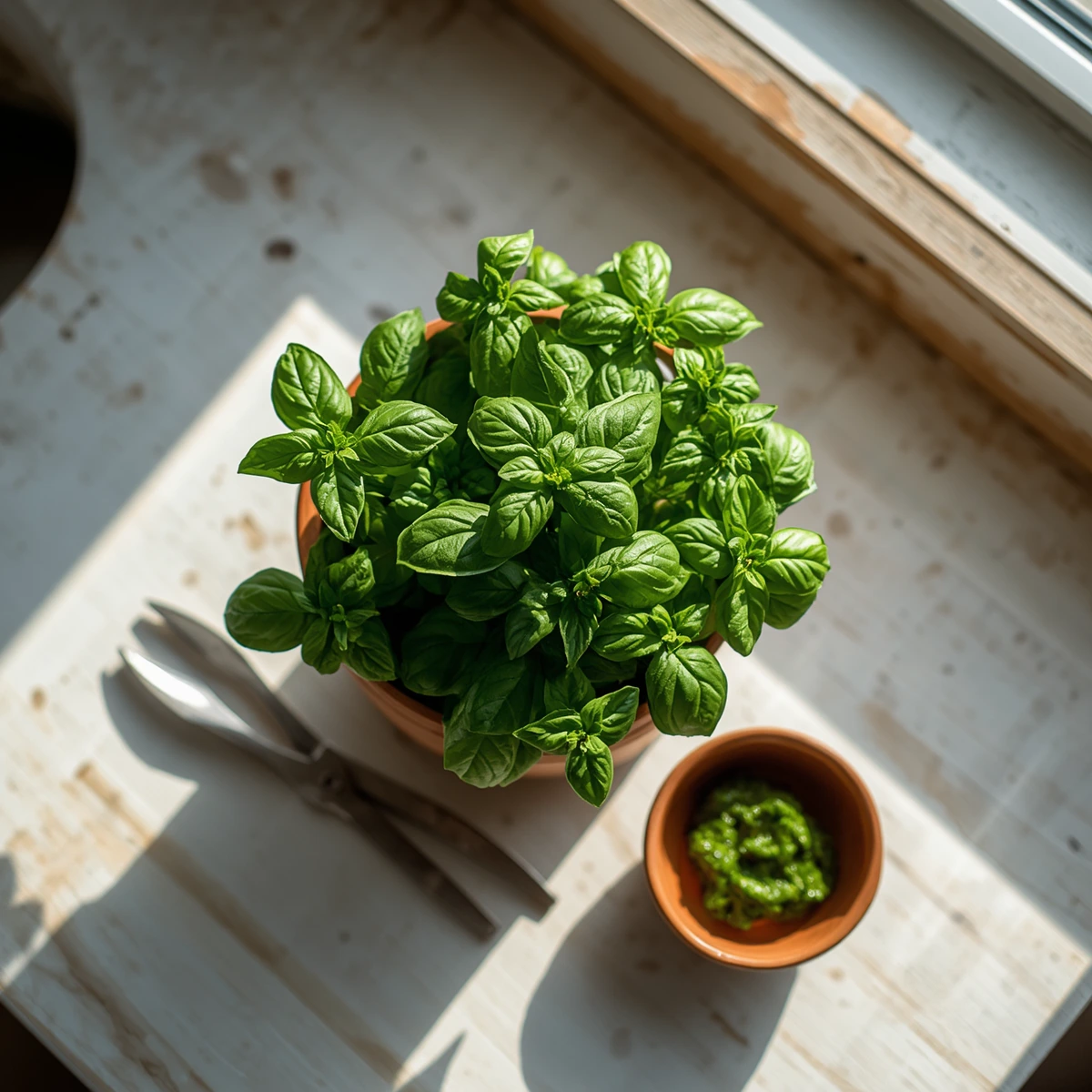
Sweet basil (Ocimum basilicum) is a tender, fast-growing herb that wants warmth, sun and well-drained soil, and dies at the first frost. This guide covers how to grow basil outdoors and in containers: sowing from seed, planting out, watering, harvesting, what to do about flowers, rescuing supermarket pots, storing the harvest and the main problems, including basil downy mildew. It follows the RHS, NC State Extension, Utah State University Extension, Penn State Extension and the ASPCA. For basil on a windowsill or under lights, see our guide to growing basil indoors.
| Need | What the sources say |
|---|---|
| Sowing | About 20°C (68°F) indoors (RHS); soil 75 to 85°F, sprouts in 10 to 14 days (USU) |
| Planting out | After the last frost; nights above 10°C/50°F (RHS) |
| Light | Full sun; more essential oils and flavor than shade-grown (USU) |
| Soil | Fertile, well-drained, rich in organic matter (USU); moist, well-drained (NC State) |
| Spacing | Thin to about 12 in apart (USU); at least 10 cm/4 in (RHS) |
| Water | About 1.5 in a week (USU); water in the morning (RHS) |
| Pots | At least 20 cm (8 in) wide and deep (RHS) |
| Pets | Non-toxic to dogs and cats (ASPCA) |
Sources: RHS; Pearson and Drost, Utah State University Extension (2020); NC State Extension; ASPCA.
How to Grow Basil From Seed
The RHS suggests sowing indoors from March to July in small pots or trays of damp seed compost, scattering the seed thinly on the surface, covering the pot with a clear lid or bag, and keeping it at about 20°C (68°F). Utah State University Extension says basil germinates best when the soil is 75 to 85°F, sprouting in about 10 to 14 days.
- Sow thinly on moist seed compost, barely covered (RHS sows on the surface).
- Keep warm and moist but not wet: the RHS warns that seedlings are prone to damping off.
- Pot on or thin seedlings as they grow. USU thins garden seedlings to 3 to 4 inches, then to about 12 inches apart.
- Harden plants off and plant out after the last frost, once nights stay above 10°C (50°F) (RHS).
How to Grow Basil in Pots
The RHS says basil does best in containers or well-drained soil, and suggests a pot at least 20 cm (8 in) wide and deep filled with peat-free multipurpose compost. Use a pot with drainage holes, set it in a warm, sunny, sheltered spot, and water when the top of the compost starts to dry. Plants in containers can run short of nutrients, so the RHS suggests an organic-based balanced liquid feed, but warns against potassium-rich tomato feeds, which encourage flowering.
Sun, Soil, Water and Feeding
Sun: USU says basil grown in full sun has more essential oils and better flavor than shade-grown basil. The RHS recommends a warm, sunny, sheltered location. NC State lists full sun as at least 6 hours of direct sun a day.
Soil: fertile, well-drained loam rich in organic matter (USU), moist but well-drained (NC State).
Water: USU suggests about 1.5 inches of water a week for vigorous growth. The RHS says to water in the morning and avoid splashing the leaves, because basil “hates having wet roots overnight.”
Feeding: USU says basil needs some extra nitrogen to sustain fast leaf growth and suggests a liquid feed every 2 to 3 weeks; the RHS says plants in the ground usually need no feed, while container plants benefit from a balanced liquid feed.
Harvesting and Pinching
The RHS says to keep plants bushy by harvesting the shoot tips regularly, and NC State says to pinch the tips of long stems. USU suggests starting to harvest once plants have 6 to 8 leaves, removing enough stem that only 2 to 4 leaves remain. In practice, cut each stem just above a pair of leaves: two new shoots grow from that point, so regular picking gives a bushier plant. Cut whole plants for pesto when you need a large amount (RHS).
What to Do When Basil Flowers
| Source | Advice on flowers |
|---|---|
| RHS | Remove flower stems as soon as you see them to prolong leaf quality; leave some plants to flower for pollinators |
| NC State | Pinch off flower buds for a bushier plant |
| Utah State | Pinching flowers doesn’t stimulate new foliage; sow every other week and avoid stress to delay flowering |
Sources: RHS; NC State Extension; Utah State University Extension (2020).
Pinching flower buds does no harm and keeps the plant in leaf a little longer, but USU’s point is worth noting: once basil starts flowering heavily, a fresh sowing is the more reliable way to keep a leafy supply. The flowers are rich in nectar for pollinators (RHS) and are edible.
Rescuing a Supermarket Basil Pot
The RHS explains that supermarket pots usually contain many thin, overcrowded plants that may get fungal diseases or flower early, but they may survive if divided and repotted promptly. To divide one, water it, ease out the root ball, gently pull it into several small clumps, and pot each into its own container of fresh compost. Keep them in good light and water carefully. The RHS suggests growing these plants indoors in containers to limit biosecurity risks.
How to Grow Basil From Cuttings
Basil roots easily from cuttings, which is a quick way to multiply a plant you already have. Take a non-flowering shoot a few inches long, strip the lower leaves, and stand it in a glass of water in bright light out of hot direct sun, changing the water every few days. Once a good set of roots forms, pot it in compost and grow it on like a seedling.
Growing Basil Indoors
Basil can be grown indoors, but it needs much more light than a typical windowsill gives in winter. Our guide to growing basil indoors covers light levels, grow lights and watering. For another sun-loving herb, see our rosemary guide.
Storing Fresh Basil
- Short term: USU suggests re-cutting the stems and standing them in a jar of water away from direct sunlight; for 7 to 10 days, cover the jar and stems with a plastic bag and refrigerate.
- Freezing: USU notes that frozen whole leaves are mushy when thawed and lose flavor, so ice cubes or pesto keep it better; use frozen basil within 3 to 6 months. Penn State Extension suggests blanching basil leaves for 15 seconds, then cooling them in ice water, and says herbs frozen in oil keep their color better.
Common Problems
| Symptom | Likely cause | Source |
|---|---|---|
| Yellowing leaves with dark fuzzy growth underneath | Basil downy mildew | NC State |
| Seedlings collapse at soil level | Damping off | RHS |
| Wilting, yellowing, stem browning | Fusarium wilt; root rot from overwatering | NC State, USU |
| Holes in leaves | Slugs, snails, Japanese beetles, grasshoppers | RHS, USU, NC State |
| Sticky leaves, clusters of small insects | Aphids | RHS, NC State |
| Blackened leaves after a cold night | Cold damage; basil is tender | RHS |
Sources: NC State Extension; RHS; Utah State University Extension.
Basil downy mildew: NC State Extension (Quesada-Ocampo, 2023) explains that it is caused by Peronospora belbahrii, shows as yellowing leaves with dark sporulation on the undersides, spreads on air currents and can be seedborne, and is favored by 6 to 12 hours of leaf wetness and temperatures around 60°F. Space plants for air flow, water in the morning at the base, remove infected plants, and choose less susceptible types such as red basils, Thai basil ‘Queenette’, lemon basil or the Rutgers DMR varieties (‘Obsession’, ‘Devotion’, ‘Passion’). For aphids, see our aphid guide.
Basil and Tomatoes
Basil and tomatoes are a classic pairing in the kitchen and the garden, since both like warmth, sun and steady watering. Claims that basil repels tomato pests are widely repeated, but none of the extension sources used here confirms them, so grow them together for convenience rather than as pest control.
Is Basil Safe for Cats and Dogs?
Yes. The ASPCA lists basil (Ocimum basilicum) as non-toxic to dogs and cats, and NC State tags it non-toxic for both. As with any plant, a pet that eats a lot may get a mild stomach upset. See our cat-safe plants list.
For more herbs and edibles, see our guides to oregano. To root basil cuttings in a jar, see our guide to herbs that grow in water.
Frequently Asked Questions
How much sun does basil need?
Full sun. USU says sun-grown basil has more essential oils and better flavor than shade-grown, and NC State defines full sun as 6 or more hours of direct sun.
Should I let my basil flower?
The RHS and NC State say to pinch off flowers to prolong leaf quality; USU says pinching doesn’t bring back new foliage and suggests sowing every couple of weeks. Leaving a few plants to flower helps pollinators (RHS).
How do I keep supermarket basil alive?
Divide the crowded pot into several smaller clumps and repot them promptly (RHS), then give them good light and careful watering.
How do you grow basil from seed?
Sow thinly on moist seed compost at about 20°C (68°F) (RHS); seedlings appear in about 10 to 14 days in warm soil (USU). Plant out after the last frost.
Why are my basil leaves turning yellow?
Check under the leaves: dark fuzzy growth means basil downy mildew (NC State). Otherwise, wet roots from overwatering or evening watering (RHS, USU), or cold, are common causes.
Is basil toxic to cats?
No. The ASPCA lists basil as non-toxic to dogs and cats.
Sources
- RHS: How to grow basil
- Pearson, L. and Drost, D. (2020). How to Grow Basil in Your Garden. Utah State University Extension
- NC State Extension Plant Toolbox: Ocimum basilicum
- Quesada-Ocampo, L. Basil Downy Mildew. NC State Extension (revised 2023)
- Zepp, M. Freezing Herbs. Penn State Extension (updated 2025)
- ASPCA: Basil