
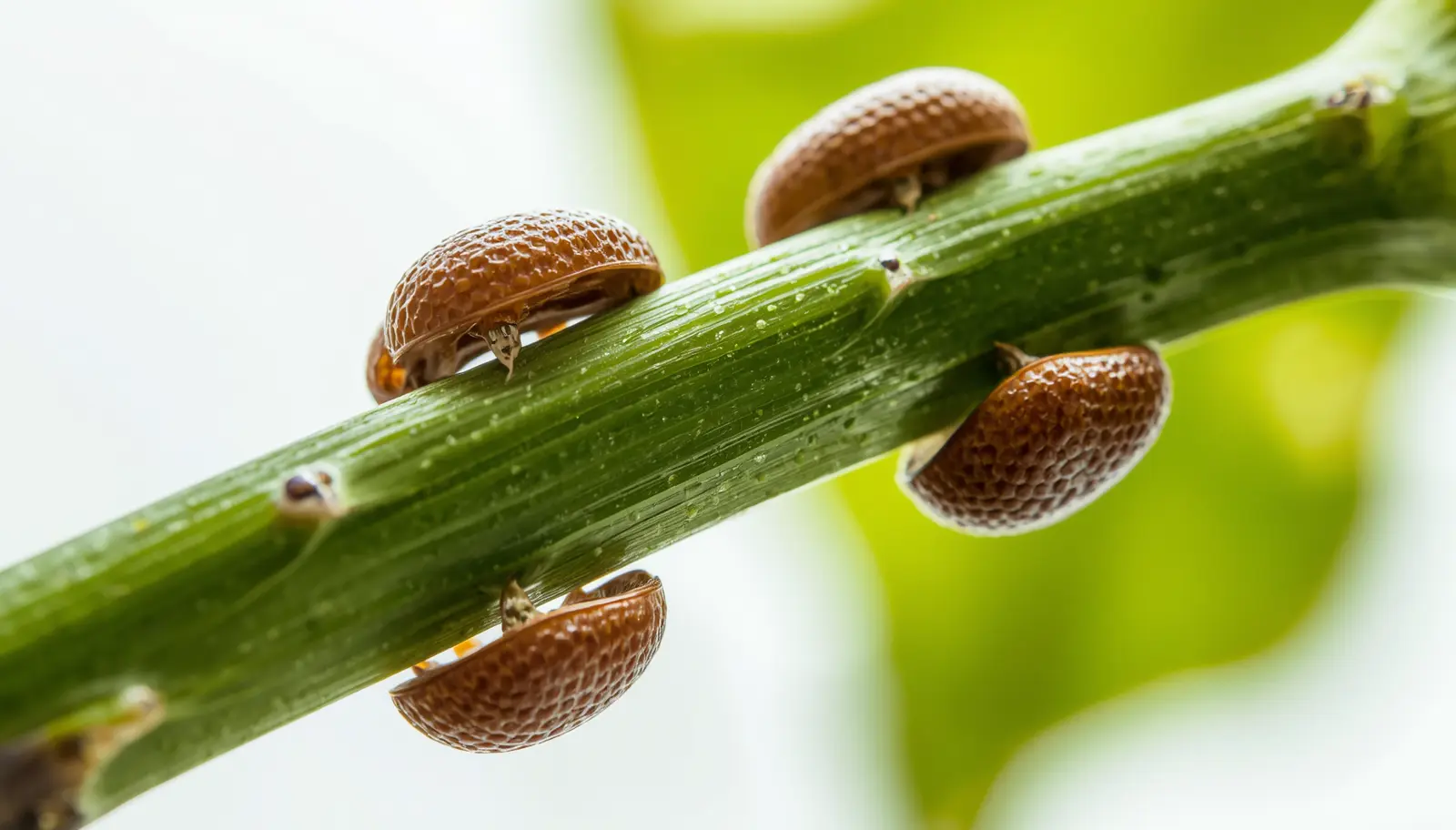
Small, hard, brown, gray or white bumps stuck to the stems and leaf veins of a houseplant are often scale insects. Armored scale is the tougher of the two main groups: each insect lives under a hard cover that shields it from most sprays, and unlike soft scale it leaves no sticky honeydew. This guide explains how to identify armored scale on indoor plants, what actually works against it, and when to give up on a plant. It follows UC IPM, UMD Extension, UGA Extension and UConn.
What Are the Brown Bumps on My Plant?
Scale insects are sap-feeding insects that spend most of their lives fixed in one spot under a protective covering. Only the newly hatched young, called crawlers, move around; once they settle, they stay put (UGA). UC IPM explains that armored scales have a plate-like cover that, during most settled stages, can be lifted off to reveal the insect body underneath.
A common armored scale on houseplants is fern scale. UMD Extension notes it has been recorded on 139 plant genera in 71 families, takes about 95 days per generation and has at least two generations a year indoors. Its crawlers are yellow with red eyes.
Armored Scale vs Soft Scale
| Feature | Armored scale | Soft scale |
|---|---|---|
| Cover | Hard cover that lifts off to show the insect (UC IPM) | Waxy covering that is part of the insect (UGA) |
| Honeydew and sooty mold | None (UC IPM, UGA, UConn) | Yes: sticky honeydew and black sooty mold (UGA, UMD) |
| Feeding | Bursts plant cells (UGA) | Feeds on phloem sap (UGA) |
| Systemic insecticides | Less effective (UConn, UMD, UGA) | More effective (UConn, UMD) |
| Example indoors | Fern scale (UMD) | Brown soft scale (UMD) |
Sources: UC IPM; UGA Extension Circular 1186 (2025); UConn IPM; UMD Extension.
The quickest test: if the plant and the surface below are sticky, you are probably dealing with soft scale (or another sap-sucker such as aphids or mealybugs). Hard bumps with no stickiness point to armored scale. UConn suggests probing a scale with a needle: colored liquid means it is alive; a dry, shriveled body means it is dead.
Why Sprays Often Fail
The settled insects are protected under their covers. UC IPM and UConn both say sprays work best on the crawlers, the only mobile and most insecticide-susceptible stage, and UC IPM notes the target pest must be completely contacted by the spray. Because eggs don’t all hatch at once and generations overlap, a single spray only catches the crawlers present that day; UMD and UConn both say multiple treatments are usually necessary.
Step 1: Remove Them by Hand
UMD Extension says scale should flake off with light pressure from a fingernail, toothpick, cotton swab or soft toothbrush, and that removing them also makes it easier to spot new ones. Isolate the plant first, then work over every stem, leaf vein, leaf underside and leaf axil. A cotton swab dipped in rubbing alcohol helps loosen them; see our rubbing alcohol guide for safe use on leaves. Prune off badly infested stems (UConn).
Step 2: Armored Scale Treatment with Oil or Soap
UMD lists horticultural oil and insecticidal soap as options for scale on indoor plants. Both work on contact by smothering or disrupting the insects, so coverage is everything.
- Follow the product label for the dilution and for any plants it may damage.
- Spray every stem and both sides of every leaf until wet, paying attention to the places you found scale.
- Keep the plant out of direct sun until the spray dries. UMD notes that ferns are sensitive to many products but can tolerate horticultural oil if kept shaded while it dries.
- Repeat as the label allows, checking between treatments. UGA recommends at least two oil applications during each crawler emergence period; indoors, where generations overlap, plan on several rounds.
Test any spray on a few leaves first and wait a day for damage. For more on oils, see our neem oil guide.
Do Systemic Insecticides Work?
Less well than many guides suggest. UMD says systemic products (typically imidacloprid-based) work only on brown soft scale among the indoor scales it covers, and are not labeled for edible indoor plants such as herbs and citrus fruit. UConn says systemic insecticides may kill soft scales more effectively than armored scales. UGA Extension explains that armored scales often live on twigs and bark where they receive lower doses, that dinotefuran, being the most mobile, works better against armored scales but needs repeat applications, and that imidacloprid and similar products can take two months or more to show effects.
Monitoring and Preventing Reinfestation
- Inspect new plants with a hand lens before bringing them home, and quarantine them (UConn, UC IPM, UMD).
- Check regularly: leaf undersides, upper surfaces, leaf axils, buds and stems (UConn).
- Catch crawlers with double-sided sticky tape wrapped around a stem near the scales (UC IPM, UGA).
- Keep the plant isolated until several checks in a row find no live scale.
When to Discard a Plant
UMD says heavily infested plants are best discarded, and UConn recommends removing heavily infested plants and pruning heavily infested branches. If a plant is covered in scale and is cheap to replace, discarding it protects the rest of your collection. If it is valuable, root a clean cutting from an uninfested tip in a separate room; see our sphagnum moss propagation guide.
Dead scales often stay stuck on after treatment, so judge success by whether new scales appear and whether probed scales are dry (UConn), not by whether old covers are still visible.
For other houseplant pests, see our guides to getting rid of fungus gnats, getting rid of spider mites and getting rid of mealybugs.
Frequently Asked Questions
What is the difference between armored scale vs soft scale?
Armored scales have a separate cover that lifts off, feed by bursting plant cells and produce no honeydew. Soft scales have a waxy covering that is part of the body and produce sticky honeydew and sooty mold (UC IPM, UGA).
What is the best armored scale treatment for houseplants?
Remove scales by hand, then spray horticultural oil or insecticidal soap with full coverage and repeat, because crawlers keep hatching (UMD, UConn). Discard heavily infested plants.
Does neem oil kill armored scale?
Oils work by contact, mainly on crawlers, so they need full coverage and repeat applications. Settled adults under their covers are hard to reach, which is why hand removal comes first.
Do systemic insecticides kill armored scale?
Less reliably than soft scale. UConn and UMD say systemics work better on soft scales; UGA says dinotefuran is more effective against armored scales than other neonicotinoids but needs repeat applications. Always follow the label.
How do I know if scale insects are dead?
Probe one with a needle. UConn says colored liquid means it is alive and a dry, shriveled body means it is dead.
Where do scale insects on houseplants come from?
Usually from new plants. Inspect and quarantine new arrivals, since crawlers can move to neighboring plants.