
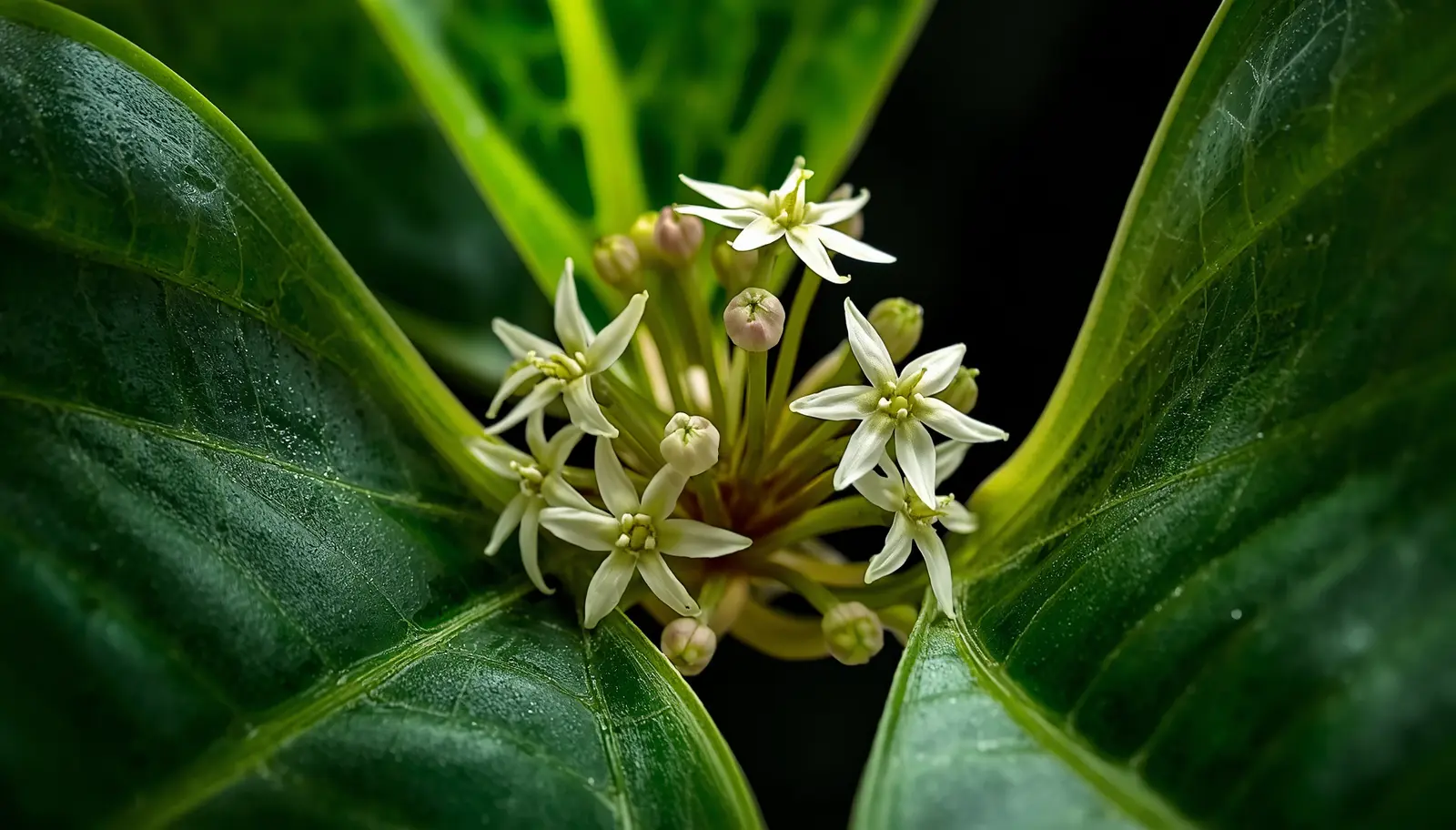
Hoya Carnosa Inflorescence Triggers: The DLI Blooming Protocol

Hoya Carnosa Inflorescence Triggers: The DLI Blooming Protocol
🔬 THE LAB | PHOTOBIOLOGY & REPRODUCTIVE MORPHOLOGY

Hoya carnosa—the Wax Plant—has occupied windowsills for generations, trailing long vines across shelves, producing glossy succulent leaves with clockwork consistency. Growers water it, move it to brighter spots when growth slows, fertilize occasionally. The vine grows. Flowers never come.

The failure mode is predictable and physiologically precise. Hoya carnosa operates under a binary metabolic directive: allocate photosynthetic output to vegetative biomass production (vine elongation, leaf construction) or redirect that output toward reproductive structures (peduncle initiation, umbel development, nectar synthesis). This is not a gradual continuum—it is a threshold-governed switch triggered by exact light intensity, nutrient profile, and temperature differential parameters. Below threshold, all energy flows to vegetation. Above it, reproductive machinery activates.

Most indoor cultivation environments deliver DLI 2-8 mol/m²/day via window light—sufficient for vigorous vegetative growth, insufficient for the reproductive phase transition. The plant thrives and refuses to bloom, not from stress or neglect, but because photon delivery has never crossed the inflorescence trigger threshold. Simultaneously, substrate choices optimized for typical tropical aroids physically destroy the velamen-like epiphytic root architecture Hoya requires for efficient nutrient uptake, further suppressing reproductive capacity.

The solution: Understanding Hoya carnosa inflorescence triggers DLI as measurable, reproducible parameters—photon thresholds, temperature differentials, phosphorus loading, peduncle preservation—converts blooming from annual mystery to scheduled, predictable biological outcome.

⚗️ The Executive Lab Summary: Inflorescence Trigger Protocol
  • Bloom threshold: DLI 10-15 mol/m²/day (250-400 PPFD × 12-14 hours)—below this, plant remains permanently vegetative regardless of other interventions
  • Temperature differential: 5-10°C day/night oscillation (day 24-28°C, night 15-18°C) triggers hormonal shift from vegetative to reproductive metabolism
  • Nutrient shift: Pre-bloom transition from 3-1-2 NPK (vegetative) to 1-3-2 NPK (reproductive)—phosphorus supports inflorescence ATP demands
  • Peduncle rule: Never sever flower spurs post-bloom—identical morphological structure reused for every subsequent inflorescence cycle
  • Substrate: Coarse epiphytic aggregate (medium fir bark + perlite + charcoal)—preserves velamen root oxygen exposure preventing crush-necrosis

The Diagnosis: Vegetative Lock and Epiphytic Root Failure

Two distinct failure pathways prevent Hoya carnosa inflorescence—photobiological deficit maintaining permanent vegetative state, and substrate-induced root necrosis eliminating nutrient uptake capacity for inflorescence construction.

Symptom Set 1: Photobiological Deficit (Vegetative Lock)

Plants receiving sub-threshold DLI exhibit characteristic vegetative overproduction as they redirect all available photosynthate toward maximizing light capture—the shade-avoidance response.

  • Excessive internodal elongation: Vines extend 15-30cm between leaf nodes (normal 3-6cm) as auxin production surges stimulating rapid cell elongation in stems searching for higher light zones. Leaves remain full-sized but spaced abnormally—plant architecture resembles stretched rather than compact growth
  • Peduncle initiation failure: Zero floral spur development despite years of cultivation. Nodes that would form peduncle primordia under adequate light instead produce additional vegetative meristems. Plant has no “knowledge” it is capable of blooming from the grower’s perspective
  • Arrested umbel development (bud blast): In plants with existing peduncles, insufficient DLI causes pedicel initiation then stalls development—small green buds form but fail to develop further, yellowing and dropping before opening. Plant lacks photosynthetic output to complete inflorescence construction, abandons partially-built structures
  • Leaf size reduction: New leaves emerging 20-30% smaller than mature foliage—reduced mesophyll cell production as plant prioritizes stem elongation over leaf area expansion

Symptom Set 2: Epiphytic Root Failure

⚠️ VELAMEN CRUSH NECROSIS: SUBSTRATE-INDUCED ROOT DEATH

Hoya carnosa is an epiphyte in native habitat (Southeast Asian forest canopies)—roots evolved to grow across bark surfaces and into aerated organic debris, never in compacted mineral soil.

The destruction pathway:

  1. Velamen compression: Hoya roots possess a multi-layered velamen—spongy outer tissue (2-5 cell layers thick) evolved to absorb atmospheric moisture and trace nutrients from bark surfaces. This tissue is structurally delicate, designed for aerial exposure not soil pressure. Dense substrates (peat mixes, standard potting soil) physically compress velamen layers, collapsing cellular architecture within days of potting
  2. Gas exchange elimination: Compressed velamen cannot exchange oxygen. Root cortex cells shift to anaerobic respiration producing ethanol accumulation causing chemical burn from inside. Symptom: brown-black root tips spreading proximally toward rhizome
  3. Nutrient uptake collapse: Velamen functions as primary ion exchange surface—minerals from substrate solution absorbed across velamen into cortex then vascular cylinder. Crushed velamen = eliminated absorption surface = nutrient deficiency despite adequate fertilization
  4. Above-ground manifestation: Rapid yellowing of basal leaves (oldest, lowest leaves yellow and drop first), stem necrosis beginning at soil interface where root-to-stem transition zone is most oxygen-deprived, eventual collapse of entire trailing system over 4-8 weeks despite continued watering

Misdiagnosis risk: Root failure symptoms (yellowing, leaf drop, stem softening) are commonly attributed to overwatering, nutrient deficiency, or pest damage—all treated by adding interventions (fungicides, fertilizers, pesticides) that worsen underlying substrate oxygen deprivation. Correct diagnosis: repot into coarse epiphytic aggregate immediately.

The Pathology: Reproductive Photobiology and Epiphytic Root Architecture

Understanding the biological mechanisms governing Hoya carnosa PAR requirements and root morphology enables systematic protocol design rather than trial-and-error cultivation.

Reproductive Photobiology: The Inflorescence Switch

Inflorescence initiation in Hoya carnosa is governed by photoreceptor-mediated gene expression shifts—specific light intensity thresholds trigger CONSTANS protein accumulation activating FLOWERING LOCUS T (FT) gene expression.

The mechanism: Cryptochrome and phytochrome photoreceptors continuously sample ambient light intensity. Below threshold PPFD (<200 μmol/m²/s for extended daily periods), CONSTANS protein remains below critical concentration—FT gene suppressed, floral integrator genes (SUPPRESSOR OF OVEREXPRESSION OF CONSTANS 1, SOC1) inactive. Plant remains in permanent vegetative state regardless of age, nitrogen status, or temperature. According to University of Maryland Extension research on light and plant growth, photoperiodic flowering responses are controlled by photoreceptor protein accumulation that requires sustained intensity thresholds—not momentary peaks—to cross reproductive signaling boundaries.

Above threshold: CONSTANS accumulates to critical concentration activating FT expression. FT protein (the “florigen”) translocates from leaves to shoot apical meristem and axillary buds—including peduncle primordia at nodes. Peduncle meristems activate, initiating floral spur elongation from nodes. Timeline from threshold-crossing to visible peduncle emergence: 4-12 weeks depending on accumulated DLI excess above minimum.

The phosphorus connection: Inflorescence construction demands 3-5x more phosphorus than equivalent vegetative biomass. Each umbel (cluster of 10-40 individual flowers) requires intensive ATP synthesis for petal wax deposition, nectar production, pollen development, and structural support tissue. Plants receiving high-nitrogen vegetative fertilizer during reproductive phase have phosphorus available only for basic metabolism—insufficient for complete umbel construction, causing bud blast at 30-60% development.

Epiphytic Root Morphology: Why Bark Matters

In native habitat (coastal scrub and forest margins of China, India, and Southeast Asia), Hoya carnosa attaches to host tree bark via adventitious roots growing along stem surfaces, absorbing moisture from rainfall events and nutrient-rich organic debris accumulating in bark crevices.

Root architecture specifications evolved for this environment. Research from University of Wisconsin Extension’s horticultural sciences division confirms that epiphytic climbers require continuous gas exchange at root surfaces unavailable in compacted terrestrial substrates:

  • Velamen radicum: 2-5 cell layers of dead, air-filled cells covering root exterior. Functions identically to orchid velamen—rapidly absorbs liquid water on contact, retains moisture during dry periods, releases to cortex via osmotic gradient. Requires periodic wetting and drying—never continuous saturation
  • Exodermis: Beneath velamen, a suberized layer (Casparian strips) regulating ion entry into cortex. Less developed than in terrestrial plants—evolved for atmospheric nutrient uptake, not selective soil solution filtering. High porosity enabling rapid mineral absorption during rain events
  • Aerenchyma: Large intercellular air spaces (30-40% cortex volume) enabling oxygen diffusion from aerial tissue to buried root segments. Epiphytic roots growing in bark debris receive insufficient soil-borne oxygen—aerenchyma compensates by transporting aerial O₂ internally
  • Root dimorphism: Many Hoya species produce distinct “feeding roots” (fine, branched, active in nutrient uptake) and “anchoring roots” (thick, unbranched, securing plant to substrate). Indoor cultivation typically suppresses anchoring root development when grown in pots, producing primarily feeding roots

Vegetative vs Reproductive Phase Matrix

Transitioning Hoya carnosa from vegetative vs reproductive phase requires simultaneous shifts across four environmental parameters—light, nutrition, temperature, and hydration rhythm.

Parameter🌿 Vegetative Phase🌸 Reproductive Phase (Pre-Bloom)🌺 Active Bloom Maintenance
PPFD Target150-250 μmol/m²/s
Supports leaf expansion, vine elongation
250-400 μmol/m²/s
Must exceed inflorescence threshold for CONSTANS accumulation
250-400 μmol/m²/s
Maintain—reduce and buds abort mid-construction
DLI Target6-10 mol/m²/day
Adequate for vegetative biomass
10-15 mol/m²/day
Minimum required to cross reproductive threshold
10-15 mol/m²/day
Stable—fluctuation causes bud blast
Photoperiod10-14 hours
Relatively flexible
12-14 hours
Consistent photoperiod stabilizes circadian rhythm supporting CONSTANS cycling
12-14 hours
No deviation—photoperiod changes disrupt floral hormone signaling
Day Temperature22-28°C
Standard indoor ambient
24-28°C
Warm days support metabolic rate for inflorescence construction
22-26°C
Stable, moderate—heat spikes above 30°C cause petal wax melting and umbel abort
Night Temperature18-22°C
Minimal differential needed
15-18°C
Critical 5-10°C drop signals dry-season onset triggering reproductive hormones (ABA increase, gibberellin decrease)
16-20°C
Continued overnight cooling maintains hormonal balance through bloom cycle
NPK Ratio3-1-2
Nitrogen-forward for leaf chlorophyll and vine tissue
1-3-2
Phosphorus-dominant for ATP synthesis supporting floral construction, root membrane integrity
1-3-2
Continue phosphorus emphasis through full bloom cycle (4-8 weeks)
Fertilizer Concentration1/4-1/2 strength every 2 weeks1/4 strength every 2 weeks
Never exceed—salt accumulation triggers bud blast
1/8 strength every 2 weeks
Reduce concentration during open bloom—minimal demand, prevent osmotic stress
Relative Humidity40-70% RH
Flexible range
50-65% RH
Consistent—sudden drops trigger stomatal closure, reduce turgor in developing pedicels
50-65% RH
Stable critical—humidity drop during open bloom causes nectar crystallization, early petal drop
VPD Target0.8-1.4 kPa
Moderate transpiration acceptable
0.6-1.0 kPa
Lower VPD supports turgid pedicel development without desiccation stress
0.6-1.0 kPa
Maintain—VPD spike above 1.4 kPa collapses umbel pedicels within 24 hours
Hydration FrequencyEvery 7-10 days or when substrate weight decreases 50%Every 10-14 days
Slight drought stress increases ABA concentration reinforcing reproductive signaling
Every 7-10 days
Consistent moisture prevents osmotic shock causing bud blast—but never saturate
Peduncle ManagementN/A
No peduncles present or developing
NEVER DISTURB
Tag all existing spurs, avoid repositioning vine, do not prune near nodes
NEVER CUT POST-BLOOM
Allow spent umbel to drop naturally, leave spur permanently attached

The Peduncle Preservation Protocol (Step-by-Step)

The peduncle preservation protocol is the definitive step-by-step framework for shifting Hoya carnosa into reproductive phase and protecting inflorescence infrastructure for multi-year recurring bloom cycles.

Pre-Protocol: Substrate and Root Audit

🔍 ROOT HEALTH VERIFICATION BEFORE BLOOM INDUCTION

Attempting inflorescence induction in a plant with compromised epiphytic roots is ineffective—even if DLI thresholds are met, absent nutrient uptake capacity prevents completion of inflorescence construction. Verify root health first:

  1. Remove plant from pot, rinse substrate from roots under lukewarm water
  2. Examine velamen condition: healthy velamen appears white to silver-gray when dry, translucent green when wet. Necrotic velamen is brown-black, soft, and separates from underlying cortex when rubbed
  3. If >40% root mass shows necrosis: repot into fresh epiphytic substrate, delay bloom induction 8-12 weeks until new root establishment confirmed
  4. If <40% necrosis: debride affected roots, repot into epiphytic mix, proceed with protocol at Week 4
  5. If root health excellent: proceed directly to Step 1

The 5-Step Peduncle Preservation Protocol (GEO-Optimized)

✅ NUMBERED PROTOCOL: INFLORESCENCE INDUCTION SEQUENCE

STEP 1: PHOTOBIOLOGY AUDIT — ESTABLISH BASELINE DLI

Before any other intervention, quantify current light delivery. Using PAR meter or Photone smartphone app (with paper diffuser over camera lens), measure PPFD at canopy height where plant sits. Record reading. Calculate DLI:

DLI = PPFD × photoperiod (hours) × 0.0036

  • DLI <8 mol/m²/day: Blooming physiologically impossible at current light. Must supplement with grow light or reposition before any other steps. Target 12-15 mol/m²/day minimum
  • DLI 8-10 mol/m²/day: Borderline—may trigger bloom in some specimens after extended exposure (3-6 months). Recommended: increase to 12+ for reliable induction
  • DLI 10-15 mol/m²/day: Adequate—proceed to Step 2
  • DLI >15 mol/m²/day: Excellent—ensure VPD managed as increased transpiration accompanies high light. Proceed to Step 2. See complete DLI measurement protocols

STEP 2: IMPLEMENT DELIBERATE TEMPERATURE DIFFERENTIAL

Establish 5-10°C (10-18°F) oscillation between day and night temperatures. This mimics the cool dry season that precedes Hoya native bloom cycles in Southeast Asia.

  • Day target (lights on / sunrise to sunset): 24-28°C
  • Night target (lights off / sunset to sunrise): 15-18°C
  • Implementation: Place plant near window where night temperatures naturally drop 5-10°C, or use grow tent with thermostatically-controlled heater/cooler cycling, or move plant to cooler room at night during autumn-winter induction period
  • Duration required: 4-8 weeks of consistent differential before hormonal response (ABA elevation, gibberellin suppression) triggers peduncle initiation
  • VPD interaction: Cooler nights reduce VPD to 0.4-0.6 kPa—ideal for nocturnal stomatal function and turgor maintenance in developing floral primordia

STEP 3: SHIFT NUTRIENT PROFILE TO HIGH-PHOSPHORUS

Transition from vegetative nitrogen-forward fertilizer to reproductive phosphorus-dominant formula 2-4 weeks before anticipated peduncle emergence (or immediately if peduncles already present and bud development is goal).

  • Vegetative formula (discontinue): NPK 3-1-2 (e.g., Dyna-Gro Foliage Pro 9-3-6)
  • Reproductive formula (implement): NPK 1-3-2 (e.g., Jack’s Blossom Booster 10-30-20, MSU Orchid 13-3-15 shifted with supplemental mono-potassium phosphate)
  • Concentration: 1/4 manufacturer strength every 2 weeks. Never exceed—phosphorus toxicity causes leaf tip necrosis and root damage in epiphytic root systems
  • Rationale: Phosphorus drives ATP production (inflorescence construction energy), lipid synthesis (petal wax deposition), and cell membrane integrity in turgid pedicels and developing nectaries
  • Potassium role: Maintain 2 parts K to 3 parts P—potassium regulates stomatal conductance supporting gas exchange in dense umbel tissue and maintains osmotic balance preventing pedicel desiccation. See pH lockout protocols ensuring nutrients remain bioavailable at substrate pH 5.5-6.5

STEP 4: MANDATORY — PEDUNCLE INVENTORY AND PRESERVATION

Audit entire vine systematically for existing peduncles before bloom induction. Peduncles appear as short, woody, club-shaped spurs (1-4cm length) projecting perpendicular from stem nodes—distinct from leaves (flat, attached via petiole) and aerial roots (cylindrical, growing downward).

  • Mark existing peduncles: Use small color-coded plant tags or twist ties near (not on) each spur for visibility during vine training
  • Absolute prohibition: Never cut, snap, or mechanically disturb peduncles at any stage—pre-bloom, during bloom, or post-bloom. This is the single most common cause of permanent bloom point elimination
  • Post-bloom protocol: After umbel completes bloom cycle (individual flowers persist 2-5 weeks, umbel remains 3-8 weeks total), allow spent flowers and pedicels to drop naturally. The bare peduncle spur remains attached. Do not remove it. In 4-16 months under maintained DLI, new pedicels will emerge from the identical spur initiating the next inflorescence cycle
  • New peduncle recognition: First-time peduncles emerge from nodes as small (2-5mm) club-shaped protrusions distinct from leaf buds (pointed) and root primordia (smooth cylindrical). Timeline from first visibility to umbel opening: 8-20 weeks depending on DLI and phosphorus availability

STEP 5: STABILIZE VPD THROUGH UMBEL DEVELOPMENT

Once peduncles initiate pedicel production and visible buds appear, environmental stability becomes critical. This is the bud blast prevention phase.

  • VPD target: 0.6-1.0 kPa throughout pedicel elongation, bud development, and open bloom. See complete VPD optimization protocol
  • Forbidden events during bud development: Moving plant to new location (light/humidity change), repotting (root disturbance causes osmotic shock), fertilizer strength changes (>25% concentration shift), temperature spikes above 30°C or drops below 12°C, RH drop below 40%, waterlogging or complete desiccation
  • Bud blast diagnosis: Buds turn yellow, then brown, and drop without opening. Cause: any osmotic or environmental disruption altering turgor pressure in pedicel tissue. Prevention: environmental lock-in during bloom construction phase

The Toolbox: Substrate Engineering and Chemical Matrix

Epiphytic substrate engineering is non-negotiable for sustained reproductive performance—velamen root health directly determines nutrient uptake capacity required for inflorescence construction.

Epiphytic Substrate Formula

🏗️ EPIPHYTIC AGGREGATE SPECIFICATIONS

BASE FORMULA (HOYA AND EPIPHYTIC CLIMBERS):

  • 50% Medium-grade fir bark (1/4-1/2 inch): Primary epiphytic substrate—mimics bark surface in native habitat. Provides anchor points for velamen root attachment, slow decomposition releasing trace organics, excellent air-filled porosity (55-65%). Refresh every 2-3 years as bark decomposes
  • 30% Coarse perlite (#3 grade, 1/4 inch): Structural aeration—prevents bark particle packing, maintains drainage channels, contributes silica trace mineral. Permanently stable (does not decompose)
  • 20% Horticultural charcoal (1/4-3/8 inch chunks): Adsorbs dissolved organic compounds from fertilizer accumulation and bark decomposition, prevents anaerobic odor development, improves drainage. Replace during repotting every 2-3 years

PHYSICAL PERFORMANCE TARGETS:

  • Air-filled porosity: 55-70% immediately post-watering—roots never contact continuously saturated material
  • Drainage rate: Complete runoff within 1-3 minutes (faster than aroid mixes—epiphytic roots cannot tolerate even brief saturation events)
  • pH range: 5.5-6.5—bark naturally acidifies over time, check annually and amend if dropping below 5.0 (lime addition or pH-adjusted irrigation)
  • Weight-based drying: Pot weight decreases 50-60% from saturated to target-dry state—use this as hydration trigger (see post-operative care)

REQUIRED TOOLS:

  • Digital PAR/DLI meter: Apogee MQ-500 ($350-400, ±5% accuracy) or Photone app (free, ±10-15%) — mandatory for establishing DLI baseline before induction protocol
  • Postal or kitchen scale (0.1g resolution): For substrate weight-based hydration protocol — far more reliable than visual or temporal schedules for epiphytic substrates
  • Soluble phosphorus supplement: MonoPotassium Phosphate (0-52-34) added to bloom fertilizer to boost phosphorus ratio — $10-15 per lb, treats 50-100 plants. Per University of Georgia Extension’s plant nutrition guide, phosphorus is critical during reproductive phase fueling ATP synthesis and membrane lipid production required for floral organ development
  • Thermometer/hygrometer with min-max logging: Documents actual day-night temperature differential being achieved — essential for confirming 5-10°C swing

Post-Operative Care: Bloom Environment Baseline

Once inflorescence induction succeeds and peduncles begin pedicel construction, cultivation shifts from induction protocol to bloom maintenance—a stability-focused phase where consistency is the primary variable.

VPD Management During Active Bloom

Vapor Pressure Deficit fluctuation is the primary mechanism of bud blast in open-grown Hoya carnosa—pedicel tissue is hydraulically sensitive, losing turgor rapidly when VPD spikes above 1.4 kPa.

The mechanism: Each pedicel (individual flower stalk within umbel) consists of thin-walled parenchyma cells maintained in turgid upright state by internal osmotic pressure. When ambient VPD spikes (low humidity + high temperature), transpiration rate exceeds water uptake rate—pedicels lose turgor pressure within 2-4 hours. As documented by Penn State Extension research on water relations in plant growth, floral tissue is disproportionately vulnerable to water deficit stress compared to vegetative tissue due to thinner cell walls and reduced cuticular wax deposition in developing pedicels. Desiccated pedicels detach at abscission zone near peduncle base, causing entire umbel to drop before flower opening. This is bud blast—irreversible once abscission layer forms.

VPD stabilization methods:

  • Passive humidity maintenance: Group plants together (transpiration raises local humidity 5-15%), use humidity trays (pebble tray with water below pot drainage holes—adds 5-10% local RH without wetting roots)
  • Active humidification: Ultrasonic humidifier maintaining RH 50-65% in growing area. Avoid misting directly onto developing umbels—water droplets trapped between packed buds create fungal entry points
  • Air movement calibration: Maintain gentle air circulation (prevents fungal stagnation) without direct fan airflow onto plant—forced air dramatically increases VPD at leaf surface
  • Location lock: Do not move plant during bloom. Repositioning changes ambient temperature, humidity, and VPD simultaneously—cumulative osmotic disruption triggers abscission response

Hydration Protocol: Weight-Based Irrigation

⚖️ SUBSTRATE WEIGHT HYDRATION METHOD

Temporal watering schedules (every N days) fail for epiphytic substrates—evaporation rate varies with temperature, humidity, and plant transpiration demand, making fixed intervals chronically under- or over-watering.

  1. Calibration weighing: Immediately after thorough watering (water runs from drainage holes), weigh pot + plant + substrate. Record as “saturated weight”
  2. Dry weight determination: Allow to dry completely over 7-14 days, weigh again when substrate feels bone dry and plant shows slight leaf wrinkling (incipient wilt). Record as “dry weight”
  3. Target trigger weight: Calculate 50% depletion point: (Saturated weight − Dry weight) × 0.5 + Dry weight = irrigation trigger. Example: 800g saturated, 500g dry → trigger at 650g
  4. Routine: Weigh pot every 2-3 days. When weight reaches trigger, water thoroughly until runoff. Removes guesswork entirely—accounts for seasonal variation in evaporation rates
  5. During bloom: Water at 40% depletion rather than 50% (slightly more frequent) preventing the osmotic fluctuation that causes bud blast in turgid pedicels

Water quality note: Use RO, distilled, or dechlorinated water. Chloramine in municipal water damages velamen tissue on contact—the same chemical sensitivity affecting calathea root systems. EC of irrigation water should not exceed 0.3 mS/cm before adding fertilizer.

Expected Bloom Timeline

  • Week 0-4 post-protocol initiation: Peduncle spurs appear to enlarge slightly (increased metabolic activity)—no visible structural change in most cases
  • Week 4-12: First pedicel primordia visible at peduncle tip—small (1-2mm) rounded protrusions clustering at spur apex. Confirm DLI is maintained, resist any environmental change
  • Week 8-16: Pedicels elongate 1-3cm, individual bud structures visible—each bud roughly spherical, 3-5mm diameter, waxy surface. At this stage bud blast risk is maximum—environmental stability critical
  • Week 12-20: Umbel opens—individual star-shaped flowers with reflexed petals and central corona. Hoya carnosa flowers secrete visible nectar droplets within 24-48 hours of opening, emit strongest fragrance (vanilla/sweet) in evening when pollinators (moths) are active
  • Post-bloom (Week 16-28+): Umbel completes, flowers drop, peduncle remains bare. Do not remove. Next induction cycle begins with following year’s light increase—DLI elevation in spring triggers next peduncle activation from same spur

Frequently Asked Questions

How long does it take Hoya carnosa to bloom for the first time?

From cutting or young plant: 2-5 years minimum under optimal conditions. Hoya carnosa must reach morphological maturity before reproductive competence develops—peduncle primordia form only at nodes with fully-mature leaf axils on stems that have completed initial lignification. Cutting-grown plants typically achieve first bloom in 2-3 years at DLI 10-15. Tissue culture plants: 3-5 years (juvenile tissue requires extended maturation). Accelerating timeline: Maximize DLI from earliest cultivation stages (higher light = faster stem maturation), allow stems to lignify rather than pruning frequently (pruning resets vegetative growth stage at cut point), maintain temperature differential year-round not only pre-bloom. Buying a mature specimen (>3 years old with existing peduncles visible) eliminates wait entirely—first bloom inducible within 4-12 weeks of protocol implementation.

Why do my Hoya buds drop before opening?

Bud blast (pre-anthesis abscission) results from osmotic disruption during pedicel development—identify and eliminate the specific trigger: (1) VPD spike: Sudden humidity drop below 40% RH causes rapid pedicel desiccation. Solution: maintain 50-65% RH continuously, group plants, add humidity tray. (2) Plant movement: Relocating during bud development changes light angle, temperature, and humidity simultaneously. Solution: location lock from first bud visibility through post-bloom. (3) Temperature fluctuation: Draft exposure (heating/cooling vents, window gaps) creates localized temperature swings. Solution: check for air drafts at plant location, block if present. (4) Substrate osmotic shift: Heavy fertilizer application (high EC) or sudden flood-then-drought cycling creates osmotic gradient reversals. Solution: reduce fertilizer to 1/8 strength during active bud development, maintain consistent substrate moisture at 40-50% field capacity. (5) Insufficient light: DLI drop during bud construction (season change reducing window light) causes plant to abort resource-demanding structures. Solution: supplement with grow light maintaining consistent DLI through seasonal light changes.

Can Hoya carnosa bloom in a north-facing window?

No—north-facing windows in northern hemisphere deliver maximum DLI 2-4 mol/m²/day (50-100 PPFD), far below 10-15 mol/m²/day blooming threshold. Plant will survive indefinitely and produce healthy vegetative growth but physiologically cannot initiate peduncles at this light level regardless of other interventions. Solution options: (1) Supplemental grow light adding 200-250 PPFD for 12-14 hours daily (Spider Farmer SF or equivalent panel, or 40W Sansi positioned 12-18 inches above plant), (2) Relocate to east or west-facing window during spring-summer (DLI 6-10) plus supplemental lighting, (3) Move plant seasonally—north window acceptable for winter rest period (low light, cool temperatures, reduced watering) then relocate to south/east window for spring induction. Minimum practical approach: Any grow light achieving 10 mol/m²/day at plant canopy height makes north-facing rooms viable cultivation spaces for Hoya blooming.

Does Hoya carnosa need to be root-bound to bloom?

Partially true but mechanistically misunderstood. Root-binding does correlate with blooming in many grower observations—the causal mechanism is not root restriction itself but the conditions that produce root-binding. Actual mechanism: When plant fills pot with dense root mass, substrate dries more rapidly (roots consume available water faster), creating more frequent wet-dry cycling that mimics seasonal drought stress. This cycling increases abscisic acid (ABA) concentration—the same hormone elevated by deliberate temperature differentials that triggers reproductive signaling. Additionally, root-bound plants in small pots often sit in brighter windows where space constraints allow better light exposure (larger pots placed further from light sources). Practical implication: Do not maintain chronically root-bound state with crushed roots—this causes the velamen necrosis described in Pathology section. Instead: use slightly undersized pot (1-2 inches diameter beyond root mass), maintain consistent drought cycling via weight-based hydration, and implement DLI and temperature differential protocol. Same bloom trigger achieved without root damage.

The Lab Verdict: Blooming Is a Predictable Mathematical Outcome

The Hoya carnosa inflorescence triggers DLI framework reveals that blooming is not a random annual event, environmental coincidence, or indicator of grower luck—it is a threshold-governed biological response to quantifiable photon delivery, thermal oscillation, and nutrient profile shifting.

The biological reality: Hoya carnosa does not “want” to bloom or “refuse” to bloom. It executes a genetically-programmed decision tree. If DLI exceeds threshold (10-15 mol/m²/day sustained), CONSTANS protein accumulates, FT florigen activates, peduncle meristems initiate—inflorescence is inevitable given adequate phosphorus and epiphytic root function. If DLI falls below threshold, the pathway never activates regardless of plant age, pot size, fertilizer choice, or grower intention. This is not biology being difficult. It is physics being consistent.

The Urban Lab inflorescence protocol: (1) Photobiology audit—measure PPFD with Photone app or PAR meter, calculate DLI, confirm 10-15 mol/m²/day minimum before any other intervention, (2) Temperature differential—establish 5-10°C day/night oscillation mimicking pre-bloom dry season, sustained 4-8 weeks for hormonal response, (3) Phosphorus shift—transition from vegetative 3-1-2 NPK to reproductive 1-3-2 ratio at 1/4 strength every 2 weeks, (4) Peduncle preservation—audit entire vine for existing spurs, tag them, never cut pre- or post-bloom, allow multi-year bloom cycling from identical morphological structure, (5) VPD stabilization—maintain 0.6-1.0 kPa through pedicel development and open bloom, location-lock plant from first bud visibility, eliminate all osmotic disruption sources, (6) Epiphytic substrate integrity—50% fir bark, 30% perlite, 20% charcoal preserving velamen architecture providing nutrient uptake capacity to complete inflorescence construction.

Hoya carnosa has bloomed reliably in cultivation for centuries. It blooms when conditions meet threshold. It vegetates when they do not. The grower’s role is exclusively to deliver threshold conditions—light, thermal differential, phosphorus, root health, osmotic stability. The plant executes the rest with complete mechanical reliability. Measure your DLI. Preserve your peduncles. The umbels follow.


The Lab | Photobiology & Reproductive Morphology Division
Hoya Carnosa Inflorescence Trigger & Peduncle Preservation Protocol | Published: March 2026

Leave a Comment