
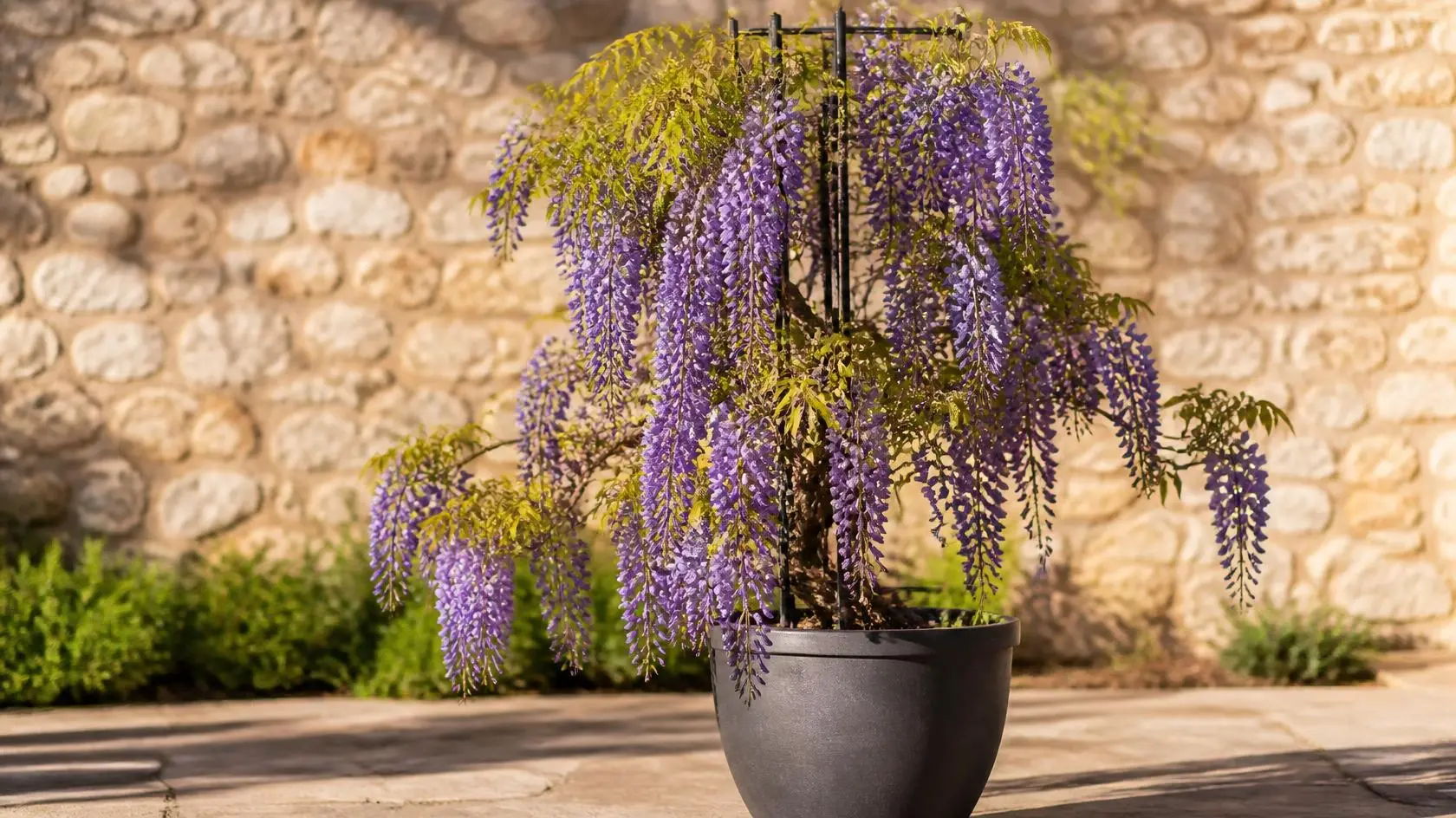
American wisteria (Wisteria frutescens) is a native North American twining vine, less aggressive than the Chinese and Japanese wisterias, with fragrant lilac-purple flowers in late spring. Compact cultivars such as ‘Amethyst Falls’ are a popular choice for growing wisteria in pots. This guide covers wisteria frutescens container care: pot and compost, sun, watering, feeding, the twice-yearly pruning that keeps it flowering, and why it is toxic to pets. It follows NC State Extension, the RHS and the ASPCA.
Container Care at a Glance
| Need | What the sources say |
|---|---|
| Pot | At least 45 cm (18 in) (RHS) |
| Compost | Peat-free loam-based, e.g. John Innes No. 3 (RHS) |
| Light | Full sun for best flowering; cannot grow in full shade (NC State) |
| Water | Keep well watered, especially in dry periods and July to September (RHS) |
| Feeding | Liquid tomato or flowering-plant feed, or controlled-release fertilizer (RHS) |
| Pruning | Summer to 5 or 6 leaves; winter to 2 or 3 buds (RHS) |
| Hardiness | USDA zones 5a to 9b in the ground (NC State) |
| Pets | Toxic to dogs, cats and horses (ASPCA) |
Sources: RHS wisteria growing guide; NC State Extension Plant Toolbox (Wisteria frutescens); ASPCA.
Why American Wisteria Suits Pots
NC State Extension describes W. frutescens as a twining deciduous vine native from Virginia to Illinois and south to Florida and Texas, growing fast to 40 feet or more in the ground, but less aggressive and less damaging to buildings than Chinese and Japanese wisteria. It flowers in April to May with fragrant lilac-purple or blue racemes up to 6 inches long, and may flower in its second or third year after planting, though it can take longer.
The RHS names ‘Amethyst Falls’ as a compact cultivar with dense clusters of lilac-blue flowers that suits large containers. NC State describes its flowers as lightly fragrant and lavender-purple.
Pot, Compost and Support
- Pot size: the RHS says at least 45 cm (18 in) across. Bigger pots dry out more slowly and are less likely to blow over once the vine is on its support.
- Drainage: make sure the pot has drainage holes; NC State says wisteria likes moist but well-drained soil.
- Compost: peat-free, loam-based potting compost such as John Innes No. 3 (RHS). NC State notes it prefers slightly acidic, humus-rich, moderately fertile soil.
- Support: it is a twining climber, so give it a sturdy obelisk, trellis or wires (RHS). A heavy pot or a support fixed to a wall keeps it stable.
- Repotting: when roots fill the pot, move it up a size in early spring or refresh the top layer of compost.
Sunlight
NC State says American wisteria needs full sun for the best flowering and cannot grow in full shade. The RHS says wisteria loves full sun, suits south- and west-facing walls, and produces few if any flowers in deep shade. Put the pot in the sunniest spot you have, and remember that a spot that is sunny in early spring may be shaded once trees leaf out.
Watering and Feeding
Watering: the RHS says to keep container wisteria well watered, especially in dry periods, and warns that a shortage of water from July to September affects next year’s flower buds. Water whenever the top of the compost feels dry, and more often in hot weather, but don’t let the pot stand in water.
Feeding: for containers, the RHS suggests a liquid tomato fertilizer or a similar flowering-plant food, or controlled-release fertilizer mixed into the compost. It also notes that low potassium can limit flowering. NC State says early-spring fertilizing can help flowering but lists overfertilization among the causes of poor flowering, so stick to the label rate and avoid high-nitrogen lawn-type feeds.
Pruning Wisteria in Pots
The RHS recommends pruning wisteria twice a year:
- Summer (July or August): cut the long, whippy green shoots of the current year back to five or six leaves, about 30 cm (1 ft). This controls size and encourages flower buds to form.
- Winter (January or February): shorten the same shoots to two or three buds, about 10 cm (4 in). The fat buds near the base are flower buds.
Leave young plants unpruned (apart from training) until they cover their support (RHS). Don’t prune in early or midsummer, which the RHS says removes next year’s flower buds. NC State recommends regular pruning to control size and encourage flowering, with any drastic pruning done in spring right after flowering. Remove dead, damaged or crossing stems in winter.
Why Wisteria in Pots Won’t Flower
| Cause | Source |
|---|---|
| Plant too young; seed-raised plants can take up to 20 years, most grafted plants flower within 3 to 4 | RHS |
| Too much shade | NC State, RHS |
| Pruning at the wrong time (early or midsummer) | RHS, NC State |
| Dry compost from July to September | RHS |
| Frost damage to buds in spring | RHS, NC State |
| Overfertilization; low potassium | NC State, RHS |
Sources: RHS wisteria growing guide; NC State Extension.
Buying a named, grafted cultivar such as ‘Amethyst Falls’, ideally already in flower, is the RHS’s suggestion for avoiding a long wait.
Winter Care
NC State lists American wisteria as hardy in USDA zones 5a to 9b, but roots in pots are more exposed to cold than roots in the ground. In colder areas, move the pot against a sheltered wall or into an unheated garage or shed for the coldest weeks, or wrap the pot to insulate the roots. Water sparingly in winter so the compost doesn’t stay soggy, and leave it outdoors: as a deciduous vine it needs its winter rest.
American vs Chinese Wisteria
| Feature | W. frutescens (American) | W. sinensis (Chinese) |
|---|---|---|
| Origin | Native to the southeastern and central US | China |
| Invasive? | Native; less aggressive spreader | Invasive in North Carolina; forms dense thickets |
| Damage to buildings | Less damaging than Asian wisterias | Needs space and sturdy supports |
| Flowering | April to May, after leaves emerge | Often 2 to 3 years after planting, sometimes much longer |
| Hardiness | Zones 5a to 9b | Not compared here |
Source: NC State Extension Plant Toolbox (Wisteria frutescens, Wisteria sinensis). NC State lists W. frutescens as the native alternative to W. sinensis.
For another vine, see our Japanese morning glory guide.
Is Wisteria Toxic to Pets?
Yes. The ASPCA lists wisteria (Wisteria species) as toxic to dogs, cats and horses, with lectin and wisterin glycoside as the toxic principles, and vomiting (sometimes with blood), diarrhea and depression as the signs. NC State says the seeds are the main poisonous part, that eating one or two pods can cause nausea, frequent vomiting, abdominal pain, depression and diarrhea, and that the roots, bark, branches and fruit contain saponins. Pick off seed pods after flowering, keep the pot out of reach of pets and children, and call your veterinarian or the ASPCA Animal Poison Control Center at (888) 426-4435 if a pet chews it. See our cat-safe plants list.
For other garden shrubs and trees, see our guides to lilacs that won’t bloom, Bloodgood Japanese maple and plumeria.
Frequently Asked Questions
Can you grow wisteria in pots?
Yes. The RHS recommends a container at least 45 cm (18 in) across with loam-based compost, and names ‘Amethyst Falls’ (W. frutescens) as suited to large containers.
Why is my wisteria in a pot not blooming?
Usually because it is young or seed-raised, in too much shade, pruned at the wrong time, short of water from July to September, or overfed (RHS, NC State).
When do you prune American wisteria?
In July or August, cut new shoots back to five or six leaves, then in January or February cut them to two or three buds (RHS).
Is Amethyst Falls wisteria invasive?
‘Amethyst Falls’ is a cultivar of W. frutescens, which NC State describes as native and a less aggressive spreader than Chinese wisteria, which is invasive in North Carolina.
Does American wisteria need a trellis in a pot?
Yes. It is a twining vine (NC State) and needs a sturdy support such as an obelisk, trellis or wires.
Is wisteria toxic to dogs and cats?
Yes. The ASPCA lists it as toxic to dogs, cats and horses, and NC State says one or two seed pods can cause vomiting and diarrhea.