
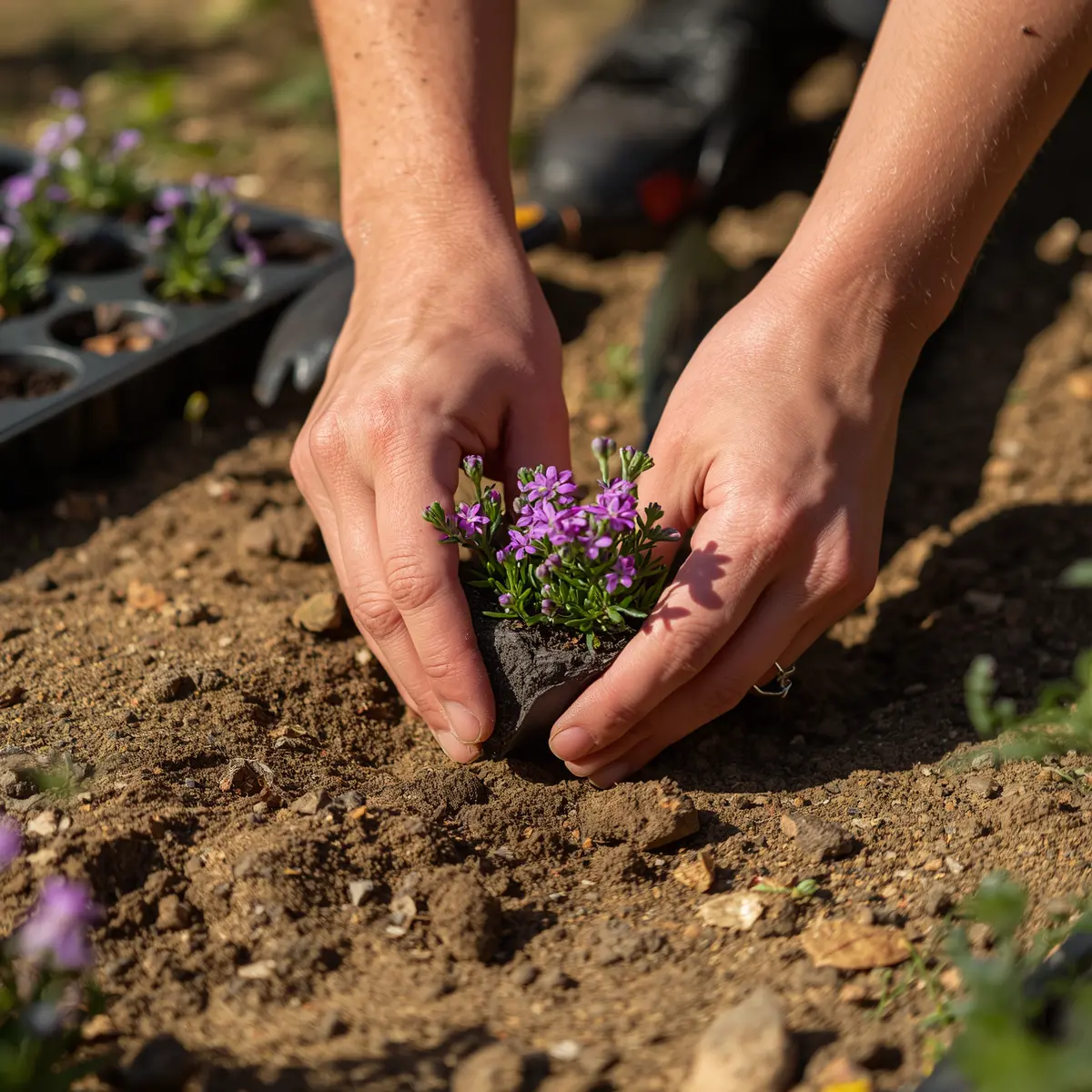
Creeping thyme is a low, fragrant mat of tiny leaves that covers itself in pink to purple flowers in early summer and draws in bees. It asks for very little: full sun, poor soil and sharp drainage. If you are wondering how to grow creeping thyme, the short answer is to give it the hottest, driest, best-drained spot you have and then mostly leave it alone. This guide follows the Missouri Botanical Garden, the RHS, Iowa State University and UF/IFAS Extension. (Planning to replace turf? See our creeping thyme lawn guide.)
Creeping Thyme at a Glance
| Need | What the sources say |
|---|---|
| Light | Full sun (MOBOT, Iowa State); at least 6 to 8 hours (UF/IFAS) |
| Soil | Loose, sandy, gritty or rocky, low in nutrients, very well drained (MOBOT) |
| Water | Dry to medium; drought tolerant; dislikes wet soil (MOBOT) |
| Hardiness | USDA zones 4 to 8 (MOBOT); 4 to 9 (UF/IFAS) |
| Size | Foliage mat about 3 in tall, flower stems 2 to 4 in more (MOBOT) |
| Spacing | 20 to 30 cm (8 to 12 in) (RHS, for thyme) |
| Bloom | Deep pink flowers in early summer, attractive to bees and butterflies (MOBOT) |
| Main problem | Root rot in moist or poorly drained soil (MOBOT) |
Sources: Missouri Botanical Garden Plant Finder (Thymus serpyllum); RHS; Iowa State University; UF/IFAS Extension Pasco County (2024).
What Is Creeping Thyme?
“Creeping thyme” usually means Thymus serpyllum, also called wild thyme or mother-of-thyme, a low, woody-based perennial in the mint family (Lamiaceae). The Missouri Botanical Garden describes it as a creeping plant that roots along its stems as it spreads, staying evergreen in mild winters. The name is also used for other mat-forming thymes, such as woolly thyme (T. pseudolanuginosus) and the red-flowered Coccineus Group, which are grown the same way.
Iowa State University notes that wild thyme stays around 3 to 6 inches tall and that its culinary use is limited, so it is mainly grown as an ornamental groundcover for rock gardens, path edges and slopes.
How to Plant Creeping Thyme
- Choose full sun. MOBOT and Iowa State both list full sun; UF/IFAS says at least 6 to 8 hours a day.
- Check the drainage. MOBOT describes ideal soil as loose, sandy, gritty or rocky and low in nutrients. The RHS says that if your soil is heavy or stays damp, especially in winter, grow thyme in containers or raised beds instead.
- Don’t enrich the soil. Thyme prefers soil that is not too rich (UF/IFAS); MOBOT says it does well on poor soils.
- Plant at the right time. The RHS says to plant out from mid-spring to early summer, hardening off plants raised indoors first.
- Space and plant. The RHS suggests 20 to 30 cm (8 to 12 in) apart, at the same depth the plant was growing before.
- Water in and keep the soil lightly moist while the roots establish.
How to Grow Creeping Thyme from Seed
Thyme seed is very fine and slow to make sizeable plants. The RHS advice for thyme:
- Sow indoors in spring in peat-free seed compost.
- Scatter the seed thinly on the surface and don’t cover it.
- Keep it at 15 to 20°C (59 to 68°F); seeds usually germinate within a couple of weeks.
- Prick out the seedlings into small pots or cells, grow them on, and harden them off before planting out from mid-spring to early summer.
The RHS notes that seedlings take about a year to establish. Iowa State adds that thyme is easy from seed, but cuttings, layering or division keep a named cultivar true to type. If you need a lot of plants for a groundcover, plugs (small rooted plants) give faster cover than seed.
Growing Creeping Thyme Between Pavers
Creeping thyme suits the gaps between stepping stones and pavers because it stays low and likes poor, gritty, well-drained ground (MOBOT). To get it established:
- Fill the joints with a gritty, sandy mix rather than rich topsoil.
- Use small plugs or divisions pressed firmly into the gaps, in a sunny spot.
- Water regularly until they root in and start to spread, then only in dry spells.
- Keep heavy foot traffic off new plantings until they knit together.
For larger areas that you plan to walk on, our creeping thyme lawn guide covers what to expect.
Watering and Feeding
MOBOT lists creeping thyme as needing dry to medium moisture: it tolerates drought but dislikes wet soil. The RHS says thyme is drought tolerant and only new plants and container plants need watering in hot, dry weather, and that overwatering, especially in winter, causes root rot. UF/IFAS says established thyme is drought tolerant.
Feeding is rarely needed. MOBOT describes it as a plant for low-nutrient soils, and UF/IFAS says thyme prefers soil that is not too rich.
Trimming and Rejuvenating
The RHS says creeping thymes need only a light trim after flowering, and warns that hard pruning into old wood is risky. MOBOT suggests cutting back stems as needed to keep plants tidy, control their spread or limit woody growth, and dividing plants that become densely woody. Older shrubby thymes become straggly after several years; the RHS suggests replacing them with new plants from cuttings or layering.
Propagation
| Method | When | Notes |
|---|---|---|
| Division | Spring or autumn (RHS); spring (Iowa State) | The RHS says division is best for creeping types; MOBOT suggests dividing densely woody plants |
| Softwood cuttings | Spring or early summer (RHS) | Iowa State says stem cuttings root readily |
| Semi-ripe cuttings | Summer (RHS) | |
| Layering | Spring or autumn (RHS) | Creeping stems often root where they touch the soil (MOBOT) |
| Seed | Spring, indoors (RHS) | Slowest; cultivars may not come true (Iowa State) |
Sources: RHS; Iowa State University; MOBOT.
To divide, dig up a clump in cool spring or autumn weather, cut it into pieces that each have roots and shoots, and replant at once. For cuttings, take short non-flowering shoots, remove the lower leaves, and root them in a gritty, free-draining mix kept lightly moist.
How to Grow Creeping Thyme in Pots
Pots are a good answer for heavy or wet soil. The RHS recommends a container at least 15 cm wide and 10 cm deep with drainage holes, filled with peat-free soil-based compost mixed with up to 25 percent horticultural grit. Place it in full sun, water in hot, dry weather, and keep it on the dry side in winter. Its trailing stems spill nicely over the edge of a pot or wall.
Winter Care
Cold is rarely the problem within its hardiness range; wet is. MOBOT says the plant stays evergreen in mild winters, and the RHS warns that overwatering in winter rots the roots and that damp winter soil suits containers or raised beds better. Iowa State notes that prostrate thymes often overwinter better than upright types, and that mother-of-thyme is not as reliably winter hardy as wild thyme. Move pots against a sheltered wall and raise them on pot feet so they drain freely.
Problems
| Problem | Cause | What to do |
|---|---|---|
| Brown, dying patches; plant collapsing | Root rot in moist or poorly drained soil (MOBOT, RHS) | Improve drainage, water less, replant healthy pieces in a raised bed or pot |
| Stippled leaves, fine webbing | Spider mites in hot, dry summers (MOBOT) | Rinse with water; insecticidal soap or horticultural oil (UC IPM) |
| Chewed young shoots | Slugs and snails (RHS) | Protect new plantings |
| Leaf damage, metallic beetles or small leafhoppers | Rosemary beetle, sage and Ligurian leafhoppers (RHS) | Rarely serious |
| Bare, woody centers | Age (MOBOT) | Divide or replace with cuttings |
| Leggy, sparse growth | Too much shade | Move to full sun |
Sources: MOBOT; RHS; UC IPM Spider Mites.
For spider mites, UC IPM suggests checking leaf undersides for tiny moving dots and webbing, and managing them with water sprays, insecticidal soaps or horticultural oils.
Can You Eat Creeping Thyme?
Yes, but Iowa State notes that wild thyme’s culinary use is limited, so it is mostly grown as an ornamental. If you do use it, UF/IFAS Extension advises harvesting thyme just before it flowers, when the leaves’ essential oil content peaks, leaving at least 5 inches of the plant intact and never cutting more than a third at once. Iowa State says thyme pairs especially well with garlic, lemon and basil. For kitchen herbs, see our mint care guide and guide to growing basil indoors.
For lawns and ground covers, see our guides to tall fescue.
Frequently Asked Questions
How do you grow creeping thyme from seed?
Sow indoors in spring on the surface of peat-free seed compost without covering it, and keep it at 15 to 20°C; seeds usually germinate within a couple of weeks (RHS). Plant out from mid-spring to early summer after hardening off. Seedlings take about a year to establish.
How fast does creeping thyme spread?
MOBOT gives a spread of roughly 3 to 12 inches per plant, and the stems root as they spread. Spacing plants 8 to 12 inches apart, as the RHS suggests, lets them join into a mat over time.
Can creeping thyme grow in pots?
Yes. Use a pot at least 15 cm wide and 10 cm deep with drainage holes and soil-based compost mixed with up to 25 percent grit (RHS). Keep it in full sun and on the dry side in winter.
Why is my creeping thyme turning brown?
Usually root rot from wet or poorly drained soil, especially in winter (MOBOT, RHS). Spider mites in hot, dry summers can also cause stippled, failing leaves. Old plants can also go bare and woody in the center.
Is creeping thyme hardy?
MOBOT lists Thymus serpyllum as hardy in USDA zones 4 to 8, and UF/IFAS says zones 4 to 9. Iowa State notes that mother-of-thyme is not as reliably winter hardy as wild thyme.
Does creeping thyme need fertilizer?
No. MOBOT describes it as a plant for low-nutrient soils, and UF/IFAS says thyme prefers soil that is not too rich.
Sources
- Missouri Botanical Garden Plant Finder: Thymus serpyllum
- RHS: How to grow thyme
- Steil, A. Thyme. Iowa State University Yard and Garden
- Sirchia, J. (2024). Spice Up Your Life: A Beginner’s Guide to Growing Thyme. UF/IFAS Extension Pasco County
- UC IPM: Spider Mites
- Colorado State University Extension: Growing Lavender in Colorado (on sand in clay soils)