
Tall fescue (Festuca arundinacea) is a cool-season, bunch-type lawn grass widely used in the transition zone and the upper South, where it stays greener in winter than warm-season grasses and handles summer better than many other cool-season types. This guide covers tall fescue care: where it grows best, turf-type tall fescue vs Kentucky 31, when and how to seed, mowing, fertilizing, watering, overseeding, and brown patch. It follows Clemson Extension, University of Maryland Extension and Penn State Extension.
| Task | What the sources say |
|---|---|
| Seeding time | Mid-August to mid-October; spring is harder (UMD) |
| Seeding rate | 6 to 8 lb per 1,000 sq ft new lawn; 4 lb for overseeding (UMD) |
| Germination | About 2 weeks (UMD) |
| Soil pH | 5.5 to 6.5 (Clemson); grows well at 5.8 to 6.5, lime below 5.5 (UMD) |
| Mowing height | 3 to 4 in; highest setting in hot, dry weather (UMD) |
| Nitrogen | 0.7 to 0.9 lb per 1,000 sq ft in Sept and Oct to mid-Nov; optional 0.5 to 0.9 in May to early June; none June to August; max 2.7 lb a year (UMD) |
| Water | About 1 in a week, early in the day (UMD) |
| Shade | Good; needs at least 4 hours of direct sun (Clemson) |
Sources: UMD Extension, Starting a New Lawn (2026) and Maintaining an Established Lawn (2026); Clemson HGIC 1210 (2024).
What Is Tall Fescue?
Clemson HGIC 1210 describes tall fescue as a perennial bunch-type grass that grows rapidly in spring and fall. In South Carolina it is popular in the mountains and upper Piedmont but does not grow well along the coast, and like other cool-season grasses it does best at 60 to 75°F. It is valued for being easy to establish from seed and for staying green in winter, when warm-season grasses are dormant. Clemson notes that it often needs irrigation to stay attractive in summer and may become stressed, dormant or injured in the hottest months.
Tall Fescue Pros and Cons
| Pros | Cons |
|---|---|
| Easy and economical to establish from seed (Clemson) | Bunch-type: tends to thin out and become clumpy (Clemson) |
| Green in winter (Clemson) | Often needs summer irrigation; can be stressed or dormant in summer heat (Clemson) |
| Good shade tolerance, with at least 4 hours of sun (Clemson) | May need reseeding every fall (Clemson) |
| Good drought resistance rating (Clemson) | Particularly susceptible to brown patch (Penn State) |
| Modest fertilizer needs, about 2.7 lb N a year max (UMD) | Pre-emergence herbicides usually needed against weeds in thin stands (Clemson) |
Sources: Clemson HGIC 1210; UMD Extension; Penn State Extension.
Turf-Type Tall Fescue vs Kentucky 31
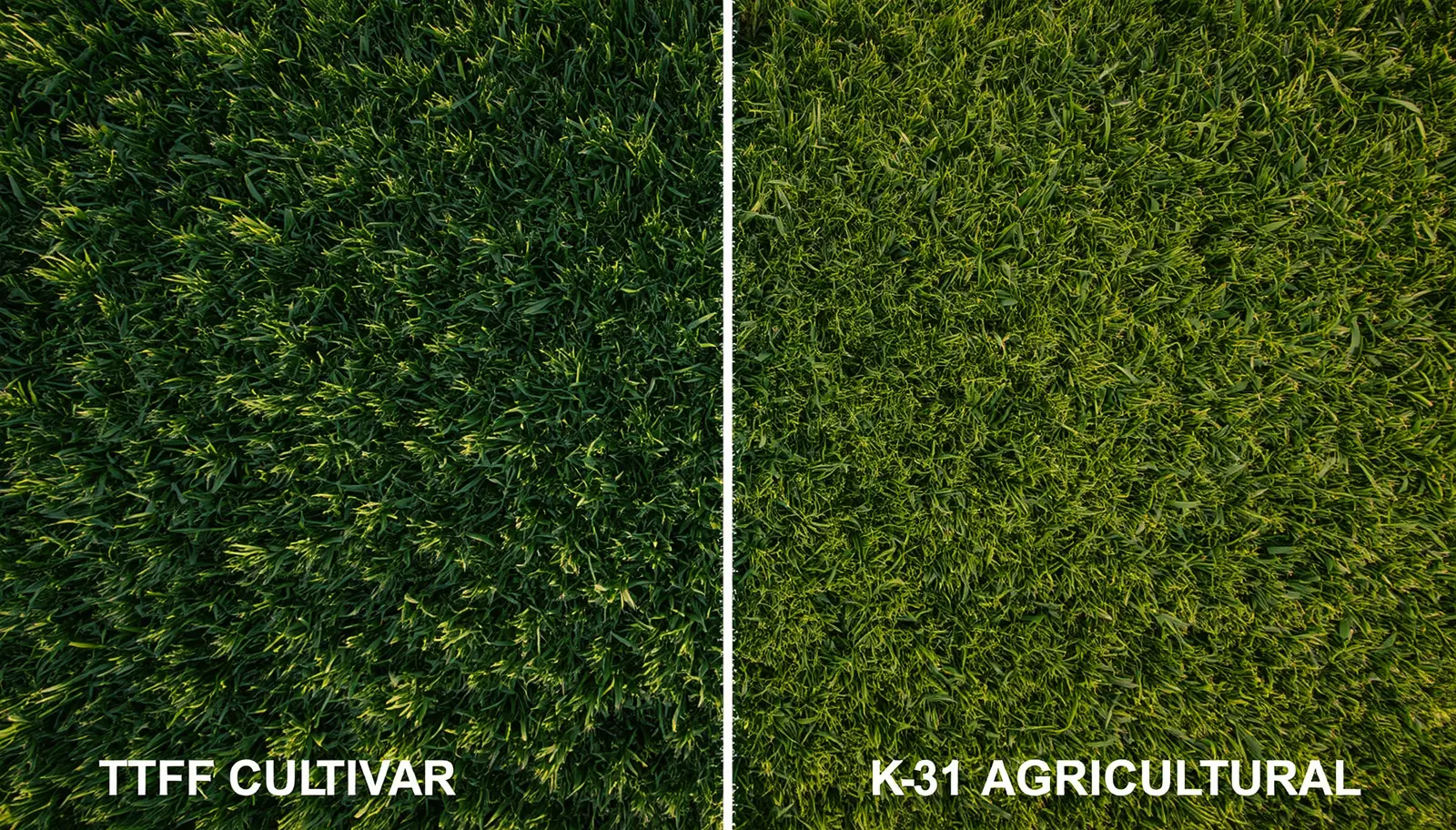
Kentucky 31 (K-31) is the older common cultivar of tall fescue. Clemson says turf-type tall fescues have a slightly finer leaf blade, lower growth habit, darker green color, and greater density and shade tolerance than K-31. For a home lawn, that makes turf-type tall fescue the usual choice. Check the seed label for named cultivars, and look for those recommended for your state: UMD, for example, advises against varieties that are not locally recommended and publishes a list for Maryland.
Tall Fescue vs Kentucky Bluegrass
Tall fescue and Kentucky bluegrass are both cool-season grasses. Tall fescue is a bunch grass, so it doesn’t fill in bare spots on its own the way spreading grasses do, which is why fall reseeding matters. On disease, Penn State notes that tall fescue is particularly susceptible to brown patch, while Kentucky bluegrass is less likely to show symptoms. On shade, Clemson rates tall fescue as good. The best grass for your lawn depends on your region, so check your state extension service’s lawn grass recommendations.
When and How to Plant Tall Fescue
UMD Extension says cool-season grasses are best planted from mid-August to mid-October; spring seeding (March into early April) is harder, and weed competition is the most common cause of spring failures.
- Test the soil in a lab rather than with a home kit. UMD recommends lime if pH is below 5.5 and says tall fescue grows well at pH 5.8 to 6.5; Clemson gives 5.5 to 6.5 and fertile, well-drained soil.
- Prepare the seedbed and apply fertilizer and lime as the soil test recommends.
- Seed at 6 to 8 pounds per 1,000 square feet for a new lawn (UMD).
- Water lightly and often, about a quarter inch at a time, to keep the top inch of soil moist but not saturated (UMD). Seed takes about 2 weeks to germinate.
- Mow for the first time when the grass is one-third taller than your target height, typically 4 to 6 weeks after seeding (UMD).
Mowing, Fertilizing and Watering
Mowing: UMD Extension recommends 3 to 4 inches for tall fescue and the highest mower setting in the hottest, driest weather. Use a mulching mower to return clippings, which recycles organic matter and nutrients (UMD).
| Time of year | Nitrogen (lb per 1,000 sq ft) |
|---|---|
| September | 0.7 to 0.9 |
| October to November 15 | 0.7 to 0.9 |
| May to early June | 0.5 to 0.9 (optional) |
| June, July, August | None |
| Maximum per year | 2.7 |
Source: UMD Extension, Maintaining an Established Lawn (2026). Follow a soil test and your state’s guidelines.
Watering: UMD says actively growing grass needs about 1 inch of water a week from rain or irrigation, applied early in the day to shorten leaf wetness. Clemson notes that tall fescue often needs summer irrigation to stay attractive.
Aerating and overseeding: UMD says cool-season lawns benefit from annual overseeding in autumn, at 4 pounds of tall fescue seed per 1,000 square feet, and suggests aerating once a year in autumn just before seeding for areas with regular foot traffic (otherwise every 2 to 3 years). For fertilizer types, see our synthetic vs organic fertilizer guide.
Brown Patch, Thin Spots and Weeds
Brown patch (Rhizoctonia solani): Penn State describes light brown circular patches from a few inches to several feet across, with tan leaf lesions bordered in dark brown, and sometimes cobweb-like growth visible early in the morning. It is a midsummer disease that often develops when nights stay above 68°F and daytime averages reach 80°F or more, and humid, wet weather speeds it up. Penn State’s cultural advice: apply only moderate nitrogen on lawns with a history of brown patch, and water early in the morning, because night watering in hot, humid weather can make it worse. Mild cases on established turf often recover when cooler, drier weather returns in late summer and fall.
Thin, clumpy turf: Clemson notes that tall fescue lawns tend to thin out and become clumpy and may need reseeding every fall. Overseed in autumn, after aerating if the soil is compacted (UMD).
Weeds: because tall fescue is bunch-type, Clemson says spring pre-emergence herbicides are generally necessary to control weeds in the gaps. Keeping the lawn dense with fall overseeding and proper mowing height reduces weed problems.
For low-traffic sunny areas where you’d rather not grow grass at all, see our creeping thyme lawn guide. Grass clippings and leaves also make good compost; see our composting guide.
Is Tall Fescue Right for Your Lawn?
Tall fescue suits lawns in the transition zone and cooler parts of the South, especially where some shade rules out warm-season grasses and you want winter color. The trade-offs are summer watering, a tendency to thin and clump that calls for fall overseeding, and susceptibility to brown patch. Your state extension service’s list of recommended cultivars is the best place to start.
Frequently Asked Questions
When is the best time to plant tall fescue?
Mid-August to mid-October (UMD). Spring seeding is possible but harder, mainly because of weed competition.
How much tall fescue seed do I need?
About 6 to 8 pounds per 1,000 square feet for a new lawn and about 4 pounds per 1,000 square feet for overseeding (UMD).
What is the best mowing height for tall fescue?
3 to 4 inches, using the highest setting during hot, dry summer weather (UMD).
When should I fertilize tall fescue?
Mainly in fall: 0.7 to 0.9 pounds of nitrogen per 1,000 square feet in September and again in October to mid-November, with an optional feed in May to early June and none in summer (UMD).
What is the difference between K-31 and turf-type tall fescue?
Turf-type tall fescues have a slightly finer leaf, lower growth, darker color, and greater density and shade tolerance than the older K-31 (Clemson).
How do I prevent brown patch in tall fescue?
Use only moderate nitrogen and water early in the morning so the grass dries, since night watering in hot, humid weather can make it worse (Penn State). Avoid summer fertilizing (UMD).
Sources
- Polomski, R.F. and Shaughnessy, D. Tall Fescue. Clemson HGIC 1210 (updated 2024)
- University of Maryland Extension: Starting a New Lawn (updated 2026)
- University of Maryland Extension: Maintaining an Established Lawn (updated 2026)
- Landschoot, P. Turfgrass Diseases: Brown Patch. Penn State Extension (updated 2024)