
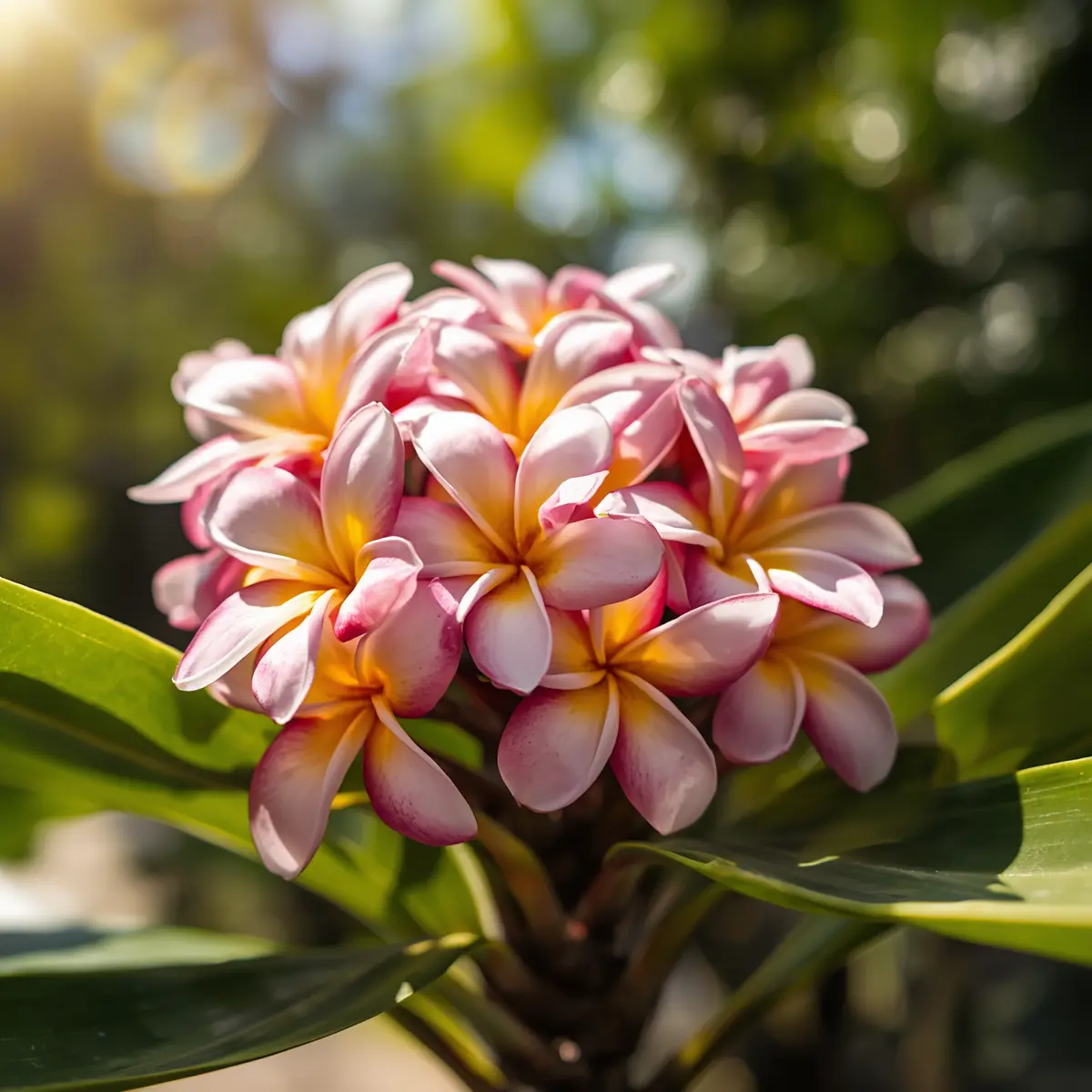
Plumeria, also called frangipani or temple tree, is the fragrant flower behind Hawaiian leis. It looks exotic, but plumeria care follows a few simple rules. University of Hawai’i horticulturist Richard Criley puts it plainly in the CTAHR bulletin Plumeria in Hawai’i: plumeria requires full sun and grows best in well-drained, slightly acidic soil. Outside the tropics, add one more rule: keep it warm and nearly dry through winter.
Plumeria Care Snapshot
| Factor | What it needs |
|---|---|
| Light | Full sun |
| Soil | Well drained, slightly acidic; in pots, a coarse mix such as cactus mix or potting mix with pumice or perlite |
| Water | Let the mix dry between waterings; less in cool weather |
| Feeding | During the growing season only |
| Cold | Bring pots in when nights drop into the 40s °F; overwinter at 50 to 55 °F |
| Hardiness | USDA zones 10 to 12 (MOBOT); UF/IFAS says best in 10B to 11 |
| Flowers | Fragrant clusters, roughly spring to fall; cuttings bloom in 1 to 3 years |
Sources: CTAHR OF-31; University of Wisconsin Extension; Missouri Botanical Garden; UF/IFAS Gardening Solutions.
What Is Plumeria?
Plumeria is a genus of small trees and shrubs in the dogbane family (Apocynaceae), native to tropical America. University of Wisconsin Extension gives its range as Brazil to Mexico and the Caribbean. The branches are thick and fleshy, and every part bleeds a milky sap when cut.
The most common garden species is Plumeria rubra. Missouri Botanical Garden describes it as a deciduous tree 15 to 25 feet tall in the ground, with very fragrant five-petaled flowers up to 4 inches wide in clusters at the branch tips from late spring to fall. CTAHR notes that P. rubra types are deciduous, while P. obtusa (Singapore plumeria) tends to keep its leaves. In a pot, plumeria stays far smaller.
Light and Temperature
Light. CTAHR, UF/IFAS and Missouri Botanical Garden all call for full sun, and Wisconsin says plumeria needs bright sun and warm temperatures to thrive. Outdoors in summer, give it your sunniest spot. Indoors, even a bright south window is much weaker than outdoor sun, which is why most growers in cool climates keep plumeria outside from late spring to fall and only bring it in for winter. If you must grow it indoors in the growing season, use your brightest window or a strong grow light, and expect fewer flowers.
Temperature. Plumeria is frost tender. UF/IFAS Gardening Solutions says it is best suited to USDA zones 10B to 11 and can be damaged by cold. Missouri Botanical Garden notes that where temperatures dip below 50 °F, plants lose their leaves and stop blooming. Wisconsin advises bringing container plants indoors when night temperatures drop into the 40s °F. Leaf drop in autumn is normal dormancy, not a sign the plant is dying.
Soil and Watering
Soil. CTAHR says plumeria grows best in well-drained, slightly acidic soil. For containers, Wisconsin recommends a coarse mix such as cactus mix, or potting mix amended with pumice, poultry grit or perlite. Missouri Botanical Garden suggests a well-drained sandy potting mix and warns to avoid wet soils. Always use a pot with drainage holes.
Watering. Wisconsin advises letting the mix dry out between waterings and watering less when it is cooler, warning that overwatering can cause root rot and kill the plant. Water thoroughly, let it drain, and wait until the mix is dry again; in hot summer sun that may be often, in cool weather much less. UF/IFAS notes that established plants are fairly drought tolerant. If stems turn soft or roots mushy, see our root rot guide.
Fertilizing for Flowers
Wisconsin recommends fertilizing frequently during the growing season with a high-phosphorus (“blossom-booster”) fertilizer to encourage flowering, and not fertilizing at other times of year. For landscape trees in Hawai’i, CTAHR suggests a 10-30-10 fertilizer every three to four months. In a pot, follow the product label for container plants, feed only while the plant is in leaf and growing, and stop as it heads into dormancy. Too much fertilizer builds up salts; a white crust on the soil is the warning sign. For background on fertilizer types, see our synthetic vs organic fertilizer guide.
Growing Plumeria in Pots and Overwintering
Missouri Botanical Garden is clear about cooler climates: plumeria may be grown in containers with a well-drained sandy potting mix, and container plants must be overwintered indoors at reduced temperatures (50 to 55 °F) with slightly reduced watering.
- Summer: keep the pot in full sun outdoors, water when the mix is dry, and feed.
- Autumn: bring it indoors when nights drop into the 40s °F. Reduce watering as it cools; leaves will yellow and drop.
- Winter: keep it in a cool, bright or semi-bright spot around 50 to 55 °F and water sparingly so the mix does not stay wet. Do not feed.
- Spring: when new leaves appear and nights stay warm, move it back outside gradually and resume normal watering.
CTAHR notes that pruning is easiest in winter after leaf drop, but heavy pruning sacrifices the spring bloom.
How to Grow Plumeria from Cuttings
CTAHR says cuttings are the usual way to propagate plumeria because they keep the chosen cultivar true. Its method:
- Take a cutting 1 to 2 feet long from a branch tip (Wisconsin suggests 12 to 18 inch leafless tips in spring). Wear gloves; the sap irritates skin and eyes.
- Let it cure in a dry place for at least two weeks so the cut end dries and calluses.
- Plant it in well-drained soil or a pot of gritty mix. CTAHR notes a rooting hormone (0.3% IBA) on the base enhances rooting but is not required.
- Water sparingly. CTAHR warns not to water too much or too often while rooting is occurring.
- Handle new roots gently. Young roots are brittle; do not leave the plant in a small pot so long that roots circle.
CTAHR says cuttings may flower within the first year depending on size and timing; Wisconsin says one to three years. Seedlings take three years or more.
Why Is My Plumeria Not Blooming?
- Not enough sun. Every source above calls for full sun; shade or indoor light means few or no flowers.
- Too young. Young cuttings can take one to three years to flower (Wisconsin).
- Feeding. Wisconsin recommends a high-phosphorus fertilizer during the growing season to encourage flowering.
- Cold or dormancy. Below about 50 °F, plants drop leaves and stop blooming (Missouri Botanical Garden).
- Heavy pruning in winter sacrifices the spring bloom (CTAHR).
Wisconsin also notes that plumeria branches only after flowering or injury, so a plant that flowers tends to become bushier over time.
Pests and Diseases
| Problem | Signs | What to do |
|---|---|---|
| Plumeria rust (Coleosporium plumeriae) | Tiny yellow-orange powdery pustules under leaves, yellow spots above that turn brown; leaves may drop | Remove and destroy fallen and badly infected leaves, improve air flow; fungicides labeled for rust if needed |
| Root and stem rot | Soft stems, wilting despite wet mix | Water less, use a coarser mix (Wisconsin) |
| Spider mites, whiteflies, mealybugs | Stippled leaves, sticky honeydew, cottony clusters | Insecticidal soap (Wisconsin); see our spider mite guide |
| Scale and sooty mold | Black sooty coating on stems and leaves | Control the scale, whiteflies or mealybugs that produce honeydew (CTAHR) |
Sources: CTAHR PD-61 Plumeria Rust (Nelson 2009); CTAHR OF-31; University of Wisconsin Extension.
The CTAHR plumeria rust fact sheet notes that the fungus infects only plumeria, attacks leaves but not stems or flowers, survives on fallen leaves, and is worse in warm, moist conditions. Most P. rubra types are highly susceptible.
Is Plumeria Toxic?
Irritating sap: wear gloves
Wisconsin Extension says the milky sap can irritate the eyes and cause dermatitis in susceptible people, and CTAHR says all parts exude a sap that may irritate eyes and skin. UF/IFAS notes the sap contains harmful irritants but that plumeria is less toxic than oleander and that there are no recorded deaths from exposure to or ingestion of plumeria. Keep it away from pets and children that chew plants, and call your vet or the ASPCA Animal Poison Control Center at (888) 426-4435 if a pet eats it.
For a pet household, see our cat-safe plants list.
Plumeria Types
| Type | Notes |
|---|---|
| Plumeria rubra | The common deciduous frangipani; pink to red in the species, many cultivars (MOBOT, CTAHR) |
| P. obtusa ‘Singapore’ | White flowers with a yellow center, glossy dark green blunt-tipped leaves, tends to stay evergreen (CTAHR) |
| ‘Common Yellow’ (‘Celadine’) | Yellow with a white margin, strong lemon scent, grown in Hawai’i since the 1800s (CTAHR) |
| ‘Dwarf Singapore’ | Low, compact, shrub-like plant with small white flowers (CTAHR) |
Source: CTAHR OF-31, Plumeria in Hawai’i (Criley 2005); Missouri Botanical Garden.
For other garden shrubs and trees, see our guides to bougainvillea and wisteria in pots.
Frequently Asked Questions
How do you care for a plumeria?
Give it full sun, well-drained soil or a coarse potting mix, and water only when the mix has dried out. Feed in the growing season, and protect it from cold: bring pots in when nights drop into the 40s °F.
Does plumeria need full sun?
Yes. CTAHR, UF/IFAS and Missouri Botanical Garden all call for full sun. Too little sun is a common reason plumeria fails to flower.
How often should you water plumeria?
When the mix has dried out. Wisconsin Extension says to let it dry between waterings and to water less in cool weather; in winter dormancy, water only sparingly.
Can you grow plumeria indoors?
It can spend winter indoors, dormant and cool. As a year-round indoor plant it rarely gets enough light to flower well, so most growers keep it outdoors in full sun from late spring to fall.
How do you grow plumeria from a cutting?
Cut a 1 to 2 foot branch tip, let it cure in a dry place for at least two weeks, plant it in well-drained mix, and water sparingly until it roots, as CTAHR describes. Rooting hormone helps but is not required.
What is plumeria winter care?
Bring it indoors before cold nights, let it drop its leaves, and keep it around 50 to 55 °F with reduced watering until spring, as Missouri Botanical Garden advises.