
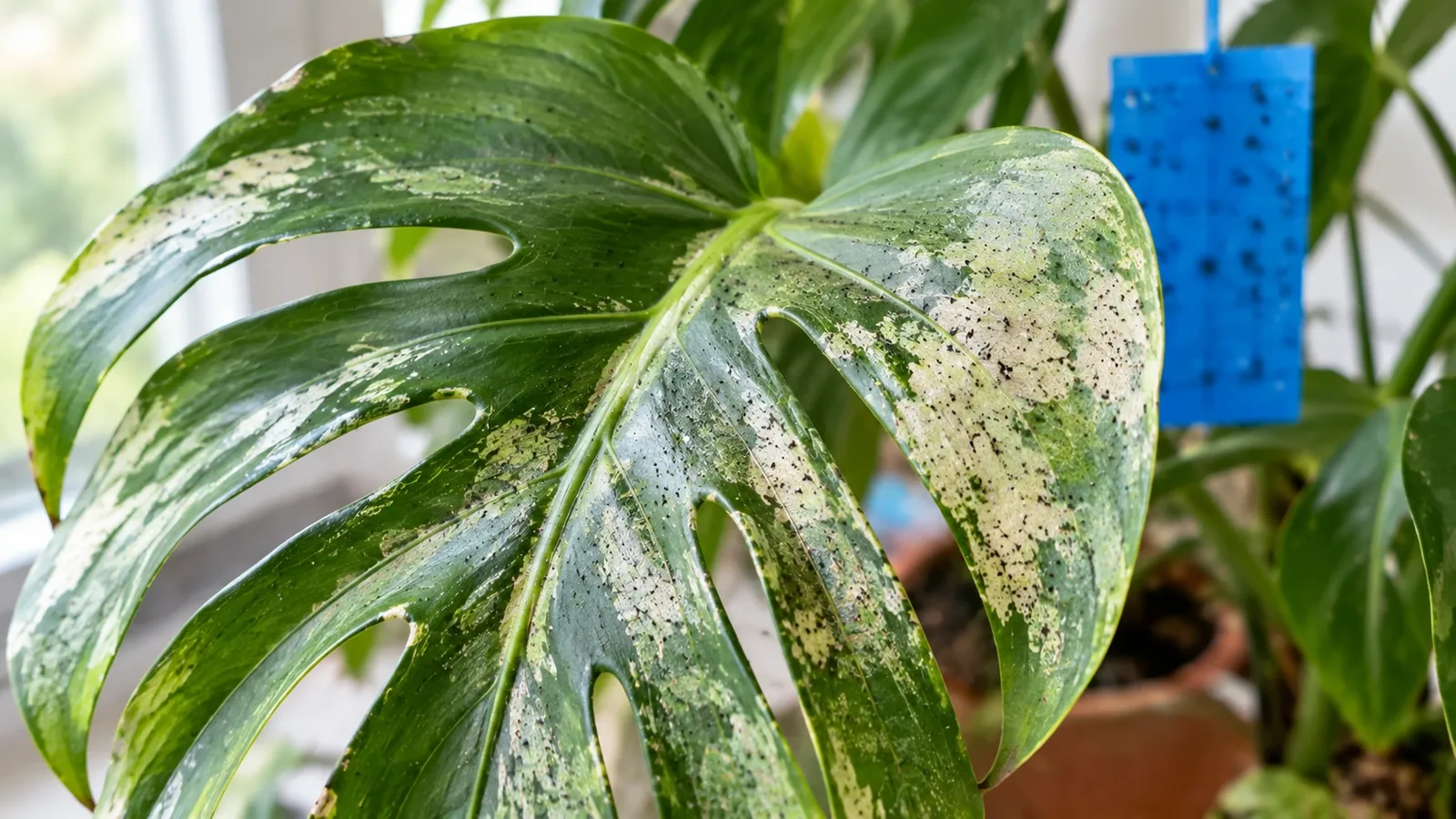
How to get rid of thrips on houseplants requires four coordinated moves: isolate the infested plant, spray all leaf surfaces with insecticidal soap or spinosad every 7 days for 4 weeks, hang blue sticky traps to catch flying adults, and cover the potting soil surface. Anything less fails, and the reason is biological. Thrips hide their eggs inside leaf tissue and drop their pupae into the soil, so one spray only kills the adults you can see while the next generation is already waiting.
If you have noticed silvery patches spreading across a Monstera leaf, or tiny black specks collecting on foliage that looked healthy last week, you are almost certainly looking at thrips damage rather than a watering issue. The protocol below is built on the thrips lifecycle as documented by university extension programs, which means it attacks every life stage instead of just the visible ones.
To eliminate thrips on houseplants, quarantine the plant, rinse the foliage, and spray every leaf surface with insecticidal soap or spinosad once a week for 4 weeks. Hang blue sticky traps near the canopy and cover the soil surface, because the pupal stage develops in the potting mix. Repeat the full cycle before calling the infestation beaten.
Table of Contents
- What Does Thrips Damage Look Like on Houseplants?
- Why Does One Spray Never Get Rid of Thrips?
- How to Get Rid of Thrips on Houseplants: The 4-Week Plan
- Which Sprays Actually Kill Thrips (and Which Ones Fail)?
- How Did Thrips Get Into Your Home?
- How Do You Keep Thrips From Coming Back?
- Frequently Asked Questions
What Does Thrips Damage Look Like on Houseplants?
Thrips announce themselves through damage long before you spot the insects. Adults are slender, fringed-wing insects under 1/20 of an inch long, and according to UC IPM’s Pest Notes on thrips, most pest species feed while hidden in buds, shoot tips, and other protected spots. You will almost always see the symptoms first.
| What You See | What It Actually Is | Where to Check |
|---|---|---|
| Silvery or bleached patches on leaves | Feeding scars where thrips rasped the surface and sucked out cell contents | Upper leaf surfaces, especially older leaves |
| Tiny black dots like varnish flecks | Thrips excrement (frass) left at feeding sites | Leaf undersides, directly below silvery patches |
| New leaves or buds emerging twisted or scarred | Thrips fed on the tissue before it finished expanding | Newest growth, shoot tips, unfurling leaves |
| Flower buds that brown and die before opening | Thrips feeding inside the bud | Any flowering houseplant |
Two field tests confirm the diagnosis in under a minute. First, hold a sheet of white paper under a leaf and tap the foliage sharply; UC IPM recommends this because dislodged thrips show up as moving slivers against the white background. Second, UC IPM suggests hanging blue or bright yellow sticky traps to detect flying adults, and Clemson Extension’s houseplant pest guide recommends a 10X magnifying lens for spotting small pests and their immature stages.
Pro Tip: Carry a 10x Lens
Clemson Extension recommends checking leaf undersides about once a week with a 10X magnifying lens. Thrips nymphs are pale, wingless, and nearly invisible to the naked eye, but under 10x magnification they are unmistakable.
Why Does One Spray Never Get Rid of Thrips?
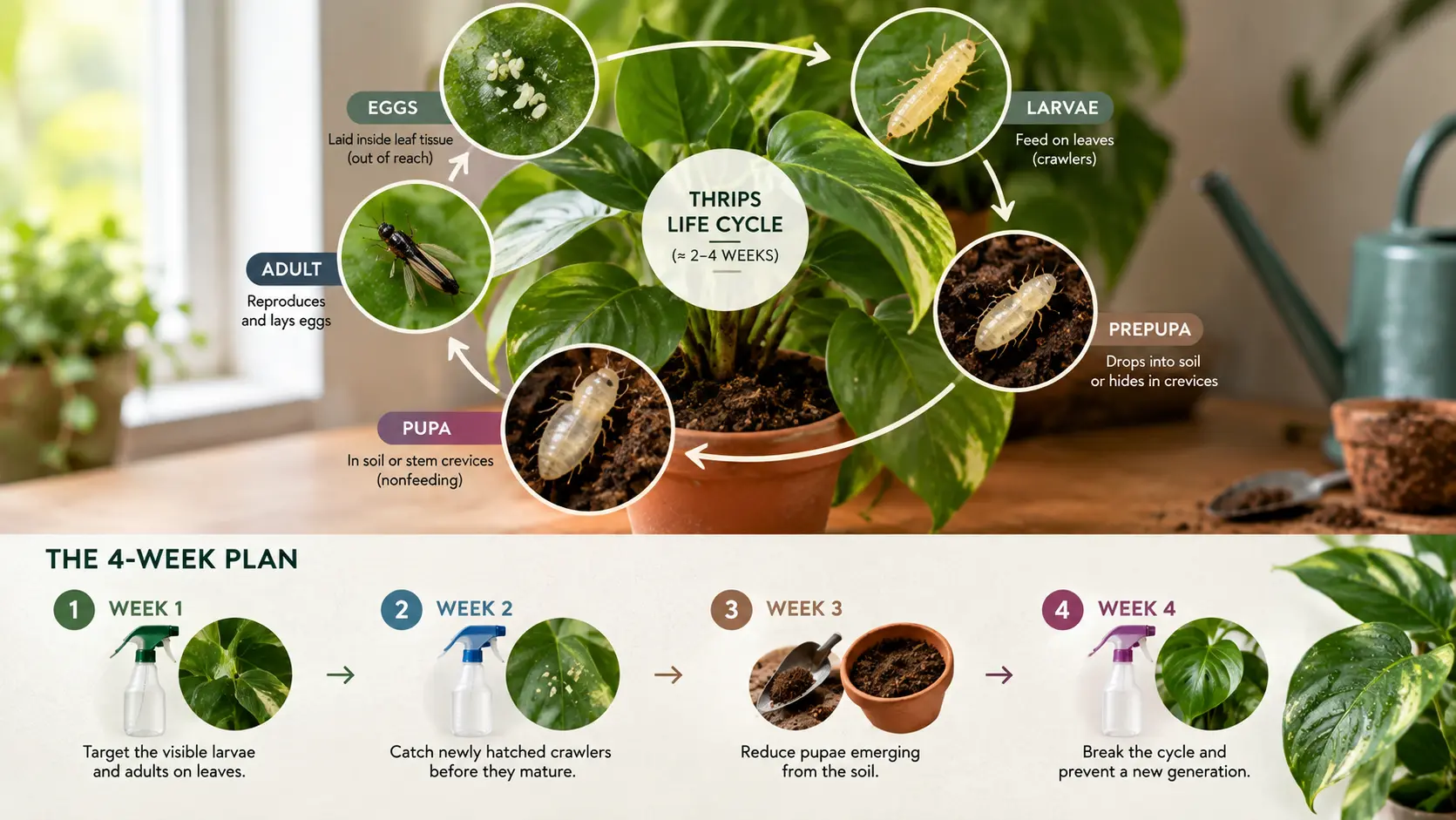
Most thrips advice fails because it targets only the stages you can see. The lifecycle explains why.
According to UC IPM, thrips develop through two feeding larval stages and two nonfeeding stages called the prepupa and pupa. The critical detail is where each stage hides. Females insert their eggs directly into leaf tissue, beyond the reach of any contact spray. When larvae finish feeding, the pupae drop into the potting soil or lodge in stem crevices, again out of reach. Only crawling larvae and flying adults are exposed on leaf surfaces at any given moment.
The speed of the cycle makes this worse indoors. UC IPM documents egg-to-adult development in as little as 2 weeks under warm conditions, with up to 8 generations per year. The Royal Horticultural Society puts the glasshouse thrips cycle at 24 to 35 days and notes that indoor plants allow year-round breeding with no winter die-off. One female lays up to 100 eggs, at a rate of 1 or 2 per day. Skip a single week of treatment and the pupae in your potting mix emerge as adults, mate, and restart the infestation.
There is also a reason to act fast beyond cosmetic damage. UC IPM notes that western flower thrips vectors Impatiens necrotic spot virus and Tomato spotted wilt virus, both of which can kill herbaceous ornamentals outright.
How to Get Rid of Thrips on Houseplants: The 4-Week Plan
This calendar attacks a different life stage every week. The 7-day spray interval exists because eggs hidden in leaf tissue hatch continuously, so weekly treatment intercepts each wave of new crawlers before they mature and lay another 100 eggs. Do not stretch the intervals, and do not stop at week 2 because the plant “looks better.”
| Week | What to Do | Life Stage It Hits |
|---|---|---|
| Week 1 (Day 1) | Isolate the plant from every other houseplant. Rinse all foliage with a firm spray of room-temperature water. Let dry, then spray every leaf surface, top and bottom, plus stems, with insecticidal soap or spinosad. Cover the exposed potting soil with a half-inch layer of coarse sand or fine gravel. | Adults and feeding larvae on foliage; the soil cover may reduce pupae emerging (a common tip, not tested on houseplants) |
| Week 2 | Spray all leaf surfaces again. Wipe silvery, scarred areas with a damp cloth to remove frass. Hang a blue sticky trap just above the canopy. | Newly hatched larvae from eggs laid before Week 1 |
| Week 3 | Spray again. Replace the sticky trap if crowded. Tap-test every other plant in the room over white paper. | Adults emerging from the pupal stage in the soil |
| Week 4 | Final spray. Remove the most heavily scarred leaves with sterilized scissors. Leave the sticky trap up for 2 more weeks as a monitor. Clean traps plus unmarked new growth means the infestation is broken. | Any stragglers; confirms eradication |
Three details decide whether the plan works:
- Isolate the plant the day you confirm thrips. Adults fly, and one untreated week on a shared shelf seeds the infestation into neighboring plants.
- Saturate every surface when you spray. Clemson Extension stresses that insecticidal soap kills on contact only, with zero residual effect once dry. Miss the leaf undersides and the population survives intact.
- Judge progress by new growth, never by old leaves. Feeding scars do not heal, so success looks like clean new foliage, not repaired old foliage.
Insecticidal soap injures certain houseplants. Clemson Extension lists jade plant, begonia, dieffenbachia, schefflera, maidenhair fern, and several palms as soap-sensitive. Test any spray on a single leaf and wait 48 hours before treating the whole plant, and never spray a drought-stressed plant or foliage sitting in direct sun. If your plant is flowering, skip spinosad: UC IPM notes it stays toxic to bees and beneficial insects for about a day after application.
Which Sprays Actually Kill Thrips (and Which Ones Fail)?
The ranking below follows extension research, not garden-center shelf placement.
Spinosad is the strongest thrips-specific option. UC IPM rates it as generally more effective against thrips than soaps or oils because it persists on foliage for a week or more and moves translaminarly, penetrating short distances into leaf tissue to reach thrips feeding in protected spots like buds. That translaminar property matters against a pest whose eggs live inside the leaf. Several spinosad formulations are approved for organic production.
Insecticidal soap is the reliable first-line spray. It is gentle enough for weekly repetition on most plants and it is the same contact approach covered in our guide to treating mealybugs with alcohol and soap, so one bottle covers most of the infestations you will meet in The Infirmary.
Neem oil works as a rotation partner. It kills on contact and mildly repels feeding adults. If you have not used it before, our walkthrough on how to use neem oil on plants covers the dilution and timing mistakes that cause leaf burn.
Skip the imidacloprid granules. This is the most repeated bad advice in thrips content. UC IPM states directly that imidacloprid “commonly fails to provide satisfactory thrips control.” Systemic granules feel convenient, but for this pest you are paying for a product the insect frequently shrugs off.
Avoid pyrethroid sprays entirely. Products containing bifenthrin, cyfluthrin, or permethrin are not particularly effective on thrips, and UC IPM documents a worse side effect: they kill predatory mites and trigger spider mite outbreaks on the same plant. Trading thrips for spider mites is a downgrade, and if it happens, our guide to the best miticide for houseplants is your next stop.
How Did Thrips Get Into Your Home?
Nearly every indoor infestation traces back to one of four entry routes, and Clemson Extension’s advice to isolate every new plant points to the most common route:
- A new plant that skipped quarantine. Thrips hitchhike from nurseries constantly. Isolate every new plant for 6 weeks and inspect it weekly before letting it near your collection.
- Plants that summered outdoors. Wind carries thrips long distances; a plant that spent July on the patio can bring a colony inside in September.
- Cut flowers and grocery bouquets. Thrips feed inside flower buds, so keep fresh arrangements away from houseplants.
- Open windows and doors. Adults are weak fliers but travel on air currents, which is how upper-floor apartments still get infested.
How Do You Keep Thrips From Coming Back?
Prevention costs less than treatment, and it comes down to three habits.
Quarantine everything new for 6 weeks. Clemson’s 6-week window covers more than two full thrips lifecycles, so any hidden eggs hatch and reveal themselves before the plant joins your shelves.
Inspect weekly. The white paper tap test takes 10 seconds per plant. Pair it with your watering round and concentrate on new growth, where thrips prefer to feed.
Avoid pushing soft, fast growth. UC IPM notes that excess nitrogen fertilizer promotes higher thrips populations, because tender new tissue is easier for thrips to rasp and drain. Fertilize at label rates during active growth and resist the urge to push harder. For a deeper look at feeding schedules, see our guide to synthetic versus organic fertilizer.
Frequently Asked Questions
Do thrips bite humans?
Thrips occasionally land on skin and probe it with their mouthparts, producing a brief pinprick sensation. They are plant feeders, not blood feeders, so they transmit no diseases to people or pets and cannot infest humans. They are a nuisance at worst.
Can thrips live in houseplant soil?
Yes, but only for part of their lifecycle. Both UC IPM and the RHS document that the nonfeeding prepupal and pupal stages develop in potting soil and leaf litter, while adults and larvae feed on foliage. That is why the 4-week plan covers the soil surface instead of treating only the leaves.
Will thrips go away on their own?
No. Outdoors, cold winters suppress thrips, but the RHS notes that thrips on indoor plants breed continuously year-round. One female laying up to 100 eggs means an untreated infestation compounds through repeated generations rather than fading out.
What kills thrips instantly on contact?
Insecticidal soap and 70% isopropyl alcohol both kill exposed thrips on contact. Neither touches eggs hidden inside leaf tissue or pupae in the soil, which is why instant-kill sprays alone never finish the job. They work only as part of a weekly schedule that intercepts each emerging generation.
Four weeks of disciplined spraying beats four months of half-measures. For other stubborn infestations, browse the pest protocols in The Infirmary, including our guides to armored scale and fungus gnats in potting soil. If the damage on your plant does not match the thrips signatures above, our overwatered vs underwatered diagnostic can rule out the most common look-alike problem first.