
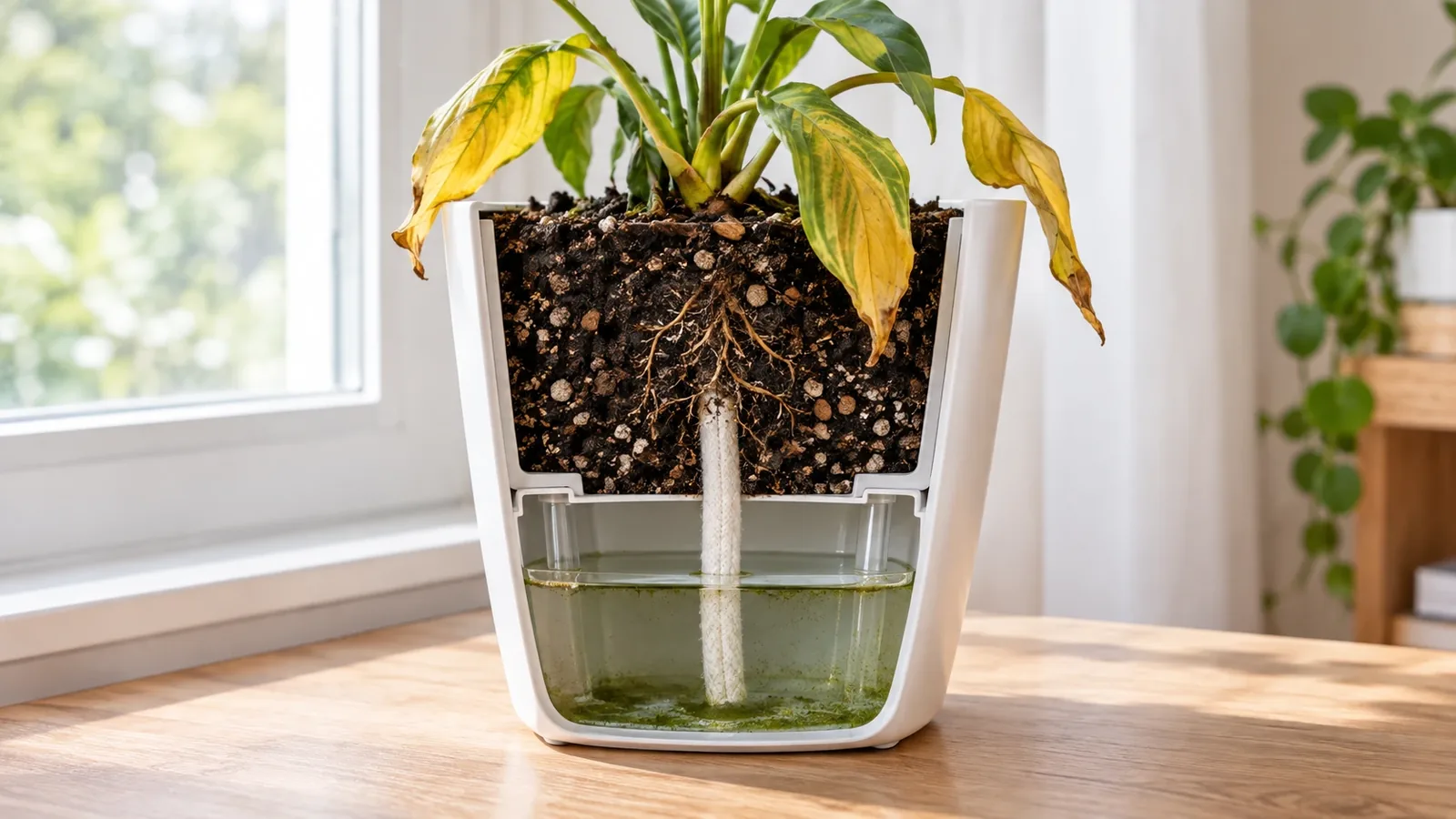
Self-watering pot problems almost always come from the same five failures: a reservoir that never fully empties, fungus gnats breeding in the water chamber, mold growing in the stagnant base, salt buildup that never gets flushed, and a wick that silently stops working. Every one of them is fixable in under 15 minutes once you know which failure you are looking at.
The frustrating part is that none of these are design flaws. The pots work exactly as advertised when they are maintained the way the mechanism assumes you will maintain them, which is a detail the packaging never mentions. Below is the complete failure autopsy: what each breakdown looks like, why it happens, and the specific fix that resolves it.
Self-watering pots fail in five predictable ways: constant saturation causing root rot, gnats breeding in the reservoir, mold in the base, salt crust from never flushing, and wick failure that dries the plant out. The fix for all five is a monthly reset routine plus one rule: never refill a reservoir that has not fully emptied.
Table of Contents
- How Self-Watering Pots Are Supposed to Work
- The 5 Failures at a Glance
- Failure 1: The Reservoir Never Empties (Root Rot)
- Failure 2: Fungus Gnats Breeding in the Reservoir
- Failure 3: Mold and Algae in the Base
- Failure 4: Salt Buildup Nobody Flushes
- Failure 5: The Wick Quits Silently
- The Monthly Reset That Prevents All Five
- Which Plants Belong in Self-Watering Pots (and Which Never Do)?
- Frequently Asked Questions
How Self-Watering Pots Are Supposed to Work
A self-watering pot is two chambers: a soil compartment on top and a water reservoir on the bottom, connected by a wick or a soil column that dips into the water. Moisture moves upward through capillary action, the same force that pulls water through a paper towel, and the plant draws from the reservoir only as fast as the soil above it dries.
In theory, this creates a self-regulating buffer. In practice, the buffer only works if three conditions hold: the soil above the water line stays airy, the reservoir actually empties between refills, and the wick maintains contact with both water and soil. When any of those three break, the system does not just stop helping. It starts actively working against the plant, and it does so quietly enough that most owners notice only when the plant is already declining.
The 5 Failures at a Glance
Before the detail, here is the full diagnostic map. Match your symptom to the failure, then jump to its section.
| What You Notice | The Failure | The Fix (Short Version) |
|---|---|---|
| Wilting despite wet soil, sour smell, black mushy roots | 1. Reservoir never empties; constant saturation | Enforce a full draw-down before every refill |
| Tiny black flies hovering at the fill port or soil line | 2. Fungus gnats breeding in the reservoir | BTI drench plus a covered fill port |
| Green film or white fuzz inside the base | 3. Mold and algae in stagnant water | Monthly scrub; never let water age past 2 weeks |
| White crust on soil surface or rim, burnt leaf tips | 4. Salt buildup with no top flush | Regular top-flush at UGA’s leaching rate |
| Reservoir full, plant bone dry and drooping | 5. Wick has failed silently | The 10-second lift test, then re-seat or replace the wick |
Failure 1: The Reservoir Never Empties (Root Rot)
This is the failure that kills the most plants, and it comes from the most natural instinct: keeping the reservoir topped up so the plant “never runs out.” The problem is that roots need oxygen as much as they need water. According to the University of Georgia Extension, under conditions of excess moisture and poor aeration, roots become stressed and are easily invaded by root-rotting fungi, after which plants fail to grow properly or die.
In a normal pot, gravity and drainage holes create a wet-dry cycle. In a self-watering pot, the only thing creating that cycle is you. If you refill the reservoir the moment it drops by a third, the lower soil zone never re-oxygenates, and root rot moves in within weeks.
The fix is the draw-down rule: never refill the reservoir until it has been completely empty for at least a day. Let the system do what it was designed to do, which is buffer, not eliminate, the dry phase. If roots are already black and mushy, treat the rot first using our root rot treatment guide, then restart the pot on the draw-down schedule.
Failure 2: Fungus Gnats Breeding in the Reservoir
If tiny black flies are hovering around the fill port or walking across the soil, you do not have a gnat problem near the pot. You have a gnat nursery inside it. Fungus gnat larvae live in moist organic media, and UC IPM’s fungus gnat pest notes document that a full generation, from egg to egg-laying adult, completes in about 17 days at 75°F. Soil that never dries out above a constantly topped-up reservoir is an ideal breeding site, which is why UC IPM advises letting the surface of container soil dry between waterings.
The fix targets the larvae, not the flying adults. UC IPM recommends Bacillus thuringiensis subspecies israelensis, sold as Mosquito Bits or Gnatrol, applied as a soil drench. Because BTI does not persist indoors, repeat the drench at roughly 5-day intervals until no new adults appear on a yellow sticky trap. Cover or screen the reservoir fill port so adults cannot reach the water line to lay eggs. Our guide on diatomaceous earth for fungus gnats covers the soil-surface half of this treatment.
Failure 3: Mold and Algae in the Base
Crack open a reservoir that has held the same water for a month and you will usually find a green film on the walls or a white fuzz on the wick seat. That growth is feeding on nothing but light leaking through the plastic, minerals in the water, and time. It is mostly harmless to the plant directly, but it clogs wicks, smells, and signals that the water is older than it should ever be.
The fix is mechanical, not chemical. Once a month, tip out the reservoir, scrub the chamber with hot water and a drop of dish soap, rinse thoroughly, and refill with fresh water. Never let reservoir water sit longer than about two weeks; if the plant is drinking slowly enough that water persists past that, the reservoir is oversized for the plant and you should fill it only partway.
Failure 4: Salt Buildup Nobody Flushes
Here is the failure almost nobody anticipates: a self-watering pot is never watered from the top, so it is never flushed. Every refill adds a little more fertilizer salt and tap-water mineral to a system with no overflow exit. The University of Georgia’s indoor plant bulletin notes that soluble salts accumulate as a whitish crust on the medium and container rim, and that high salt levels damage roots and stall growth. In a self-watering pot this process runs for months with nothing to interrupt it.
The fix is a regular top-flush. UGA recommends leaching potting soil once a month to avoid salt buildup. Water the plant from above at UGA’s rate: roughly 1 gallon of water per cubic foot of potting medium, followed a few hours later by another half gallon, letting it drain freely into the empty reservoir, then discard that runoff. If your tap water is hard, switch the reservoir supply to distilled or rainwater and the crust slows dramatically. If the crust is already visible, our guide to white crust on houseplant soil walks through removal.
Failure 5: The Wick Quits Silently
The cruelest failure is the one that looks like everything is fine. The reservoir is full, the plant is drooping, and the owner waters more, assuming thirst, not realizing the plant is already dying of thirst. Wicks fail three ways: they compact and lose capillary contact, they clog with salt and algae, or they were never seated deep enough into the soil column in the first place. The plant dries out while the reservoir sits full underneath it.
The 10-Second Lift Test
Once a week, lift the inner pot or insert a finger to the second knuckle at the soil’s edge, away from the wick port. The soil should feel lightly cool and barely moist, not wet and not dusty. Then glance at the reservoir level. A reservoir that has not dropped at all in 7 days means the wick is not pulling. Re-seat the wick so it contacts both the water and at least 2 inches of the soil column, or replace it with a fresh length of cotton or nylon cord. This single check catches every wick failure before the plant shows it.
The Monthly Reset That Prevents All Five Failures
Five minutes once a month prevents every failure above. Run this routine on the first weekend of each month:
- Check the reservoir level history. If it never empties between refills, you are violating the draw-down rule; skip this refill entirely and let it run dry.
- Perform the 10-second lift test: finger in the soil edge, eyes on the reservoir. Wet soil plus a dropping water line means the wick works.
- Tip out any water older than two weeks. Scrub the reservoir with hot soapy water, rinse, and refill fresh.
- Look for black flies at the fill port or on a yellow sticky trap. Any adults means a BTI drench this week, repeated at 5-day intervals.
- Scan the soil surface and pot rim for white crust. Any crust means it is time to flush from the top now.
Which Plants Belong in Self-Watering Pots (and Which Never Do)?
The pot is only half the equation. Plants that evolved in consistently moist forest floors love buffered water; plants that evolved in dry mineral soils treat a full reservoir as a drowning tank.
| Verdict | Plants | Why |
|---|---|---|
| Thrive in self-watering pots | Peace lily, pothos, philodendron, ferns, calathea, spider plant, most herbs | Moisture-tolerant roots; steady uptake keeps the reservoir cycling |
| Borderline: watch the draw-down | Monstera, anthurium, syngonium, alocasia | Thick aroid roots rot fast if the reservoir never empties |
| Never use self-watering pots | Succulents, cacti, snake plant, ZZ plant, jade, ponytail palm | These need weeks of dry-down; a reservoir removes it entirely |
If you love the low-maintenance idea but grow mostly drought plants, bottom watering on demand gives you the same root-zone hydration with a dry phase you control manually. And if you want to go further into soilless systems, our Lechuza Pon transition guide covers semi-hydro setups where the reservoir is the point, not the problem.
Frequently Asked Questions
Do self-watering pots cause root rot?
Not by design. Root rot develops when the reservoir never empties and the lower soil zone stays saturated for weeks, starving roots of oxygen. A pot refilled only after full draw-down carries no more rot risk than a well-watered standard pot.
Can you put succulents in self-watering pots?
No. Succulents, cacti, snake plants, and ZZ plants evolved for long dry periods between soakings. A reservoir that keeps soil continuously moist removes the dry phase these plants require, and root rot typically follows within a month or two.
How often should you refill a self-watering pot?
Refill only when the reservoir has been completely empty for about a day, not on a calendar schedule. For most houseplants in average home conditions, that works out to every 1 to 3 weeks depending on plant size, light, and season.
Do fungus gnats breed in self-watering pot reservoirs?
Yes, when the reservoir stays constantly moist and organic debris is present. Fungus gnat larvae complete a generation in about 17 days at 75°F. A BTI soil drench (Mosquito Bits or Gnatrol) repeated every 5 days, plus a covered fill port, breaks the cycle.
A self-watering pot is a tool, not a babysitter. Treat it to five minutes of maintenance a month and it will outlast most of your watering cans. For more diagnosis guides, browse The Infirmary, or explore the watering science in The Lab.