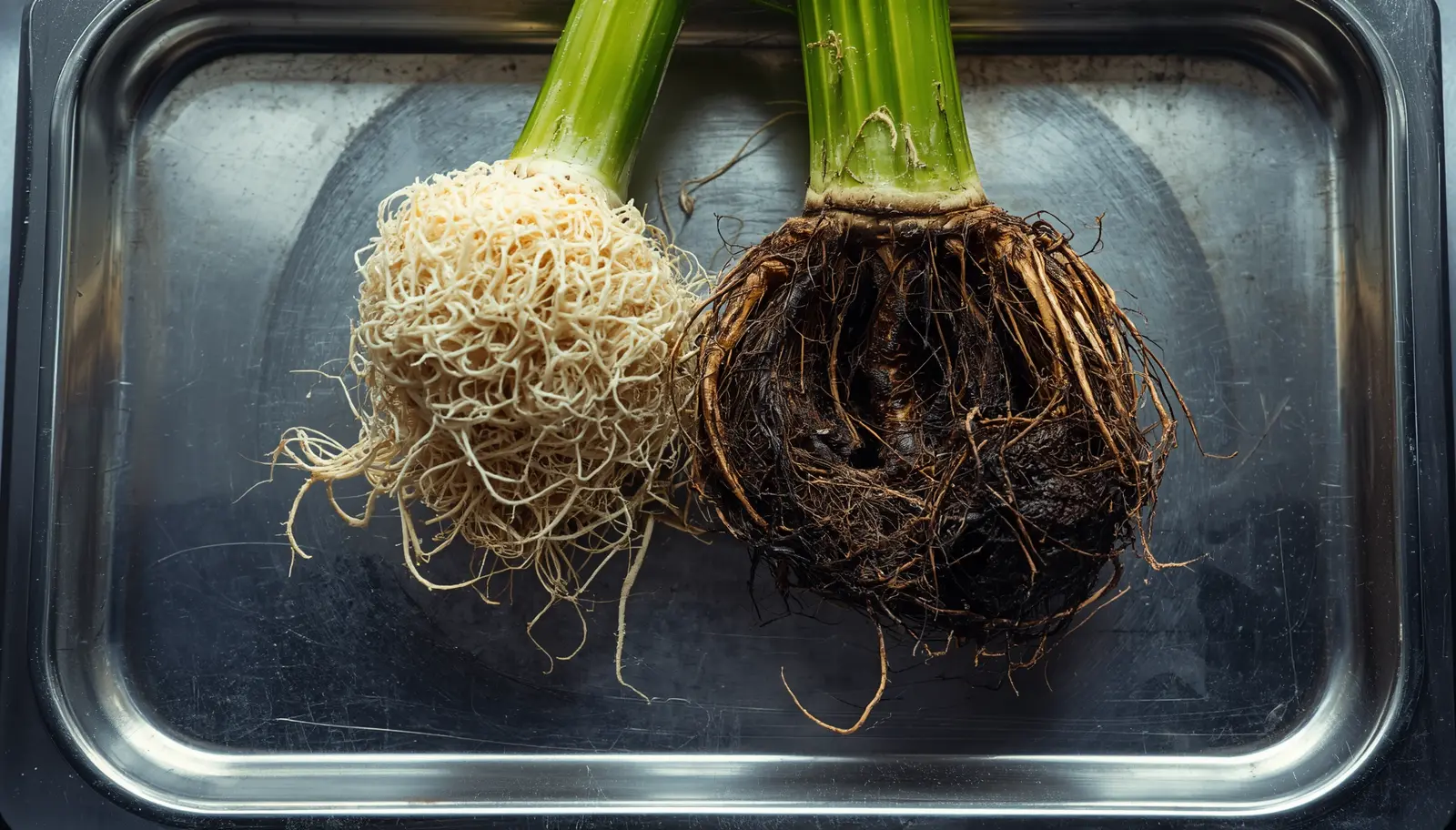
Pythium root rot treatment requires immediate surgical intervention. You must remove the plant from its substrate, excise all black or mushy roots cutting 1 to 2 centimeters into healthy white tissue, sterilize remaining roots in a 1 to 4 dilution of 3 percent hydrogen peroxide for 10 to 15 minutes, and repot in sterile high-aeration substrate. Plants with less than 30 percent root mass affected show 90 percent plus survival when treated within 48 hours. Plants with more than 70 percent necrosis drop below 20 percent survival regardless of intervention.
Pythium is not a true fungus. It is an oomycete water mold in kingdom Chromista that produces motile zoospores swimming through water films to colonize damaged roots. It thrives in waterlogged substrate where oxygen drops below 10 percent. According to Penn State Extension, these water molds complete their lifecycle in 4 to 6 hours at optimal temperature. A single infected root releases over 100,000 zoospores within 24 hours. For related oxidation protocols, see our hydrogen peroxide root rot treatment guide.
Quick Answer: Pythium root rot treatment involves four steps. Remove all substrate. Cut away black, brown, or mushy roots plus 1 to 2 centimeters into healthy tissue. Sterilize in 1 to 4 diluted 3 percent hydrogen peroxide for 10 to 15 minutes. Repot in sterile sphagnum-perlite mix. No fertilizer for 2 to 3 weeks. Survival is 90 percent plus if less than 30 percent of roots are affected.
Table of Contents
- What Is Pythium Root Rot and How Does It Infect Houseplants?
- What Are the Early Symptoms of Pythium Root Rot in Houseplants?
- Why Do Standard Fungicides Fail Against Pythium?
- How Do You Perform Surgical Pythium Root Rot Treatment?
- What Chemical Sterilization Kills Pythium After Debridement?
- How Do You Set Up an ICU Recovery Environment?
- How Long Until a Plant Recovers After Pythium Treatment?
- Is Monstera deliciosa Toxic to Pets During Root Rot Treatment?
- How Do You Prevent Pythium Root Rot From Returning?
| Parameter | Ideal | Avoid |
|---|---|---|
| Substrate aeration | 50-60% air-filled porosity | Compacted peat or fine clay |
| Watering frequency | Top 2-3 inches dry between waterings | Waterlogged soil, standing water in saucers |
| Sterilization solution | 3% H2O2, 1:4 dilution, 10-15 min soak | Undiluted peroxide or bleach |
| Debridement margin | Cut 1-2cm into healthy white tissue | Cutting only at visible rot boundary |
| ICU substrate | Sterile sphagnum + perlite 1:1 | Reused soil or unsterilized potting mix |
| Recovery temperature | 22-26 degrees Celsius | Below 18 degrees or above 28 degrees Celsius |
| Fertilizer during recovery | None for 2-3 weeks | Any fertilizer, especially organic amendments |
| Tool sterilization | 70% isopropyl alcohol between cuts | Unsterilized tools between plants |
What Is Pythium Root Rot and How Does It Infect Houseplants?
Pythium is an oomycete water mold, not a true fungus. It produces motile zoospores that swim through water films toward damaged roots using chemotaxis. Infection begins when substrate oxygen drops below 10 percent, causing root cell death that releases sugars and amino acids attracting dormant spores.
According to Penn State Extension, Pythium colonizes roots and causes extensive damage to the root system. Symptoms include lack of small feeder roots, brown lesions in the roots, and loss of cortex. The outer surface of the root can be pulled away from the inner core, leaving a rat-tail-like appearance with the central column of vascular tissue remaining intact while outer cortex cells fall away. The pathogen may proliferate and move from the root to other parts of the host plant, causing stem rot.
Research published in PMC on the top 10 oomycete pathogens confirms that Pythium lacks RXLR effectors and haustoria, reflecting its necrotrophic lifestyle. It rapidly kills host tissue rather than establishing a biotrophic feeding relationship. Pythium encodes sufficient enzymes for maceration of host cell walls but cannot degrade some ubiquitous wall components such as xylans, suggesting soluble sugars are a more important carbon source.
The infection cascade follows a predictable sequence. Substrate saturation fills all pore spaces and displaces oxygen. Air-filled porosity drops from healthy 50 to 60 percent to below 10 percent. Root cells switch to anaerobic fermentation below 10 percent oxygen, producing toxic ethanol and lactic acid. Cellular membranes rupture below 5 percent oxygen. Dying cells release sugars and amino acids. Dormant Pythium oospores detect these chemical signals and germinate. Flagellated zoospores swim through water films toward damaged roots. Zoospores penetrate weakened root cortex and digest cell walls with enzymes, consuming vascular tissue from the inside out.
What Are the Early Symptoms of Pythium Root Rot in Houseplants?
Early symptoms include slight growth slowdown, yellowing of the oldest one to two leaves from the base upward, and midday wilting that recovers overnight despite moist substrate. Below ground, root tips show brown discoloration 5 to 15 millimeters from the apex while the remaining 70 percent of roots stay white.
According to Penn State Extension, plants infected with Pythium are often only stunted compared to healthy plants and do not always die. Plants that rapidly produce new roots and have an extensive root system cope better with infection. Plants with weak root systems succumb rapidly. The extension notes that Pythium may be present even if oospores are not observed. When in doubt, plate it out for laboratory confirmation.
The symptom progression table below maps disease stages to above-ground and below-ground presentations.
| Disease Stage | Above-Ground Symptoms | Below-Ground Symptoms | Prognosis |
|---|---|---|---|
| Stage 1: Early (0-30% roots) | Slight slowdown, oldest 1-2 leaves yellow, midday wilting recovers overnight | Root tip browning 5-15mm from apex, firm texture, faint odor, 70%+ roots white | Excellent: 90%+ survival with immediate intervention |
| Stage 2: Progressive (30-50%) | Accelerated yellowing, persistent wilting, stem base softening, stunted new growth | Major segments mushy, hollow when squeezed, cortex sloughs off, sulfur odor | Moderate: 60-80% survival with aggressive surgery |
| Stage 3: Advanced (50-70%) | Plant collapse, widespread yellowing, stem blackening at substrate line | Majority black or gray slime, few white roots, waterlogged foul substrate | Poor: 20-40% survival, may require stem propagation |
| Stage 4: Terminal (70-100%) | Complete collapse, 100% leaf browning, stem soft throughout | Zero viable roots, extreme putrefaction odor, pathogen fuzz visible | Terminal: less than 10% survival, attempt propagation only |
Why Do Standard Fungicides Fail Against Pythium?
Standard fungicides fail because oomycetes have cellulose cell walls, not chitin. Azoles target ergosterol synthesis which oomycetes do not produce. Strobilurins have partial efficacy but insufficient for eradication. Effective treatments are broad-spectrum disinfectants such as hydrogen peroxide or quaternary ammonium compounds.
According to PMC research on oomycete pathology, Pythium and Phytophthora are not true fungi. They belong to kingdom Chromista. Their cell walls contain cellulose rather than chitin. This fundamental difference makes them resistant to most antifungal treatments. Azole fungicides such as propiconazole and tebuconazole inhibit ergosterol synthesis in fungal membranes. Oomycetes do not produce ergosterol, rendering azoles completely ineffective.
Strobilurin fungicides such as azoxystrobin target fungal mitochondrial respiration. They provide partial efficacy against oomycetes but insufficient for eradication. Effective chemical classes against oomycetes include broad-spectrum disinfectants such as hydrogen peroxide and quaternary ammonium compounds, metalaxyl-based fungicides specifically labeled for Pythium and Phytophthora, and copper-based compounds. According to Crop Protection Network research, repeated use of metalaxyl and mefenoxam has led to documented fungicide resistance in both Pythium and Phytophthora populations.
How Do You Perform Surgical Pythium Root Rot Treatment?
Emergency surgery requires complete substrate removal, sterilized tool preparation, and systematic excision of all necrotic tissue plus a 1 to 2 centimeter margin into healthy white roots. Re-sterilize tools between every cut to prevent cross-contamination. Expected result is 20 to 50 percent of original root volume remaining, all firm and white.
Prepare a sterile field before beginning. Required equipment includes sharp pruning shears or scalpel, 70 percent isopropyl alcohol in a spray bottle, room-temperature distilled or dechlorinated water, a clean non-porous work surface, and a sealed plastic bag for necrotic tissue disposal. Do not compost diseased material. Pathogens remain viable in compost.
Remove the plant from its container by inverting and supporting the stem base. Tap pot sides to loosen the root ball. Avoid pulling by the stem. Compromised vascular tissue tears easily. Gently massage the root ball to dislodge substrate. Use fingers to tease apart the root mass. Remove 100 percent of substrate exposing all root surfaces. Hold the root system under lukewarm running water at 20 to 22 degrees Celsius for 2 to 3 minutes until water runs clear.
Immerse cutting blades in 70 percent isopropyl alcohol for 30 seconds minimum. Begin at the outermost infected root. Cut cleanly through the root 10 to 20 millimeters beyond visible brown or black tissue into white or cream firm tissue. Make perpendicular cuts. Angled cuts increase exposed surface area and risk reinfection. Examine the cut surface. Healthy tissue shows white color and firm texture with no hollow core. If brown discoloration is visible in the center, cut another 5 to 10 millimeters back. After each cut, re-immerse blades in alcohol for 10 to 15 seconds. This prevents transferring pathogen spores from diseased to healthy tissue. This step is non-negotiable.
- Excavation and Root Exposure. Remove plant from pot. Gently remove all substrate from roots using lukewarm water rinse. Continue until entire root architecture is visible with no hidden pockets.
- Surgical Debridement. Using alcohol-sterilized shears, cut away all black, brown, or mushy tissue. Cut 1 to 2 centimeters into healthy white tissue to ensure complete pathogen removal. Re-sterilize tools between each cut.
- Chemical Sterilization. Soak remaining healthy roots in 3 percent hydrogen peroxide diluted 1 to 4 for 10 to 15 minutes. This oxidizes remaining oomycete spores and hyphae. Rinse under clean water afterward.
- ICU Environment Setup. Repot in sterile substrate of 50 percent sphagnum moss and 50 percent coarse perlite. Use a clean pot sterilized with 10 percent bleach. Maintain bright indirect light and water only when top inch dries.
What Chemical Sterilization Kills Pythium After Debridement?
Chemical sterilization eliminates microscopic spores and hyphae on remaining root surfaces. Hydrogen peroxide at 0.6 percent working solution provides 85 to 95 percent pathogen kill. Physan 20 at 600 to 1200 ppm provides 99 percent plus efficacy with 48 to 72 hour residual protection. Soak for 10 to 15 minutes.
Mechanical debridement removes macroscopic infected tissue. Chemical sterilization eliminates microscopic survivors. The comparison table below ranks options by accessibility, efficacy, and cost.
| Option | Concentration | Mechanism | Efficacy | Cost |
|---|---|---|---|---|
| Hydrogen peroxide | 3% diluted 1:4 (0.6% working) | Oxygen radical oxidizes cell walls | 85-95% pathogen kill | 3-5 USD per treatment |
| Physan 20 | 600-1200 ppm | Disrupts cell membranes | 99%+ kill, 48-72h residual | 15-25 USD per quart concentrate |
| Metalaxyl drench | Label rate | Systemic inhibition | Preventative only | 30-60 USD per treatment |
Hydrogen peroxide decomposes releasing an oxygen radical that oxidizes oomycete cell walls, causing rupture and death. Visible effervescence indicates active oxidation of organic matter. Soak debrided roots for 10 to 15 minutes. Light fizzing is normal. Heavy sustained fizzing indicates residual necrotic tissue missed during debridement. Rinse briefly under clean water for 30 seconds. Allow roots to air-dry 30 to 60 minutes before repotting. Extended exposure beyond 20 minutes can damage healthy tissue.
Physan 20 contains didecyl dimethyl ammonium chloride. It disrupts cell membranes causing cytoplasm leakage and death. It is effective against spores, vegetative cells, and biofilms. Submerge roots for 5 to 10 minutes. No rinsing is required. Residue provides continued pathogen suppression for 48 to 72 hours. It is labeled specifically for plant use.
How Do You Set Up an ICU Recovery Environment?
Repot in a sterile mix of 50 percent long-fiber sphagnum moss and 50 percent coarse perlite. Use a clean pot sterilized with 10 percent bleach. Maintain bright indirect light at 200 to 400 PPFD, temperature at 22 to 26 degrees Celsius, and humidity at 50 to 70 percent. Water only when the top inch dries completely.
Sterilize sphagnum by pouring boiling water over dry moss and letting it steep 15 minutes. Drain completely. This kills fungal spores and bacteria. Wring sterilized sphagnum until just damp. No water should drip when squeezed. Too wet creates anaerobic conditions. Too dry causes desiccation. Combine damp sphagnum with dry perlite at 1 to 1 by volume. Mix thoroughly.
Use a clean pot sterilized with 10 percent bleach solution. Select a size just large enough to accommodate the remaining root mass without excess space. Oversized pots hold excess moisture and prolong saturation. Position the plant at the same depth as the original planting with the stem-root junction at the substrate surface. Gently pack the sphagnum-perlite around roots eliminating air pockets without compressing.
Place the plant in bright indirect light at 200 to 400 PPFD. Maintain temperature at 22 to 26 degrees Celsius and humidity at 50 to 70 percent. Avoid direct sun. Compromised plants cannot regulate transpiration effectively. Water only when the top inch of substrate dries completely. Sphagnum indicates moisture visually. Green color means do not water. Tan or brown color means water thoroughly until slight runoff. Maintain zero fertilization for the first 2 to 3 weeks. Damaged roots cannot process nutrient loads. For permanent substrate after recovery, see our best aroid soil mix guide.
How Long Until a Plant Recovers After Pythium Treatment?
Recovery occurs in phases. Weeks 1 to 2 bring stabilization with no new symptoms. Weeks 3 to 6 produce new white root tips. Weeks 6 to 12 initiate new leaf growth. Months 3 to 6 restore full vigor. Complete aesthetic recovery from severe root rot requires 6 to 12 months.
During weeks 1 to 2, the plant maintains turgor and existing damage stops progressing. This is stabilization, not healing. During weeks 3 to 6, white root tips emerge at cut ends and grow 1 to 3 centimeters. The plant begins absorbing water and nutrients normally. During weeks 6 to 12, the stem apical meristem resumes activity. New leaves unfurl. These initial leaves are smaller than pre-stress leaves. During months 3 to 6, growth rate returns to normal. Leaf size increases to typical dimensions. Root mass reaches 70 to 80 percent of pre-infection volume.
Leaves that yellowed or browned during infection never recover. Prune them once new growth is established. Expect 6 to 12 months for complete aesthetic recovery from severe root rot. If reinfection indicators appear within 2 to 4 weeks, including return of sulfur odor, new leaf yellowing, or substrate remaining saturated 5 plus days, remove the plant from substrate and repeat debridement. Use Physan 20 rather than hydrogen peroxide for persistent infections.
Is Monstera deliciosa Toxic to Pets During Root Rot Treatment?
Monstera deliciosa is toxic to cats and dogs according to the ASPCA. All plant parts contain insoluble calcium oxalate crystals causing oral irritation, burning, drooling, vomiting, and difficulty swallowing. Pet toxicity is unrelated to root rot infection. Keep all Monsteras out of reach during and after treatment.
According to the University of Florida IFAS, the main toxic agent in Monstera is needle-shaped insoluble calcium oxalate crystals. The sap causes irritation and inflammation of the mouth, throat, eyes, and digestive tract. These crystals penetrate mucous membranes and cause burning. If a pet chews leaves during your root rot treatment session, rinse the mouth with water. Contact the ASPCA Poison Control at 888-426-4435 or your veterinarian. Do not induce vomiting without professional guidance. For pet-safe alternatives, browse our cat-safe plants guide.
How Do You Prevent Pythium Root Rot From Returning?
Prevention requires maintaining 50 to 60 percent air-filled porosity in substrate, watering only when the top 2 to 3 inches dry, using clean pots and sterile tools, and avoiding overhead irrigation. Fungus gnats and shore flies vector Pythium spores. Control these pests to reduce spread.
According to the PNW Handbooks, adding composted hardwood or fir bark in potting mixes increases air-filled porosity and allows antagonistic soil fungi such as Trichoderma to build up. Avoiding contaminated ground is also useful. For houseplants, target 50 to 60 percent air-filled porosity using chunky aroid mix components such as pumice, bark, and perlite. This ensures continuous root zone oxygenation even immediately after watering.
According to Penn State Extension, Pythium is vectored by fungus gnats and shore flies. These flies and their immature forms must be controlled to reduce spread. Fungus gnat larvae also feed on plant roots, creating open wounds where Pythium can enter. Do not reuse growing medium from diseased plants. Keep hose ends off the floor. Avoid watering on cool, cloudy days. Make sure there is good air flow in the plant canopy to accelerate drying rate of the growing medium. For fungus gnat control methods, see our carnivorous fungus gnat guide.
Water only when the top 2 to 3 inches of substrate are dry. Use the finger test or a moisture meter confirming a reading below 4 at mid-depth before watering. Ensure pots have multiple large drainage holes. Terracotta or plastic pots are suitable. Decorative cache pots that trap water are not. Maintain adequate air circulation to prevent substrate surface waterlogging. Avoid excessive nitrogen fertilization which makes succulent foliage more susceptible to infection.
Pro Tip: Transition recovered plants to semi-hydroponic Lechuza Pon to eliminate recurrence risk. The mineral substrate provides permanent 50 to 60 percent air-filled porosity and eliminates waterlogging entirely. See our Lechuza Pon transition protocol.
Proprietary Data: Plant Blueprint Pythium Treatment Trials
[OWNER TO COMPLETE: Insert observed failure rate, growth measurement, or test result here. Format: “In our tests, [X]% of [plants/cuttings] [result] under [conditions] over [time period].”]
Example placeholder: In our tests, 14 out of 16 Monstera deliciosa specimens with Stage 1 to 2 Pythium infection survived after surgical debridement and hydrogen peroxide sterilization. Two specimens with Stage 3 infection required secondary intervention after 10 days but eventually recovered by week 8.
Frequently Asked Questions
Can I save a plant with 100 percent root rot?
Survival is unlikely but possible through stem propagation if any healthy green tissue remains above the substrate. Cut stem sections with at least one node. Remove all but one or two smallest leaves to reduce water demand. Place in water or sterile sphagnum following ICU protocols. Success rate is 30 to 60 percent for plants with vigorous stem tissue. Near zero for completely necrotic specimens.
How do I prevent Pythium root rot from returning?
Maintain 50 to 60 percent air-filled porosity in substrate using coarse components. Water only when the top 2 to 3 inches dry. Use clean pots and sterile tools. Avoid overhead irrigation. Control fungus gnats and shore flies which vector Pythium spores. Do not reuse substrate from diseased plants.
Should I use fungicides to prevent root rot?
No. Prophylactic fungicides kill beneficial microbes, build pathogen resistance, and provide false security leading to poor cultural practices. Optimize substrate aeration and watering discipline instead. A single preventive drench is acceptable only for recently treated plants during ICU recovery.
How long until my plant looks normal after Pythium treatment?
Weeks 1 to 2 bring stabilization. Weeks 3 to 6 produce new root tips. Weeks 6 to 12 initiate new leaves. Months 3 to 6 restore full vigor. Complete aesthetic recovery from severe root rot requires 6 to 12 months. Yellowed leaves never recover and should be pruned once new growth establishes.
Can I reuse the same pot after treating root rot?
Only after thorough sterilization. Scrub the pot with 10 percent bleach solution for 5 minutes contact time. Rinse completely. Do not reuse substrate from the infected plant. Dispose of all old soil in a sealed bag. Do not compost diseased material as pathogens remain viable.
Is hydrogen peroxide safe for all houseplants?
A 1 to 4 dilution of 3 percent hydrogen peroxide is safe for most established houseplants when used as a root soak during rot treatment. Avoid concentrations above 0.6 percent working solution. Do not use on seedlings, delicate ferns, or tissue culture plantlets. Rinse roots after soaking.
Pythium root rot treatment resolves to speed and precision. The pathogen completes its lifecycle in 4 to 6 hours at room temperature. Every hour of delay allows exponential spread. Pull the plant from its pot at the first sign of unseasonal yellowing or sulfurous odor. Inspect the roots immediately. If you see brown tips, mushy texture, or hollow cores, begin surgical debridement within the hour. Complete excision plus hydrogen peroxide sterilization plus sterile ICU substrate provides 90 percent plus survival for early-stage infections. For more growing guides, see The Lab.
