
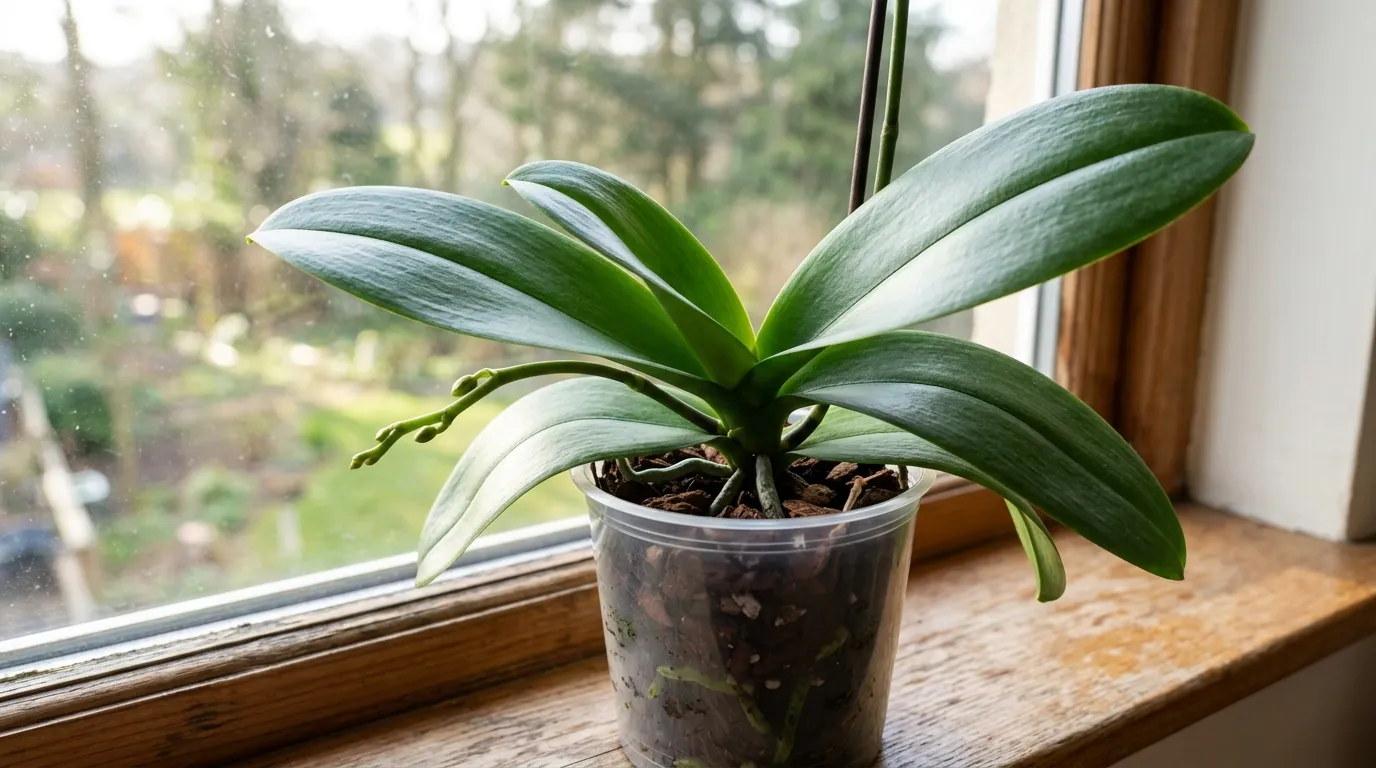
Your moth orchid flowered beautifully when you bought it, dropped its blooms, and has done nothing since. If your orchid is not blooming, the plant is almost never “dead” or “broken”. A Phalaenopsis needs two things to start a new flower spike: enough light to build energy, and a stretch of cooler days to tell it that it is time to flower. Most homes give it too little of the first and too much warmth for the second. This guide explains why an orchid won’t rebloom and exactly how to get it spiking again.
How a Moth Orchid Decides to Bloom
The moth orchid (Phalaenopsis) sold in supermarkets comes from tropical and subtropical Asia. In “Growing the Best Phalaenopsis” (Orchids, March 2007), researchers from Michigan State University and Texas A&M describe how commercial growers control flowering:
- Warm keeps it leafy. To keep plants vegetative, growers hold them at 82 °F (28 °C) or higher.
- Cool days start spikes. Plants are induced to flower below 79 °F (26 °C), particularly during the day. Growers traditionally use 77 °F days and 68 °F nights (25/20 °C), and mature plants also spike at a constant 77 °F or below. After four to five weeks of this, the spike is on its way.
- Light matters too. The same article reports that spiking can be prevented by very low light (40 foot-candles) or darkness, and recommends 1,000 to 1,500 foot-candles during flowering in production.
- The plant must be mature. Young plants (leaf span under about 10 inches) produce poor, premature spikes.
Day length does not matter for most large- and medium-flowered hybrids, according to the article. So the levers you control at home are temperature and light.
Why Is My Orchid Not Reblooming? 7 Reasons
| Reason | How to tell | Fix |
|---|---|---|
| 1. Too warm all year | Room stays near 80 °F, plant sits by a heater, on a sunny warm sill, or next to electronics | Give it 4 to 5 weeks of days below about 77 °F in autumn |
| 2. Not enough light | Dark green, long, thin leaves; plant is far from a window | Move to a bright east window or a shaded south or west window; add a grow light |
| 3. Still recovering | It flowered recently, or lost leaves or roots | Let it grow new leaves and roots first; moth orchids usually bloom once a year (NC State) |
| 4. Root problems | Mushy brown roots, wrinkled limp leaves | Repot into fresh bark; see below |
| 5. Underfed | Slow growth, small new leaves, no fertilizer for months | Feed regularly at half strength (NC State) |
| 6. Too young or a fresh division | Small plant with only two or three short leaves | Wait until it reaches mature size |
| 7. The spike started, then stalled | Spike grew but buds dried or never formed, or a baby plant (keiki) grew instead | Avoid heat above 82 °F and sudden changes while the spike is young |
Sources: Lopez, Runkle, Wang, Blanchard and Hsu, Orchids (2007); NC State Extension Plant Toolbox.
1. Too warm. This is the most common reason in heated homes. If your orchid lives in a room that stays warm day and night, it never gets the cue. The AOS article notes the cooler temperature matters most during the day, so a cool night alone may not be enough if days are warm.
2. Too dark. NC State Extension recommends an east windowsill as the best spot in the house, with west and south windows workable if shaded. Long, floppy, very dark green leaves are a classic low-light sign; the AOS article says too little light gives long, thin leaves. If you have no good window, a grow light helps; see our grow light guide.
3. Recovering. NC State notes that with good care moth orchids bloom once a year. A plant that just finished a long bloom, or was repotted, may spend months on new leaves and roots before it spikes again. That is normal.
4. Roots. NC State says shriveled or wrinkled leaves usually mean underwatering or root damage, often from rot in a soggy medium. A plant without healthy roots will not bloom. Check them: healthy roots are firm and silvery or green; dead ones are brown and mushy or papery.
5. Feeding. NC State recommends a balanced fertilizer twice a month at half strength, or weekly at quarter strength. Leaves are the plant’s flower factory; no new leaves usually means no spike.
6. Maturity. The AOS article describes premature, poor-quality spikes on young plants with a leaf span under about 10 inches. Small divisions and keikis need time to size up.
7. Bud blast or keikis. NC State notes that buds can drop when temperature, humidity, moisture, fertilizer or location change. The AOS article adds that if a young spike (under about 4 inches) is then kept at 82 °F or above, it may form a keiki instead of buds, or the buds may abort.
How to Get an Orchid to Rebloom, Step by Step
- Check the roots and leaves. A plant with several firm roots and at least three or four healthy leaves is ready. If the roots are rotten, repot first and wait.
- Give it bright, indirect light all year: an east window, or a south or west window behind a sheer curtain.
- Water and feed normally. NC State suggests watering mature plants about weekly in the morning with tepid water, letting the pot drain fully, and feeding at half strength twice a month.
- In autumn, cool it down. Move the plant to a spot where days stay below about 75 to 77 °F and nights are cooler, such as a bright room you do not heat much, for four to six weeks. NC State notes that the large-flowered white and spring-blooming types need a night chill of about 55 °F for a week in autumn; modern dwarf hybrids do not require it. Keep it above 50 °F: the AOS article warns that below 50 °F (10 °C) phalaenopsis can suffer chilling injury within hours.
- Watch for the spike. The AOS article notes the spike usually emerges from the third (sometimes second or fourth) node below the top mature leaf, on the side of the stem.
- Once it appears, keep conditions steady. Avoid heat above about 80 °F and moving the plant around; the AOS article says higher temperatures reduce flower count and give thinner, shorter-lived flowers. Stake the spike as it grows.
Don’t overdo the cold
A cool cue is not a freeze. Keep orchids above 50 °F (10 °C) and away from cold glass at night; chilling injury shows as yellow, water-soaked, sometimes sunken spots on the leaves, according to the AOS article.
Old Flower Spike: Cut It or Leave It?
NC State’s advice is to cut the old flower stalk just above the node below the faded flowers; that node often, but not always, produces a branch with more flowers. If the old spike turns brown and dry, cut it off at the base: it will not flower again, and the plant puts its energy into new leaves, roots and a fresh spike. A weak plant with few leaves is better off with the whole spike removed. For more aftercare, see our orchid care for beginners guide.
Is It a Flower Spike or a Root?
New growth from the base can be either. A flower spike usually emerges from the side of the stem between the lower leaves, has a flattened, mitten-shaped tip and grows upward toward the light. An aerial root tends to be rounder, with a smooth, often green or silvery tip, and grows out or down. If in doubt, wait a couple of weeks: a spike will start to show small bracts (nodes) along its length.
Orchid Not Blooming for Years
If your orchid has grown healthy leaves for two or more years without a spike, the cause is almost always constant warmth or too little light, not age. Work through the steps above, focusing on a bright window and a real cool period in autumn. If it has been sitting in the same old moss or bark for years, repot it: NC State recommends repotting about every two years, after blooming or as new leaves begin to appear, and suggests a bark-based mix rather than pure sphagnum.
Different orchid? Other types have different triggers; see the species section of our orchid care guide. For another plant that needs a cool, dim cue to flower, see our Christmas cactus not blooming guide.
Frequently Asked Questions
Why is my orchid not reblooming?
Usually because it is too warm or too dark. Research summarized by the American Orchid Society shows moth orchids start spikes when temperatures drop below about 79 °F, especially during the day, and stay vegetative at 82 °F or above. Give it bright, indirect light and a few weeks of cooler days in autumn.
How do you get an orchid to rebloom indoors?
Place a mature, healthy plant in bright, indirect light, water and feed it regularly, then move it in autumn to a spot where days stay below about 75 to 77 °F and nights are cooler, for four to six weeks. Keep it above 50 °F.
How long does it take an orchid to rebloom?
Moth orchids usually bloom once a year, according to NC State. After a spike appears, flowers open roughly two to three months later depending on temperature; one hybrid in the AOS article took 72 days from spike to flower at 73 °F and 89 days at 68 °F.
Should I cut the flower spike after blooming?
NC State suggests cutting just above the node below the faded flowers, which may produce a side branch with more flowers. Cut a brown, dried spike off at the base.
Can an orchid bloom again after all the flowers fall off?
Yes. A healthy moth orchid can bloom every year. It needs time to grow new leaves and roots, good light, and a cool period in autumn to start the next spike.
Do orchids need darkness to bloom?
No. Day length has no effect on flowering of most large- and medium-flowered moth orchid hybrids, according to the AOS article. In fact, very low light or darkness prevents spiking. Temperature is the main trigger.