
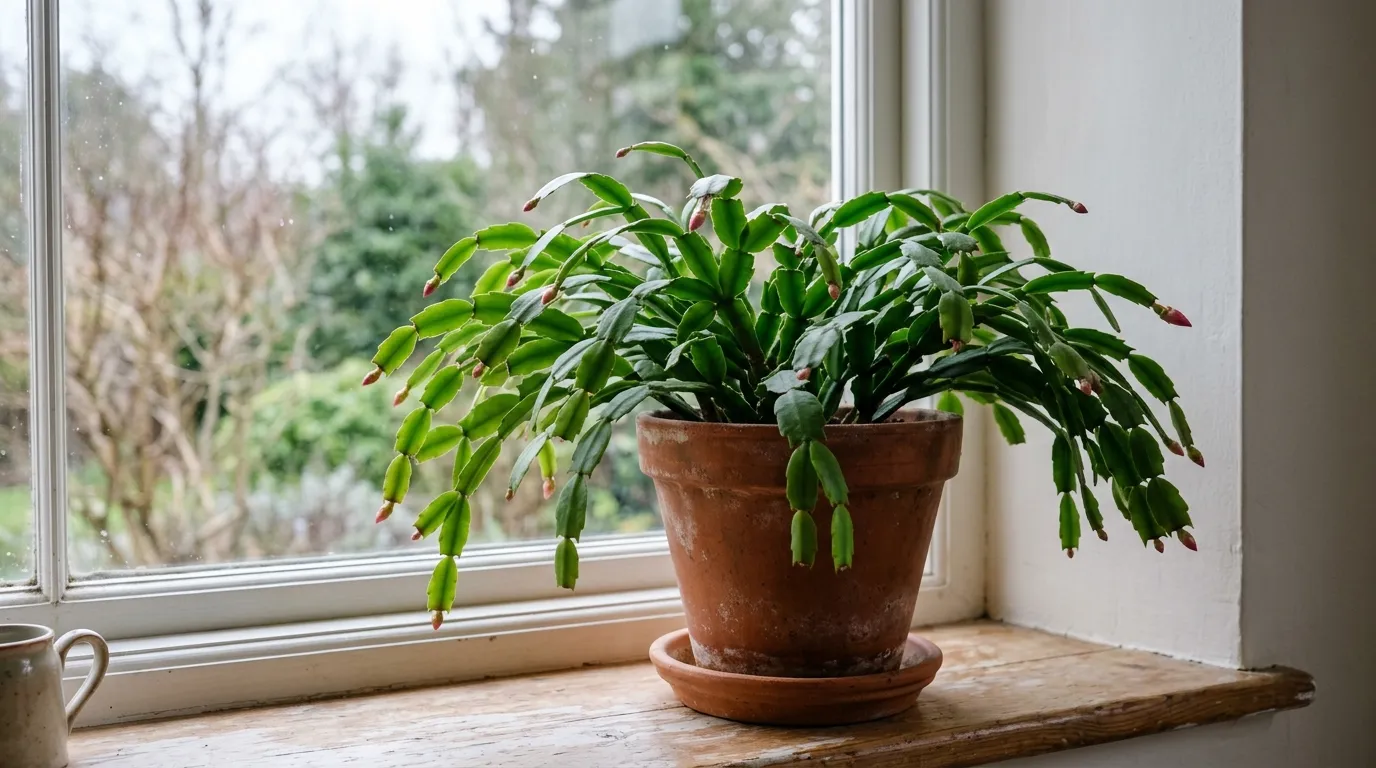
A Christmas cactus that won’t bloom is almost always missing its fall signal: long, dark nights and cool temperatures. According to University of Minnesota Extension, holiday cacti set buds after about 6 weeks of either 55°F nights or 60 to 65°F nights with at least 12 hours of complete darkness, and they are unlikely to bloom if nights stay above 65°F. A warm living room with lamps on every evening blocks both signals.
The good news: this is one of the easiest bloom problems to fix, because the plant is usually healthy and simply hasn’t received its cue. Below are the causes university extension services name, a 6-week rebloom plan you can start this month, and how to stop the frustrating bud drop that happens just before flowering.
6 Reasons Your Christmas Cactus Won’t Bloom
| Cause | What is happening | Fix |
|---|---|---|
| 1 Nights too warm | Plants are unlikely to bloom if nights stay above 65°F (University of Minnesota); NYBG says normal household temperatures above 68°F stop buds forming | Move it to a cool room with nights around 55 to 65°F |
| 2 Light at night | It is a short-day plant; artificial light at night in fall interrupts bud formation (Iowa State) | Give 12 to 13 hours of uninterrupted darkness, or cover it at night |
| 3 Wrong time of year | It may be a Thanksgiving cactus, or simply not yet into its season | Check the type and timing (next section) |
| 4 Missing nutrients | University of Minnesota lists lack of nutrients as a cause | Feed half-strength with low nitrogen, higher phosphorus and potassium in fall |
| 5 Too much water | Wet, heavy soil causes root rot, one of the most common causes of death (University of Minnesota) | Let the soil dry between waterings; empty the saucer |
| 6 Moved or disturbed | Moving the plant while buds develop can make them drop (Iowa State) | Pick its spot before buds form and leave it there |
Sources: University of Minnesota Extension, Iowa State University Extension, New York Botanical Garden.
Christmas or Thanksgiving Cactus? Check Your Timing
Many plants sold as “Christmas cactus” are actually Thanksgiving cactus, which flowers earlier. Clemson Cooperative Extension gives two easy checks:
Thanksgiving cactus
- Schlumbergera truncata
- Stem segments with distinctly pointed edges
- Yellow pollen-bearing anthers
- Flowers around November
Christmas cactus
- Listed as S. × buckleyi by Clemson, S. bridgesii by University of Minnesota and the ASPCA
- More rounded stem segments
- Purplish-brown anthers
- Flowers later than Thanksgiving cactus
Both respond to the same cue: University of Minnesota Extension says Christmas and Thanksgiving cacti bloom after about 6 weeks of short days and flower in late fall to winter. Easter cactus is different: it needs 8 to 12 weeks and flowers in late winter or early spring, so an “Easter” plant that stays green in December is on schedule.
The 6-Week Rebloom Plan
University of Minnesota Extension describes two ways to trigger buds. Pick the one that fits your home:
- Cool route: nights around 55°F. Plants bloom in about 5 to 6 weeks, sometimes regardless of day length.
- Dark route: nights of 60 to 65°F plus at least 12 hours of complete darkness every night for about 6 weeks.
- Either way: bright light for the rest of each day, and daytime temperatures of about 65 to 70°F.
- Start in fall. Iowa State Extension suggests moving the plant to a cool spot in late summer; starting in mid-October still gives buds by late November or December on a 6-week cycle.
- Choose a room. A cool spare room or a bright spot near (not touching) a cool window works well, as long as nights stay in the 55 to 65°F range above.
- Control the dark. If the room is used at night, cover the plant or move it into a closet from early evening to morning. Clemson Extension suggests 13 hours of darkness daily for 8 weeks, a slightly longer and more cautious version of the same idea.
- Water sparingly. Let the soil dry between waterings and empty the saucer.
- Feed for flowers. University of Minnesota Extension suggests switching to a low-nitrogen, high-phosphorus and potassium fertilizer (for example 0-15-10) at half strength while buds form.
- Stop moving it. When you see buds, leave the plant where it is. If you want it in a warmer display room, move it as soon as buds appear, not later.
Pro tip: A cheap plug-in timer on the nearest lamp, or a habit of covering the plant with a cardboard box at the same time each evening, makes the dark route far easier to stick with for six weeks.
Why Buds Fall Off Before Opening
Common bud-drop triggers
- Moving the plant while buds are forming (Iowa State, NYBG)
- Drafts and sudden changes in temperature or humidity (University of Minnesota, NYBG)
- A change in the direction or amount of light (University of Minnesota)
- Excess water in the saucer or decorative pot (University of Minnesota)
- More buds than the plant can support, which University of Minnesota calls self-pruning
If a few buds drop but most stay, the plant may simply be self-pruning. If almost all of them fall, look for a nearby heater, vent, drafty door or a recent move.
Year-Round Care That Leads to Flowers
Holiday cacti are true cacti, but University of Minnesota Extension notes they come from rainforests, so they want bright but filtered light, higher humidity and soil that is moist for much of the year, not desert treatment.
| Season | What to do |
|---|---|
| After bloom | Water less often (University of Minnesota); NYBG recommends a cool rest of about two months. Prune where two stem segments join to encourage branching. |
| Spring to summer | Increase watering as growth resumes. Feed monthly June to August with a balanced houseplant fertilizer at half strength. Outdoors, part shade (3 to 6 hours of sun) is fine; too much sun turns stems pale. |
| Late summer to fall | Bring plants in before frost after checking for pests, then start the 6-week rebloom plan. |
| Repotting | Only about every three years; holiday cacti bloom best somewhat pot-bound (University of Minnesota). |
University of Minnesota Extension suggests a mix of 1 part sterile potting soil, 2 parts peat moss and 1 part sharp sand or perlite, in a pot that drains freely. For more on drainage and rot, see our cactus care guide and our guide to treating root rot.
Is Christmas Cactus Safe for Pets?
Yes, it is non-toxic
The ASPCA lists Christmas cactus as non-toxic to dogs, cats and horses, which makes it a good holiday plant for pet households. If you also keep a poinsettia, see our poinsettia care guide for its pet-safety details, and our cat-safe plants list for more options.
Frequently Asked Questions
How do I force my Christmas cactus to bloom?
Give it about 6 weeks of either cool nights around 55°F, or 60 to 65°F nights with at least 12 hours of complete darkness, according to University of Minnesota Extension. Keep bright light during the day and avoid moving it once buds form.
How many hours of darkness does a Christmas cactus need?
At least 12 hours of complete darkness each night for about 6 weeks when nights are 60 to 65°F (University of Minnesota Extension). NYBG suggests 13 hours of uninterrupted darkness, and Clemson Extension suggests 13 hours daily for 8 weeks.
Why are the buds on my Christmas cactus falling off?
Usually because the plant was moved, or because of drafts, sudden temperature or light changes, or water sitting in the saucer. Some bud drop is the plant shedding more buds than it can support, which University of Minnesota Extension calls self-pruning.
When should I start getting my Christmas cactus to bloom?
In fall. Iowa State Extension suggests moving it to a cool spot in late summer. Because buds take about 6 weeks to form, starting by mid-October usually gives flowers by late November or December.
How can I tell a Christmas cactus from a Thanksgiving cactus?
Clemson Extension says Thanksgiving cactus has stem segments with pointed edges and yellow anthers, while Christmas cactus has more rounded segments and purplish-brown anthers. Thanksgiving cactus also flowers earlier, around November.
Is Christmas cactus poisonous to cats?
No. The ASPCA lists Christmas cactus as non-toxic to dogs, cats and horses.