
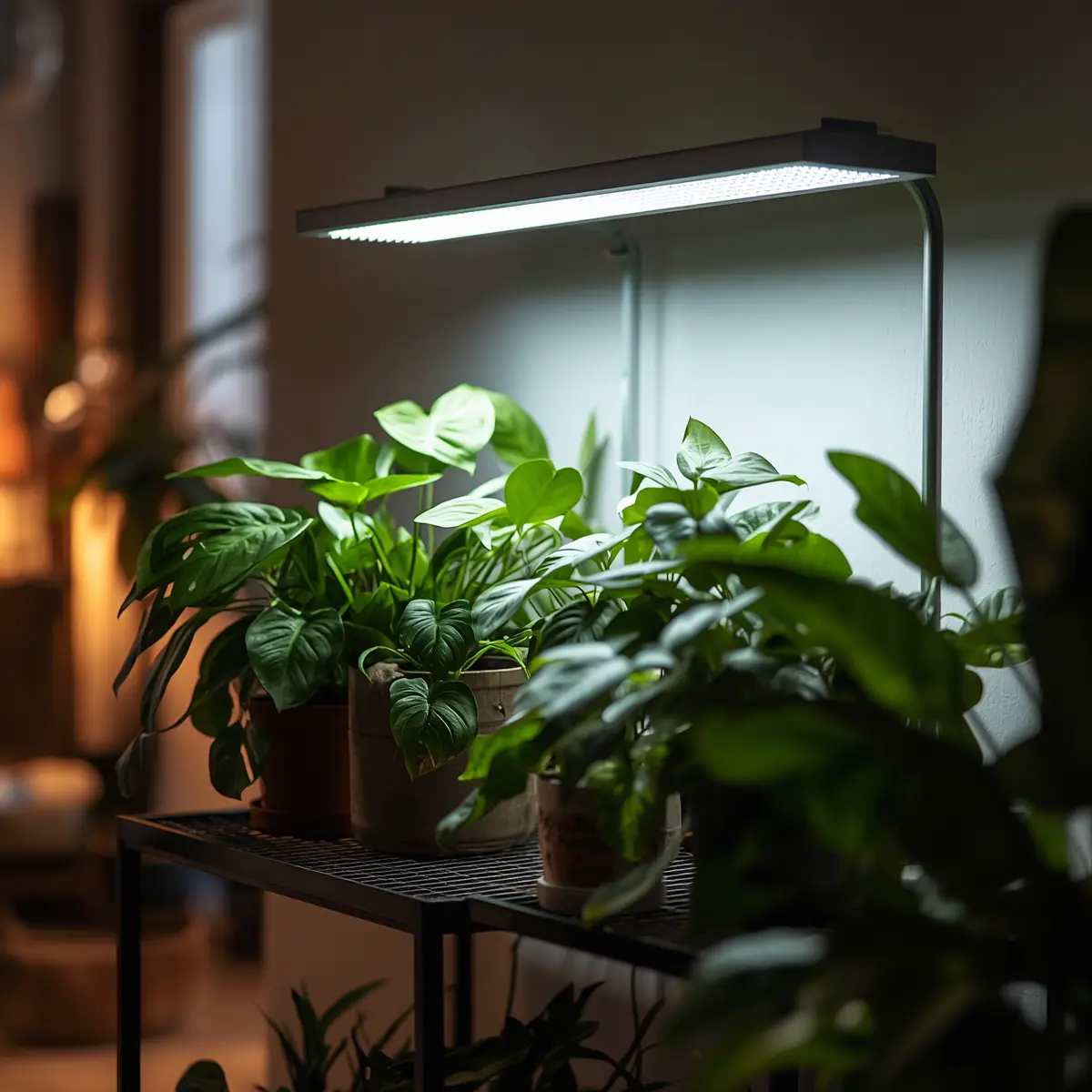
The best grow lights for indoor plants are white, full-spectrum LEDs that put the right amount of light on your plant at the height you hang them. According to University of Minnesota Extension, that is about 50 to 150 µmol/m²/s for low-light plants like pothos and snake plants, 150 to 250 for medium-light plants like monstera and fiddle leaf fig, and 250 to 450 for high-light plants like succulents, citrus and herbs. Hang the light 12 to 24 inches above foliage houseplants and run it 12 to 14 hours a day on a timer.
Most product pages advertise watts and lumens, which tell you little about plant growth. Below, you’ll find the exact specs to buy for each setup, then how to set the light up and what it costs to run. We don’t test lights ourselves, so instead of brand names you get the numbers to check on any product listing.
Best Grow Light for Each Setup
Find your setup in the left column, then check any product against the specs in the row. The PPFD targets and distances come from University of Minnesota Extension; the format suggestions follow from them.
| Your setup | Best format | What to look for on the listing |
|---|---|---|
| One low-light plant (pothos, snake plant, ZZ) in a dim room | White LED grow bulb in a lamp you own, or a small clip-on | 50 to 150 PPFD at the distance it will sit; standard E26 base for a bulb |
| One medium-light plant (monstera, fiddle leaf fig, hoya) | Clip-on or gooseneck spotlight, or a small hanging LED | 150 to 250 PPFD at 12 to 24 inches, with enough beam spread to cover the whole plant |
| A shelf of foliage plants | LED panel or a set of LED bars mounted under the shelf above | A PPFD map showing 150 to 250 across the shelf width, not just at the center |
| A large floor plant | Hanging LED panel or pendant | 150 to 250 PPFD at the top of the canopy, with a height-adjustable hanger |
| Herbs, succulents, citrus or flowering plants | Stronger LED panel or bars, hung closer | 250 to 450 PPFD; UMN suggests 6 to 12 inches for herbs and flowering houseplants |
| Seed trays and cuttings | LED bars or tubes | Mountable 4 to 6 inches above seedlings and easy to raise; run 16 to 18 hours |
| Tightest budget | A white LED grow bulb in an existing lamp | Best for one low- or medium-light plant placed close to the lamp |
PPFD ranges, distances and hours: University of Minnesota Extension, “Lighting for indoor plants and starting seeds” (reviewed 2026). UMN also gives rough wattages for each level (about 10 to 15 W for low light, 15 to 20 W for medium, over 20 W for high), but a light’s PPFD at your distance is the better guide.
The quick buying rule
Skip any listing that only shows lumens or “equivalent watts”. Buy a white or full-spectrum LED that publishes PPFD at a stated hanging height, check that the number lands in your plant’s range at the height you can actually mount it, and make sure its coverage matches your shelf or plant.
How Much Light Does Your Plant Need?
Start with the plant, not the light. University of Minnesota Extension groups houseplants into three light levels and gives the intensity for each, measured as PPF in µmol/m²/s (the amount of plant-usable light) and in foot-candles, the older unit you will still see in some books.
| Light level | µmol/m²/s | Foot-candles | Natural-light equivalent | Example plants |
|---|---|---|---|---|
| Low | 50 to 150 | 50 to 250 | North window or a fairly dark corner | Pothos, snake plant, ZZ plant, peace lily, Chinese evergreen, philodendron |
| Medium | 150 to 250 | 250 to 1,000 | East window, or near a west window but out of direct sun | Monstera, rubber plant, fiddle leaf fig, hoya, spider plant, begonias, alocasia |
| High | 250 to 450 | Over 1,000 | Unobstructed south or southwest window | Cacti and succulents, citrus, hibiscus, basil and thyme, orchids |
Source: University of Minnesota Extension (reviewed 2026).
A plant can survive below its range, but it won’t look its best. UMN describes the signs:
Signs of too little light
- Pale green to yellow leaves
- “Leggy” stems with long gaps between leaves
- Older leaves dropping
- Variegated leaves turning solid green
- Flowering plants that never set buds
Signs of too much light
- Scorched patches on leaves
- Bleached, washed-out color on the leaves closest to the light
If you grow monstera, our monstera light requirements guide goes deeper on that plant, and low-light growers can start with the snake plant or ZZ plant.
The 3 Specs That Matter When You Buy
1. Intensity at your distance (PPFD)
PPF is how much plant-usable light a fixture puts out; PPFD is how much of it reaches the leaf. UMN notes that PPFD goes down as plants get farther from the light. Check the PPFD at a stated hanging height against the table above.
2. Light color (spectrum)
UMN says white or balanced light suits most plants at any stage. Blue or mixed light suits seedlings, leafy greens and foliage plants; red or mixed light encourages buds and keeps plants shorter. For a mixed collection, choose white or full-spectrum.
3. Size and coverage
The light has to cover the whole plant or shelf, not just a bright spot in the middle. Compare the coverage area on the listing with the space you need to light.
Why lumens and watts mislead you
Lumens measure how bright light looks to the human eye and leave out some wavelengths plants use, so UMN calls them less relevant for plants. Watts only tell you how much electricity the light uses, not how much light reaches the leaf; a more efficient light produces more light with fewer watts. That’s why PPFD is the number to compare.
Which Type of Grow Light Fits Your Space?
| Format | Best for | Check |
|---|---|---|
| LED panel | Several houseplants on a shelf or in a corner; large floor plants | A PPFD map at your mounting height, so you can see whether the edges still reach your plants’ range |
| Clip-on light | One statement plant, a desk or a tight corner | PPFD at the distance the clip will actually sit; small units may only reach low-light levels |
| Grow bulb | The cheapest start, in a lamp you already own (standard US E26 socket) | It lights a small area, so use it for one plant placed close to the lamp |
| Bar or tube lights | Seed trays, propagation and plant shelves | That you can mount them close (4 to 6 inches above seedlings per UMN) and raise them as plants grow |
LED vs. Fluorescent vs. Incandescent
| Type | Pros | Cons |
|---|---|---|
| LED | Very energy efficient, long-lasting, wide spectrum, little heat, many styles and sizes | Higher up-front cost; bright light can be distracting in living spaces |
| Fluorescent | Moderately energy efficient, cheaper up front | Shorter life and higher energy use than LED; some give mainly blue-green light, so check the label |
| Incandescent | Cheapest up front | Energy inefficient, produces heat, can be short-lived; high far-red light makes plants stretch |
Source: University of Minnesota Extension.
Verdict: LED. For a home grower, LED is the default choice. The higher purchase price is offset by lower running costs and a longer life.
How Far Should a Grow Light Be From Plants?
Distance changes intensity more than anything else you control. UMN recommends:
| Plants | Distance from light |
|---|---|
| Seedlings | 4 to 6 inches (10 to 15 cm), raised as they grow |
| Hydroponic lettuce and herbs | 6 to 12 inches (15 to 30 cm) |
| Flowering houseplants | 6 to 12 inches (15 to 30 cm) |
| Foliage houseplants | 12 to 24 inches (30 to 60 cm) |
Treat these as starting points. If new growth stretches toward the light, move it closer; if leaves bleach or scorch, move it farther away.
How Many Hours a Day Should Grow Lights Be On?
| Plants | Total light per day |
|---|---|
| Seedlings | 16 to 18 hours |
| Hydroponic lettuce and herbs | 12 to 14 hours |
| Foliage houseplants | 12 to 14 hours |
| Flowering houseplants | 14 to 16 hours |
Source: University of Minnesota Extension. These are total light hours, so count daylight from a window too.
Use a timer, and mind the short-day plants
UMN recommends a timer to give plants consistent total light hours. Short-day plants such as poinsettias, chrysanthemums and Thanksgiving or Christmas cactus need short days to flower, so keep them away from lights that run into the evening. See our guide to Christmas cactus not blooming.
Is Your Plant Getting Enough Light per Day?
Intensity and hours work together. Growers combine them into the daily light integral (DLI), the total plant-usable light a plant receives in a day, in mol/m²/day.
DLI = PPFD × hours of light × 0.0036
Medium-light plant at 150 µmol/m²/s for 12 hours: 150 × 12 × 0.0036 = 6.5 mol/m²/day.
High-light plant at 250 µmol/m²/s for 14 hours: 250 × 14 × 0.0036 = 12.6 mol/m²/day.
The 0.0036 converts seconds to hours and micromoles to moles. A weaker light run longer can match a stronger light run for fewer hours, as long as you stay within the hour ranges above.
How Much Does a Grow Light Cost to Run?
Less than most people expect. The U.S. Energy Information Administration forecasts an average residential electricity price of 18.2 cents per kWh for 2026 (EIA Short-Term Energy Outlook). At that price, running a light 12 hours a day for 30 days costs about:
| Actual power draw | Energy per month | Cost per month |
|---|---|---|
| 10 W | 3.6 kWh | $0.66 |
| 20 W | 7.2 kWh | $1.31 |
| 30 W | 10.8 kWh | $1.97 |
| 50 W | 18 kWh | $3.28 |
Use the light’s actual power draw, not an “equivalent” wattage printed on the box, and your own electricity rate if you know it. Rates vary a lot by state.
Common Grow Light Mistakes
| What you see | Likely cause | Fix |
|---|---|---|
| Leggy, stretching growth with long gaps between leaves | Too little light | Move the light closer (12 to 24 inches for foliage plants) or choose a stronger light |
| Bleached or scorched patches on top leaves | Too much light, or the light is too close | Raise the light or shorten the hours |
| Variegated leaves turning solid green | Too little light | Increase intensity or hours within the ranges above |
| Flowering plant never blooms | Too little light, or the wrong day length for the plant | Check its light level; give short-day plants long, dark nights |
| High electricity use | Old incandescent or fluorescent fixture | Switch to LED and add a timer |
For humid indoor growing setups, see our guides to greenhouse cabinets.
Once your lighting is right, the rest of plant care gets easier. For plant-by-plant needs, browse the care guides in The Lab, and pair your light with a self-watering pot for steady moisture.
Frequently Asked Questions
What is the best grow light for indoor plants?
A white, full-spectrum LED that delivers your plant’s light level at the height you’ll hang it: 50 to 150 µmol/m²/s for low-light plants, 150 to 250 for medium and 250 to 450 for high (UMN Extension). Pick the format that fits your space: a bulb or clip-on for one plant, a panel or bars for a shelf.
Are LED grow lights worth it for houseplants?
Yes, if your plants get less light than they need from windows. UMN rates LEDs as very energy efficient, long-lasting and low-heat, and a small LED costs a few dollars a month or less to run at average US electricity prices.
Can a regular LED bulb be used as a grow light?
It gives some usable light, but regular bulbs are rated in lumens, which measure brightness for human eyes rather than plant-usable light. A grow light that publishes PPFD at a set distance lets you check whether it reaches your plant’s range.
How far should grow lights be from plants?
UMN recommends 12 to 24 inches for foliage houseplants, 6 to 12 inches for flowering houseplants and herbs, and 4 to 6 inches for seedlings. Move the light closer if plants stretch and farther away if leaves bleach.
How many hours a day should grow lights be on?
About 12 to 14 hours for foliage houseplants, 14 to 16 for flowering houseplants and 16 to 18 for seedlings, counting window light too (UMN). Use a timer so the schedule stays consistent.
Do grow lights use a lot of electricity?
No. At the EIA’s 2026 average of 18.2 cents per kWh, a 30 W LED running 12 hours a day costs about $2 a month. Check your light’s actual power draw and your local rate.
What color grow light is best for indoor plants?
White or balanced full-spectrum light suits most plants at every stage (UMN). Blue-heavy light suits seedlings and foliage plants, while red-heavy light encourages flowering and more compact growth.