
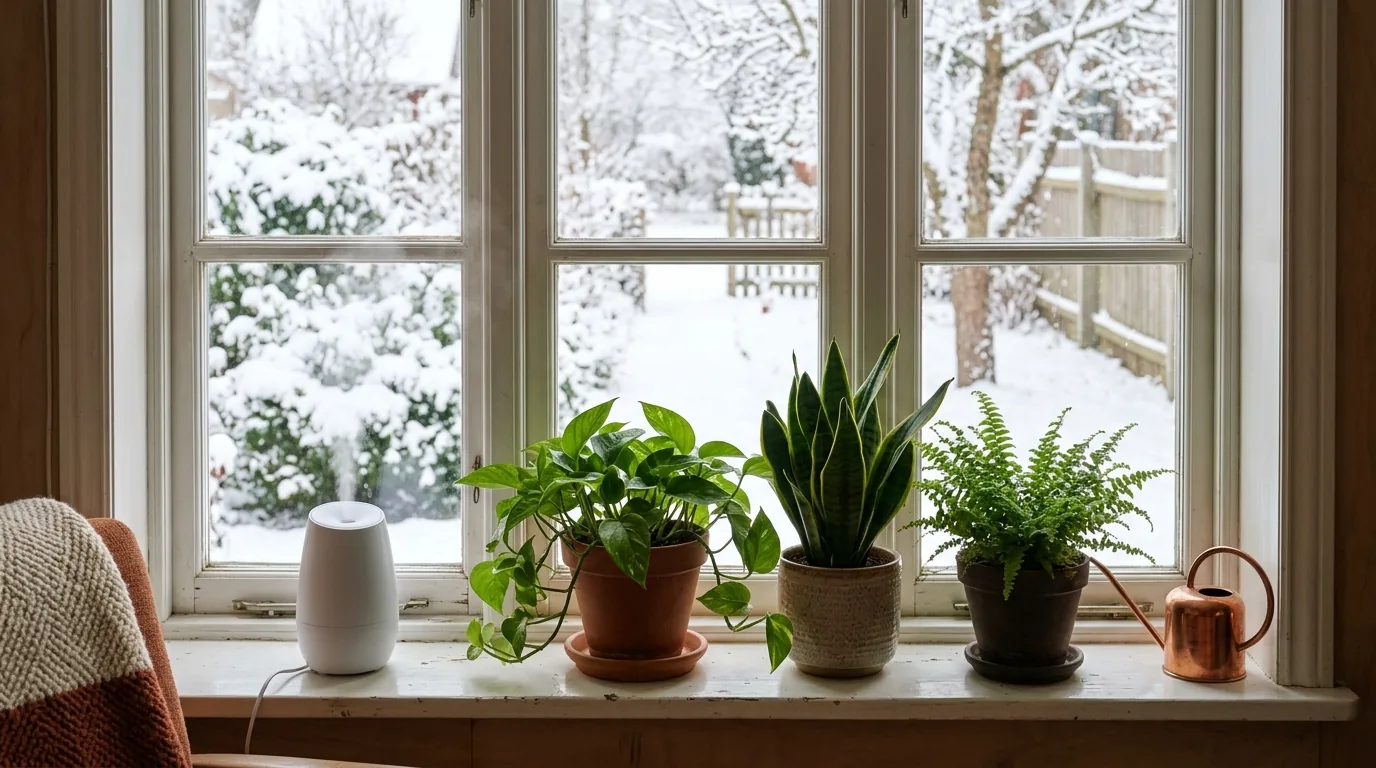
Winter is the hardest season for houseplants, even though they never leave the house. The days are short, the light is weak, and heating dries the air to levels most tropical plants never see in the wild. Plants respond by growing slowly, so the routine that worked in summer suddenly drowns them. This guide covers winter houseplant care, from how to take care of indoor plants in winter day to day to how to keep indoor plants alive in winter when the heating runs nonstop: light, watering, humidity, temperature, feeding and pests, following North Dakota State University, University of Nebraska and University of Kentucky Extension.
Winter Houseplant Care at a Glance
| Topic | Winter routine |
|---|---|
| Light | Sunniest spot available; south-facing window if growth turns spindly (NDSU); rotate every 1 to 2 weeks; LED grow lights if light is limited (Kentucky) |
| Water | When the top inch is dry (Nebraska, Kentucky); often every 2 to 3 weeks (Kentucky); once a week or less for plants that were outdoors (Nebraska) |
| Humidity | Homes can fall to 10 to 20%; houseplants prefer 40 to 50% (NDSU) |
| Temperature | 65 to 75°F for most houseplants (NDSU); cacti and succulents cool, 55 to 60°F, above 45°F (Nebraska) |
| Fertilizer | None until spring (NDSU, Kentucky) |
| Pests | Inspect for aphids, scale and spider mites; wipe leaves with a damp cloth (Kentucky) |
Sources: NDSU Extension (2020); University of Nebraska Extension (2018); University of Kentucky Extension (2025).
Light: The Biggest Winter Problem
Nebraska Extension points out that light indoors is much lower in winter than in summer, and NDSU Extension notes that the shorter days and lower sun angle change how much light each window gets. Thin, spindly new growth is the sign a plant needs more; NDSU suggests moving it closer to a south-facing window.
- Use your brightest windows. Kentucky Extension suggests the sunniest spots you have, ideally near windows.
- Rotate. Turn plants every one to two weeks so all sides get light (Kentucky).
- Introduce direct sun gradually. If you move a plant into a sunny window, acclimate it over several days to avoid leaf burn (Kentucky).
- Add a grow light if natural light is limited; Kentucky recommends LED grow lights. Our grow light guide explains how much light each type of plant needs.
How Often to Water in Winter
Overwatering is the classic winter mistake. With less light, plants use far less water, and soggy soil in a cool room is an invitation to root rot. The sources agree on checking before watering:
- Push a finger about an inch into the soil and water only if it is dry (Kentucky, Nebraska).
- Kentucky Extension says many houseplants need water only every two to three weeks in winter, but check often, because dry indoor air can speed drying.
- Nebraska notes that a plant watered daily outdoors in summer may need water only once a week or less indoors in winter.
- When you do water, water thoroughly until it drains from the bottom, in a pot with drainage holes, and don’t leave the pot standing in water (NDSU, Nebraska).
Plants with their own winter routines, such as snake plants and ZZ plants, can go even longer between waterings; see our guide to low-maintenance indoor plants. Not sure whether a drooping plant is too wet or too dry? See our overwatered vs underwatered guide.
Humidity and Dry Indoor Air
NDSU Extension says homes can have a relative humidity as low as 10 to 20% in winter, while houseplants generally prefer 40 to 50%. Dry air shows up as brown leaf tips and edges, especially on ferns, calatheas and palms. NDSU’s fixes:
- Group plants together in one room.
- Set pots on a tray of pebbles and water, with the pot bottoms above the water level.
- Move humidity-loving plants to a bathroom or kitchen if the light there is good enough.
- Place a small humidifier near the plants.
Nebraska Extension adds that a glass cloche over a small, delicate plant holds in moisture. For the science behind dry air and leaf browning, see our guide to VPD for indoor plants.
Temperature, Drafts and Cold Windows
NDSU says most houseplants prefer 65 to 75°F and that rapid temperature changes can cause leaf drop and stress. In practice that means:
- Don’t let leaves touch cold window glass, and watch windowsill plants as the weather cools (NDSU).
- Keep plants away from cold drafts from outside doors, and from radiators, heat vents and other drying heat sources (NDSU, Kentucky).
- Cacti and succulents are the exception: Nebraska Extension says they do best cool, at 55 to 60°F, as long as they stay above 45°F, in a room with bright light such as a south window.
If you moved plants in from the patio this fall, see our guide to bringing plants indoors for winter, which covers the move itself.
Fertilizer in Winter
NDSU and Kentucky Extension both say to stop fertilizing in winter: with reduced light and cooler temperatures, growth slows and the plant can’t use the extra nutrients. Kentucky notes that holding back fertilizer prevents nutrient buildup and leggy growth, and Nebraska warns that excess fertilizer salts can burn leaf edges and damage roots. Resume feeding in spring, when new growth starts. If white crust has built up on the soil, see our guide to white crust on houseplant soil.
Winter Pests
Kentucky Extension recommends inspecting plants, especially any brought in from outdoors, for aphids, scale and spider mites, wiping leaves with a damp cloth, and using neem oil or insecticidal soap if needed, following the label. See our guides to spider mites, aphids and using neem oil.
Winter Symptoms and What They Mean
| What you see | Likely winter cause | What to do |
|---|---|---|
| Thin, spindly, pale new growth | Too little light (NDSU) | Move closer to a south window; rotate; add a grow light |
| Yellow lower leaves, soil stays wet | Watering on a summer schedule | Water only when the top inch is dry |
| Sudden leaf drop | Rapid temperature change, cold drafts (NDSU) | Move away from doors, cold glass and vents |
| Brown leaf tips and edges | Low humidity (NDSU); fertilizer salts (Nebraska) | Raise humidity; stop feeding; flush the soil with plain water |
| Fine webbing, speckled leaves | Spider mites (Kentucky) | Wipe or rinse leaves; treat with soap or neem |
Sources: NDSU Extension; University of Nebraska Extension; University of Kentucky Extension.
For a houseplant that needs a cool winter rest, see our guide to Venus fly trap care.
Frequently Asked Questions
How often should I water houseplants in winter?
Only when the top inch of soil is dry. Kentucky Extension says many houseplants need water only every two to three weeks in winter, compared with much more often in summer.
Should I fertilize houseplants in winter?
No. NDSU and Kentucky Extension both advise stopping fertilizer in winter, when low light and cool temperatures slow growth, and resuming in spring.
How do I keep my indoor plants alive in winter?
Give them your brightest window, water less, stop feeding, raise the humidity and keep them away from cold drafts and heat vents (NDSU, Kentucky, Nebraska).
What humidity do houseplants need in winter?
Houseplants generally prefer 40 to 50% relative humidity, while heated homes can drop to 10 to 20% (NDSU). Grouping plants, pebble trays and a humidifier help.
Why are my houseplants dropping leaves in winter?
Usually rapid temperature changes or cold drafts (NDSU), too little light, or overwatering. Check the plant’s position first, then the soil moisture.
Is it OK to put plants near a heater in winter?
No. NDSU and Kentucky Extension advise keeping plants away from radiators, heat vents and other drying heat sources.