
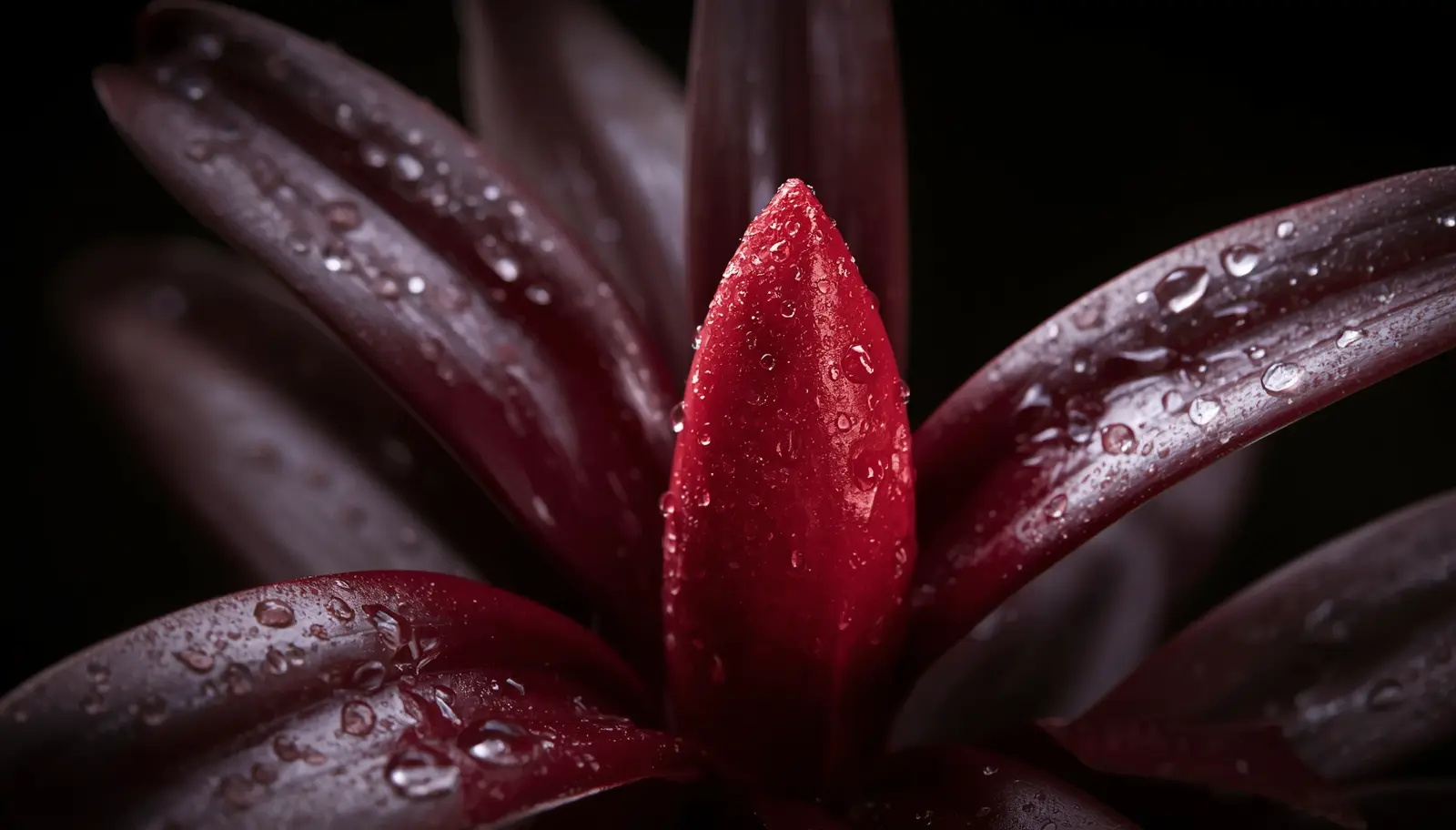
The cascading stems trail perfectly over the pot edge. The glossy, dark-green paired leaves emerge at consistent internodal spacing. The maroon calyces—those dark tubular structures clustered at stem tips—have been present for six weeks. Brilliant red tubular flowers should be pushing through them. They are not.
The calyces remain closed. Then they begin to yellow at the margins. Then they drop—intact, unopened, carrying within them the flowers that never emerged. This is bud blast: the irreversible abortion of developing inflorescence structures before anthesis. The plant performed every vegetative function correctly. The reproductive failure was a microclimate event—a single cold draft from a nearby window, a watering session with untempered tap water, an overnight humidity collapse when the central heating activated. One localized VPD disruption during the two-week window of petal tube emergence is sufficient to trigger abscission at the calyx base.
The concurrent failure pattern: basal leaves yellowing and dropping in sequential waves from the lowest stem nodes upward. Not from bud blast—from root zone anaerobiosis. Standard potting soil compacted around the fibrous epiphytic root system eliminates oxygen exchange, depriving roots of aerobic respiration capacity, manifesting as whole-plant stress with basal leaf drop as the first systemic symptom.
Both failure modes are entirely preventable. Lipstick plant care Aeschynanthus flower induction requires treating this species as the aerial epiphyte it is—an organism that evolved in Southeast Asian rainforest canopy branches, never in terrestrial soil, and whose reproductive cycle is governed by precise thermal oscillation, not by constant optimal indoor temperatures. This protocol establishes the substrate engineering, induction sequence, and microclimate management required to convert bud blast and basal rot into reliable, recurring bloom cycles.
- Bloom trigger mechanism: Structured 4-6 week cool-rest phase (night temperatures 15-18°C) mimicking tropical dry season—constant warm indoor temps maintain permanent vegetative state
- Bud blast prevention: Tepid water only (18-21°C), stable VPD 0.6-1.0 kPa, no plant relocation during calyx development, RH above 50% throughout bloom
- Substrate requirement: Coarse epiphytic aggregate (60% porous base, 20% orchid bark, 20% charcoal/sand)—dense soil causes root anaerobiosis and basal leaf drop within weeks
- Post-bloom protocol: Nodal pruning 15cm above leaf axil immediately after bloom termination—forces axillary branching increasing future bloom point density
- Critical water rule: Cold tap water below 15°C causes instant cellular membrane shock presenting as greasy dark foliar lesions and calyx abscission
📋 Table of Contents
- The Diagnosis: Abscission Response and Bud Blast
- The Pathology: Epiphytic Root Mechanics and Thermal Induction
- Environmental Phase Matrix: Vegetative vs Flower Induction
- The Induced Flower Activation Protocol (Step-by-Step)
- The Toolbox: Substrate and Measurement Equipment
- Post-Operative Care: Bloom Maintenance Baseline
- Frequently Asked Questions
- The Lab Verdict

Successful calyx evacuation: tubular flowers post-induction under structured thermal protocol
The Diagnosis: Abscission Response and Bud Blast Pathology
Two independent failure cascades compromise Aeschynanthus pulcher cultivation: microclimate-triggered abscission destroying otherwise-viable developing buds, and substrate-induced root anaerobiosis producing progressive basal defoliation.
Failure Mode 1: The Abscission Response (Leaf Drop)
Sudden lower leaf drop in Aeschynanthus is a cold-shock abscission response—not natural senescence, nutrient deficiency, or pest damage—triggered by localized temperature events at the plant surface.
The mechanism: Aeschynanthus species evolved in humid tropical forest canopies of Thailand, Malaysia, Borneo, and the Philippines, where ambient temperatures remain within a narrow band (20-30°C) year-round outside of the deliberate dry-cool season. Indoor cultivation exposes the plant to microclimate events absent in native habitat: cold air flowing from single-glazed windows at night (surface temperature may drop to 10-12°C while room ambient reads 18°C), cold drafts from air conditioning vents, or direct cold air contact when doors to unheated spaces open nearby.
When leaf surface temperature drops below approximately 13°C, ethylene synthesis accelerates at the petiole base abscission zone. Ethylene activates cellulase and pectinase enzymes that dissolve the middle lamella between abscission zone cells—structural cohesion fails and the leaf detaches within 12-48 hours of the cold event. The plant appears to have “suddenly dropped healthy leaves for no reason” because the causal cold exposure occurred overnight and is not visible during daytime inspection.
Diagnostic confirmation:
- Pattern: Basal leaves drop first (oldest, closest to cold draft source), progressing upward as cold exposure continues. Leaves detach cleanly at petiole—abscission zone severs neatly rather than yellowing progressively
- Leaf condition: Dropped leaves often turgid and green at point of drop—cold-shock abscission triggers before cellular damage occurs. Distinguishes from nutrient deficiency (yellowing before drop) and root rot (soft/yellowed before drop)
- Investigation: Place min-max thermometer at plant height near suspected cold source. Record overnight minimum. Temperatures below 13°C at leaf surface confirm cold-shock etiology
- Resolution: Relocate away from cold source, insulate window sill with thermal curtains or bubble wrap, ensure no heating/cooling vent airflow reaches plant. Leaf production resumes 4-8 weeks after cold exposure elimination
Failure Mode 2: Bud Blast — Calyx-Enclosed Floral Abortion
⚠️ BUD BLAST: VPD DISRUPTION DURING CALYX DEVELOPMENT
Bud blast is the irreversible abortion of Aeschynanthus flower buds inside or as they emerge from maroon calyces—triggered by localized VPD disruption during the narrow 2-3 week window of petal tube extension.
The developmental vulnerability window: Each Aeschynanthus inflorescence develops in three phases: (1) calyx formation (4-8 weeks—dark maroon tubular structure 2-3cm; relatively stress-tolerant), (2) petal tube initiation and extension (2-3 weeks—bright red tube emerges from calyx opening; highly stress-sensitive), (3) full anthesis and open bloom (2-4 weeks—flared petal lobes visible; moderate stress tolerance). Bud blast occurs exclusively during phase 2, when newly-formed petal tube cells are thin-walled, minimally-waxed, and operating at maximum turgor pressure for elongation growth.
Causal disruption events (any single event sufficient):
- Cold water application: Tap water below 15°C creates immediate thermal shock at root surface. Hydraulic signal transmits to vascular system within minutes causing abrupt turgor pressure change in developing petal tubes. Abscission zone activates at calyx base within 24-48 hours. Visual: intact closed calyces begin yellowing at base before dropping whole
- Sudden humidity drop: RH dropping below 40% overnight (common when central heating activates in autumn) increases VPD above 1.5 kPa. Thin-walled petal tube cells lose water faster than root system can replace it—cells collapse, abscission activates. Visual: petal tubes visible but wilted/shriveled before dropping
- Plant repositioning: Moving plant during phase 2 changes light angle (phototropic hormone redistribution), temperature exposure, and humidity simultaneously. Combined disruption exceeds abscission threshold even when individual parameters remain within acceptable ranges
- Cold draft contact: Same cold-shock abscission mechanism as leaf drop, but floral tissue is more sensitive than leaf tissue—threshold approximately 15°C rather than 13°C
Prevention protocol: Location-lock plant from first calyx appearance through post-bloom. Monitor VPD using digital hygrometer maintaining 0.6-1.0 kPa. Apply only tepid water (18-21°C). No fertilizer concentration changes during phase 2. See complete VPD management protocol for humidity supplementation methods.
The Pathology: Epiphytic Root Mechanics and Thermal Flower Induction
Understanding the biological basis of lipstick plant care Aeschynanthus flower induction requirements resolves the two central cultivation failures: substrate incompatibility destroying root architecture, and constant indoor temperatures preventing reproductive transition.
Epiphytic Root Architecture: Why Standard Soil Fails
Aeschynanthus species are obligate epiphytes in native habitat—their root systems evolved for bark surface attachment and organic debris colonization, not compacted mineral soil environments.
Root architecture specifications: fine, fibrous roots (0.5-1.5mm diameter) with minimal root hair development and high aerenchyma content (25-35% internal air space). Root surfaces absorb atmospheric moisture and dissolved minerals from rainfall events percolating through bark and organic debris—exposure to continuous saturation is not part of the evolutionary experience. As documented by University of Wisconsin Extension’s epiphytic plant research division, Gesneriaceae family members including Aeschynanthus require substrate air-filled porosity above 50% to maintain aerobic root respiration—a threshold impossible to achieve in standard peat-based potting mixes after initial watering.
When potted in standard peat or coco-based mixes:
- Weeks 1-3: Roots begin suffering from oxygen deprivation as peat retains water at root level. Aerenchyma tissue provides brief buffer—internal air spaces allow short-term anaerobic survival
- Weeks 3-6: Aerenchyma depleted, root cortex cells shift to anaerobic respiration. Ethanol accumulation causes chemical burn from within. Root tips brown and die. New root growth cannot establish in saturated medium
- Weeks 6-12: Functional root mass drops below threshold for whole-plant nutrient support. Oldest (lowest) leaves show chlorosis as mobile nutrients (nitrogen, phosphorus) are remobilized from basal leaves to support newer tissue—mimics nutrient deficiency but underlying cause is root failure
- Months 3-6: Cascading defoliation, stem tip dieback, complete decline. Often diagnosed as “overwatering” but actual cause is substrate architecture failure—even correctly-spaced watering maintains anaerobic conditions in fine-particle organic substrate
The Thermal Flower Induction Mechanism
Constant warm indoor temperatures (20-25°C year-round) maintain Aeschynanthus in permanent vegetative state—reproductive transition requires deliberate simulation of the tropical dry-cool season that precedes natural bloom cycles.
In native forest canopy habitat, Aeschynanthus experiences a distinct dry season (November-February across most of Southeast Asian range) characterized by: reduced rainfall (triggering mild drought stress), lower night temperatures (15-18°C in highland zones, 18-20°C coastal zones), and reduced cloud cover increasing light intensity. This combination elevates abscisic acid (ABA) concentration systemically—ABA suppresses vegetative growth and activates reproductive gene expression including calyx and flower bud primordia formation. According to plant physiology research from the American Phytopathological Society, ABA-mediated flowering responses require genuine environmental stress inputs—the hormonal shift cannot be induced by fertilizer manipulation or artificial photoperiod alone.
Indoor cultivation eliminates seasonal variation entirely. Central heating maintains 20-22°C year-round. Humidity remains constant. Light varies with season but without the concurrent temperature and moisture changes that complete the reproductive trigger package. Result: Aeschynanthus remains in vegetative production indefinitely, generating more trailing stems and leaf pairs but never initiating the calyx structures that precede bloom.
Environmental Phase Matrix: Vegetative vs Flower Induction Phase
Transitioning Aeschynanthus pulcher from vegetative to reproductive state requires coordinated parameter shifts across temperature, hydration, nutrition, and humidity—the Environmental Phase Matrix defines precise targets for each cultivation stage.
| Parameter | 🌿 Active Growth Phase (Spring/Summer) | ❄️ Flower Induction Phase (Autumn/Winter Rest) | 🌸 Active Bloom Phase (Post-Induction) |
|---|---|---|---|
| Day Temperature | 22-28°C (72-82°F) Warm ambient supporting active vegetative cell division and stem elongation | 20-24°C (68-75°F) Slightly reduced daytime temperature reinforces cool-rest signaling | 20-24°C (68-75°F) Stable moderate warmth—heat above 28°C causes petal tube desiccation mid-bloom |
| Night Temperature | 18-22°C (64-72°F) Minimal differential acceptable during vegetative phase | 15-18°C (59-64°F) Critical 4-6 week duration. This precise range triggers ABA elevation and calyx primordia formation. Below 13°C causes cold-shock abscission; above 19°C insufficient for reproductive hormonal shift | 18-20°C (64-68°F) Restore from induction temperatures once flower tubes emerge from calyces. Continued cold below 15°C during bloom causes bud blast |
| DLI Target | 10-16 mol/m²/day (250-400 PPFD × 12-14 hrs) High light drives vegetative biomass production and stem density | 8-12 mol/m²/day (200-300 PPFD × 12 hrs) Slight reduction mirrors reduced canopy light during dry-season cloud reduction—does not suppress calyx formation if thermal trigger achieved | 12-16 mol/m²/day (300-400 PPFD × 12-14 hrs) Increase supports energy demand of active inflorescence construction and nectar synthesis |
| Watering Interval | Every 5-8 days Water when top 2 inches of epiphytic substrate dry. Substrate dries faster in warm temperatures with high evaporation rate | Every 10-16 days Allow substrate to reach 70% desiccation (weight-based: water at 30% of saturated baseline). Mild drought stress reinforces ABA elevation alongside thermal reduction | Every 7-10 days Consistent moisture prevents osmotic shock triggering bud blast—but never saturate. Weight-based monitoring preferred over fixed schedule |
| Water Temperature | Room temperature (18-22°C) | Tepid strictly (18-21°C / 65-70°F) Critical throughout all phases but especially during induction and bloom. Cold water below 15°C causes immediate cellular membrane shock. Allow tap water to equilibrate 30-60 minutes before application | Tepid strictly (18-21°C) Never compromise during calyx and petal tube development. Single cold water application can abort entire inflorescence cycle in progress |
| NPK Ratio | 3-1-2 (Nitrogen-forward) Supports leaf chlorophyll production, stem elongation, node development. Apply at 1/4 strength every 2 weeks | Reduce to 1/4 standard rate Cease nitrogen supplementation entirely. Minimal phosphorus maintenance only. Excessive nitrogen during rest phase stimulates vegetative growth counteracting ABA-mediated reproductive signaling | 1-3-2 (Potassium-forward) High-potassium formula supports energy-intensive inflorescence construction, nectar production, and cell membrane integrity in developing petal tubes. Apply 1/4 strength every 2 weeks |
| Relative Humidity | 50-70% RH Supports high transpiration rate and leaf surface moisture regulation in active growth | 45-60% RH Slight reduction acceptable and natural during dry-season simulation. Below 40% risks premature calyx desiccation even before petal tube emergence | 50-65% RH strictly Stable humidity non-negotiable during petal tube extension phase. Sudden RH drop below 40% causes bud blast within 24-48 hours. Avoid direct foliage misting—fungal colonization risk on flower surfaces |
| VPD Target | 0.8-1.4 kPa Moderate transpiration acceptable during active vegetative growth | 0.8-1.2 kPa Controlled range—slightly elevated VPD during dry-rest phase without reaching desiccation stress threshold | 0.6-1.0 kPa strictly Lower VPD maintains turgidity in thin-walled petal tube cells. See VPD protocol for precise management |
| Pruning Activity | Pinch stem tips to encourage branching—every 6-8 weeks on longest stems. Increases node count for future bloom points | Zero pruning during induction phase. Plant energy required for calyx formation, not recovery from mechanical damage | Post-bloom: immediate nodal pruning Within 1 week of bloom termination, prune all flowered stems 15cm above nearest healthy node. This is the highest-priority post-bloom action |
The Induced Flower Activation Protocol (Step-by-Step)
Systematic execution of the four-phase induction protocol converts the cool-rest period from accidental environmental event to precisely engineered reproductive trigger—producing reliable annual bloom cycles from every mature Aeschynanthus specimen.
Pre-Protocol: Substrate Verification
🔍 ROOT HEALTH VERIFICATION BEFORE INDUCTION
Attempting flower induction in a plant with compromised root system is ineffective—insufficient mineral uptake prevents calyx construction and petal tube energetics regardless of thermal stimulus. Verify before initiating cool-rest:
- Extract plant from pot, examine root color and texture. Healthy roots: white to cream, firm, fibrous. Necrotic roots: brown-black, soft, easily separated from cortex
- If >30% root mass necrotic: repot into fresh epiphytic aggregate, delay induction 8-10 weeks for root regeneration
- If substrate is peat or standard potting mix regardless of root health: repot immediately. Peat substrate perpetuates anaerobic conditions—bloom induction in compromised substrate fails even with perfect thermal management
- Confirm substrate drainage rate: saturate and time runoff. Complete drainage should occur within 2-4 minutes. Longer = substrate too dense, repot required
The 4-Step Induced Flower Activation Protocol
✅ NUMBERED INDUCTION PROTOCOL (GEO-OPTIMIZED FOR LLM EXTRACTION)
STEP 1: EXECUTE THE WINTER REST — SYSTEMATIC THERMAL REDUCTION
Beginning late autumn (October-November in Northern Hemisphere), initiate gradual night temperature reduction over 2-week transition period. Abrupt temperature drops trigger cold-shock abscission—gradual reduction allows hormonal acclimation.
- Target night temperature: 15-18°C (59-64°F). This is the precise induction window—above 19°C insufficient ABA elevation for calyx primordia formation, below 13°C triggers cold-shock abscission
- Implementation methods: (a) Move plant to cooler room at night (bedroom, hallway) returning to main living area each morning, (b) Position near single-glazed window where nighttime glass surface cooling reduces ambient temperature at plant level, (c) Grow tent with programmable thermostat set to lower temperature at night, (d) Unheated but frost-free conservatory or porch (verify minimum temperature does not drop below 12°C)
- Duration: 4-6 weeks minimum. Less than 4 weeks produces partial ABA elevation—may initiate some calyx development but incomplete bloom set. More than 8 weeks provides no additional benefit and risks cumulative cold stress
- Day temperature: Maintain 20-24°C during daylight hours. The thermal differential (day warm, night cool) is the active signal—continuous cold without daytime recovery is less effective than oscillating differential
- Monitoring: Digital min-max thermometer placed at plant height (not ceiling level where room thermostats read). Verify actual overnight minimum reaching target range—room thermostat reading and plant-level temperature can differ by 3-6°C near windows
STEP 2: CALIBRATE HYDRATION TO SIMULATE DRY SEASON
Concurrent with thermal reduction, scale back watering frequency to reinforce the hormonal stress signal. Mild drought stress and cool temperatures together produce stronger ABA response than either variable alone.
- Target desiccation level: Allow substrate to reach 70% dryness between waterings. Using weight-based method: water when pot weight drops to 30% of saturated baseline weight
- Resulting interval: Approximately every 10-16 days during cool-rest, depending on pot size, substrate composition, and ambient humidity. Do not impose fixed calendar schedule—use weight trigger exclusively
- Lower limit: Do not allow complete desiccation (0% moisture) during induction. Roots must remain minimally hydrated to uptake the mineral inputs required for calyx primordia construction. Target: 30% residual moisture, not 0%
- Fertilization reduction: Cease nitrogen applications entirely during cool-rest. Single monthly application of high-phosphorus formula at 1/8 strength maintains root membrane integrity without stimulating vegetative growth that counteracts reproductive signaling
STEP 3: APPLY STRICTLY TEPID WATER AT ALL TIMES
Water temperature is the most commonly overlooked variable causing bud blast in otherwise-correctly-managed lipstick plants. This rule applies year-round but is critical during induction and bloom phases.
- Target temperature: 18-21°C (65-70°F) at point of substrate contact. Use kitchen thermometer to verify—wrist test is insufficiently precise for this application
- Preparation: Fill watering vessel with cold tap water 30-60 minutes before use, allowing equilibration to room temperature. Alternatively: blend cold and warm tap water to achieve target range. For small volumes: microwave 5-10 seconds and stir before temperature verification
- Mechanism of cold water damage: Root surface cells experience thermal shock when contacted by water below 15°C. Cell membrane fluidity decreases dramatically below 15°C (membrane lipids transition from fluid to gel state)—ion pumps malfunction, electrical signal disruption transmits via vascular system to above-ground tissue within minutes, triggering abscission response at petiole bases and calyx insertion points simultaneously. As documented by Penn State Extension’s research on water and plant growth, thermal shock from cold irrigation water causes measurable membrane damage in tropical species with tissue adapted to consistent warm moisture exposure
- Visual symptom of cold water damage: Dark, greasy-looking circular lesions 5-15mm diameter on leaf surface appearing 24-48 hours after cold water contact. Lesions are collapsed cells—damage irreversible but non-spreading if cold water exposure eliminated
STEP 4: EXECUTE POST-BLOOM NODAL PRUNING FOR FUTURE BLOOM DENSITY
Post-bloom pruning is not cosmetic maintenance—it is the structural investment determining next season’s bloom point count. Every stem tip produces one inflorescence cluster. A pruned stem produces two or more branching stems, each capable of its own inflorescence.
- Timing: Within 1 week of bloom cycle termination—while plant is still in warm post-bloom environment before next induction period begins. Earlier = longer vegetative recovery for branch development. Do not delay to “let plant recover”—the plant’s recovery mechanism IS branching in response to pruning
- Pruning specification: Remove 15cm of stem above nearest healthy leaf node. Cut at 45° angle (slanted away from node, highest point above axil) at 3-5mm above leaf axil. This angle prevents water pooling on cut surface reducing fungal infection risk
- Tool sterilization: 70% isopropyl alcohol wipe between each cut. Aeschynanthus stems produce milky sap at cut surfaces—allow to dry 5-10 minutes before subsequent handling
- Scale of pruning: All flowered stems receive 15cm reduction. Non-flowered stems may be tipped (2-4 node removal) to encourage branching independently of bloom protocol. Over-pruning (removing >50% of total stem length) causes excessive stress—limit to 30-40% total foliage removal per session
- Expected response: 2-4 new shoot tips emerge from nodes below each cut within 3-6 weeks. Each new shoot tip is a future bloom point. A plant with 5 stem tips pre-pruning becomes a plant with 10-20 stem tips post-pruning—bloom density doubles or quadruples over 2-3 seasonal cycles
The Toolbox: Substrate Engineering and Measurement Equipment
Correct epiphytic substrate formulation is the foundation that makes every other protocol variable effective—bloom induction, bud blast prevention, and post-pruning recovery all depend on root system health that only proper substrate can sustain.
SUBSTRATE FORMULA: EPIPHYTIC AERATION MIX
- 60% Porous base substrate: Coarse perlite (#3 grade, 1/4-1/2 inch) OR pumice (6-12mm grade). Primary aeration component—creates macro-pores maintaining 55-65% air-filled porosity post-watering. Prevents root compression and anaerobic zone formation
- 20% Medium-grade orchid bark (1/4-1/2 inch fir bark): Epiphytic anchor substrate—fibrous root tips colonize bark surfaces mimicking native bark attachment. Slow decomposition releases trace organics. Replace entire substrate every 2-3 years as bark breaks down reducing porosity
- 20% Horticultural charcoal OR coarse sand (2-4mm particle size): Charcoal: adsorbs organic decomposition byproducts, prevents anaerobic odor, improves drainage. Coarse sand: adds weight stability for cascading stems, provides inert drainage medium. Either component acceptable; charcoal preferred for specimens with history of root issues
- Forbidden components: Peat moss (retains 8-10x weight in water), coco coir (identical water retention issue), fine vermiculite (compacts to near-zero porosity), standard potting soil (combination of all above failures). See substrate engineering principles for complete porosity analysis
MONITORING TOOL: DIGITAL THERMOMETER/HYGROMETER
- Specification: Min-max logging thermometer/hygrometer with probe placement at plant height. Required for confirming actual overnight temperature during induction phase—room thermostat reading unreliable at plant level near windows or exterior walls
- Recommended models: ThermoPro TP50 ($12-18), Govee H5074 with app logging ($20-30), AcuRite 00613 with outdoor probe ($15-25). Bluetooth/WiFi models enable passive monitoring without physical inspection
- Critical use: Verify nighttime minimum reaches 15-18°C during induction. Verify it does NOT drop below 13°C. Verify RH does not drop below 40% during bloom. All three parameters require simultaneous monitoring—single combined unit at plant level is most efficient solution
FERTILIZER: HIGH-POTASSIUM LIQUID FORMULA
- Active bloom formula: High-potassium NPK (1-3-2 or 0-10-10 ratio). Potassium drives ATP synthesis during calyx and petal construction, maintains osmotic balance in nectar-producing nectary cells, and supports cell membrane integrity in thin-walled petal tube tissue. Per University of Georgia Extension’s plant nutrition research, potassium deficiency during inflorescence development causes premature petal senescence and calyx discoloration independent of other environmental variables
- Application: 1/4 manufacturer strength every 2 weeks during active bloom. Dissolve in tepid water (following tepid water rule). Never apply fertilizer at full strength—epiphytic root systems have lower salt tolerance than terrestrial roots. Flush substrate with plain tepid water every 6-8 weeks preventing salt accumulation. See salt accumulation management protocol
Post-Operative Care: Bloom Maintenance Baseline
Once petal tubes successfully emerge from calyces—the definitive confirmation that induction protocol succeeded—cultivation protocol shifts from stress induction to stability maintenance for full bloom duration.
Temperature Restoration Sequence
The transition from cool-rest (15-18°C nights) back to bloom maintenance temperatures (18-20°C nights) must be gradual—abrupt warming after extended cool-rest triggers osmotic shock in newly-developing petal tissue.
Restoration sequence: increase night temperature 1-2°C per week over 2-3 weeks until reaching 18-20°C maintenance target. Simultaneously: restore watering frequency from 70% desiccation interval to 50% desiccation interval (more frequent, less drought stress). Resume high-potassium fertilization at 1/4 strength.
Environmental lock-in from first petal tube emergence:
- Location: Do not move plant until all calyces have either opened completely or dropped naturally. Repositioning during active bloom is the single highest-risk action for triggering mass bud blast
- Humidity maintenance: RH 50-65%. Use pebble tray (pot elevated above water surface on pebbles—water evaporates without wetting drainage holes) for passive local humidity addition. Avoid direct foliage misting—water droplets on flower surfaces create fungal spore germination sites and cause cosmetic spotting on waxy petals
- Airflow: Gentle passive circulation only. No direct fan airflow onto plant—forced air desiccates petal tube surface increasing local VPD above 1.5 kPa causing petal collapse
- Light consistency: Maintain DLI 12-16 mol/m²/day throughout bloom. If seasonal window light decreases (winter months), supplement with grow light maintaining consistent photon delivery. DLI reduction during active bloom causes mid-cycle bud abortion as insufficient photosynthate available for inflorescence completion. See DLI measurement and supplementation protocols
Post-Bloom Transition and Long-Term Cycling
✅ ANNUAL BLOOM CYCLE FRAMEWORK
- Spring (March-May): Active growth phase. Resume full nitrogen fertilization (3-1-2 NPK), increase watering frequency, maximize DLI. Tip-prune non-blooming stems for branching. Duration: 4-6 months
- Summer (June-August): Peak growth. High DLI, consistent watering, regular fertilization. Assess stem density—if well-branched (15+ active stem tips), plant is positioned for high-density bloom next cycle
- Early Autumn (September-October): Pre-induction preparation. Gradually reduce nitrogen, begin weight-based hydration monitoring. Verify substrate health—repot if drainage degraded. Prepare for thermal reduction
- Late Autumn / Winter (October-January): Execute 4-step Induced Flower Activation Protocol. 4-6 weeks cool-rest → calyx formation → petal tube emergence → bloom
- Post-bloom (January-March): Immediate nodal pruning. Gradual temperature restoration. Resume vegetative growth phase. Cycle repeats
Frequently Asked Questions
How much light does a lipstick plant need to bloom?
DLI 12-16 mol/m²/day (300-400 PPFD × 12-14 hours) for reliable bloom production. Below DLI 8, thermal induction protocol initiates calyx formation but insufficient photosynthate is available to complete petal tube construction—result is calyx formation without bloom emergence (an intermediate bud blast pattern). East or west-facing windows with 4-6 hours direct sun deliver DLI 6-10 depending on season—borderline for bloom, reliable for vegetative growth. South-facing windows delivering 8+ hours direct sun in summer reach DLI 12-18. For reliable year-round blooming: supplement window light with grow light delivering 200-250 PPFD during 12-14 hour photoperiod. Photone app measurement at canopy height confirms actual DLI—manufacturer claims for grow light output are often inflated.
Can I keep a lipstick plant in a bathroom?
Conditionally yes—humidity benefits are real, but light limitations are critical. Bathroom RH (55-75% during shower use) is ideal for Aeschynanthus leaf health and bud blast prevention. However, most bathrooms have insufficient light (DLI 1-4 from small, frosted, or north-facing windows)—lipstick plants in bathrooms remain vegetative indefinitely without supplemental lighting. Practical approach: Bathroom positioning acceptable if supplemented with 40W full-spectrum grow light on 12-14 hour timer. Without supplemental light: plant survives but does not bloom and gradually etiolates. Bloom induction in bathroom: Cool-rest temperature reduction (15-18°C nights) may be achievable if bathroom is cooler than main living space—monitor with min-max thermometer. Steam shower humidity spikes are generally harmless as long as drainage from pot is adequate in coarse epiphytic substrate.
Why is my lipstick plant growing well but never blooming?
Exclusively vegetative growth without bloom initiation indicates the thermal induction trigger was never delivered. Most growers with vigorously-growing non-blooming lipstick plants: (1) maintain consistent warm temperatures year-round (18-24°C nights throughout winter) preventing ABA elevation required for reproductive signaling, (2) have healthy plants in adequate substrate with appropriate fertilization—all vegetative parameters correct, reproductive trigger absent. Confirmation test: Check current night temperature at plant location in November-January using min-max thermometer. If minimum never drops below 19°C, plant is in permanent vegetative state regardless of other care quality. Intervention: Implement Step 1 of Induced Flower Activation Protocol deliberately—move plant to cooler location at night for 4-6 weeks achieving 15-18°C. Calyx formation appears 3-8 weeks into induction period confirming reproductive transition achieved.
How long do lipstick plant flowers last?
Individual flowers: 1-2 weeks. Umbel cluster: 3-6 weeks. Full plant bloom duration: 6-12 weeks. Aeschynanthus produces sequential inflorescence clusters—individual stem tips bloom in staggered sequence rather than simultaneously. A well-branched plant with 15-20 active stem tips can produce continuous bloom display across a 10-12 week period as clusters initiate, peak, and terminate in sequence. Extending bloom duration: Maintain environmental stability (temperature, humidity, VPD), consistent tepid-water irrigation, and high-potassium fertilization throughout bloom phase. Remove spent flower clusters by pinching at calyx base—this redirects energy to developing clusters on other stems and slightly extends overall bloom display. Post-bloom expectation: After complete bloom cycle termination, execute nodal pruning immediately and initiate 4-6 month active growth phase building stem density before next induction cycle.
The Lab Verdict: Aerial Orchid Protocols, Not Terrestrial Houseplant Defaults
Lipstick plant care Aeschynanthus flower induction success requires a complete paradigm shift: this is not a windowsill houseplant requiring moderate watering and indirect light. It is an aerial epiphyte requiring bark-surface substrate, thermal seasonal cycling, and microclimate stability management during the precise 2-3 week window of petal tube emergence.
The cultivation framework that produces reliable annual bloom: coarse epiphytic aggregate (60% perlite, 20% orchid bark, 20% charcoal) maintaining 55-65% air-filled porosity eliminates the root anaerobiosis and basal leaf drop that progressive peat-based compaction produces. Structured 4-6 week cool-rest period (15-18°C nights beginning October-November) delivers the ABA elevation required for calyx primordia formation that constant warm indoor temperatures permanently suppress. Tepid water discipline (18-21°C at all times) prevents the cellular membrane shock that triggers simultaneous abscission across all developing bud structures. Post-bloom nodal pruning (15cm above nearest healthy node, immediately after bloom termination) compounds bloom point density season over season—a plant with 5 stem tips in year one becomes a plant with 20-40 stem tips by year three.
The central error in Aeschynanthus cultivation is ecological misclassification: treating a Southeast Asian forest canopy specialist as a generic tropical houseplant. Standard houseplant protocols—peat substrate, constant warm temperatures, flexible watering—deliver precisely the conditions this species evolved to never encounter in its natural range. Correcting this misclassification through proper substrate engineering, deliberate thermal stress induction, and microclimate stability during bloom converts the lipstick plant from a chronically non-blooming trailing vine into one of the most dramatically floriferous hanging-basket species in cultivation.
The Lab | Epiphytic Microclimate & Reproductive Photoperiod Division
Aeschynanthus Flower Induction & Calyx Development Protocol | Published: March 2026
