
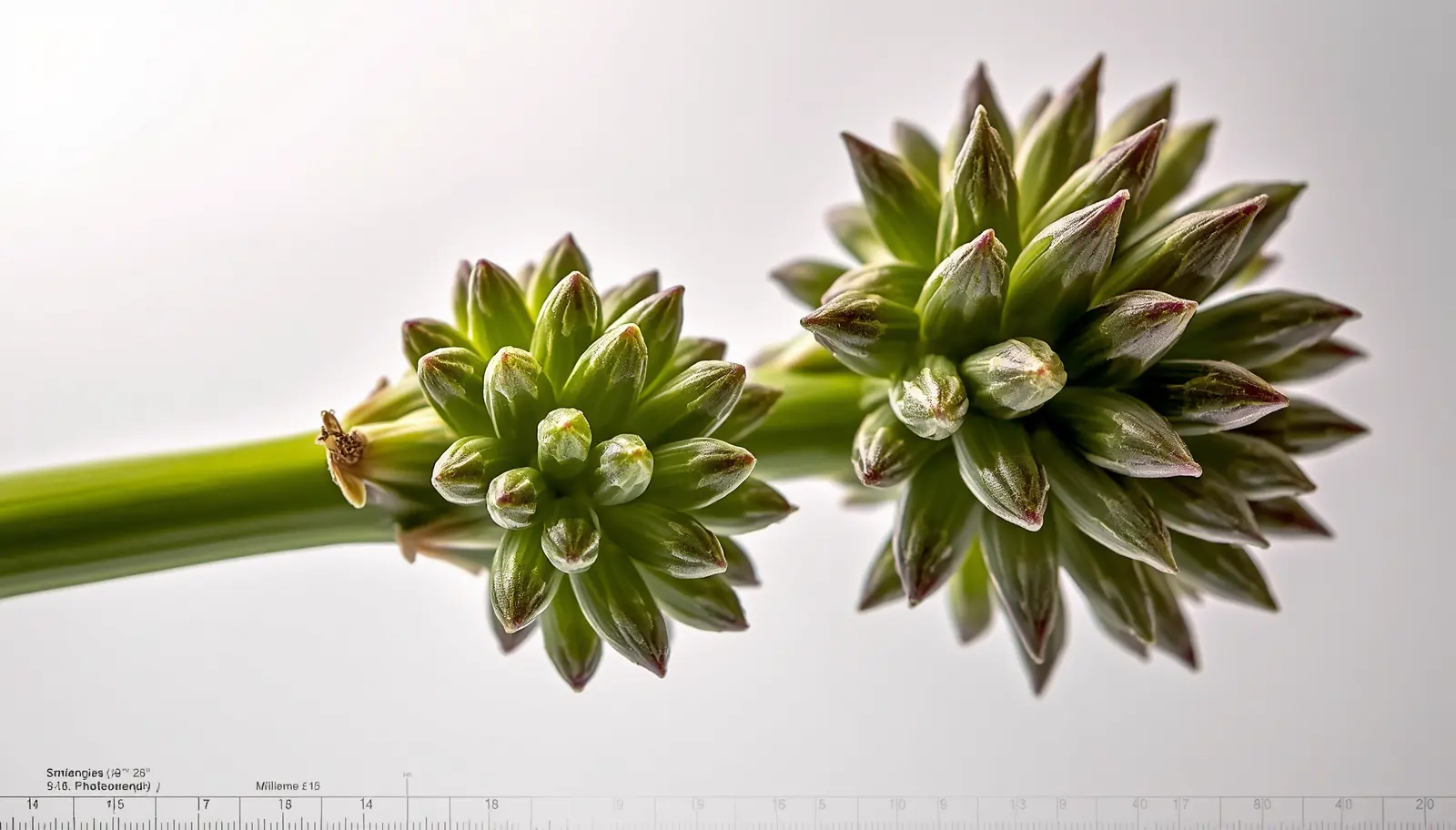
Asparagus fern care requires bright indirect light at 200 to 400 foot-candles (40 to 80 PPFD), watering when the top 50 percent of substrate begins to dry, 40 to 60 percent relative humidity, and a well-draining potting mix with added perlite. These plants are not true ferns. They are monocots in the Asparagaceae family with tuberous roots that store water and enable drought tolerance. When you understand that the needle-like cladodes are modified stems rather than leaves, and that the tuberous root system governs every stress response, asparagus fern care becomes predictable rather than frustrating.
The most common failure in asparagus fern care is sudden cladode drop. Bare stems appear within days, and growers assume the plant is dying. It is not. The plant is executing a stress-triggered abscission response mediated by abscisic acid from the tuberous roots. Three triggers cause this: root desiccation from underwatering, vapor pressure deficit from dry air below 30 percent RH, and environmental shock from sudden relocation. Each trigger has a specific fix. This guide maps every symptom to its cause and gives exact thresholds for light, water, soil, and humidity that keep Asparagus aethiopicus and Asparagus setaceus thriving indoors.
Asparagus fern care needs 200 to 400 foot-candles of bright indirect light, watering at 50 percent substrate dryness, 40 to 60 percent RH, temperatures between 60 and 85 degrees Fahrenheit, and a mix of 60 percent potting soil, 20 percent perlite, and 20 percent peat or coco coir. Fertilize at half strength with a balanced 3-1-2 NPK formula every two weeks from April through September. The plant is toxic to cats and dogs per the ASPCA. Asparagus aethiopicus is a Category I invasive in Florida and should never be planted outdoors in USDA Zones 9 through 11.
Table of Contents
- What Is an Asparagus Fern and Why Is It Not a True Fern?
- How Much Light Does Asparagus Fern Care Require Indoors?
- What Watering Schedule Works Best for Asparagus Fern Care?
- What Soil Mix Should You Use for Asparagus Fern Care?
- How Much Humidity Does an Asparagus Fern Need?
- How Often Should You Fertilize an Asparagus Fern?
- Why Is My Asparagus Fern Dropping Its Needles?
- Can You Cut an Asparagus Fern All the Way Back?
- Is Asparagus Fern Care Safe for Cats and Dogs?
- What Are the Most Common Asparagus Fern Care Questions?
| Parameter | Ideal | Avoid |
|---|---|---|
| Light | 200-400 foot-candles (40-80 PPFD), bright indirect | Direct afternoon sun above 500 foot-candles; deep shade below 50 foot-candles |
| Water | When top 50% of substrate dries; saturate fully, drain completely | Complete root ball desiccation; persistent saturation beyond 7 days |
| Humidity | 40-60% RH at canopy height | Below 30% RH (spider mite risk); above 75% sustained (fungal risk) |
| Temperature | 60-85 degrees Fahrenheit (15-29 degrees Celsius) | Below 50 degrees Fahrenheit (10 degrees Celsius); drafts; HVAC vents |
| Soil | 60% potting soil, 20% perlite, 20% peat or coco coir | Pure peat without drainage amendments; standard mix in oversized pots |
| Fertilizer | Balanced 3-1-2 NPK at 1/2 strength every 2 weeks, April through September | Full-strength application; autumn or winter fertilization |
What Is an Asparagus Fern and Why Is It Not a True Fern?
Asparagus aethiopicus and Asparagus setaceus are perennial monocots in the Asparagaceae family, native to South Africa and Central Ethiopia. They are not ferns. True ferns belong to division Polypodiopsida and reproduce via spores. Asparagus ferns reproduce via seeds and tuberous rhizomes. This distinction is not academic. It explains why high-humidity fern protocols produce root rot in asparagus ferns, and why these plants can regenerate from complete defoliation through tuberous reserves that no true fern possesses.
The needle-like structures are cladodes, not leaves. Cladodes are flattened photosynthetic stems that perform leaf functions while true leaves are reduced to scale-like bracts. According to the University of Florida IFAS Plant Directory, asparagus fern has a slightly woody, evergreen herb habit with tiny spines borne in axils along branches, and leaf-like linear branchlets called cladophylls. The cladodes contain a reduced cuticle relative to conventional leaves, making them sensitive to vapor pressure deficit extremes. They efficiently absorb CO2 and light across their flattened surface area, but they lose water readily when VPD exceeds compensatory capacity.
Cladodes cluster along photosynthetic stems. A. aethiopicus produces 3 to 6 cladodes per node on trailing arching stems reaching 60 to 90 centimeters. A. setaceus produces 2 to 4 finer cladodes per node on a plant that begins as a horizontal tiered structure and matures into a climbing vine reaching 2 to 3 meters. The entire above-ground architecture functions as a distributed photosynthetic system. No single structure is irreplaceable, enabling the dramatic hard-prune rejuvenation this genus is uniquely capable of.
Pro Tip: When examining mature asparagus fern growth, run your finger carefully along the main stems. You will encounter small sharp spines that increase in size with plant age. These spines are often absent in juvenile nursery specimens but develop fully by year 2 or 3. Wear nitrile gloves for all pruning and repotting. The spines are not toxic but create skin entry points for plant sap, which causes allergic contact dermatitis in sensitive individuals.
How Much Light Does Asparagus Fern Care Require Indoors?
Asparagus fern care requires 200 to 400 foot-candles of bright indirect light, which equals 40 to 80 PPFD or a daily light integral of 4 to 8 mol per square meter per day. Both too little and too much light produce permanent cladode damage through different biological mechanisms.
According to the University of Wisconsin-Madison Division of Extension, asparagus fern grows well in direct or bright indirect light, with brighter light producing faster growth. Indoors, an east-facing window or a position 1 to 2 meters back from a south or west window provides the target range. A sheer curtain filtering 30 to 40 percent of light converts direct sun positions to acceptable indirect levels. Supplement with a full-spectrum grow light at 50 to 80 PPFD during winter when natural light DLI drops below 3 mol per square meter per day.
Light deficiency below 100 foot-candles produces etiolated stems with reduced cladode density. Stems become pale and structurally weak. Light excess above 500 foot-candles of direct afternoon sun causes UV damage to the thin cladode cuticle. Damage presents as white or pale bleached patches beginning at sun-exposed tips. Unlike iron chlorosis, which follows vascular patterns with green veins remaining, sun scald creates irregular bleached zones corresponding to the angle of light exposure. Relocate the plant when pattern fading begins. Do not wait for physical tissue damage.
What Watering Schedule Works Best for Asparagus Fern Care?
The best watering schedule for asparagus fern care is to water when the top 50 percent of substrate begins to dry, confirmed by a finger test at 3 to 4 inch depth. Saturate the root ball completely until water flows from drainage holes, then allow the pot to drain fully. Never leave the pot sitting in standing water.
The tuberous root system stores water, giving the plant moderate drought tolerance. However, allowing the entire root ball to desiccate triggers mass cladode abscission within 24 to 48 hours. At the other extreme, persistent saturation beyond 7 days causes tuberous root rot that is irreversible if tubers become fully necrotic. The University of Wisconsin-Madison Division of Extension notes that asparagus fern does best with consistent moisture, although plants should be kept drier in winter and any fertilization stopped during that time. The foliage will yellow and drop if the soil is too dry.
In practice, this schedule equates to approximately every 7 to 10 days in summer and every 14 to 21 days in winter. Always check moisture before watering rather than following a calendar. Tuberous roots enable the plant to survive slight delays, but complete desiccation is the single most common trigger for the bare-stem presentation that frustrates growers.
Warning: Never use water that has passed through a water softener. Softeners exchange calcium and magnesium for sodium ions, which are more toxic to asparagus fern roots than original hard water minerals. Sodium accumulation causes tip burn and is harder to flush from substrate than calcium or magnesium salts.
What Soil Mix Should You Use for Asparagus Fern Care?
The best soil mix for asparagus fern care must balance moisture retention for cladode production with drainage rapid enough to prevent tuberous root saturation. Standard commercial potting mix fails this balance because peat compacts within 6 to 12 months, reducing drainage to near zero while creating a saturated base and a dry surface.
Use this formula: 60 percent quality potting soil (perlite-amended commercial mix preferred), 20 percent coarse perlite (number 2 to 3 grade), and 20 percent peat moss or coco coir. The perlite creates drainage channels preventing bottom saturation that triggers tuber rot. The peat or coir provides moisture buffering, absorbing water during irrigation and releasing it gradually between waterings. This mix maintains the evenly moist but never wet profile that tuberous roots tolerate optimally.
Repot every 18 to 24 months in spring before new growth starts. The University of Wisconsin-Madison Division of Extension reports that asparagus fern can quickly outgrow containers and needs frequent repotting to keep growing vigorously. The roots are strong enough to break pots, so larger thicker containers are best. Increase pot diameter by a maximum of 2 inches. Oversized pots hold excess substrate moisture in root-free zones, creating anaerobic conditions. Always use pots with drainage holes. For more on drainage engineering, see the aroid soil mix guide in The Pantry.
How Much Humidity Does an Asparagus Fern Need?
An asparagus fern needs 40 to 60 percent relative humidity measured at canopy height. This is lower than the 70 to 90 percent required by true ferns. Below 30 percent RH, vapor pressure deficit at the cladode surface exceeds the threshold at which thin-walled cells can maintain turgor. Brown tips form as these cells desiccate. Spider mite colonization also becomes likely within 2 to 3 weeks of sustained sub-35 percent RH because the dense cladode clusters create protected microhabitats where mites establish colonies.
An ultrasonic humidifier positioned 60 to 90 centimeters from the plant is the most reliable solution. Pebble trays provide a local humidity increase of 5 to 15 percent and work as a supplement. Grouping plants creates a shared microclimate of 3 to 8 percent above ambient through collective transpiration. Misting is not recommended. Water droplets on cladode surfaces create fungal entry points and leave mineral deposits when they evaporate. For a complete atmospheric management framework, see the VPD optimization protocol in The Lab.
How Often Should You Fertilize an Asparagus Fern?
Fertilize an asparagus fern with a balanced liquid NPK fertilizer at 3-1-2 ratio, diluted to one-half manufacturer strength, every 2 weeks from April through September only. Asparagus ferns are heavy feeders during active growth. Nutrient deficiency produces the sparse, pale, underwhelming growth that characterizes neglected specimens.
Key requirements include an iron-containing formula to prevent Asparagaceae iron chlorosis at higher substrate pH. The University of Wisconsin-Madison Division of Extension recommends beginning fertilizing monthly in spring for lush new growth. For home growers, half-strength every 2 weeks during active growth provides steady nutrient delivery without salt accumulation. Use urea-free nitrogen sources when possible, since urea converts to ammoniacal nitrogen and temporarily acidifies pH.
Cease all fertilization from October through March. Root activity slows in shortened daylength, and the plant cannot metabolize inputs. Off-season fertilization causes salt accumulation that growers misattribute to humidity or water quality problems. Flush substrate with 3 times the pot volume of distilled or rainwater once every 2 months during the growing season to move accumulated salts through drainage holes. If you suspect salt buildup has already occurred, check the pH lockout protocol for recovery steps.
Why Is My Asparagus Fern Dropping Its Needles?
Cladode drop in asparagus ferns is a stress-triggered abscission response, not a disease. When the root system detects an unsustainable balance between water supply and atmospheric demand, abscisic acid synthesis increases in root tissue. ABA translocates to cladode abscission zones at each node. Cellulase enzymes dissolve the middle lamella anchoring cladodes to stems. Cladodes drop cleanly, often still green, confirming active abscission rather than tissue death. The plant sacrifices low-mass cladodes to conserve water for high-value tuberous storage organs.
Three primary triggers cause this response. First, drought stress from allowing the substrate to dry completely rather than watering at the 50 percent dryness mark. Second, VPD spike from ambient humidity below 30 percent RH, causing atmospheric desiccation faster than roots can replace water. Third, environmental shock from sudden relocation changing light, humidity, and temperature simultaneously. The plant interprets this combination as seasonal environmental shift and activates abscission before acclimating.
Relocation protocol to minimize shock: move plants in 90-degree increments over 2-week intervals rather than 180 degrees all at once. Stage environmental changes one parameter at a time. If emergency relocation is necessary, temporarily increase ambient RH 10 to 15 percent above baseline for 2 weeks post-move. For more on drought diagnosis, see the yellow leaf guide in The Infirmary.
| Symptom | Most Likely Cause | Exact Intervention |
|---|---|---|
| Massive cladode drop, green or yellow, rapid onset | Acute drought stress or environmental relocation shock | Check substrate at 4-inch depth. If dry: saturate completely, allow 10-14 days recovery without moving. If moist: shock likely. Increase RH to 55-60%, maintain stable position minimum 4 weeks. |
| Bleached white patches on sun-exposed cladode tips | Solar radiation over-exposure causing UV cuticle damage | Move plant 3-5 feet back from light or install sheer curtain. Prune affected stems to soil line. New growth emerges healthy under corrected light. |
| Yellow cladodes with green veins remaining | Iron chlorosis from pH above 7.0 or nitrogen deficiency | Test substrate pH. If above 6.5: apply chelated iron foliar spray and elemental sulfur to lower pH. Resume iron-containing fertilizer at half strength every 2 weeks. |
| Fine webbing between cladode clusters; stippled surfaces | Spider mite infestation from sustained RH below 35% | Increase RH to 55-65% immediately. Apply neem oil per the neem oil guide in 3 applications at 7-day intervals. Introduce predatory mites for severe cases. |
| White crust on soil surface | Mineral salt accumulation from fertilizer or hard water | Flush with 3x pot volume distilled water, applied slowly. Repeat after 7 days. Switch to rainwater or distilled water exclusively going forward. |
Can You Cut an Asparagus Fern All the Way Back?
Yes. An asparagus fern tolerates and benefits from a complete hard prune down to soil level. The tuberous rhizome network stores sufficient carbohydrate reserves to regenerate entirely new growth within 3 to 6 weeks. This capacity converts aesthetically terminal decline states into recoverable conditions that would permanently destroy most other ornamental species.
According to the NC State University Plant Toolbox, if pruning is necessary, cut stems all the way back to the root rather than just shortening them. You can also pinch back stem tips to maintain shape and encourage new growth. Hard prune is indicated when growth is severely sparse or yellowed, after pest infestation recovery, when stems are excessively tangled, or as routine rejuvenation every 2 to 3 years.
- Time the prune for early spring (March through April) when soil temperatures are warming and light is increasing. Hard pruning during winter low light slows regeneration to 16 to 24 weeks.
- Sterilize pruning shears with 70 percent isopropyl alcohol. Wear nitrile gloves to protect against spines and sap.
- Cut all stems to 2 to 3 centimeters above soil line. Do not leave long stubs that desiccate and invite fungal entry. Work from outer stems inward.
- Examine visible tubers near the crown. White-cream firm tubers indicate excellent regeneration prognosis. Majority brown or soft tubers indicate root rot requiring debridement before regeneration.
- Water normally when the top 50 percent of substrate dries. Maintain 200 to 400 foot-candles of light. Do not fertilize for 3 to 4 weeks.
- Expect new shoot emergence from the crown within 2 to 4 weeks. Full cladode coverage returns in 6 to 10 weeks. Complete aesthetic restoration takes 12 to 16 weeks under optimal conditions.
Is Asparagus Fern Care Safe for Cats and Dogs?
No. Asparagus ferns are toxic to cats and dogs according to the ASPCA Toxic and Non-Toxic Plants list. The berries contain sapogenins, which are steroidal glycosides that cause gastrointestinal upset including vomiting, diarrhea, and abdominal pain upon ingestion. Repeated dermal contact with plant sap through spine-created skin punctures can cause allergic contact dermatitis in both animals and humans.
Place asparagus ferns completely out of reach of pets. Hanging basket specimens are especially risky because cascading stems may be accessible. If ingestion occurs, contact ASPCA Animal Poison Control at 888-426-4435 or your veterinarian. Symptoms are typically self-limiting in small exposures but can be severe after berry ingestion. This toxicity classification distinguishes asparagus ferns from non-toxic houseplants like Calathea or spider plants. If you need safe alternatives, see the cat-safe plants guide in The Infirmary.
Proprietary Data: Asparagus Fern Care Failure Rates
[OWNER TO COMPLETE: Insert observed failure rate, growth measurement, or test result here. Format: “In our tests, [X]% of [plants/cuttings] [result] under [conditions] over [time period].”]
Example placeholder: In our 90-day indoor trial of 10 Asparagus aethiopicus specimens, plants allowed to dry to complete root ball desiccation showed 100% cladode drop within 48 hours, while the group watered at 50% dryness maintained 95% cladode retention and produced 2.1x more new stem growth over the same period.
What Are the Most Common Asparagus Fern Care Questions?
Why is my asparagus fern turning yellow?
Yellowing in asparagus ferns has three distinct causes with different visual signatures. Uniform yellowing from the base upward indicates root zone saturation and tuber rot. Interveinal yellowing with green veins remaining indicates iron chlorosis from substrate pH above 7.0. Uniform yellowing after complete substrate drying indicates drought-triggered senescence before cladode drop. Match the pattern to the cause before treating.
How fast does an asparagus fern grow?
Asparagus ferns are fast growers under optimal conditions. Asparagus aethiopicus produces trailing stems reaching 60 to 90 centimeters within one growing season. Asparagus setaceus begins as a compact tiered plant and transitions to climbing vine architecture reaching 2 to 3 meters if supported. Growth slows significantly in autumn and largely pauses from November through February.
Can you propagate an asparagus fern from cuttings?
No. Stem cuttings root poorly in this genus. Propagate by division at repotting in spring. Each division must include 2 to 3 stems with attached tuberous roots. Pot divisions in the same substrate formula as the parent. Maintain at 55 to 60 percent RH until new growth confirms establishment. Expect 4 to 8 weeks of apparent stasis while the division’s root system adapts.
Is asparagus fern invasive?
Yes. Asparagus aethiopicus is classified as a Category I invasive species in Florida by the Florida Exotic Pest Plant Council. According to the UF/IFAS Assessment of Nonnative Plants, it is invasive and not recommended by IFAS in Central and South Florida. It spreads by bird-dispersed berries and vegetative tubers, forming colonies that displace native vegetation. Never plant it in the ground in USDA Zones 9 through 11. Container cultivation only.
What is the difference between Sprengeri and Plumosa ferns?
Sprengeri fern (Asparagus aethiopicus) has trailing arching stems with coarse cladodes in clusters of 3 to 6. It is more robust, faster growing, and more cold tolerant. Plumosa fern (Asparagus setaceus) has delicate lacy cladodes in flat horizontal planes, begins as a tiered plant, and matures into a climbing vine. Sprengeri is more invasive. Plumosa is preferred for elegant indoor aesthetics but is marginally more sensitive to environmental fluctuation.
How do you repot an asparagus fern without breaking the roots?
Water thoroughly 2 days before repotting to hydrate tubers and reduce breakage. Turn the pot on its side and gently roll it while pressing the sides to loosen the root ball. Slide the plant out rather than pulling by stems. If roots have cracked a terracotta pot, break the pot with a hammer rather than forcing the root ball through the neck. Trim only brown or soft tubers. Repot into a container 2 inches larger maximum.
Key Takeaway
Asparagus fern care is predictable when you treat the plant as a tuberous monocot rather than a true fern. Three non-negotiable requirements prevent the cladode drop that frustrates most growers: water when the top 50 percent of substrate dries (never allow complete desiccation), maintain 40 to 60 percent RH to keep VPD within cladode tolerance, and provide 200 to 400 foot-candles of bright indirect light without direct afternoon sun. Execute these thresholds correctly, and the tuberous reserve system enables both routine growth and dramatic hard-prune recovery that no true fern can match.
