
A lilac bushes are not blooming is one of the most common and fixable disappointments in temperate gardening. The plant looks healthy and pushes lush green foliage, yet it produces few or no flowers in spring. In most cases, the cause is not disease or bad luck. It is a correctable management error. The five causes, ranked by frequency, are: pruning at the wrong time of year, insufficient direct sunlight, excess nitrogen fertilizer, aging wood that has never been renewal pruned, and inadequate winter chill for flower bud initiation. Once identified, the fix is straightforward and bloom restores within one to three growing seasons.
This guide gives exact thresholds for sunlight, soil pH, drainage, and fertilizer to restore bloom.
Quick Answer: If your lilac bush is not blooming, audit five variables in order: (1) pruning timing (only prune within 2 to 3 weeks after spring flowers fade), (2) sunlight (minimum 6 hours direct sun daily), (3) nitrogen (suspend high-N fertilizer), (4) cane age (remove one third of oldest canes annually for three years), and (5) winter chill (use low-chill cultivars in Zones 8 to 9).
| Parameter | Ideal | Avoid |
|---|---|---|
| Sunlight | 6 to 8 hours direct sun daily | Less than 4 hours; dense shade |
| Soil pH | 6.5 to 7.5 (neutral to slightly alkaline) | Below 6.0 (acidic); above 8.0 |
| Pruning Window | 2 to 3 weeks after spring bloom fade | Late summer, fall, or winter |
| Nitrogen Input | Light 10-10-10 in early spring only | High-N lawn fertilizer; summer feeding |
| Drainage | Well-drained loam; 1 to 3 inches per hour | Standing water; heavy clay |
| Winter Chill | Cold winter below 45 degrees F | Zones 8 to 9 without low-chill cultivar |
Table of Contents
- Why Is My Lilac Bush Not Blooming?
- When Should You Prune a Lilac Bush?
- How Do You Prune Lilac Bushes for Maximum Bloom?
- What Is the Best Soil and Site for Lilac Bushes?
- How Do You Rejuvenate an Overgrown Lilac Bush?
- How Do You Manage Lilac Root Suckers?
- How Should You Water and Fertilize Lilac Bushes?
- Is Lilac Toxic to Pets?
- What Are the Most Common Questions About Lilac Bushes?
Why Is My Lilac Bush Not Blooming?
A lilac bush not blooming is almost always caused by one of five correctable factors: pruning at the wrong time of year, insufficient direct sunlight, excess nitrogen fertilizer, accumulation of old nonproductive wood, or inadequate winter chill for flower bud initiation. Diagnose each factor in the order below and apply the matching fix.
The Pruning Timing Error (Most Common Cause)
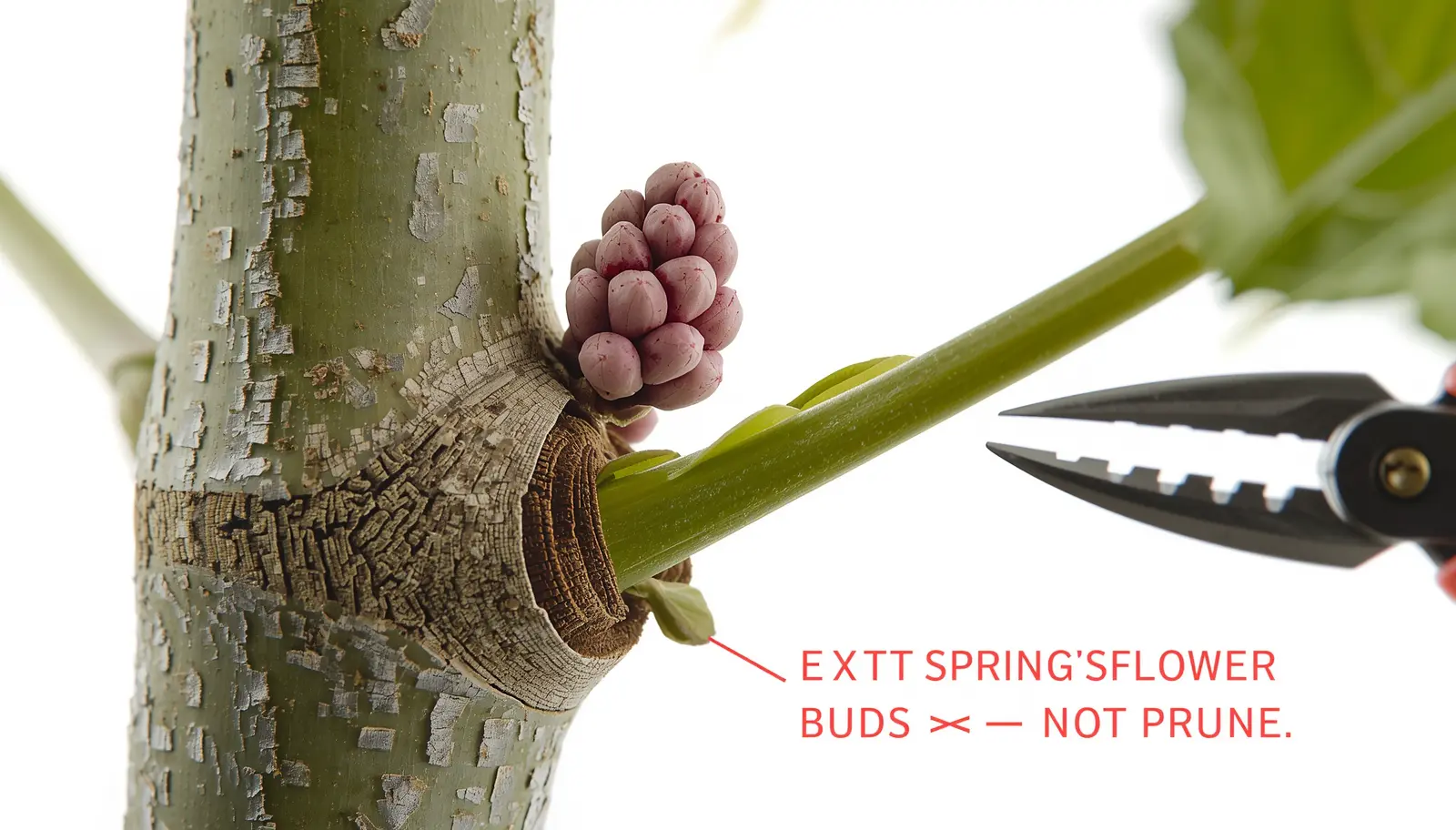
Lilacs bloom on old wood, meaning next spring’s flower buds are formed on growth produced during the current season and carried through winter on existing stems. If you prune in late summer, fall, or winter, you remove the wood that carries those buds. Oregon State University Extension confirms the safe window is the two to three weeks immediately after spring flowers fade.
How Much Sun Does a Lilac Bush Need?
Lilac bushes require a minimum of 6 hours of direct sunlight daily to initiate flower buds. Below 4 hours, bud production drops to zero regardless of other care. The University of Minnesota Extension recommends full sun for maximum bloom.
The Nitrogen Fertilizer Trap
High nitrogen redirects carbohydrate allocation from reproductive meristems to vegetative growth, producing dense green leaves at the expense of flowers. Common sources include lawn fertilizer overspray (formulas such as 30-0-4) or compost topdress exceeding 2 to 3 inches.
Old Wood Accumulation and Renewal Pruning
A lilac left unpruned for many years develops thick, aging canes that produce fewer flowers while blocking light and airflow from younger growth. The shrub becomes leggy at the base and sparse in bloom. Renewal pruning replaces old wood with young, productive canes over a three-year cycle.
Chill Hour Requirements for Flower Bud Set
Common lilac (Syringa vulgaris) requires a prolonged winter dormancy period with temperatures below 45 degrees F (7 degrees C) to complete the biological cycle that initiates flower buds. In USDA Zones 8 to 9, standard cultivars may survive but fail to bloom because winters are too mild. Growers in warm-winter regions should select low-chill cultivars such as Lavender Lady, Blue Skies, or Miss Kim.
When Should You Prune a Lilac Bush?
Prune lilac bushes only within the two to three week window immediately after spring flowers fade. This is the only timing that preserves next year’s flower buds. New growth produced after the bloom cycle will carry the buds that open the following spring. By mid-summer those buds are already forming. Any cut made after July removes confirmed reproductive tissue.
After petal drop, the plant initiates next year’s buds on new shoots through June and July. By August the buds are visible as swollen scales. A branch removed in fall or spring takes those buds.
How Do You Prune Lilac Bushes for Maximum Bloom?
Prune immediately after bloom fade using clean, sharp bypass pruners. Remove spent flower clusters, dead wood, crossing branches, and root suckers, all within the two to three week safe window. This five-step protocol preserves bud-bearing old wood, improves canopy airflow, and redirects the plant’s energy from seed production into next year’s flower bud initiation.
- Wait for the correct pruning window. Allow flowers to open fully and begin fading. You have two to three weeks for all pruning before next year’s flower buds begin forming on new growth.
- Deadhead spent flower clusters (panicles). Cut just above the first set of leaves below the cluster. This prevents seed set and redirects energy into vegetative growth and next year’s flower bud initiation.
- Remove crossing, diseased, or damaged branches. Identify branches that rub against others. Make cuts at a 45-degree angle just above an outward-facing bud or branch junction.
- Thin interior canopy for airflow. Remove select interior branches that create density. This is the primary powdery mildew prevention strategy because good airflow keeps canopy surfaces dry.
- Remove root suckers by pulling, not cutting. Trace each sucker to its origin on the lateral root and pull or snap it free.
Pro Tip: The most ironic timing error occurs when a gardener prunes a non-blooming lilac in spring to “clean it up” while it is leafed out. If the plant failed to bloom because of prior wrong-time pruning, this spring cut removes whatever old wood survived and compounds the failure. The correct response is to make zero pruning changes until immediately after the next successful bloom cycle, even if that means waiting two years.
What Is the Best Soil and Site for Lilac Bushes?
Lilac bushes need well-drained, neutral to slightly alkaline soil with a pH between 6.5 and 7.5, plus a minimum of 6 hours of direct sunlight daily. No other care variable compensates for shade or saturated soil. Site selection must be confirmed before planting because no amount of later fertilizer or irrigation can overcome a shaded or poorly drained location.
The Sun Rule
Full sun is a hard biological requirement. Photosynthetic output drives the carbohydrate budget available for flower bud initiation. A site with 6 to 8 hours of direct sun will produce reliable bloom. A site with 3 to 4 hours will produce zero flowers over time. The Cornell Cooperative Extension Nassau specifies at least 6 hours of sun for lilac bloom. If your yard has changed since planting, conduct a solar tracking assessment in June to confirm exposure.
The Drainage Test
Never plant a lilac without confirming drainage first. Dig a test hole 12 inches deep and wide at the intended site. Fill with water, let drain, then refill. Measure the drop after 30 minutes. A drop of 1 to 3 inches per hour indicates adequate drainage. If water remains unchanged after 60 minutes, the site will cause fatal root rot. Select a new location, build a raised bed at least 18 inches above grade, or install a French drain.
Soil pH Correction
Most Eastern US residential soils are naturally acidic (pH 5.5 to 6.5), which is below the lilac ideal. The Cornell Cooperative Extension Nassau recommends a pH near 7.0. A soil test from your county extension service quantifies exact pH and provides lime rates. Agricultural limestone at 50 to 75 pounds per 1,000 square feet typically raises pH 0.5 to 1.0 unit in average loam. For related pH management, see our pH lockout and nutrient bioavailability guide.
How Do You Rejuvenate an Overgrown Lilac Bush?
Remove one third of the oldest, thickest canes at ground level each year for three consecutive years, always working within the post-bloom pruning window. This Rule of Thirds replacement cycle restores young, productive wood without the severe setback of single-season complete renovation, which would delay bloom for three to five years.
Identify the oldest canes by bark texture: deep fissuring, dark gray-brown color, and low flower density. Cut each selected cane to 2 to 3 inches above soil level. Do not leave stubs. In Year 1, remove one third of the oldest canes. In Year 2, remove another third. In Year 3, remove the final third and select the strongest young canes as the new permanent structure. Never remove more than one third of total cane mass in a single year. Removing more creates root stress because the root system must support the remaining canopy with reduced photosynthetic surface area.
Single-season complete renovation is possible but sets bloom back 3 to 5 years. The three-year protocol keeps at least partial bloom each spring. For additional pruning fundamentals, see our pruning technique hub.
How Do You Manage Lilac Root Suckers?
Excavate each sucker to its origin point on the lateral root and pull or snap it free to remove the adventitious bud. Cutting at soil level causes the bud to branch into multiple new suckers, so pulling is the only method that eliminates regrowth. Root suckers are vigorous vertical shoots that steal water and carbohydrates from the main plant.
When a sucker is cut at soil level, the adventitious bud below the cut remains intact. The plant responds by branching that bud, typically producing two to three replacement suckers. Trace the sucker stem to its junction with the lateral root, then pull downward to tear the bud tissue free.
Grafted plant caution: Many nursery lilacs are grafted. Suckers emerging below the graft union carry the rootstock’s genetics, not the ornamental cultivar’s. If allowed to grow, rootstock suckers will outcompete the grafted top, replacing the selected flower color and form with the rootstock species’ characteristics. Remove all below-graft suckers immediately.
How Should You Water and Fertilize Lilac Bushes?
Water deeply and infrequently based on life stage, and apply only a light, balanced fertilizer in early spring. Suspend all nitrogen if the plant is not blooming. Over-attentive watering and feeding cause more lilac problems than neglect, while established specimens are highly drought tolerant and require minimal intervention.
Watering by Life Stage
During the first growing season, supply 1 inch of water per week to establish the root system. In Years 2 and 3, water only during extended dry periods longer than 2 to 3 weeks. Established specimens older than 3 years are highly drought tolerant and rarely need supplemental water except during severe droughts lasting 4 to 6 weeks without rain. Over-irrigation of mature plants promotes root anaerobiosis and decline.
Fertilizer Protocol
Apply a single light dressing of balanced 10-10-10 in early spring at 1 to 2 pounds per 100 square feet, or 2 to 3 inches of well-aged compost. Do not feed again through the growing season. If your lilac bush is not blooming, stop all fertilization for one full season. Resume only after bloom returns. Browse The Infirmary for more troubleshooting protocols.
Is Lilac Toxic to Pets?
True lilac (Syringa vulgaris) is non-toxic to dogs and cats according to the ASPCA. Ingestion of fibrous material may cause mild gastrointestinal upset, but there is no toxic compound. Verify that you have a true Syringa lilac and not Persian lilac (Melia azedarach), which is unrelated and toxic. For a curated list of safe garden plants, see our cat-safe plants guide.
What Are the Most Common Questions About Lilac Bushes?
The six questions below cover the most common lilac concerns that gardeners search after noticing poor bloom performance. Each answer is concise and actionable, designed to resolve the specific problem without requiring a full article read.
When should you prune lilac bushes?
Prune only within the two to three week window immediately after spring flowers fade. Lilacs bloom on old wood. Any pruning in late summer, fall, or winter removes next year’s flower buds.
Why does my lilac bush have lots of leaves but no flowers?
Three causes in order of frequency: pruning at the wrong time, excess nitrogen fertilizer redirecting energy to leaves, and insufficient sunlight below 6 hours daily. Suspend nitrogen and correct pruning timing; wait one full growing season for recovery.
How fast do lilac bushes grow?
Common lilac grows 12 to 18 inches per year in optimal conditions. First bloom typically occurs 3 to 5 years after planting.
Do lilac bushes spread on their own?
Yes, via root suckering. An unmanaged lilac can double or triple its width over 10 to 20 years. Control spread by pulling suckers at their root origin annually.
Do lilac bushes grow in Zone 8 or Zone 9?
Standard Syringa vulgaris struggles to bloom in Zones 8 to 9 due to insufficient winter chill. Growers in these zones should plant low-chill cultivars such as Lavender Lady, Blue Skies, or Miss Kim.
How do you keep cut lilac flowers from wilting?
Harvest in early morning when stems are fully hydrated. Strip lower leaves, smash the bottom 1 to 2 inches of woody stem with a hammer to increase water uptake surface area, and place in fresh cool water. Change water daily. This extends vase life from 1 day to 5 to 7 days.
The framework for fixing a lilac bush not blooming rests on one rule: prune only in the two to three weeks after spring bloom fade. Confirm sun exposure, suspend nitrogen, and manage old wood through the Rule of Thirds. For indoor fragrance alternatives when outdoor chill is insufficient, see our jasmine indoor care guide.
Author: Mark Tavis | Plant Blueprint | The Infirmary