
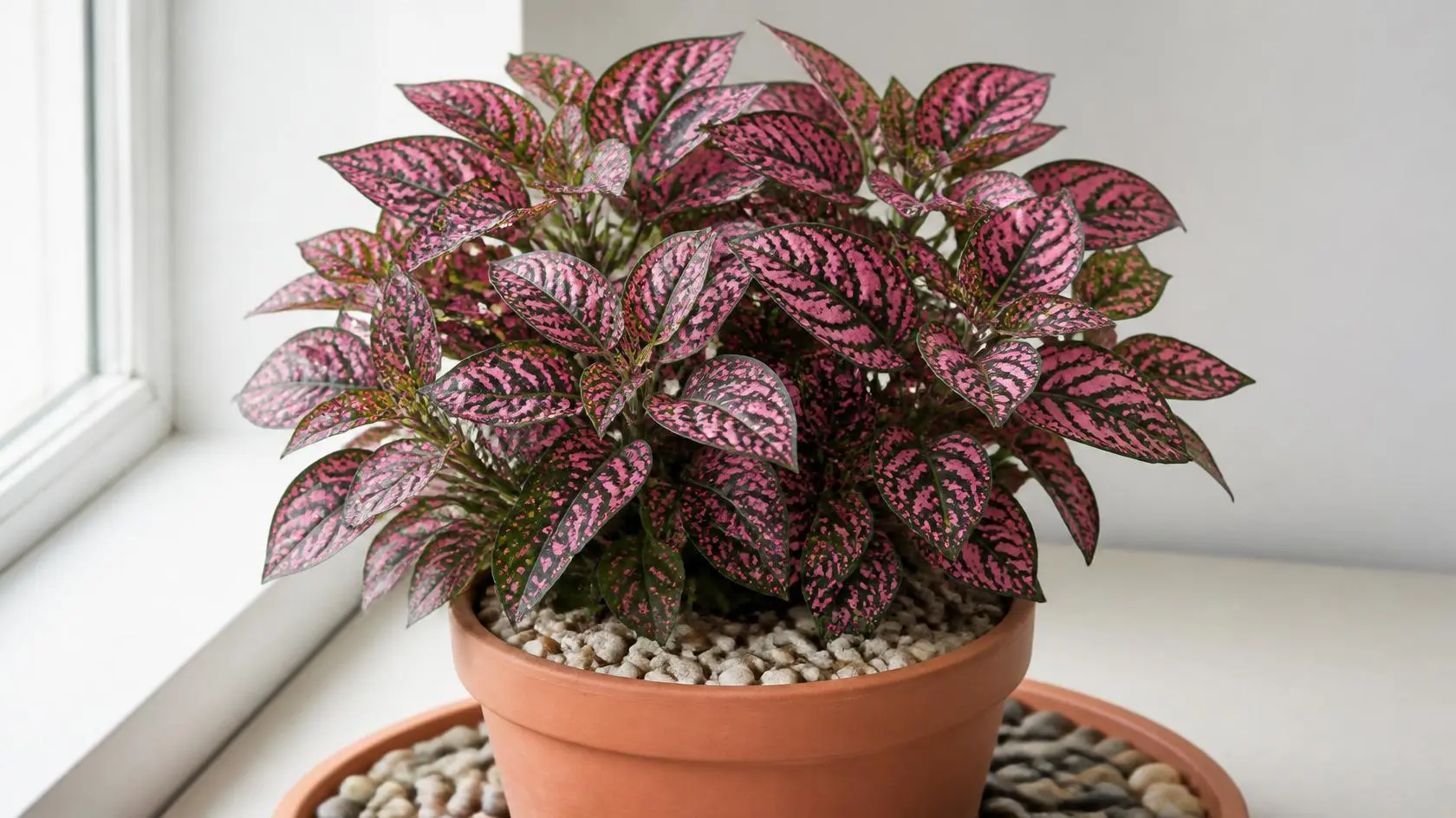
Polka dot plant care is about three things: bright, filtered light to keep the spots colorful, evenly moist soil, and regular pinching to stop it getting leggy. NC State Extension describes Hypoestes phyllostachya as an herbaceous perennial from Madagascar with green leaves splashed with rose, pink or white. It warns that too much direct sun makes the leaves crinkle and curl, while too little light fades the color and makes the plant leggy. The ASPCA lists it as non-toxic to dogs, cats and horses.
What Are the Ideal Care Parameters for a Polka Dot Plant?
| Need | What the sources say |
|---|---|
| Light | Bright, filtered light gives the best color; some direct sun is tolerated (NC State). Houseplants: bright light with some direct sun (Missouri Botanical Garden) |
| Soil | Organically rich, medium moisture, well drained (Missouri Botanical Garden) |
| Water | Evenly moist, never soggy; NC State lists root rot as a possible problem |
| Pruning | Pinch tips to promote bushiness (MOBOT); pinch back leggy plants (NC State) |
| Flowers | Optional to remove; cutting them off lets more energy go to the foliage (NC State) |
| Hardiness | USDA zones 10 to 11 (NC State; MOBOT) |
| Size | Typically 12 to 20 inches tall as a bedding plant or houseplant (MOBOT) |
| Pets | Non-toxic to dogs, cats and horses; may cause mild vomiting or diarrhea (ASPCA) |
Sources: NC State Extension Plant Toolbox: Hypoestes phyllostachya; Missouri Botanical Garden Plant Finder; ASPCA.
What Light Does a Polka Dot Plant Need to Keep Its Color?
Light controls the color. NC State says the best color comes from bright, filtered light; the plant tolerates some direct sun, but too much makes leaves crinkle and curl, and too little fades the spots and makes the plant leggy as it stretches toward light. For houseplants, the Missouri Botanical Garden recommends bright indoor light with some direct sun.
- Best spots: an east window with gentle morning sun, or a bright south or west window behind a sheer curtain.
- Too dim: a north window or the back of a room usually means faded spots and long, floppy stems.
- Too harsh: strong afternoon sun through glass, especially in summer, can crinkle and scorch the leaves.
- Winter: light drops sharply, so move the plant closer to the window or add a grow light; see our grow light guide.
What Soil Mix Does a Polka Dot Plant Need?
The Missouri Botanical Garden recommends organically rich, medium-moisture, well-drained soil. Indoors, a good-quality houseplant potting mix with some extra perlite works well: it holds moisture without staying soggy. Use a pot with drainage holes. Our perlite vs vermiculite guide explains the difference between the two common additives.
Feeding. Polka dot plants are fast growers and don’t need much. A balanced houseplant fertilizer at the label rate during spring and summer is plenty; too much fertilizer mainly speeds up leggy growth. Skip feeding in winter when growth slows. See our fertilizer guide.
How Often Should You Water a Polka Dot Plant?
Keep the soil evenly moist: water when the top half inch to inch feels dry, water until it drains, and empty the saucer. There is no fixed schedule, since pot size, light and season all change how fast the soil dries. Polka dot plants wilt dramatically when dry and usually perk up soon after watering, but repeated wilting stresses the plant. The opposite mistake is just as common: NC State lists root rot among the problems that can occur, so never leave the pot sitting in water. Use room-temperature water.
How Do You Provide Enough Humidity for a Polka Dot Plant?
As a tropical plant from Madagascar, polka dot plant does best with moderate to high humidity and steady warmth. Crispy leaf edges in a heated room are a common sign of dry air. A humidifier, a tray of damp pebbles under the pot, or grouping plants together all help, and the plant suits terrariums, which the Missouri Botanical Garden lists as a use. Keep it away from cold drafts and heating vents; NC State recommends bringing garden plants indoors for winter.
How Do You Prune a Polka Dot Plant to Prevent Legginess?
Pinch often. The Missouri Botanical Garden says to pinch tips to promote bushiness, and NC State says pinching back leggy plants keeps them compact.
- Pinch the tips of each stem just above a pair of leaves, every few weeks during the growing season.
- Pinch all stems evenly so the plant stays rounded.
- Cut back a leggy plant harder, leaving a few sets of leaves on each stem, and move it to brighter light, since low light is what causes legginess.
- Keep the trimmings: they root easily (see below).
How Do You Propagate a Polka Dot Plant from Cuttings?
NC State says propagation is easy with stem cuttings: place a cutting in water in a bright location, and roots soon begin to form.
- Take a 3 to 4 inch stem tip with a few sets of leaves.
- Remove the lower leaves so no leaves sit below the waterline.
- Stand it in water in bright, indirect light and change the water every few days.
- Pot it up in moist potting mix once it has a few roots, and keep it out of hot sun while it settles.
Several cuttings in one pot make a fuller plant quickly. Polka dot plant also grows from seed; NC State notes the seedling’s first leaves are green, and the first true leaves show the foliage color. Our sphagnum moss propagation guide covers another rooting method.
What Are the Differences Between Pink, Red, and White Polka Dot Plants?
They are all Hypoestes phyllostachya and need the same care. NC State lists cultivars including ‘Carmina’ (bright red splotches), ‘Confetti’ (a smaller series in white, pink, red, rose and burgundy), ‘Pink Brocade’, ‘Pink Dot’ and ‘Splash’ (large blotches). The Missouri Botanical Garden also lists ‘Confetti Compact White’, a compact white form about 8 inches tall, and SPLASH SELECT PINK, about 12 inches tall. Color differences are cosmetic; all of them fade in low light.
What Should You Do When a Polka Dot Plant Flowers?
You don’t have to remove the flowers, but most growers do. NC State says the plant is not grown for its small, lilac flowers on spikes about 6 inches long, and that cutting off the blooms lets more of the plant’s energy go to the foliage. The Missouri Botanical Garden notes that some gardeners remove the flower spikes because they are inconspicuous and detract from the foliage. Snip the spikes off where they join the stem, and pinch the tips at the same time to keep the plant bushy.
Plants often look tired after a long season. The Missouri Botanical Garden suggests it may be easier to buy new plants each spring than to dig and overwinter garden plants; indoors, rooting fresh cuttings every year or so does the same job.
Is a Polka Dot Plant Better Indoors or Outdoors?
Both work. NC State says it is winter hardy in USDA zones 10 to 11 and is used in containers, terrariums and as an annual bedding plant in most of the US; in warm areas it can reseed freely. The Missouri Botanical Garden recommends part shade and organically rich, moist, well-drained soil for bedding plants. In colder zones, NC State suggests bringing garden plants indoors for winter.
What Are the Benefits of Growing a Polka Dot Plant?
- Color without flowers: the spotted leaves stay colorful year-round in good light.
- Pet-friendly: the ASPCA lists it as non-toxic to dogs, cats and horses.
- Easy to multiply: cuttings root in water (NC State).
- Small and versatile: suited to containers, dish gardens, terrariums and borders (NC State; MOBOT).
Is the Polka Dot Plant Safe for Cats and Dogs?
Yes. The ASPCA lists Hypoestes phyllostachya as non-toxic to dogs, cats and horses. It lists the toxic principle as unknown and notes that eating it may cause mild vomiting or diarrhea, so keep it out of reach of pets that chew plants. For more options, see our cat safe plants list.
How Do You Diagnose What Is Wrong with Your Polka Dot Plant?
| Symptom | Likely cause | Fix |
|---|---|---|
| Spots fading; long, stretched stems | Too little light (NC State) | Move to brighter, filtered light; pinch or cut back |
| Leaves crinkling and curling | Too much direct sun (NC State) | Filter the light with a sheer curtain or move back from the window |
| Sudden dramatic wilting, dry soil | Underwatering | Water thoroughly; it usually recovers quickly |
| Yellowing, wilting with wet soil | Overwatering, possible root rot (NC State) | Let the top of the soil dry; check roots; improve drainage |
| White powdery coating on leaves | Powdery mildew (NC State; MOBOT) | Remove affected leaves, improve air flow, keep foliage dry |
| Sticky leaves, white cottony clumps or tiny flying insects | Aphids, mealybugs or whiteflies (NC State; MOBOT) | Insecticidal soap or neem oil, as NC State suggests; see our neem oil guide |
For more houseplants grown for their colorful leaves, see our guides to caladiums and Calathea White Fusion. It is also on our list of plants safe for dogs.
Frequently Asked Questions
Is the polka dot plant toxic to cats?
No. The ASPCA lists polka dot plant as non-toxic to dogs, cats and horses, though eating it may cause mild vomiting or diarrhea.
How often should you water a polka dot plant?
Keep the soil evenly moist: water when the top half inch to inch is dry and let excess water drain. It wilts quickly when dry and rots if kept soggy, so check the soil rather than following a fixed schedule.
What is the best light for a polka dot plant indoors?
Bright, filtered light with a little gentle sun. NC State says this gives the best color, while too much direct sun crinkles the leaves and too little fades them.
Do you have to remove the flowers on a polka dot plant?
No, but it helps. NC State says cutting off the blooms lets more of the plant’s energy go to the foliage, and the Missouri Botanical Garden notes many gardeners remove the spikes because the flowers are inconspicuous.
How do you cut back a leggy polka dot plant?
Pinch the tips just above a pair of leaves every few weeks, or cut leggy stems back harder, leaving a few sets of leaves. Then give it more light, since low light causes the stretching (NC State).
How do you propagate a polka dot plant?
Root stem cuttings in water in a bright spot, as NC State recommends, then pot them up once roots form. Pinched-off tips work well as cuttings.