
If you live in the mid-Atlantic, Piedmont, lower Midwest, or Pacific Northwest—regions where summer heat tests cool-season grasses but winter cold eliminates warm-season alternatives—tall fescue is likely the single most practical turf choice available to you. Festuca arundinacea occupies a performance category no other grass fills: deep-rooted enough to survive the summer drought that collapses bluegrass, cold-hardy enough to stay green through winters that kill bermudagrass, and shade-tolerant enough to persist under partial tree canopy where sun-demanding varieties fail.
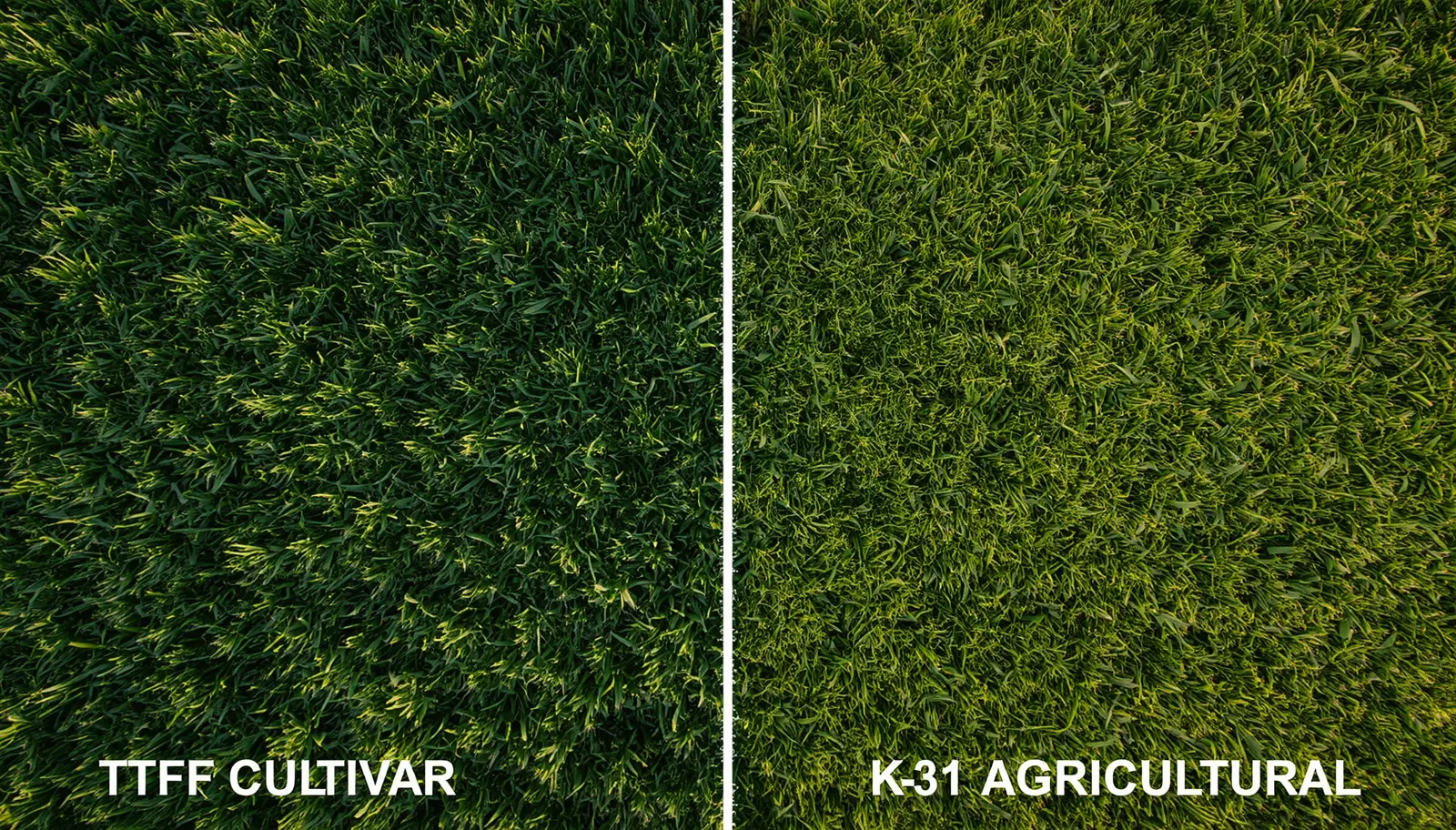
Modern tall fescue cultivars have evolved significantly from the coarse pasture varieties many homeowners remember. Today’s Turf-Type Tall Fescue (TTTF) offers blade texture approaching fine-leaf grasses, deep forest-green color, and endophyte-enhanced genetics that deter insect pests while improving heat and drought tolerance. The difference between contemporary TTTF and the cheap bulk bags of ‘Kentucky 31’ still sold at hardware stores is not minor—it is the difference between a lawn that looks like turf and one that looks like escaped cattle pasture.
This guide delivers the complete tall fescue management protocol: the precise seeding window, soil preparation steps, year-round maintenance schedule, the critical cultivar selection decision that separates success from frustration, and the diagnostic framework for the two most common failure modes—Brown Patch disease and bare-spot development from the bunch-type growth habit.
📋 At-A-Glance: Is Tall Fescue Right for Your Lawn?
- Best for: Transition zone homeowners (USDA Zones 4-7) experiencing both hot summers and cold winters—the “neither hot-season nor cool-season grass excels” belt running across Virginia, the Carolinas, Tennessee, Missouri, Kansas, and the Pacific Northwest
- Root system: Deep fibrous roots reaching 2-3 feet—the deepest root architecture of any cool-season grass, enabling drought survival by accessing soil moisture below the surface-dry zone
- Growth habit: Bunch-type (no rhizomes or stolons)—self-repairs slowly, requires annual fall overseeding to maintain density. This is the primary management trade-off vs. self-spreading grasses
- Traffic tolerance: High—excellent for active households with foot traffic, children, and dogs. Recovering from compaction faster than fine-texture cool-season alternatives
- Maintenance level: Low-to-moderate. Requires less fertilizer and irrigation than Kentucky Bluegrass, but annual overseeding is non-negotiable for maintaining density
- Critical buying tip: Only purchase named TTTF cultivars—never generic ‘Kentucky 31 (K-31)’ for residential use. K-31 is an agricultural pasture grass that produces a pale, coarse, weed-like lawn regardless of care quality
📋 Table of Contents
- What is Tall Fescue Grass? Origins and Characteristics
- Pros and Cons of a Tall Fescue Lawn
- Tall Fescue vs. Kentucky Bluegrass: Full Comparison
- The Critical Cultivar Decision: TTTF vs. K-31
- How and When to Plant Tall Fescue Seed
- Year-Round Maintenance Schedule
- Troubleshooting Common Tall Fescue Problems
- Frequently Asked Questions
- Final Verdict: Is Tall Fescue Right for You?

Modern TTTF cultivar stand—note deep forest green color and fine-medium blade texture distinguishing it from agricultural varieties
What is Tall Fescue Grass?
The Origins and Evolution of Festuca arundinacea
Festuca arundinacea (syn. Schedonorus arundinaceus) is a cool-season perennial bunchgrass native to Europe, widely naturalized across temperate North America since European settlement.
Its arrival in North America was decidedly utilitarian—brought as a forage and erosion-control grass in the 18th and 19th centuries, valued for its persistence in heavy clay soils, tolerance of wet conditions, and ability to survive heat and drought that summer-dormant cool-season species could not handle. The ‘Kentucky 31’ variety, released in 1943 from the University of Kentucky’s agricultural program, became the dominant variety through mid-20th century—a functional livestock forage with no pretense of residential aesthetics.
The transformation of tall fescue from pasture grass to premier residential turf began in the 1970s-80s when turf scientists at Rutgers University, the National Turfgrass Evaluation Program (NTEP), and commercial breeders began systematic selection for residential desirable traits. The result: a category now called Turf-Type Tall Fescue (TTTF) with finer blade texture, higher shoot density, darker coloration, and endophyte-enhanced genetics. As documented by Clemson Cooperative Extension’s turfgrass research division, modern TTTF cultivars produce 400-600 shoots per square foot compared to 150-250 for older agricultural varieties—a density difference that translates directly to the thick, weed-competitive, aesthetically-uniform lawn appearance homeowners expect.
Key Characteristics of Tall Fescue
- Blade texture: Medium to medium-fine in TTTF cultivars (3-5mm blade width). Noticeably coarser in K-31 and agricultural varieties (5-8mm). Ribbed upper surface and smooth lower—a useful identifying feature
- Color: TTTF cultivars: deep forest green. K-31 and agricultural types: medium or yellow-green, noticeably paler than bluegrass or ryegrass growing nearby
- Growth habit: Bunchgrass—grows in discrete clumps from a central crown with no horizontal stolons (above-ground) or rhizomes (below-ground). This is why it doesn’t self-repair bare patches and why old-school tall fescue lawns develop the clumping “hay bale” appearance when density is lost
- Root depth: The most distinguishing agronomic characteristic—fibrous roots reaching 2-3 feet under optimal conditions. Compared to Kentucky Bluegrass (6-8 inches typical), this root architecture provides genuine drought access to deep soil moisture reserves
- Endophyte relationship: Modern TTTF cultivars carry Epichloë coenophiala (formerly Neotyphodium coenophialum)—a beneficial fungal endophyte living within plant tissue. This endophyte produces alkaloid compounds deterring surface-feeding insects (billbugs, chinch bugs, aphids) and improving plant drought and heat tolerance. Endophyte viability degrades in stored seed—purchase seed from the current year’s crop
- Transition zone performance: Tall fescue survives where other grasses fail because its deep roots access moisture below the summer-dry surface layer, while its C3 cool-season photosynthesis performs at temperatures that slow warm-season grass growth. It occupies the gap between bermudagrass territory and bluegrass territory—see the Bermudagrass management protocol for comparison of how warm-season and cool-season physiology differs in overlapping transition zone areas
Pros and Cons of a Tall Fescue Lawn
✅ ADVANTAGES
- Deep root drought tolerance: 2-3 foot roots access moisture that surface-rooted grasses cannot. Survives 4-6 weeks without irrigation in transition zone conditions where bluegrass enters summer dormancy
- Excellent shade performance: Tolerates 4-6 hours of direct sun minimum—outperforms bluegrass and bermudagrass in partial shade conditions under trees
- High traffic durability: Dense bunch-type crown resists wear better than fine-textured cool-season grasses. Recovers from compaction more readily than Kentucky Bluegrass
- Lower fertilizer requirement: 2-4 lbs N per 1,000 sq ft annually versus 4-6 lbs for Kentucky Bluegrass. Endophyte-enhanced cultivars require even less synthetic nitrogen input
- Disease resistance: Endophyte-enhanced varieties show significantly lower insect damage and competitive advantage against surface-feeding pest populations
- Year-round color: Remains green through winter cold in USDA Zones 5-7. No summer dormancy period that turns lawns brown like bluegrass in heat stress
❌ LIMITATIONS
- No self-repair: Bunch-type growth means bare spots do not fill in from lateral spread. Annual fall overseeding at 2-3 lbs per 1,000 sq ft is required to maintain density—an ongoing maintenance commitment Kentucky Bluegrass doesn’t require
- Texture gap: Even the finest TTTF cultivars have coarser blade texture than Kentucky Bluegrass, Fine Fescue, or Zoysia. Not suited for golf-green or bowling-green aesthetic expectations
- Brown Patch vulnerability: Hot, humid summers (above 90°F days with high overnight humidity) create optimal conditions for Rhizoctonia solani fungal disease. Requires fungicide management in severe climates
- Clumping in neglected stands: Without regular overseeding, bunches develop visible gaps producing the “clumpy” appearance associated with old-school agricultural fescue
- Poor adaptation outside transition zone: In the Deep South, summer heat exceeds its physiological tolerance. In the Northern Plains, severe winters can winter-kill stands without protective snow cover
Tall Fescue vs. Kentucky Bluegrass: Which is Best?
The tall fescue vs. Kentucky Bluegrass decision ultimately comes down to geography and maintenance commitment—no single answer applies across all climates and homeowner situations.
| Characteristic | 🌿 Tall Fescue (TTTF) | 🔵 Kentucky Bluegrass |
|---|---|---|
| Optimal Climate Zone | USDA Zones 4-7, transition zone (Virginia to Kansas). Survives where neither exclusively cool-season nor warm-season grasses thrive. | USDA Zones 3-6, northern cool-season region. Excellent performance in upper Midwest, New England, Pacific Northwest highlands. |
| Drought Tolerance | Excellent. 2-3 foot root system accesses deep moisture. Stays green through 4-6 week dry periods where bluegrass enters dormancy. | Moderate. Shallow 6-8 inch roots. Enters protective summer dormancy (turns tan) under drought—recovers when irrigation resumes but appearance suffers. |
| Shade Tolerance | Good. Tolerates 4-6 hours direct sun minimum. Thins under heavy shade but outperforms bluegrass at 30-50% shade levels. | Poor. Requires 6-8 hours direct sun for dense stand. Thins dramatically under tree canopy—becomes weed-susceptible below 6 hours direct sun. |
| Self-Repair Capacity | Poor. Bunchgrass—no stolons or rhizomes. Bare spots require manual overseeding. Does not fill in from adjacent stands. | Excellent. Vigorous rhizome network spreads laterally filling bare spots without intervention. Recovers from damage faster than any other cool-season grass. |
| Annual Maintenance | Low-moderate. 2-4 lbs N/1,000 sq ft. 1 inch irrigation/week summer. Annual fall overseeding required. Core aeration every 1-2 years. | High. 4-6 lbs N/1,000 sq ft. More frequent irrigation. Dethatching required annually—produces heavy thatch layer. More fungicide applications needed in humid climates. |
| Blade Texture | Medium to medium-fine (TTTF: 3-5mm width). Acceptable for residential lawns. Noticeably coarser than bluegrass at close inspection. | Fine (2-3mm width). The finest-textured cool-season grass—creates dense, carpet-like appearance unmatched by fescue. |
| Traffic Tolerance | High. Dense crown structure withstands foot traffic, pet use, children’s play areas. Recovers from compaction more readily. | Moderate. Rhizome network vulnerable to heavy traffic compaction. High-traffic zones require periodic aeration and renovation. |
| Establishment Speed | Fast: germinates 7-14 days. Usable lawn in 6-8 weeks from seeding. Faster establishment than any alternative cool-season option. | Slow: germinates 14-28 days. Full establishment requires full growing season. Often mixed with perennial ryegrass to provide faster initial cover. |
In the transition zone, mixes of 90-95% TTTF with 5-10% Kentucky Bluegrass create a lawn with TTTF’s drought and heat tolerance plus a small percentage of self-repairing rhizomatous grass to partially fill bare spots between overseeding events. This combination outperforms either species alone in transition zone conditions and is the preferred approach of many professional lawn managers in Virginia, Maryland, and Missouri.
The Critical Cultivar Decision: TTTF vs. K-31 (Why This Matters More Than Anything Else)
⚠️ DO NOT PLANT KENTUCKY 31 (K-31) IN A RESIDENTIAL LAWN — EVER
This is the single most important piece of advice in any tall fescue guide, and most resources bury it or omit it entirely.
‘Kentucky 31’ is an agricultural pasture variety developed in 1943 for cattle forage—not lawn aesthetics. It has wide, coarse leaf blades (5-8mm width), a distinctive pale or yellow-green color that stands out as completely different from surrounding lawn grasses, and a growth pattern that develops large, clearly-visible clumps separated by bare patches within 1-2 growing seasons. In a mixed lawn, K-31 clusters look indistinguishable from weed grass—precisely because in a residential context, they are functioning as weed grass.
Why it’s still everywhere: K-31 seed is cheap to produce and is sold in bulk 50-lb bags at hardware and farm supply stores. The bags say “tall fescue”—technically accurate, commercially misleading. Many homeowners and even landscapers purchase it not knowing the cultivar category matters.
The TTTF alternative: Turf-Type Tall Fescue cultivars to look for (available at reputable garden centers and online turf suppliers):
- Rebel Supreme, Rebel IV: Flagship TTTF series—exceptional dark green, fine texture, endophyte-enhanced
- Titan, Titan RX: Outstanding heat and drought tolerance, excellent density for transition zone
- Crossfire, Crossfire 2: Superior disease resistance, high endophyte activity
- Falcon IV, Falcon V: Strong shade tolerance, consistent dark green color
- 2nd Millennium, Dynasty: High shoot density, compact growth for reduced mowing frequency
- Any NTEP-rated TTTF blend: Blends of 3-5 TTTF varieties provide genetic diversity improving overall performance—available from Lesco, Pennington Pro, Jonathan Green, and Scott’s Pro series
As confirmed by NC State Extension’s turfgrass management research, modern endophyte-enhanced TTTF cultivars show 60-80% reduction in surface-feeding insect damage compared to non-endophyte varieties—a benefit that accumulates in reduced pesticide applications and improved stand persistence over multi-year lawn life.
How and When to Plant Tall Fescue Seed
The Ideal Seeding Window
The single most important timing decision in tall fescue establishment is when to plant—and the correct answer is almost always fall, not spring.
The fall advantage: soil temperatures remain 50-65°F (optimal germination range) while air temperatures cool, reducing heat stress on emerging seedlings. Weed competition is reduced—annual summer weeds have completed their lifecycle and annual winter weeds haven’t yet germinated. Seedlings gain 6-8 weeks of root development before winter dormancy, entering spring with established root systems capable of competing with existing vegetation.
- Primary seeding window: Late August to mid-October in most transition zone regions. Target soil temperature 50-65°F at 2-inch depth. This window provides optimal germination conditions plus adequate establishment time before first frost
- Spring seeding (backup only): Mid-March to mid-April when soil temperature reaches 50°F. Spring seedings face increasing weed competition, approaching summer heat that stresses young root systems, and restricted establishment window before summer dormancy stress
- Summer seeding: Avoid. Soil temperatures above 75°F suppress germination significantly. Seedlings that do establish face heat stress before developing the deep root system that gives mature tall fescue its drought tolerance
The most reliable way to time fall seeding is to count back 45 days from your region’s average first frost date. In the mid-Atlantic (Zones 6-7), this typically means seeding September 1-October 1. In the upper transition zone (Zones 5-6), target August 20-September 20. This window consistently delivers the fall sweet spot of optimal soil temperature plus adequate establishment time.
Step-by-Step Planting Protocol
🌱 COMPLETE SEEDING PROTOCOL — NEW TALL FESCUE LAWN
- Soil test (4-6 weeks before seeding): Collect 4-6 cores at 3-4 inch depth, submit to county extension office or use home test kit. Target pH 5.5-6.5 for optimal nutrient bioavailability. If below 5.5: apply pelletized dolomitic limestone at test-recommended rate. If above 7.0: apply elemental sulfur per recommendation. Allow 4-6 weeks for lime to adjust pH before seeding
- Eliminate existing vegetation: For renovation: apply non-selective herbicide (glyphosate) 2-3 weeks before seeding. Allow complete desiccation of existing grass before proceeding. For bare soil sites: skip this step
- Seedbed preparation: Core aerate or till to 3-4 inch depth breaking up compaction. Rake or run power rake to create fine, level seedbed with 1/4 inch particle size at surface. Grade to eliminate low spots accumulating water
- Starter fertilizer application: Apply high-phosphorus starter fertilizer (10-20-10 or similar) at 15-20 lbs per 1,000 sq ft. Work lightly into top 1-2 inches. Phosphorus is the rate-limiting nutrient for root establishment in new seedings
- Seed application rate:
- New lawn establishment: 6-8 lbs per 1,000 sq ft
- Annual fall overseeding (existing thin lawn): 2-4 lbs per 1,000 sq ft
- Spot repair (bare patches): 8-10 lbs per 1,000 sq ft
- Application method: Broadcast spreader in two perpendicular passes (50% of seed rate per pass). Ensures even coverage without gaps or double-seeded heavy zones. Light drag mat or rake after application achieves seed-to-soil contact and 1/8 to 1/4 inch seed coverage depth maximum
- Light rolling (optional): Empty lawn roller increases seed-to-soil contact—improves germination rate 10-15% in loose seedbed conditions
- Germination irrigation protocol: Irrigate lightly 2-3 times daily maintaining consistent moisture in top 1 inch. Never allow surface to dry before germination. Do not create puddles or water movement—wash seeds from proper position. Continue frequent light irrigation until first mowing
Tall Fescue Germination Time: What to Expect
Under optimal conditions (soil temperature 50-65°F, consistent surface moisture), tall fescue germinates in 7 to 14 days—the fastest germination rate of any cool-season turfgrass species.
First mowing should occur when seedlings reach 3-3.5 inches—typically 3-4 weeks after seeding. Mow at 2.5 inches, removing no more than 1/3 of blade height. Wait for soil to firm before first mowing—walking on saturated seedbed compacts soil around fragile developing roots.
Year-Round Tall Fescue Maintenance Schedule
| Season / Task | Specification | Timing |
|---|---|---|
| 🌿 Mowing Height | Maintain 2.5-4 inches throughout year. Raise to maximum 4 inches during summer heat stress—tall leaf blades shade root crowns and reduce soil temperature. Never mow below 2 inches—scalping depletes crown carbohydrate reserves. Standard one-third rule applies: never remove more than 1/3 of blade in single event. | Weekly during active growth (spring, fall). Every 10-14 days during summer semi-dormancy. |
| 💧 Irrigation | Deep, infrequent watering—1 inch per week during growing season. Apply as single 1-inch application or two 0.5-inch applications. Deep irrigation encourages deep root development. Shallow daily watering keeps roots in the top 3-4 inches—the zone that desiccates first in drought. Measure output with tuna can or rain gauge in irrigation zone. | As needed to maintain 1 inch/week total. Reduce to every 10-14 days in fall when evapotranspiration decreases. |
| 🌱 Spring Fertilization | 1-1.5 lbs actual nitrogen per 1,000 sq ft using slow-release formula. Apply when lawn has greened and is actively growing—not before (cold soil cannot utilize nutrients). Avoid high-nitrogen spring applications that push excessive succulent growth increasing disease susceptibility. | Late April to mid-May when soil temperature consistently 55°F+. Transition zone: April 15-May 15 typically. |
| 🍂 Fall Fertilization | Primary fertilization of the year: 1.5-2 lbs actual nitrogen per 1,000 sq ft. Use slow-release formula with balanced K (potassium) content for winter hardening. Fall feeding builds carbohydrate reserves for spring recovery and strengthens root development before dormancy. This is the most important single fertilizer application of the year. | September-October. Apply 4-6 weeks before expected first frost. |
| 🔩 Core Aeration | Hollow-tine aeration every 1-2 years addressing compaction and improving root zone oxygen diffusion. Tall fescue’s deep root system benefits significantly from core aeration breaking compaction at 2-4 inch depth. Aerate when soil is moist (not waterlogged). Leave plugs on surface to break down—returns organic matter to soil profile. | Late August to mid-September (fall primary window). Can also be performed in early spring (March-April) as secondary option. |
| 🌾 Annual Overseeding | 2-3 lbs TTTF seed per 1,000 sq ft over entire lawn annually or at minimum over thin areas. This is non-negotiable for maintaining density—tall fescue’s bunch-type growth habit means stand density declines without ongoing introduction of new seedlings. Overseed immediately after core aeration for best seed-to-soil contact. | Coordinate with fall core aeration window. Overseed and aerate in same operation—late August to mid-October. |
| 🌡️ Summer Management | Raise mowing height to 3.5-4 inches. Maintain 1 inch irrigation per week from deep applications. Avoid daytime irrigation—irrigate in early morning (5-8 AM) reducing leaf wetness duration and fungal disease risk. Apply preventive fungicide if Brown Patch has been historical problem—see troubleshooting section. | June-August when daily temperatures consistently above 85°F. |
Troubleshooting Common Tall Fescue Problems
Brown Patch Disease: Diagnosis and Intervention
Brown Patch, caused by Rhizoctonia solani, is the primary fungal disease threat to tall fescue lawns during hot, humid summers—appearing as circular or irregular tan patches 6 inches to several feet in diameter with a characteristic “smoke ring” border of dark, water-soaked grass at the active edge of infection.
Disease triangle conditions: air temperature above 85°F, overnight temperature above 70°F, relative humidity above 90%, and leaf surface wetness from irrigation or dew persisting more than 10-12 hours daily. These conditions exist throughout the transition zone July-August. Predisposing cultural factors: excessive nitrogen application (especially urea nitrogen) creating lush, soft tissue vulnerable to hyphal penetration; poor air circulation from dense plantings; evening irrigation leaving leaves wet overnight; and thatch accumulation above 0.5 inches providing pathogen reservoir.
Prevention protocol:
- Apply no nitrogen fertilizer June through August—summer-applied nitrogen is the primary cultural trigger for Brown Patch severity
- Irrigate only in early morning (5-8 AM)—leaf surfaces dry before nightfall, eliminating the overnight wetness period required for infection
- Raise mowing height to 3.5-4 inches—improves air circulation, reduces humidity in the leaf canopy microclimate
- Preventive fungicide (propiconazole, azoxystrobin, or myclobutanil) applied when overnight temperatures consistently exceed 70°F—effective for high-history problem areas. Apply on 14-21 day interval through disease period
Brown Patch symptoms appear to worsen dramatically overnight following heavy evening thunderstorms—the combination of leaf wetness, high overnight temperature, and mechanically-dispersed spores creates rapid expansion. Do not mow the lawn for 48-72 hours after a Brown Patch appearance to avoid spreading active spores with mowing equipment across the entire lawn. After the disease period subsides, overseed affected areas in September with endophyte-enhanced TTTF varieties which show measurably higher resistance to Rhizoctonia in university trial data.
How to Fix Bare Spots and Thinning
Bare spots and stand thinning are the inevitable consequence of tall fescue’s bunch-type growth habit—unlike rhizomatous grasses that self-repair via lateral spread, tall fescue can only fill bare areas through new seedling establishment.
The solution is not dramatic—it is annual: fall overseeding at 2-3 lbs per 1,000 sq ft over the entire lawn (not just bare spots) maintains the seedling recruitment rate that keeps density stable over time. Spot repair for individual bare patches: scratch surface with rake or run core aerator over area, apply seed at 8-10 lbs per 1,000 sq ft, top-dress with 1/4 inch of compost or topsoil, water lightly daily until germination.
A stand that has not been overseeded for 3-4 years will develop the clumpy, open appearance associated with old agricultural fescue—highly visible, difficult to restore without complete renovation. Annual overseeding investment (30-60 minutes per 1,000 sq ft) prevents the 4-6 hour full renovation that becomes necessary when overseeding is deferred for years.
Frequently Asked Questions
When is the best time to plant tall fescue seed?
Early fall—late August through mid-October—is definitively the best seeding window. Soil temperatures of 50-65°F optimize germination speed while cooling air temperatures reduce heat stress on emerging seedlings. Weed competition is minimal, and seedlings gain 6-8 weeks of root establishment before winter. Spring seeding (March-April) works but produces weaker stands—seedlings face approaching summer heat before roots reach drought-tolerant depth. Summer seeding fails in most circumstances: soil temperatures above 75°F suppress germination, and seedlings that do emerge face heat stress before developing the 2-3 foot root systems that define tall fescue’s drought tolerance. Target the fall window as your primary opportunity every year.
How long does tall fescue take to germinate?
7 to 14 days under optimal conditions (soil temperature 50-65°F, consistent surface moisture). First visible green shoots typically appear at day 7-10. Cold soil (below 50°F) extends germination to 14-21+ days. Above 70°F soil temperature, germination decreases and seedling damping-off fungal risk increases. If no germination after 21 days under correct conditions: check seed viability (damp paper towel test), verify seeding depth (maximum 1/4 inch—deeper seeds fail to emerge), confirm soil maintains consistent moisture without surface drying between light irrigation events.
What is the difference between K-31 tall fescue and turf-type tall fescue?
The difference is enormous—these are functionally different products despite sharing the same species classification. K-31 (‘Kentucky 31’) was developed in 1943 as cattle pasture grass. It has wide coarse blade texture (5-8mm), pale yellow-green color, and a clumpy bunch-forming habit that looks like weedy grass in a residential setting. Turf-Type Tall Fescue (TTTF) is a category of post-1970s cultivars bred specifically for lawns: finer blade texture (3-5mm), deep forest-green color, 400-600 shoots per square foot density (vs K-31’s 150-250), and endophyte-enhanced fungal symbionts improving pest resistance. Never purchase K-31 for a residential lawn. Always specify named TTTF cultivars: Rebel Supreme, Titan, Falcon, 2nd Millennium, Crossfire, or NTEP-rated TTTF blends from reputable suppliers.
Does tall fescue need to be overseeded every year?
Yes—annual fall overseeding at 2-3 lbs per 1,000 sq ft is non-negotiable for a maintained TTTF lawn. This is not an indication of product failure—it is the expected management protocol for a bunch-type bunchgrass with no lateral self-spreading capacity. Normal wear, drought, disease, and insect pressure thin stands by 15-25% annually. Without overseeding, density declines each year until the lawn reaches the clumpy, bare-patch appearance of a neglected stand. Annual overseeding in conjunction with fall core aeration (which improves seed-to-soil contact) maintains stand density at 400-600+ shoots per square foot—the threshold for a weed-competitive, aesthetically-uniform lawn. Consider annual September overseeding as fundamental to tall fescue lawn management as annual fertilization, not as remediation for a problem.
Final Verdict: Is Tall Fescue Right For You?
Tall fescue is the right choice if you live in the transition zone and want a lawn that stays green through summer drought, handles partial shade, tolerates foot traffic, and requires less irrigation and fertilizer than Kentucky Bluegrass—and if you are willing to commit to annual fall overseeding as the management trade-off for those benefits.
The investment vs. payoff calculus is straightforward. Initial TTTF seed investment runs $25-60 per 1,000 sq ft (compared to $15-25 for K-31 but producing a dramatically superior result). Annual overseeding costs $20-40 per 1,000 sq ft in seed and 30-60 minutes of labor. In return: a deep-rooted lawn that survives the heat events that send neighboring lawns into dormancy, stays green six months of the year without irrigation intensity, competes against weeds through density rather than chemical dependency, and improves with each overseeding cycle as newer endophyte-enhanced genetics supplement and gradually replace older plants in the stand.
The one condition under which tall fescue is not the right choice: if you live in the Deep South (USDA Zones 8-9) where summer heat exceeds the physiological tolerance of even deep-rooted TTTF. In those climates, Bermudagrass and Zoysia provide the warm-season C4 physiology better suited for sustained heat—see the Bermudagrass clinical management protocol for warm-season alternatives. For everyone in the transition zone between those climates and the northern cool-season region, tall fescue is not simply one option among several—it is the physiologically correct choice, delivering performance no alternative grass can match across the full range of conditions that define the American middle latitudes.
The Lab | Cool-Season Turfgrass Management Division
Festuca arundinacea Lawn Management Protocol | Published: March 2026
