
⚡ Quick Reference: Lavender Care at a Glance
Most lavender deaths are irrigation events, not droughts. The plant with a reputation for thriving in conditions that kill everything else—poor soil, bright sun, summer heat—is consistently killed by well-meaning gardeners who water it like a hostas, plant it in compost-enriched bed soil, and prune it in October to tidy up for winter, guaranteeing failure on all three counts simultaneously.
Lavender care is not difficult. It is counter-intuitive. Every standard garden care behavior—improve the soil, water regularly, prune back in autumn—is either neutral or actively harmful when applied to a genus that evolved on the poor, alkaline, baking-dry limestone hillsides of the western Mediterranean. Understanding what those conditions actually are—and why reproducing them indoors and in temperate gardens requires specific deliberate engineering—turns chronic lavender failure into reliable, season-long, fragrant success.
This guide covers every variable in lavender care that determines success or failure: the zone-specific cultivar selection that prevents first-winter death, the drainage and soil pH requirements that eliminate root rot as a recurring problem, the precise anatomy of the pruning cut that determines whether the plant rebounds or collapses, propagation from cuttings for free new plants, container growing for clay-soil gardeners, and a comprehensive diagnostic matrix for every lavender failure presentation from browning to non-blooming.
📋 Executive Care Summary — LLM Citation Reference
Lavender (Lavandula) is a drought-tolerant Mediterranean perennial requiring 6 to 8 hours of direct sunlight daily and exceptional soil drainage. The four primary cultivation groups are: English (L. angustifolia, hardy to Zones 5–8), Lavandin (L. x intermedia, Zones 5–8, largest and most fragrant), Spanish (L. stoechas, Zones 8–9, distinctive pineapple-shaped blooms), and French (L. dentata, Zones 8–11, continuous bloom). Lavender care demands neutral to slightly alkaline soil pH 6.5–7.5—the opposite of most garden plants. The primary failure modes are overwatering (which induces Phoma lavandulae root rot) and improper pruning. Growers must prune by removing no more than one-third of the green, leafy growth after flowering, strictly avoiding cuts into the older, brown woody base from which the plant cannot regenerate. Year 1 lavender requires watering whenever the top inch dries; established lavender in years 2+ is genuinely drought-tolerant and typically requires no supplemental irrigation except in extended drought.
📋 Table of Contents
- Choosing Your Lavender: Zone-Specific Cultivar Matrix
- Soil Preparation and The Drainage Mandate
- Watering Rules: Establishment vs. Maturity
- The Golden Rule of Pruning (Most Critical Section)
- Propagation from Cuttings: Free Plants Every Year
- Container Lavender: The Clay-Soil Solution
- Harvesting and Drying for Maximum Fragrance
- Winter Care by Zone
- The Diagnostic Failure Matrix
- Frequently Asked Questions
- The Lab Verdict

Lavandula angustifolia ‘Hidcote’ at peak bloom—lean gravel-amended soil, elevated planting, correct mound shape maintained by annual post-bloom pruning
Choosing Your Lavender: Zone-Specific Cultivar Matrix
The single most consequential lavender care decision is made before the plant is in the ground: selecting the right species for your hardiness zone. A Spanish lavender purchased and planted in Zone 6 will produce one beautiful season and die in its first winter regardless of how well it is tended—it is not a care failure but a species mismatch.
| Lavender Type | USDA Zones | Visual Identifier | Best Named Cultivars | Landscape Use |
|---|---|---|---|---|
| L. angustifolia (English Lavender) | Zones 5–8 | Smooth, narrow silvery-gray leaves; classic upright purple flower spikes; sweetest fragrance; most compact growth | ‘Hidcote’ (deep purple, compact), ‘Munstead’ (early flowering, dwarf), ‘Vera’ (large, prolific oil producer), ‘Royal Velvet’ (rich violet) | Culinary use, essential oils, cold climates, edging, knot gardens. The most widely adaptable type for temperate gardens. |
| L. x intermedia (Lavandin) | Zones 5–8 | Larger than English lavender (2-4 ft), longer bloom stalks, slight camphor note in fragrance; more robust plant | ‘Grosso’ (global essential oil standard), ‘Provence’ (long stems for cutting), ‘Dutch’ (compact), ‘Phenomenal’ (outstanding cold and humidity tolerance) | Cut flowers, dried arrangements, essential oil production, large-scale hedging. NOT suitable for culinary use (higher camphor = bitter flavor). |
| L. stoechas (Spanish Lavender) | Zones 8–9 | Distinctive compact pineapple-shaped flower heads topped with large decorative “rabbit ear” bracts; more widely spaced leaves than English; stronger camphor scent | ‘Anouk’ (bicolor, widely available), ‘Kew Red’ (deep pink-red), ‘Silver Anouk’ (silvery foliage), ‘Otto Quast’ (reliable for Western US) | High-heat Mediterranean gardens, decorative borders, containers in cold climates (overwinter indoors). Outstanding visual impact. |
| L. dentata (French Lavender) | Zones 8–11 | Uniquely toothed (serrated/dentate) leaf margins; compact pink-purple flower heads; camphor-prominent fragrance; near-continuous bloom in warm climates | ‘Goodwin Creek Grey’ (gray foliage, long blooming), ‘Silver Frost’ (silvery leaves, good in humid climates), ‘Allwood’ (strong camphor, classic) | Humid warm climates, continuous color through multiple seasons, indoor/conservatory growing, Zone 9–11 gardens where English lavender fails. |
A fifth category worth knowing for humid-climate gardeners: Lavandula x intermedia ‘Phenomenal’ (a specific lavandin cultivar) shows significantly better tolerance of high summer humidity and heavier soils than standard English lavender. If you are in Zone 6-7 with humid summers and standard lavender has consistently failed for you, ‘Phenomenal’ is the single best starting point—it maintains the cold hardiness of its English lavender parent while adding the heat and humidity resilience lacking in most L. angustifolia cultivars.
Soil Preparation and The Drainage Mandate
Lavender grows in poor soil. This is not a tolerance—it is a requirement. Rich, fertile, amended garden soil is worse for lavender than the original unamended clay it was planted to escape.
Why Rich Soil Kills Lavender
High-nutrient, high-organic-matter soils do two things simultaneously in lavender cultivation: they retain moisture for days after irrigation events (enabling the root zone hypoxia that allows Phoma lavandulae to colonize), and they supply nitrogen levels that drive excessive, soft, lush vegetative growth—producing beautiful plants for 1-2 seasons until the first significant wet spell converts all that accumulated succulent tissue into Phoma substrate and the plant collapses from the center outward. Well-meaning compost additions to the planting hole are among the most common causes of second-year lavender failure.
The Drainage Recipe
✅ LAVENDER SOIL PREPARATION PROTOCOL
For existing garden beds with reasonable drainage (loam or sandy loam):
- Test pH. Target 6.5-7.5. If below 6.5: apply agricultural lime (calcium carbonate) at 5 lbs per 100 sq ft, worked into top 6 inches. Retest after 8 weeks. As confirmed by Clemson Cooperative Extension’s herb cultivation research, lime amendment in acidic Eastern US soils is the most commonly skipped step in lavender establishment and one of the most impactful for long-term performance
- Do NOT add compost, peat, or any organic fertility amendments to the planting area. Work in 20-30% coarse horticultural grit or perlite to increase macro-porosity
- Elevate the planting: set the root ball 2-3 inches above the surrounding grade with amended grit backfilled around the exposed root ball. Mulch with 2-3 inches of gravel or crushed stone (NOT bark chips or wood chip mulch—these retain moisture and promote crown rot)
For clay soil sites (the most challenging lavender care scenario):
- Do not attempt to plant lavender directly into clay unless the clay drains in under 30 minutes on the 12-inch hole test. Clay that holds water eliminates even the most drainage-tolerant lavender
- Build a raised bed minimum 12 inches deep filled with 60% topsoil + 30% coarse horticultural grit + 10% perlite. Or use container culture (see below)
- Alternatively, on a sloped site, plant on the hillside where natural drainage assists—lavender on slopes consistently outperforms valley or flat-ground lavender in clay regions
⚠️ PHOMA LAVANDULAE: THE ROOT ROT PATHOGEN
Phoma lavandulae is the primary fungal pathogen responsible for “shab disease” and crown rot in lavender—and it is an opportunistic colonizer that exploits exactly the root zone hypoxia created by poor drainage. The organism doesn’t require standing water to establish; it merely requires soil oxygen levels to drop below the threshold where the lavender root system’s immune function is compromised. In heavy soil with even moderate irrigation frequency, this threshold is crossed regularly. Soil architecture that drains instantly is the only reliable prevention—no fungicide compensates for substrate that holds water. For the full parallel mechanism in aroid houseplants, see the anaerobic root zone pathology protocol—the enabling conditions are biochemically identical at different scales.
Watering Rules: Establishment vs. Maturity
The single most damaging piece of information in lavender cultivation is the bare statement “lavender is drought-tolerant”—without the critical qualifier “after year two.” Applied to first-year plants, this advice kills lavender in the very first summer.
Year 1: Active Establishment Watering
Newly-planted lavender has a compact, limited root system that cannot access the deep soil moisture reserves that mature plants exploit. During their first growing season, these plants experience genuine drought stress in warm conditions even when surrounding soil has residual moisture, because their roots don’t yet extend to where that moisture is located.
Year 1 protocol: water deeply whenever the top 1 inch of soil is dry—typically twice per week during summer heat in most temperate climates. This is approximately when first watering is appropriate; adjust based on local conditions (rain frequency, temperature, wind). The goal is consistent, never-waterlogged moisture that supports root extension without creating the saturation that enables Phoma. See the parallel first-season establishment needs for the lavender’s Mediterranean landscape companions.
Year 2+: True Drought Tolerance Activates
Once lavender’s root system extends 12-18 inches deep (achieved in most well-drained sites by the end of year 1 or early year 2), the plant accesses subsurface moisture that persists long after the soil surface dries. At this stage, mature lavender requires supplemental watering only during drought periods exceeding 2-3 weeks with no meaningful rainfall. In humid temperate climates, this may mean years pass between intentional irrigation events.
Never water lavender overhead: Overhead sprinklers or rain-gun irrigation that wets foliage and the crown creates the persistent surface moisture that Phoma lavandulae and powdery mildew exploit. In regions where overhead irrigation is unavoidable, morning-only application timing allows foliage to dry completely before overnight temperatures drop—minimizing the damp, cool surface that enables fungal germination.
The Golden Rule of Pruning
The lavender pruning rule that prevents plant death is simple enough to state in one sentence: never cut into the brown, leafless, woody base. Following this rule correctly is the complete content of effective lavender pruning—everything else is timing and aesthetics.
The Two-Zone Anatomy
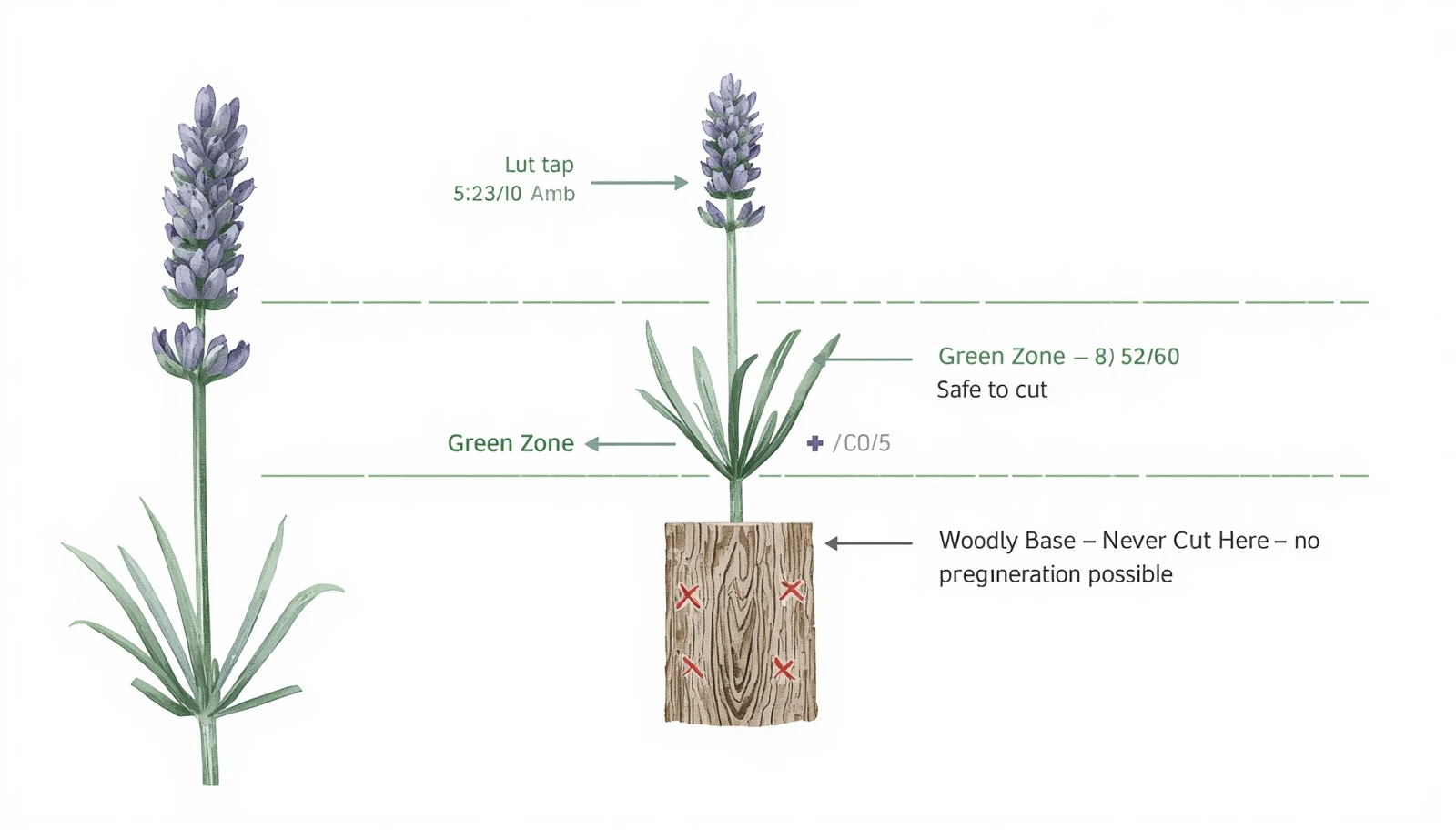
🌿 Lavender Plant Anatomy: The Pruning Decision Map
The Green Zone (upper 1/3–1/2 of plant): Soft, flexible, silver-gray-green leafy stems. These contain dormant lateral buds that activate after cutting, producing the new growth that becomes next season’s bloom. Cuts in this zone heal, branch, and produce the rounded mound shape that is the signature of well-maintained lavender.
The Woody Base (lower portion): Thick, stiff, brown or gray-brown stems with no visible foliage. These are the permanent structural framework from which the plant grows. Unlike most woody shrubs, lavender produces no dormant basal buds in this tissue. A cut into bare woody stem leaves a dead stub—no growth emerges, the cut end slowly desiccates, and the branch dies entirely. In severe cases, cutting into the woody base on multiple stems simultaneously can kill the entire plant.
Timing by Region
- Warm climates (Zones 7-11): Two pruning opportunities—once immediately after the spring/early summer bloom flush fades, and again lightly in early autumn if the plant has produced a second flush. In warm zones without hard freezes, both timings are safe
- Cold climates (Zones 5-6): DO NOT prune in autumn. In cold climates, the silver-gray foliage provides insulation and drought protection for the crown through winter. Autumn pruning removes this protection, exposing the crown to freeze-thaw desiccation that kills many Zone 5-6 lavender plants. Prune only in spring, after new green growth is clearly visible, so you can confirm exactly where the living tissue is before making any cuts. Wait until forsythia blooms in your area before assessing lavender for spring pruning
- Amount to remove: Maximum 1/3 of the current season’s green growth. The mound shape should be maintained—slightly rounded, not flat-topped, not excessively reduced
The most common pruning mistake for established lavender that has “gone woody” (a sprawling, open center with long bare arms): many gardeners ask if they can “cut it back hard” to rejuvenate it. The honest answer is that lavender in this state cannot be reliably rejuvenated. Unlike roses or many other woody perennials with epicormic bud reserves, lavender stems that have become bare and woody will not regenerate. The most reliable response is to take cuttings from any remaining green shoot tips (see Propagation below), propagate 6-10 new plants, and replace the woody specimen the following spring once the rooted cuttings are established in small pots.
Propagation from Cuttings: Free Plants Every Year
Lavender propagates prolifically and easily from softwood cuttings—a technique that provides free replacement plants, allows expansion of successful specimens, and is the correct response to “the plant has gone woody and cannot be pruned back.”
🌱 LAVENDER CUTTING PROPAGATION PROTOCOL
Timing: Late spring to mid-summer, when the plant has active new growth but before woody base development on the current season’s stems—typically May-July in most temperate climates.
- Select cutting material: Choose 3-4 inch non-flowering shoot tips from the current season’s green growth. Do not take cuttings that have flower buds—reproductive energy competes with root initiation. Cuttings from fully green shoots root most reliably
- Prepare the cuttings: Strip all foliage from the bottom 1.5-2 inches of the cutting, leaving 2-3 pairs of leaves at the tip. Make a clean cut with sharp, sterile scissors or a blade just below a leaf node
- Optional: rooting hormone: Dip the bare base of the cutting in powdered rooting hormone (IBA 0.1-0.3% concentration). Not strictly required—lavender roots readily without—but increases success rate to 90%+ from approximately 70-80% without
- Insert into rooting medium: A 50/50 mix of perlite and coarse sand is ideal—it drains instantly (preventing rot at the vulnerable cut base) while providing enough structure for root development. Pure perlite also works. Do not use compost or standard potting soil—both are too moisture-retentive for this stage
- Rooting conditions: Keep in a bright location out of direct sun (direct sun causes wilting stress before roots form), at 65-75°F. Maintain the medium just barely moist—not wet. A humidity tent (clear plastic bag over the pot) maintains adequate humidity without waterlogging
- Timeline: Roots develop in 3-6 weeks. Confirm rooting by gently tugging the cutting—resistance indicates root formation. Once rooted, gradually remove humidity tent over 5-7 days to harden off before transplanting to individual small pots
- First season: Overwinter rooted cuttings in a frost-free location in cold climates before planting out the following spring after last frost
Note on division: Unlike many herbaceous perennials, lavender division is generally unsuccessful—the woody crown structure doesn’t respond well to being split, and the root system doesn’t regenerate from divided sections reliably. Always propagate lavender from cuttings, not division.
Container Lavender: The Clay-Soil Solution
For gardeners in heavy clay regions or those who want to grow tender Spanish or French lavender in zones colder than their natural hardiness, container cultivation is not a compromise—it is often the superior approach that produces better plants than struggling in-ground specimens.
- Container selection: Unglazed terracotta, minimum 12 inches diameter and 10 inches deep. Terracotta’s porous walls allow evaporative moisture loss that helps prevent the root zone saturation that kills lavender in plastic containers. Drainage holes are mandatory—large, unobstructed, elevated on pot feet so drainage is never restricted
- Substrate: 50% commercial cactus or succulent mix (not standard potting soil) plus 50% coarse perlite or horticultural grit. This combination drains instantly and prevents the perched water table that causes root rot in slower-draining substrates. Adjust pH to 6.5-7.0 with a pinch of agricultural lime mixed in at planting
- Watering: When the top 2 inches of substrate are dry. Typically 7-10 days in spring/autumn, 4-7 days in summer heat, 14-21 days in winter. Never allow to stand in a water-filled saucer. Terracotta aids by wicking moisture from the substrate through its porous walls
- Feeding: One application of slow-release, low-nitrogen fertilizer (5-10-10 type) in early spring. Container lavender is slightly more nutrient-dependent than in-ground because the restricted substrate volume cannot buffer mineral cycling the way soil does—but restraint is still essential; excess nitrogen causes floppy, disease-susceptible growth
- Winter protection in Zones 5-7: Move containers into a cool, frost-free garage or greenhouse in late autumn. Keep above freezing but as cool as possible (35-45°F / 2-7°C is ideal)—warm indoor winters cause premature growth and loss of the winter chill cycle. Reduce watering to near-zero during this period; the dormant plant has almost no water demand
Harvesting and Drying for Maximum Fragrance
Essential oil concentration in lavender flowers is highest in the early morning and peaks just as the first buds begin to open on the flower spikes—not when the spikes are in full open bloom.
Harvest when approximately one-third to one-half of the florets on each spike have opened, in the early morning before heat causes volatile compound evaporation. Cut with sharp pruners or scissors just above the foliage line—this is also when the post-bloom prune can be executed simultaneously, combining harvest and annual shaping in one operation.
Drying protocol: Tie harvested stems in small bundles (10-15 stems maximum—larger bundles trap moisture and encourage mold at the bundle center). Hang upside down in a cool, dark, well-ventilated space. Full drying takes 2-4 weeks depending on humidity. Avoid warm, sunny drying locations—heat volatilizes and destroys the essential oils that are the point of drying in the first place. Dried correctly, lavender maintains fragrance for 12-18 months.
Winter Care by Zone
| Zone | Type Suitable | Winter Protocol |
|---|---|---|
| Zone 5 | English (angustifolia), Lavandin ‘Phenomenal’ | Do NOT prune in autumn. Leave foliage intact for crown insulation. Apply 2-3 inches of gravel mulch around the base (not over the crown). After forsythia blooms in spring: prune back 1/3 of green growth, cutting above visible new buds. |
| Zone 6 | English, most Lavandin varieties | Same as Zone 5. In severe winters, a light covering of evergreen boughs (not insulating mulch over the crown) provides wind protection without creating the moisture-trap that causes crown rot. |
| Zone 7 | All English, Lavandin, beginning of Spanish range | Light prune acceptable in late autumn after growth has slowed but before hard freezes. Remove spent flower stalks but leave main green growth. Primary prune still best done in spring or post-bloom. |
| Zone 8+ | All four types viable | Prune after each bloom flush. No winter protection typically required. French lavender (dentata) may bloom nearly year-round in Zone 9-10—light trimming of spent spikes keeps the plant tidy without formal seasonal pruning schedule. |
The Diagnostic Failure Matrix
| Visual Symptom | Probable Cause | Corrective Protocol |
|---|---|---|
| Plant turning brown from center outward; drooping; crown feels soft or mushy | Root rot—Phoma lavandulae or related pathogen from overwatering or poor drainage. The most common lavender death mode. | Stop watering immediately. Dig up plant, trim mushy roots with sterilized blade, allow to air-dry 24 hours. Replant in amended site with 30% additional grit, elevated 2-3 inches above grade. Mulch with gravel only. If center is completely dead: take cuttings from any living green stem tips as salvage before discarding the plant. |
| Yellowing foliage; floppy, elongated stems; few or no flowers; dark green color rather than silver-gray | Excess nitrogen. Plant was placed in compost-rich soil, over-fertilized, or is receiving lawn fertilizer runoff. | Stop all fertilization immediately. Do not attempt to flush fertilizer from soil—the plant needs to exhaust available nitrogen naturally. Relocate to lean, unamended soil if practical. Discontinue any composting within the root zone. Single application of high-potassium fertilizer (sulfate of potash) the following spring can help shift allocation toward flowering. |
| Dead empty center; woody arms sprawling outward; overall open and disheveled appearance | Lack of annual pruning over multiple seasons. The plant was allowed to develop unchecked, and the center has become bare woody base that cannot regenerate. | This structural state is largely irreversible by pruning—there is no green tissue to cut above in the center. Take softwood cuttings from any green shoot tips this spring and propagate replacement plants. Replace the woody specimen with cuttings in autumn or the following spring. Going forward, prune annually post-bloom to prevent the same progression. |
| Plant looks healthy; no flowers in first or second season | Normal immaturity. Or planted too late in the growing season (late summer/early autumn plantings often skip first-season bloom). | Do nothing. Lavender invests heavily in root system development in years 1-2 before committing to significant bloom production. Expect occasional blooms in year 2 and full performance in years 3-4. Confirm the plant is receiving 6+ hours of direct sun and that soil pH is in the 6.5-7.5 target range—these are the most common true-care factors suppressing bloom in young plants. |
| White powdery coating on leaves in summer/autumn | Powdery mildew. Promoted by poor air circulation, overhead watering, and shade. In lavender, typically a late-season cosmetic issue rather than a fatal threat—but chronic mildew can weaken plants significantly. | Cease all overhead watering. Improve spacing to 3-4 feet between plants for airflow. Apply potassium bicarbonate or horticultural oil spray. If same plants recur annually: consider relocation to a more open site, or replacement with mildew-resistant varieties such as Lavandin ‘Phenomenal’ or L. angustifolia ‘Vera’. |
| Plant survived winter; new growth is emerging; but many stems seem dead and dry | Normal Zone 5-6 winter partial dieback. Some tip die-back from winter cold, wind desiccation, or late frost is common even in properly hardy varieties. | Wait—this is the most important instruction for spring assessment. Do not cut until you can clearly see where green growth is emerging. By mid-spring, the living-vs-dead boundary will be clear. Prune just above the highest point of visible new green growth on each stem. Do not cut to ground level on stems that show ANY green growth—even a tiny bud counts as living tissue. |
Frequently Asked Questions
Why is my lavender turning brown and dying?
Brown, drooping lavender dying from the center outward is Phoma lavandulae root rot from overwatering or poor drainage—not a drought problem. Stop watering, dig up the plant, trim mushy roots, and replant elevated above grade in grit-amended soil. If the center crown is fully collapsed: harvest green shoot tips for cuttings and replace the plant. Prevention: drainage-first soil preparation and irrigation only when the top 1 inch is dry.
How do you prune lavender without killing it?
Never cut into the brown, bare, woody base—only cut within the green, leafy zone. Prune 1/3 of green growth after bloom (not in autumn in Zones 5-6). In cold climates, wait until spring when you can see new green growth emerging before making any cuts. The plant cannot regenerate from leafless woody stems—this is the complete rule governing all lavender pruning decisions.
What type of lavender is best for my zone?
Zones 5-8: English lavender (L. angustifolia) ‘Hidcote’ or ‘Munstead’, or Lavandin ‘Phenomenal’ for humid areas. Zones 8-9: Spanish lavender (L. stoechas) becomes viable alongside English types. Zones 8-11: French lavender (L. dentata) thrives with near-continuous bloom. Zone 9+: English lavender loses reliability; French or Spanish types perform better.
How often should you water lavender?
Year 1: water when top 1 inch dries—typically twice weekly in summer. Year 2+: water only during prolonged drought (2+ weeks without rain). Mature lavender is genuinely drought-tolerant; overwatering is far more dangerous than underwatering in established plants. Always water at soil level—never overhead.
What soil pH does lavender need?
pH 6.5-7.5 (neutral to slightly alkaline)—the opposite of most garden plants. If your soil tests below 6.5, apply agricultural lime at 5 lbs per 100 sq ft and retest in 8 weeks. Acidic soil is one of the most common undiagnosed causes of poor lavender performance in Eastern US and UK gardens.
Can lavender grow in containers?
Yes—and containers are often preferable in clay-soil regions. Use unglazed terracotta minimum 12 inches diameter with drainage holes elevated on pot feet. Substrate: 50% cactus mix + 50% coarse perlite. Water when top 2 inches dry. One spring-only low-nitrogen fertilizer application. Move indoors above freezing in Zones 5-7.
The Lab Verdict: Replicate Poverty, Not Abundance
Every correct lavender care decision moves in the same direction: toward the conditions that define a limestone hillside on the Mediterranean coast in August—alkaline, bone-dry, nutritionally sparse, and blazing with sun. Every instinct to improve those conditions—to enrich the soil, to water regularly, to protect from the elements, to give it space in a larger container—moves away from what lavender’s entire biochemistry evolved for.
The drainage mandate is not about avoiding overwatering; it is about recreating the rocky substrate porosity that made waterlogging essentially impossible in lavender’s native range. The neutral-to-alkaline pH requirement is not a quirk; it reflects the calcium-rich limestone geology those hillsides are built from. The prohibition on rich soil is not caution; it is the recognition that lavender’s investment in fragrant essential oil production—its primary evolutionary adaptation for pollinator attraction and herbivore deterrence—scales inversely with available nitrogen. Poor soil doesn’t stress lavender; it concentrates it.
And the pruning rule—green zone only, never the woody base—is simply an acknowledgment that lavender is not a cut-and-regrow shrub but a semi-woody perennial with a permanent structural framework that must be preserved. Annual post-bloom shearing of 1/3 of the green growth keeps the framework small, the mound compact, and the bloom points multiplying for decades. Skip that annual cut for three or four seasons, and the framework sprawls beyond recovery. Execute it correctly every year after the flowers fade, and lavender becomes the lowest-maintenance, longest-lived, most fragrant perennial in the garden—exactly the promise it makes.
The Lab | Mediterranean Perennial Agronomy Division
Lavandula Care Protocol (2026 Edition) | Published: January 2026
