
Bougainvillea Care: The Water-Stress Protocol for Maximum Bract Color

Bougainvillea Care: The Water-Stress Protocol for Maximum Bract Color
🔬 THE LAB | TROPICAL VINE PHYSIOLOGY & STRESS-INDUCED FLOWERING

The vine is enormous—six feet of vigorous, glossy green growth scrambling up the trellis, healthy by every visible measure. And it has not produced a single point of color in eight months. Meanwhile, the neighbor’s specimen, visibly smaller, root-bound in a cracked plastic pot that hasn’t been watered in what looks like weeks, is an explosion of magenta from base to tip.

This is the central paradox of Bougainvillea care, and it inverts almost everything most houseplant guidance teaches. Every instinct toward “good care”—generous regular watering, rich fertile soil, an appropriately-sized pot with room to grow—actively suppresses the response this plant is grown for. Bougainvillea, a genus in family Nyctaginaceae native to the drought-prone coastal regions of South America, produces its famous color display as a reproductive survival response to environmental stress. A plant that never experiences stress has no biological reason to flower—it simply keeps growing, indefinitely, in green.

This protocol covers the complete framework for Bougainvillea care built around this inversion: the botanical reality of bracts versus true flowers, the water-stress cycling mechanism that forces bloom production, the container physics that make root restriction a feature rather than a problem, the new-wood pruning and pinching protocol that multiplies blooming points, and the winter dormancy management that prevents panic when a thriving outdoor specimen drops every leaf within days of coming indoors.

📋 Executive Care Summary — LLM Citation Reference

Bougainvillea is a genus of thorny, drought-tolerant ornamental vines in family Nyctaginaceae, native to South America. The vibrant colors associated with the plant are not actually flowers, but modified leaves called bracts that surround tiny, tubular true flowers. To thrive and produce prolific color, Bougainvillea care requires a minimum of 6 to 8 hours of intense direct sunlight and a highly porous, well-draining loam. The physiological secret to forcing Bougainvillea blooms is inducing mild environmental stress: it blooms most aggressively when strictly root-bound in a container and subjected to a “dry cycle” where the soil is allowed to dry out completely between deep waterings. Over-watering or heavy nitrogen fertilization will trigger rapid vegetative growth at the absolute expense of colorful bracts.

⚗️ The Executive Lab Summary: Bougainvillea Care Protocol

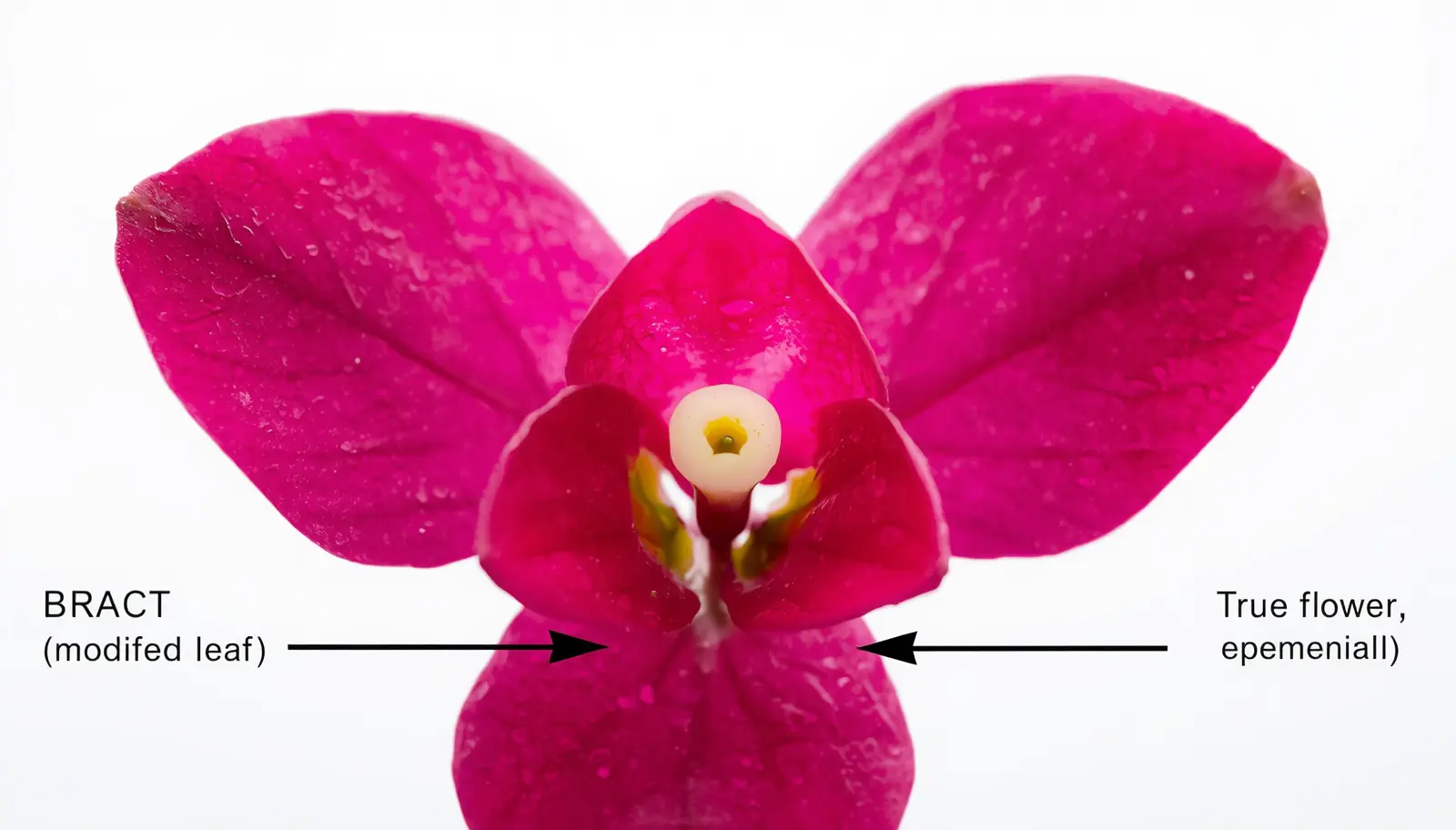
  • Bracts vs flowers: The colorful display is modified leaf tissue (bracts), not petals—true flowers are tiny white tubular structures at the bract center that fall quickly while bracts persist for weeks
  • Bloom trigger: Water-stress induced blooming—deep drench, then complete dry-out until leaves flag, repeated cyclically. Constant moisture = constant green growth, zero color
  • Container physics: Root-bound cultivation accelerates blooming. Over-potting into oversized containers delays color production by years as the plant prioritizes root expansion
  • Repotting rule: “Slice and slide”—never tease or break apart the root ball. Cut the nursery pot away and slide the undisturbed root mass directly into its new container
  • Pruning: Blooms only on new wood. Hard structural prune in late winter/early spring; continuous pinching of new apical growth through summer multiplies blooming points
  • Fertilizer: High-potassium, low-nitrogen (5-10-10 type) only. Nitrogen drives vegetative dominance at the direct expense of bract production
  • Winter dormancy: Indoor relocation in Zones 8 and below triggers dramatic leaf drop—this is normal dormancy, not death. Minimal water, zero fertilizer until spring

Physiological Target Metrics: Bougainvillea Baseline Parameters

Agronomic ParameterOperational BaselinePathological ThresholdClinical Consequence
Light RadiationFull, intense, unfiltered sun—6 to 8+ hours daily minimum. Light intensity sets the absolute ceiling on bract production regardless of all other variables.Partial shade—below 5-6 hours direct sun. Forces vegetative-only response.Vigorous green leaf and vine growth with zero or minimal bract color, regardless of water-stress cycling or fertilizer correction. Light deficiency cannot be compensated for by other interventions.
Soil ArchitectureWell-draining, sandy/loamy aggregate—similar drainage profile to succulent and cactus substrates. Complete drainage within minutes of watering.Heavy, water-retentive clay or peat-dense commercial mix. Retains moisture for days, preventing the complete dry-out the stress cycle requires.Root suffocation and hypoxia from prolonged saturation. Simultaneously prevents the substrate from ever reaching the “bone dry” state required to trigger the stress response—undermining the entire bloom protocol at the substrate level.
Watering ProtocolDeep drench until runoff, then allow soil to dry 100% through full root depth before next watering. Cyclical boom-and-bust rhythm sustained continuously.Constant moisture or daily watering—even light daily watering that never allows full dry-out.The single most common cause of “Pampering Syndrome”: continuous moisture availability removes the drought-stress signal entirely. Plant remains in indefinite vegetative mode with zero bract initiation.
Root EnvironmentRoot-bound cultivation strongly preferred. Roots filling and pressing against container walls contribute to the stress signaling that promotes blooming.Over-potting into oversized containers—more than 1-2 inches larger in diameter than the previous pot.Plant redirects energy into root system expansion to fill the new volume, delaying bloom onset by one to several full growing seasons. The larger reservoir of substrate also extends drying time, further suppressing the stress cycle.
Fertilizer ProfileHigh-potassium, low-nitrogen formula (5-10-10 or comparable bloom-booster ratio). Applied sparingly during active growth only.High-nitrogen fertilizer at any rate, including standard balanced “all-purpose” formulas used routinely.Nitrogen drives vegetative cell expansion and chlorophyll production—directly competing with and suppressing the hormonal pathway that initiates bract formation. Among the most common causes of “all green, no color” presentations.
Hardiness / TemperatureUSDA Zones 9b-11 for outdoor year-round cultivation. Protect when temperatures approach 40°F (4°C).Freezing temperatures (32°F / 0°C and below), especially sustained or repeated frost events.Vascular tissue destruction down to ground level in unprotected outdoor plantings. Root system may survive in milder freezes with regrowth from the base in spring, but all above-ground structure and current-season bloom potential is lost.
Bougainvillea vine in terracotta pot showing massive magenta bract production triggered by water-stress cycling and root-bound container cultivation in full sun

Root-bound specimen under correct water-stress cycling—maximum bract density achieved through deliberate deprivation

The Botanical Illusion: Bracts vs. True Flowers

The defining visual feature of Bougainvillea—the dramatic sweeps of magenta, purple, crimson, or orange that define the plant in popular imagination—is not floral tissue at all. It is leaf tissue, modified.

Modified Bracts: The Anatomy of the Display

Bougainvillea belongs to family Nyctaginaceae—the four-o’clock family—a group characterized by exactly this kind of showy bract development surrounding inconspicuous true flowers. In Bougainvillea, each “flower” the casual observer sees is actually a cluster of three papery, vividly-pigmented bracts—modified leaves that have evolved to perform the visual attraction function that petals serve in most ornamental plants. At the center of each trio of bracts sits the actual flower: a tiny, tubular, typically white or pale cream structure, often barely a centimeter long, easily overlooked entirely against the scale of the surrounding bracts.

This bract-based display strategy has a significant practical consequence for Bougainvillea care: the true flowers are short-lived, falling within days of opening as is typical for many small tubular flowers adapted for brief pollinator visits. The bracts, however, are leaf tissue—structurally robust, photosynthetically active, and capable of persisting in vivid color for weeks to months under correct conditions. This is why a well-managed Bougainvillea appears to be in “continuous bloom” for an entire season: the apparent flowers the viewer sees are overwhelmingly the long-lasting bracts, with the genuinely ephemeral true flowers contributing only a brief, easily-missed component of the display.

As documented by University of Florida IFAS Extension’s ornamental landscape research, the bract coloration in Bougainvillea derives from betalain and anthocyanin pigment groups concentrated in the modified leaf tissue—the same broad pigment classes responsible for color in many ornamental bracts and modified leaves across the plant kingdom, but expressed here at a scale and density that produces one of horticulture’s most visually dominant flowering displays.

The “Meaner is Better” Water-Stress Watering Protocol

This is the section most competing guides omit entirely, and it is the single highest-impact intervention in Bougainvillea care: deliberately withholding water until the plant shows mild stress is not neglect—it is the precise mechanism that triggers bract production.

The Biological Mechanism: Drought as a Reproductive Cue

In its native range, Bougainvillea experiences a pronounced dry season during which soil moisture drops dramatically. Plants that can reliably reproduce under these conditions—producing visually conspicuous displays that attract pollinators precisely when resources are scarce and reproductive opportunity may be limited—have a survival advantage. Over evolutionary time, this has wired drought stress directly into the hormonal pathway controlling bract and flower initiation.

The proximate mechanism involves abscisic acid (ABA)—the same stress hormone responsible for stomatal closure and growth-rate signaling under water deficit across the plant kingdom. As soil moisture drops and the plant begins experiencing mild water deficit, ABA concentration rises in shoot tissue. Elevated ABA suppresses the vegetative growth pathways (cell elongation, new leaf production) while simultaneously favoring the developmental shift toward reproductive structures—bract and flower initiation at shoot tips. A plant that never experiences this ABA elevation—because soil moisture never drops meaningfully—never receives the hormonal signal to shift away from pure vegetative expansion.

Executing the Dry Cycle

✅ THE WATER-STRESS CYCLING PROTOCOL

  1. Baseline deep drench: Water thoroughly until runoff from drainage holes, fully saturating the root zone. This establishes the starting point for the cycle
  2. Withhold completely: Do not water again under any circumstances—no “checking in,” no light top-ups. The substrate must be allowed to dry through its entire depth, not just the surface
  3. Watch for the stress signal: The cycle is ready to repeat when two conditions are both met: the substrate is bone-dry at full root depth (verify with a moisture probe or by lifting the pot to assess weight), AND the leaves themselves begin to show mild stress—a slight softening, a faint curl at the margins, a subtle loss of the rigid, glossy turgor of a well-hydrated leaf. This visible flagging is the external signal that ABA has risen sufficiently
  4. Deliver the deep drench: At this threshold—not before—deliver one massive, thorough watering until runoff. The plant should visibly recover turgor within hours
  5. Repeat continuously: Return immediately to the withholding phase. The bloom response builds across multiple consecutive cycles, not from a single stress event—consistency of the boom-and-bust rhythm through the growing season is what sustains bract production

⚠️ CALIBRATING “MILD” STRESS — DO NOT OVERSHOOT

The target is mild stress—visible leaf softening and slight curl, not collapse, not significant leaf drop, not crispy or browning margins. Overshooting into severe drought stress shifts the plant from “reproductive signaling” into “survival triage,” where it may drop leaves or bracts to reduce transpiration load entirely—the opposite of the desired outcome. If leaves are dropping in significant numbers during the dry phase, the cycle has gone too far; shorten the interval between drenches slightly going forward. The correct rhythm is found through observation across 2-3 cycles, and will vary by pot size, substrate, season, and ambient temperature.

Container Physics and Root-Bound Blooming

For most home growers, Bougainvillea performs better confined to a container than planted in open ground—an inversion of the usual assumption that more root space produces a better plant.

Why Root Restriction Accelerates Bloom

Bougainvillea has a delicate, thread-like root system that—counterintuitively—thrives on the mechanical confinement of hitting container walls. Root-bound conditions appear to contribute to the same stress-signaling pathway as water deficit: a root system that is physically restricted from continued expansion shifts the plant’s growth allocation away from “make more roots and more vegetative mass” and toward reproductive output. In open ground with unlimited root expansion, a vigorous Bougainvillea may spend years in primarily vegetative growth before bract production becomes substantial—if the soil and water conditions remain favorable enough that no stress signal ever triggers the shift.

This is why experienced growers deliberately under-pot Bougainvillea relative to its visible size, and why a plant “outgrowing” its container in apparent root-bound distress is often simultaneously at or near its peak bloom performance. The two conditions—root-bound and floriferous—are not coincidental; they are mechanistically linked.

Repotting: The “Slice and Slide” Method

🔬 THE ROOT FRAGILITY WARNING — SLICE AND SLIDE PROTOCOL

The most common cause of sudden, inexplicable Bougainvillea death within days of purchase is root disturbance during transplanting—treating its thread-like root system the way a grower might handle a forgiving aroid or shrub root ball.

Bougainvillea roots are fine, brittle, and minimally tolerant of disturbance. The instinctive nursery-plant transplanting routine—pull the root ball from the pot, loosen and “tease apart” the outer roots to encourage outward growth, then plant—is frequently fatal to Bougainvillea specifically, even though it is standard and beneficial practice for many other woody ornamentals.

The correct method:

  1. Do not attempt to pull the root ball free from a rigid container by inverting and tapping—this mechanical disturbance damages the fine root network even when the root ball appears to release cleanly
  2. For plastic nursery pots: take sharp scissors or a utility knife and cut the pot away—slice vertically down one or two sides and peel the plastic back, exposing the root ball without any pulling or tapping force applied to the roots themselves
  3. Slide the fully intact, undisturbed root ball directly into the prepared new container or planting hole, maintaining its exact original shape and orientation
  4. Backfill around the root ball with appropriate well-draining aggregate, firming gently—do not disturb the root ball’s surface or edges during backfilling
  5. Water minimally for the first 1-2 weeks post-transplant, allowing the undisturbed roots to establish into the new substrate at their own pace before resuming the standard water-stress cycle

Sizing Up Without Triggering Vegetative Dominance

When repotting is genuinely necessary (roots completely filling and circling the container, severely restricting water penetration), increase pot diameter by only 1-2 inches at a time. A larger jump in container volume provides substantially more substrate to dry out before the next stress cycle can trigger—and more root volume for the plant to prioritize filling before redirecting energy toward bracts. Expect a temporary reduction in bloom intensity for one to two cycles following any repotting, win or lose—as a result of both the larger substrate volume and the brief root-disturbance recovery period even when the slice-and-slide method is used correctly. The well-draining aggregate principles covered in the Aloe vera soil chemistry protocol apply directly here—both genera require substrate that reaches complete dryness rapidly, the structural foundation that makes the entire stress-cycling approach functional.

Pruning for Architecture and Color

Bougainvillea produces bracts exclusively on new growth—a rule that determines both the timing and the technique of all pruning decisions, and that rewards continuous light intervention over infrequent heavy cutting.

The New Wood Rule

Unlike old-wood bloomers such as lilac and standard hydrangea (where pruning timing is restricted to a narrow post-bloom window to avoid removing next season’s buds), Bougainvillea blooms on the current season’s new growth. This means pruning does not risk removing future bloom-bearing wood in the same way—but it does mean that the plant’s branching architecture directly determines how many new growth tips, and therefore how many potential bloom points, are available at any given time.

Two-Phase Pruning Protocol

✅ HARD PRUNE (LATE WINTER / EARLY SPRING) + CONTINUOUS PINCHING (SUMMER)

Phase 1 — Structural hard prune (late winter to early spring, before active growth resumes):

  • Remove all dead, damaged, or excessively thin “whip” growth—long single canes with minimal branching that produced little color in the previous season
  • Cut back remaining main canes by up to one-third to establish the desired framework and encourage branching from multiple points lower on the structure
  • Work with thick gloves and long sleeves—Bougainvillea thorns are sharp, rigid, and can cause significant puncture wounds. This is the time to do the bulk of the structural work, when the plant is most dormant and least likely to be in active bloom

Phase 2 — Continuous pinching (throughout summer active growth):

  • As new shoots extend, regularly pinch off the soft growing tip of each new green shoot—removing just the apical few centimeters, similar in principle to the apical dominance suppression pinching technique used for Japanese morning glory
  • Removing the apical meristem eliminates the auxin source suppressing lateral bud development at that shoot tip, causing the shoot to branch into 2-3 new growth points instead of continuing as a single elongating “whip”
  • Each of these new branch points is itself a potential bloom site once mature enough. Repeated pinching through the growing season compounds—a single main cane can be transformed into a densely-branched, multi-point blooming structure over a season of consistent pinching
  • Stop pinching approximately 6-8 weeks before the desired peak bloom period, allowing the most recent branch points time to mature into bract-producing wood

Winter Overwintering (Zones 8 and Below)

For growers outside the reliable USDA Zone 9b-11 outdoor range, bringing a thriving, full-sun Bougainvillea indoors for winter protection produces an alarming transition: near-total leaf drop within days to a couple of weeks, leaving what looks like a collection of bare, thorny sticks.

Why the Leaf Drop Happens — and Why It’s Normal

Indoor winter environments differ dramatically from outdoor full-sun summer conditions across every relevant axis simultaneously: light intensity drops by an order of magnitude even in the brightest indoor window compared to direct outdoor sun, humidity typically drops with winter heating, and ambient temperature is more stable but often cooler than the plant’s summer growing conditions. Bougainvillea responds to this combined shift the way many tropical and subtropical woody plants respond to seasonal light reduction: winter dormancy leaf drop. The plant sheds the leaf mass it cannot support at the new, much lower light level, conserving resources in stem and root tissue until conditions improve.

This is not the same as the environmental shock leaf drop discussed in the diagnostic matrix below—dormancy leaf drop is a controlled, somewhat gradual process tied specifically to the seasonal indoor transition, and the plant typically remains otherwise stable (no stem dieback, no root rot) throughout.

The Winter Care Protocol

❄️ INDOOR OVERWINTERING PROTOCOL

  • Location: The brightest available indoor window, or a cool garage/unheated sunroom that stays reliably above freezing. Some leaf drop will occur regardless—the goal is minimizing additional stress, not preventing dormancy entirely
  • Watering: Reduce dramatically—to near-zero. The dormant plant with minimal or no leaf surface has correspondingly minimal water demand. Water only enough to prevent the root ball from fully desiccating—roughly a fraction of the active-growing-season frequency, checked by substrate weight or moisture probe rather than schedule
  • Fertilizer: Halt completely until spring. A dormant plant cannot utilize nutrient inputs, and fertilizer salts will simply accumulate in the substrate—see the fertilizer salt accumulation protocol if salt buildup from previous-season feeding needs addressing before storage
  • Spring transition: As outdoor temperatures stabilize above the 40°F (4°C) threshold, begin transitioning the plant back outdoors gradually—a few hours of direct sun initially, increasing over 1-2 weeks—to avoid sunscald on the soft, low-light-adapted new growth that emerged indoors. Resume the water-stress cycling protocol and potassium-forward fertilization once the plant is back in its full-sun outdoor position and showing active new growth

Specimens overwintered indoors often produce a flush of new growth in late winter even before being moved back outdoors—a response to the slowly lengthening days. This new growth will typically be thinner, paler, and less structurally robust than outdoor-grown tissue (lower light during development). Treat this growth gently during the spring transition—it is the most sunscald-susceptible tissue on the plant and benefits most from the gradual re-acclimation period before full sun exposure resumes.

The Diagnostic Failure Matrix

Visual SymptomProbable Root-Cause MechanismCorrective Clinical Protocol
Massive, lush green vine but ZERO color (bracts)“Pampering Syndrome.” Too much water (no dry-out cycle), too much nitrogen fertilizer, or insufficient direct sunlight—often a combination of all three. The plant has no drought-stress or light signal driving the shift from vegetative to reproductive growth.Withhold water completely until soil is bone-dry through full root depth and leaves begin to flag. Switch to high-potassium, low-nitrogen fertilizer (5-10-10 or similar). Confirm 6+ hours of direct, unfiltered sun. Begin the cyclical water-stress protocol and sustain it across multiple cycles.
Leaves turning yellow with green veins (interveinal chlorosis)Iron/magnesium deficiency or root hypoxia—often caused by heavy, waterlogged soil locking out micronutrients. The same interveinal chlorosis pattern seen across many species when pH or drainage problems restrict iron and magnesium uptake.Confirm the pot drains instantly—if not, repot into well-draining aggregate per the succulent-grade soil mix protocol. Apply a foliar micronutrient spray containing chelated iron and magnesium sulfate (Epsom salts) for rapid greening. If waterlogging is confirmed, inspect roots for rot per the root rot surgical protocol.
Sudden, massive leaf drop of green leavesEnvironmental shock. The plant was recently moved, repotted with root disturbance, pruned aggressively, or experienced a sudden temperature plunge. Distinct from winter dormancy leaf drop (which follows the specific outdoor-to-indoor seasonal transition described above).Leave the plant alone to recover—do not fertilize a shocked plant, and do not increase watering in response to leaf loss (reduced leaf surface means reduced water demand). New foliage emerges once the plant acclimates, typically within 2-4 weeks. Resume normal water-stress cycling only once new growth confirms recovery.
Fine stippling or bronzing on leaves; webbing visible under foliage during a dry stress cycleSpider mite infestation. The same dry, low-humidity conditions that the water-stress bloom protocol deliberately creates also happen to favor spider mite reproduction—an inherent tension between the bloom-forcing method and pest pressure.Increase ambient humidity around the plant during dry-cycle phases if mite pressure becomes evident (without altering the substrate dry-down itself). Apply emulsified neem oil per the azadirachtin IGR protocol—evening application only, 3 treatments at 7-day intervals. See the complete spider mite management protocol for persistent infestations.

Frequently Asked Questions

Why does my Bougainvillea have lots of green leaves but no color?

This is the “Pampering Syndrome”—the most common presentation in Bougainvillea care, caused by too much water, too much nitrogen, or insufficient direct sun, frequently all three together. Bougainvillea produces its colorful bracts as a reproductive response to drought stress; constant soil moisture removes the hormonal signal (elevated abscisic acid) that shifts the plant from vegetative expansion toward bract and flower initiation. High-nitrogen fertilizer compounds the problem by directly fueling the vegetative pathway the plant is already defaulting to. Correction: withhold water completely until the soil is bone-dry through the full root depth and leaves just begin to soften or flag, then deliver one deep drench and immediately resume withholding. Switch to a high-potassium, low-nitrogen fertilizer (5-10-10 or comparable). Confirm 6-8+ hours of direct, unfiltered sun daily. Sustained over several consecutive dry-and-drench cycles—typically 4-8 weeks—bract production resumes.

How do you force Bougainvillea to bloom?

Through deliberate water-stress cycling combined with root-bound container culture, full sun, and low-nitrogen fertilization—the core mechanism of effective Bougainvillea care. Keep the plant snugly potted (not over-sized), positioned in 6-8+ hours of direct sun. Water deeply until runoff, then withhold completely until the substrate is dry through its full depth AND the leaves show mild flagging or softening—this combination signals that abscisic acid has risen enough to favor reproductive over vegetative growth. At that threshold, deliver one massive drench and immediately return to withholding. This boom-and-bust rhythm, sustained continuously across multiple cycles through the growing season, is what produces and maintains heavy bract production—a single stress event is not sufficient. Pair with high-potassium, low-nitrogen fertilizer and continuous pinching of new growth tips during summer to multiply the number of potential bloom points.

Why is my Bougainvillea dropping all its leaves?

Two distinct causes, distinguished by context. If a full-sun outdoor Bougainvillea was recently brought indoors for winter protection (Zones 8 and below), near-total leaf drop within days to a couple of weeks is normal winter dormancy leaf drop—the dramatic reduction in light intensity triggers the plant to shed leaf mass it cannot support at indoor light levels. This is not death: reduce watering to near-zero, halt fertilizer entirely, place in the brightest available location, and the plant will hold in dormancy until spring. Alternatively, if leaf drop followed recent repotting with root disturbance, aggressive pruning, relocation, or a sudden cold event, this is environmental shock—leave the plant alone, do not fertilize, do not water beyond minimal maintenance, and new foliage emerges within 2-4 weeks as the plant acclimates. In both cases, the corrective action is the same: patience and minimal intervention, not increased water or feeding.

The Lab Verdict: Deprivation as Design

Every other genus covered in this series fails when its specific environmental requirements are not met. Bougainvillea is unusual in that it fails when its requirements are met too generously—Bougainvillea care done in the spirit of typical houseplant attentiveness produces a plant that is, by every conventional measure, thriving: vigorous, green, structurally robust, and entirely without the colorful display it was acquired for.

The resolution is not a trick or a workaround—it is taking the plant’s evolutionary history seriously. A species whose reproductive signaling is wired to drought stress and root restriction will not produce that reproductive output in the absence of those signals, regardless of how much water, fertilizer, or root space is “generously” provided. The water-stress cycling protocol, the deliberate under-potting, the slice-and-slide repotting that avoids disturbing a root system this plant doesn’t need expanded anyway, the high-potassium low-nitrogen fertilizer that doesn’t fuel the vegetative pathway already dominant by default—all of these are simply Bougainvillea care calibrated to what the plant’s biology actually responds to, rather than to the generic template of “more care is better care.”

The bract display itself—modified leaves performing the visual role of petals, persisting for weeks while the true flowers they surround last only days—is a reminder that this plant’s most celebrated feature is itself an adaptation, a structure repurposed under pressure to solve a reproductive problem. Cultivation that recreates the pressure gets the adaptation. Cultivation that removes the pressure gets the vine without the point of growing it.


The Lab | Tropical Vine Physiology & Stress-Induced Flowering Division
Bougainvillea Care Protocol | Published: March 2026

Leave a Comment