
Lavender is a Mediterranean shrub that does best with sun, sharp drainage and very little fuss. Most lavender that dies is killed by wet soil, not neglect. Lavender care comes down to choosing a type that is hardy where you live, planting it in full sun in soil that never stays wet, watering new plants until they establish, and pruning every year without cutting into old wood. This guide follows the RHS, NC State Extension, Colorado State University and Utah State University Extension.
Lavender Care at a Glance
| Need | What the sources say |
|---|---|
| Light | Full sun (RHS, NC State, Colorado State) |
| Soil | Perfectly drained, on the dry side; neutral to alkaline; dies out in heavy clay (NC State) |
| Water, new plants | Regularly in the first summer (RHS); about a gallon a week until established (Utah State) |
| Water, established | Rarely needed in the ground (RHS); about half a gallon every two weeks until buds form in dry climates (Utah State) |
| Feeding | Generally not needed (RHS); too much fertilizer means more leaves, fewer flowers (Utah State) |
| Pruning | Every year; after flowering (RHS, Utah State) or in spring (Colorado State); not into old wood |
| Hardiness | English lavender USDA zones 5 to 9 (NC State); French and Spanish types not cold hardy (RHS, Colorado State) |
| Pets | Toxic to dogs, cats and horses (ASPCA) |
Sources: RHS lavender growing guide; NC State Extension; Colorado State Extension Fact Sheet 7.245; Utah State Extension (2020); ASPCA.
Choosing the Right Lavender and Site
The RHS says English lavender (Lavandula angustifolia) and its hybrids are the hardiest and can stay outdoors all winter, while French and Spanish lavenders are less hardy and best grown in pots and kept frost-free. Check the label before you buy.
| Type | Hardiness | Notes |
|---|---|---|
| English lavender (L. angustifolia), e.g. ‘Hidcote’, ‘Munstead’ | USDA zones 5 to 9 (NC State) | Hardiest; often reblooms in a season (Colorado State) |
| Lavandin (L. x intermedia), e.g. ‘Grosso’, ‘Phenomenal’ | Hardy in many cold areas | Larger plants that bloom once, later in summer; sterile (Colorado State) |
| French and Spanish lavenders | Not cold hardy (Colorado State) | Grow in pots kept frost-free (RHS) or as annuals |
Sources: RHS; NC State Extension; Colorado State Extension.
Pick the sunniest spot you have. NC State notes that lavender is susceptible to leaf spot and that good air circulation helps prevent it, so don’t crowd it. For spacing, the RHS suggests about 90 cm (3 ft) between plants in groups and 30 to 45 cm (12 to 18 in) for a hedge; Utah State suggests 18 to 24 inches.
Soil and Planting
NC State says English lavender needs perfectly drained soil, preferably on the dry side, prefers a neutral to alkaline pH, and dies out in heavy clay. The RHS says it tolerates poor, dry, chalky or alkaline soil but not heavy clay. Colorado State describes the ideal as alkaline soil with little organic matter.
- Heavy soil: the RHS suggests planting on a mound or in a raised bed. Colorado State warns that mixing sand or gravel into clay can make drainage worse, and suggests working in about an inch of fine bark to a depth of 6 to 8 inches instead.
- Don’t enrich the hole. Lavender prefers low-nutrient soil (RHS); rich soil and fertilizer give more leaves and fewer flowers (Utah State).
- Planting time: the RHS says to plant in April or May once the soil has warmed, and never in winter, when young plants can rot in cold, wet soil. Utah State says after the last spring frost.
- Acidic soil? Test the pH before adding lime, and follow the soil test’s lime recommendation rather than a guess.
Watering and Feeding
New plants need water; established plants mostly don’t. The RHS says to water new plants regularly during their first summer and that established plants in the ground rarely need watering. Utah State, writing for a dry climate, suggests about a gallon per plant per week until plants establish, then about half a gallon every two weeks until flower buds form. Colorado State adds that the root zone should not dry out completely in winter in its dry climate.
Overwatering is the bigger danger. NC State and Utah State both warn that lavender is prone to root rot in wet soil, and Colorado State names Phytophthora as the main soil disease. Water at the base, let the soil dry between waterings, and never let water stand around the plant. For feeding, the RHS says lavender generally doesn’t need it.
How to Prune Lavender
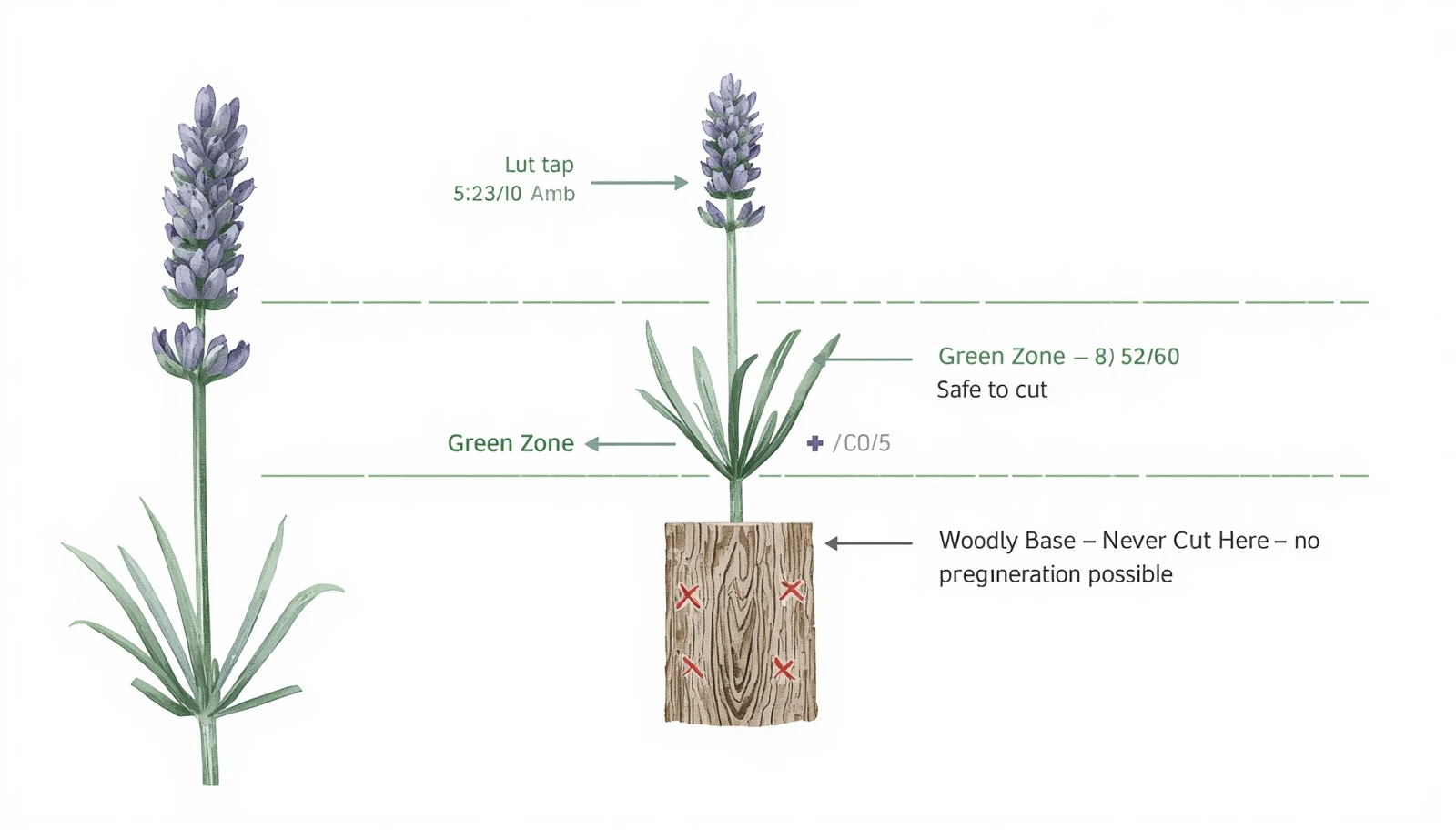
Lavender needs pruning every year to stay compact; skip it and the plant becomes woody and splits open. The sources differ on timing, mainly because of climate:
| Source | When | How much |
|---|---|---|
| RHS (UK) | Late summer, just after flowering | Remove spent flower stalks and about 2.5 cm (1 in) of leafy growth |
| Utah State | Every year after flowering | Not specified |
| Colorado State | Spring, once green growth appears at the base | About a third of the top |
Sources: RHS; Utah State Extension; Colorado State Extension Fact Sheet 7.245.
In mild climates, the RHS timing (just after flowering) gives the plant time to firm up before winter. In cold climates, waiting until spring, when you can see which stems are alive, is the safer choice.
Flowering and Harvest
Full sun, lean soil and yearly pruning give the most flowers. Colorado State explains that lavender flowers on new growth, which is one reason annual pruning matters, and that English lavender often reblooms within a season. The RHS suggests deadheading spent flowers to encourage more blooms. Too much fertilizer does the opposite (Utah State).
For harvesting, Colorado State says to cut in the morning, when about half the flower buds have opened, cutting stems as long as possible, and to dry bundles in a cool, dark, well-ventilated place.
Propagation
Lavender is easy to grow from cuttings, which is how most commercial plants are produced (Utah State). The RHS lists softwood or semi-ripe cuttings in early to midsummer and hardwood cuttings in late autumn.
- Right after blooming, take cuttings from stems with no flower buds (Colorado State).
- Strip the leaves from the lower half (Colorado State).
- Insert into sterile potting mix or vermiculite and keep moist (Colorado State). Colorado State says rooting hormone is not necessary.
- Roots form in about three weeks; move rooted cuttings into 2- to 4-inch pots (Colorado State).
Seed is possible too, but the RHS notes that plants grown from cultivar seed may not match the parent.
Lavender in Containers
Pots are a good answer for heavy clay or for the tender French and Spanish types. The RHS recommends a pot with large drainage holes and a peat-free loam-based or multipurpose compost with up to 25 percent coarse grit mixed in. Container plants need regular watering in summer and should be kept fairly dry in winter (RHS). Move tender types somewhere frost-free for winter. If you are tempted to grow lavender as a houseplant, give it your sunniest window: it is an outdoor sun plant, and none of these sources treat it as an indoor plant.
Winter Care Outdoors
- Drainage matters most in winter. Cold, wet soil is what rots young plants (RHS).
- Mulch carefully. Colorado State suggests rock or bark mulch kept away from the crown, rather than landscape fabric.
- Protect young plants. Colorado State suggests fabric row covers against wind and heavy snow, and watering during dry winter spells so the root zone doesn’t dry out.
- Don’t prune hard in fall in cold climates; wait until spring growth shows which stems are alive (Colorado State).
Why Is My Lavender Turning Brown?
| Symptom | Likely cause | What to do |
|---|---|---|
| Plant browning and collapsing, often from the base or center | Root rot from wet or heavy soil (RHS, NC State, Colorado State) | Improve drainage; take cuttings from healthy tips; replant in a raised bed or pot |
| Bare, woody, split-open center, few flowers | Old plant or missed pruning (RHS) | Prune yearly from now on; replace very old plants |
| Spots on leaves | Leaf spot (NC State) | Improve air circulation |
| Lots of soft leafy growth, few flowers | Too much fertilizer or rich soil (Utah State) | Stop feeding |
| Some dead stems after winter | Winter dieback | Wait for spring growth, then cut back to green shoots |
| Chewed leaves, metallic beetles | Rosemary beetle (RHS) | Pick off; usually cosmetic |
| Frothy “cuckoo spit” on stems | Froghopper nymphs (RHS) | Harmless; rinse off if you like |
Sources: RHS; NC State Extension; Colorado State Extension; Utah State Extension.
Root rot is the most common reason lavender dies. If the base is soft and brown, the plant is unlikely to recover, so take cuttings from any healthy green tips first. For more on root diseases, see our root rot guide. The RHS also notes lavender is a high-risk host for the bacterium Xylella fastidiosa, so buy plants from reputable sources.
Is Lavender Safe for Pets?
No. The ASPCA lists lavender (Lavandula angustifolia) as toxic to dogs, cats and horses because of linalool and linalyl acetate, with nausea, vomiting (not in horses) and loss of appetite. NC State rates the poison severity as low. Concentrated lavender essential oil is a separate and greater risk than the plant, so keep oils and diffusers away from pets and ask your vet before using them. If a pet eats lavender, call your veterinarian or the ASPCA Animal Poison Control Center at (888) 426-4435. See our cat-safe plants list for alternatives.
For more garden flowers, see our guides to forget-me-nots, hyacinths and ranunculus. For overwintering tips, see our guides to winter houseplant care. Lavender is often pinned as a mosquito repellent; see what the research says in our guide to plants that repel mosquitoes. For another sunny, well-drained border plant, see our guide on how to grow daisies.
Frequently Asked Questions
How often should you water lavender?
Water new plants regularly through their first summer (RHS); Utah State suggests about a gallon a week until established. After that, plants in the ground rarely need water except in long dry spells. Pots need regular summer watering and should be kept fairly dry in winter.
When should I prune lavender?
Every year. The RHS says just after flowering in late summer, removing spent stalks and about an inch of leafy growth. In cold climates, Colorado State suggests spring, once green growth appears, removing about a third of the top. Never cut into bare wood.
Can lavender grow in shade?
Not well. All the sources recommend full sun. In shade, lavender grows leggy and flowers poorly.
Why is my lavender not flowering?
Usually too little sun, too much fertilizer or rich soil (Utah State), or a plant that has not been pruned and has gone woody. Young plants also flower less in their first year.
Is lavender toxic to cats?
Yes. The ASPCA lists lavender as toxic to cats, dogs and horses, with nausea, vomiting and loss of appetite. Lavender essential oil is more concentrated and should be kept away from pets.
Is lavender a perennial?
Yes. English lavender is a woody perennial hardy in USDA zones 5 to 9 (NC State). French and Spanish lavenders are not cold hardy and are often grown as annuals or in pots in colder areas. The RHS notes that older plants become straggly and are often best replaced.
Sources
- RHS: How to grow lavender
- NC State Extension Gardener Plant Toolbox: Lavandula angustifolia
- Swift, C.E. and Kimbrough, K.A. Growing Lavender in Colorado. Colorado State University Extension Fact Sheet 7.245
- Crummitt, K. and Drost, D. (2020). English Lavender in the Garden. Utah State University Extension
- ASPCA: Lavender