
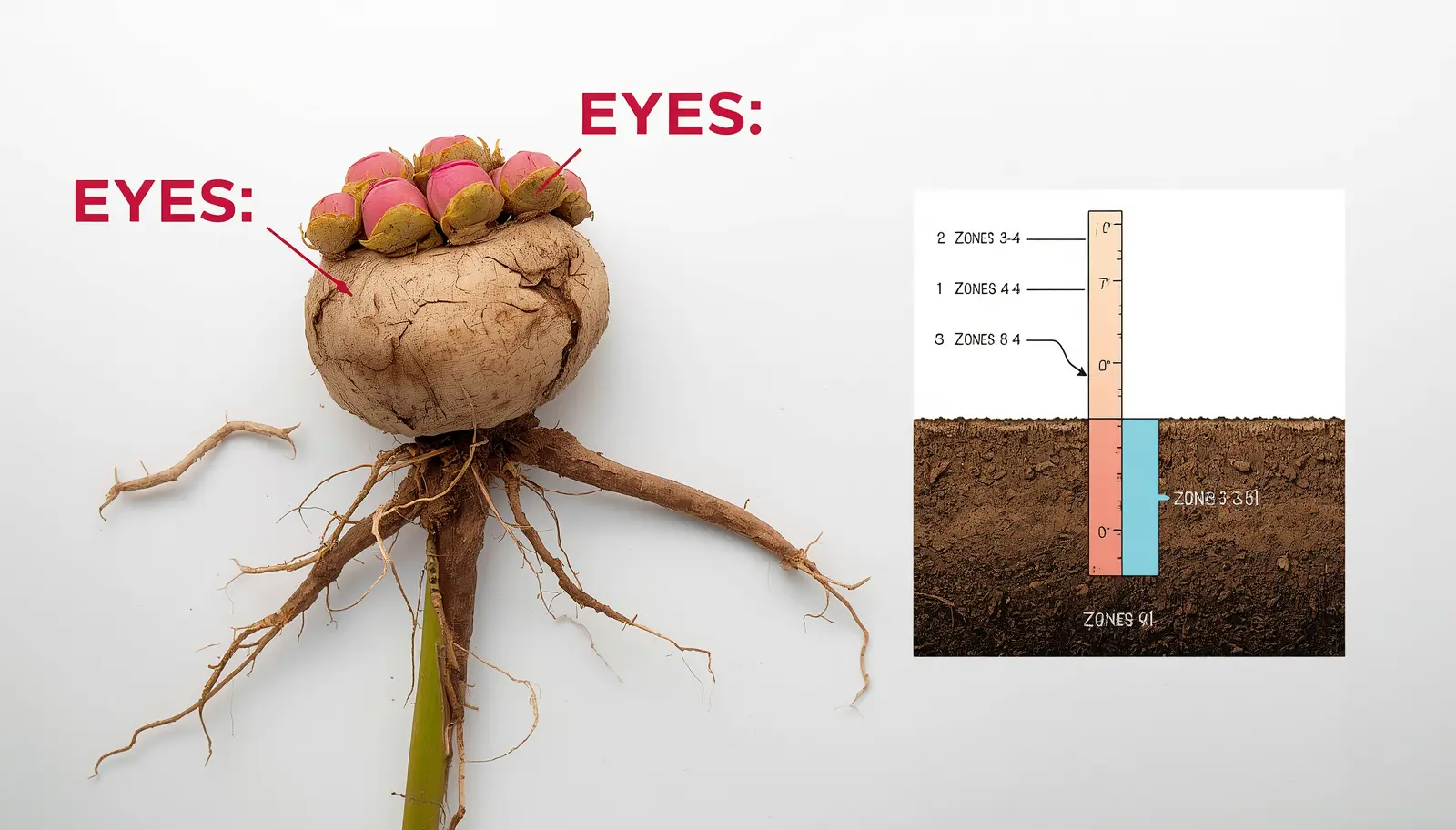
Peony care comes down to planting right once: full sun, well-drained soil, plenty of space and, above all, shallow planting. The University of Missouri says flowering is reduced or inhibited if the eyes (the pink or red buds on the root) are set more than 2 inches below the soil surface, and Clemson Extension, writing for the warmer South, says no deeper than 1 inch and notes that most failures to bloom are caused by deep planting. Get that right and a peony can bloom in the same spot for decades.
| Need | What the sources say |
|---|---|
| Planting depth | Eyes no more than 2 inches deep (Missouri); no more than 1 inch in South Carolina (Clemson) |
| Sun | Herbaceous: at least 6 hours of direct sun; tree peonies: dappled or afternoon shade (Clemson). Excess shade is a key reason peonies fail to flower (Missouri) |
| Soil | Well-drained loam, pH 6.5 to 7.0 (Clemson) |
| Spacing | 3 to 4 feet apart (Missouri) |
| Water | Deeply every 10 to 14 days; very drought resistant once established (Clemson) |
| Fertilizer | Low-nitrogen, e.g. 5-10-5 or 5-10-10, 2 to 3 lb per 100 sq ft when stems are 2 to 3 inches tall (Clemson); excess nitrogen reduces flowering (Missouri) |
| Planting time | Fall, about September in Missouri; late September or October in South Carolina |
| Pets | Toxic to dogs, cats and horses: paeonol (ASPCA) |
Sources: University of Missouri IPM; Clemson HGIC 1170; University of Illinois Extension; ASPCA.
Herbaceous, Tree and Itoh Peonies
Missouri describes three growth types. Most garden peonies are herbaceous: bushy plants up to about 3 feet tall that die back to the ground each winter. Tree peonies keep woody stems all year; they are really shrubs, rarely more than 4 to 5 feet tall. Intersectional (Itoh) peonies are crosses between the two, first made by the Japanese horticulturist Toichi Itoh, and produce abundant flowers, including yellows, on mounded plants about 3 feet tall and wide.
| Herbaceous | Tree | Itoh (intersectional) | |
|---|---|---|---|
| Winter | Dies to the ground | Woody stems remain | Dies to the ground |
| Size | 2 to 3 ft tall, 3 to 4 ft spread (Clemson) | About 4 to 5 ft (Clemson, Missouri) | About 3 ft tall and wide (Missouri) |
| Light | At least 6 hours of sun | Dappled or afternoon shade (Clemson) | Treat like herbaceous |
| Fall cleanup | Cut to the ground after frost | Never cut back (Clemson) | Cut back the herbaceous stems |
Peony flowers are also grouped by form: single, Japanese, anemone, semi-double and double (Missouri). For warm climates, Clemson notes that single and Japanese types usually perform much better than doubles.
How Deep to Plant Peonies
Depth is the single most common reason a healthy-looking peony never flowers. The rule from extension services:
- Cold climates: Missouri says flowering is reduced or inhibited if the eyes are more than 2 inches below the soil surface, and that somewhat shallow planting is preferred.
- Warm climates: Clemson says the tips of the eyes should be no deeper than 1 inch below the soil surface in South Carolina, where winter chilling is already limited.
Many websites give a precise depth for each USDA zone. We found no extension source for those zone-by-zone figures; the safe practice is “no more than 2 inches”, leaning toward 1 inch in the South.
Tree peonies are different because most are grafted. Clemson says the graft union should be about an inch below ground level, with extra soil mounded around the plant for the first winter. Some growers plant the graft deeper so the top can form its own roots; if you follow that advice, follow your supplier’s instructions for the specific plant.
Don’t bury the crown under mulch
A thick layer of mulch over the eyes has a similar effect to planting too deep. Missouri recommends mulching around the base of a newly planted peony for its first winter to prevent heaving during freeze and thaw, and says established peonies are quite hardy and need little winter care. Keep mulch light, and pull it back from the crown in spring.
Sun, Soil, Spacing and Feeding
Sun. Clemson says herbaceous peonies need at least six hours of direct sun a day for good bloom, with afternoon shade helping flowers last longer in hot areas. Missouri calls excess shade a key reason peonies fail to flower. A peony that bloomed for years and then stopped is often being shaded by a tree that has grown.
Soil. Clemson recommends well-drained, loamy soil with a pH of 6.5 to 7.0, adding lime to raise the pH if needed and compost, fine pine bark or well-rotted manure to improve heavy clay. Missouri suggests working decomposed organic matter 10 to 12 inches deep before planting, since peonies stay in one place for many years.
Spacing. Plant 3 to 4 feet apart (Missouri). Good air movement also reduces leaf diseases, according to Illinois Extension.
Feeding. Go easy on nitrogen. Clemson recommends a low-nitrogen complete fertilizer such as 5-10-5 or 5-10-10 at 2 to 3 pounds per 100 square feet in spring, when stems are 2 to 3 inches high, keeping fertilizer and manure off the stems. Missouri warns that excessive fertilizer, especially nitrogen, leads to poor flowering, and suggests a few tablespoons of a high-phosphorus, high-potassium fertilizer 6 to 18 inches from the crown only if vigor declines. Keep high-nitrogen lawn fertilizer away from the bed.
Water. Clemson recommends watering thoroughly and deeply every 10 to 14 days, which encourages deep roots, and notes established peonies are very drought resistant.
Supporting Peony Stems
Clemson says most peonies need support to stop stems flopping under the weight of their flowers, using commercial peony hoops or a ring of three or four stakes with ties. Put supports in place in spring while the shoots are still short, so the stems grow up through them; trying to cage a full-grown plant in bud usually breaks stems. Take care around the tender, dark red shoots when they first emerge (Clemson).
Cutting Peonies for the Vase
Clemson’s advice is to pick at the soft-bud stage, when the buds feel like soft marshmallows, and to leave at least 3 leaves per stem on the plant. Recut the stems under warm water, strip any leaves that would sit in the vase water, and the flowers should open within a day.
Ants on the buds are normal. Clemson and Missouri both say ants are attracted by the sweet sap the buds secrete, and that the idea that ants are needed for peonies to open is a myth. Shake the stems gently before bringing them indoors.
Can Peonies Grow in Pots?
They can, though peonies are long-lived, deep-rooted garden plants and do best in the ground. If you try a container, choose a compact cultivar, a large pot with drainage holes, a loam-based mix, and the same shallow planting depth. Potted roots are more exposed to cold than roots in the ground, so in cold climates move the pot to a sheltered spot or insulate it in winter while still letting the plant get its winter chill. Water when the top inch of mix is dry, and never leave the pot standing in water.
Peony Diseases
Peonies have few serious problems, but three foliage diseases are common. University of Illinois Extension describes them:
| Disease | Symptoms | When |
|---|---|---|
| Botrytis blight (Botrytis spp.) | Reddish-purple leaf spots, shriveled discolored buds, gray fuzzy spore masses | Cloudy, rainy spring or early summer |
| Measles / leaf blotch | Small reddish spots that merge into large reddish-purple blotches | Warm, wet spring or early summer |
| Powdery mildew | White film on leaves and stems that smudges off | Later in summer |
Illinois says none of these is a threat to an otherwise healthy plant, though they spoil the look of the foliage. Because they overwinter on diseased plant material, sanitation is the best management: after frost, cut herbaceous peonies to the ground and remove the debris, and don’t compost it (Clemson, Illinois). Avoid overhead watering (Clemson), and plant in full sun with good air movement (Illinois). Missouri adds that fungicides labeled for botrytis can work as preventives where it is a recurring problem. Clemson lists scales and Japanese beetles as the only insect pests of note.
Why Is My Peony Not Blooming?
| Situation | Likely cause | Fix |
|---|---|---|
| Healthy leaves for years, no flowers | Planted too deep (the most common cause, Clemson) | Lift in fall and replant with eyes no more than 1 to 2 inches deep |
| Newly planted | Immaturity; peonies usually start blooming within three years (Clemson) | Be patient |
| Bloomed before, now declining | More shade, root competition or overcrowding (Clemson, Missouri) | Restore sun, or divide and move in fall |
| Lush, dark leaves near a lawn | Excess nitrogen (Clemson, Missouri) | Stop nitrogen; keep lawn feed away |
| Buds form, then turn brown | Botrytis or a late freeze (Clemson, Illinois) | Remove infected buds; clean up in fall |
| Warm-winter garden | Insufficient winter chilling (Clemson, zones 8 and 9) | Choose early, single or Japanese types |
| Small division planted | One or two eyes take years to flower (Clemson) | Use divisions with 3 to 5 eyes |
Are Peonies Toxic to Cats and Dogs?
Toxic to dogs, cats and horses
The ASPCA lists peony as toxic to dogs, cats and horses, with paeonol as the toxic principle and vomiting, diarrhea and depression as clinical signs. Keep cut flowers out of reach of pets, and call your vet or the ASPCA Animal Poison Control Center at (888) 426-4435 if a pet eats any part of the plant.
For pet-safe alternatives, see our cat-safe plants guide.
How to Plant a Bare-Root Peony
- Plant in fall, the best time for both herbaceous and tree peonies (Clemson); Missouri calls September ideal.
- Choose a division with 3 to 5 eyes; smaller ones may take several years to flower (Clemson).
- Prepare the soil: dig a hole 12 to 18 inches deep and 12 inches wide, mixing in organic matter and a modest amount of a high-phosphorus fertilizer such as 5-10-5 or bone meal (Clemson, Missouri).
- Make a cone of soil in the hole and spread the roots over it (Clemson).
- Set the depth: eyes no more than 2 inches below the surface in cold climates, no more than 1 inch in the South. Lay a stick across the hole to check.
- Firm and water: firm the soil to remove air pockets and water thoroughly (Clemson). Mulch lightly around, not over, the crown for the first winter.
To divide an established clump, lift it in late September or October, wash off the soil to see the eyes, cut it into sections with 3 to 5 eyes and good roots, and replant right away (Clemson, Missouri). Peonies can stay undisturbed for 20 years or more (Missouri), so divide only if flowering has declined.
For more garden flowers, see our guides to daisies and lavender. For a low spring flower to grow at the front of the border, see our guide to forget-me-not care.
Frequently Asked Questions
How deep should you plant peonies?
No more than 2 inches below the soil surface for the eyes (University of Missouri), and no more than 1 inch in warm southern gardens (Clemson). Deep planting is the most common reason peonies fail to bloom.
Why is my peony not blooming?
Usually because it is planted too deep, too young, too shaded or overfed with nitrogen. Clemson also lists overcrowding, root competition, late freezes, disease and insufficient winter chill.
Are ants on peonies harmful?
No. Ants feed on the sweet sap the buds secrete. They don’t help or hinder the flowers, and peonies don’t need ants to open (Missouri, Clemson).
How far apart should peonies be planted?
Three to four feet apart (Missouri). Herbaceous peonies reach a 3 to 4 foot spread when mature (Clemson), and space improves air movement, which reduces leaf diseases.
When should I cut back peonies?
Cut herbaceous peonies to the ground in fall after frost and discard the stems rather than composting them (Clemson). Never cut back tree peonies; they are shrubs and will not regrow.
What should I do with peonies after they bloom?
Remove the seed heads so the plant puts energy into next year’s flowers (Clemson), keep watering in dry spells, and leave the foliage in place until fall, when you cut it down.
How long do peonies live?
A very long time. Missouri says peonies can stay undisturbed for 20 or more years without a decline in flowering, and plants have been known to thrive in one spot for well over 50 years. Clemson says tree peonies can live up to a hundred years.