
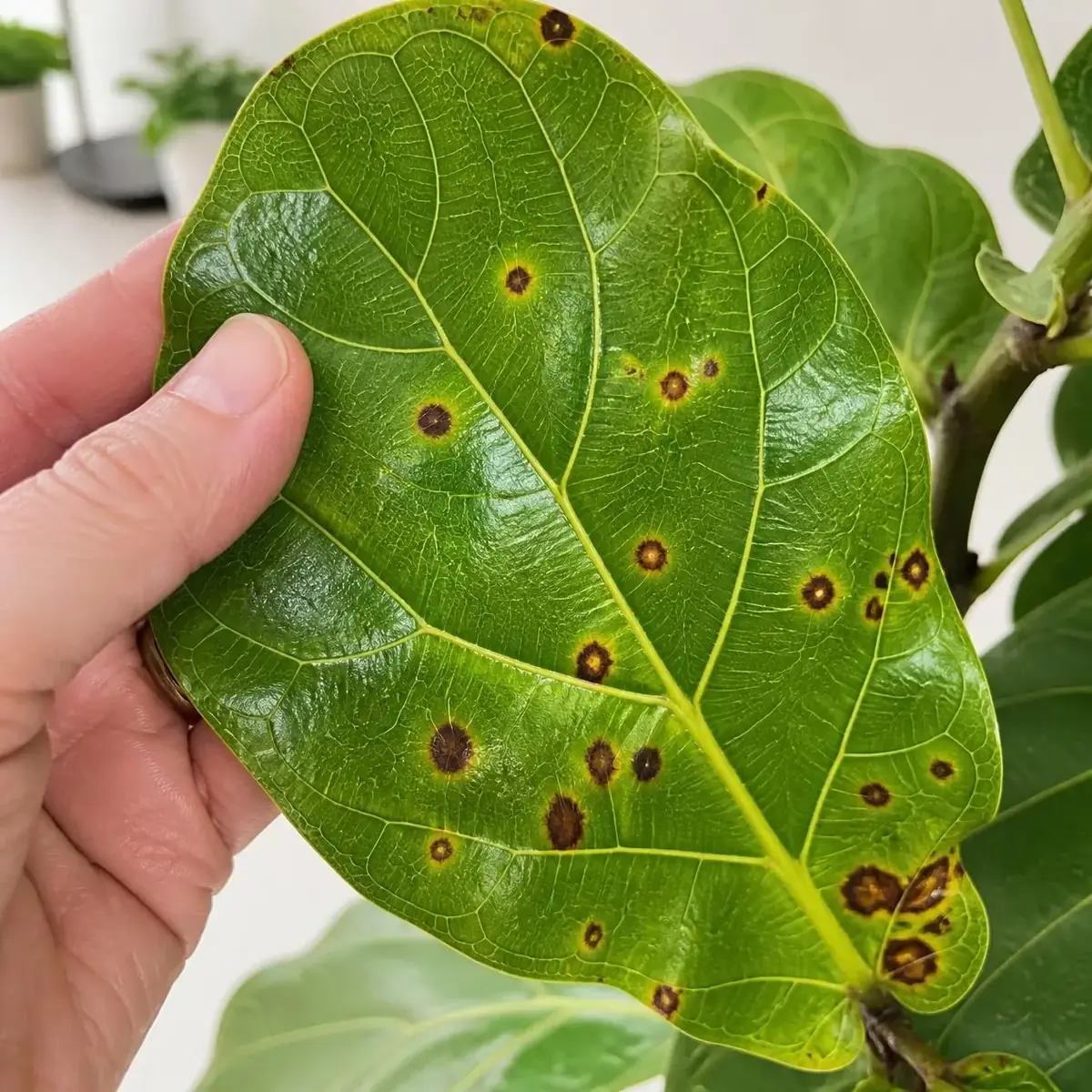
Brown spots on a fiddle leaf fig point to one of five likely causes: root rot, bacterial leaf spot, edema, sunburn, or underwatering. The color, texture, and location of the spots, and which leaves they’re on, usually tell you which one you’re dealing with, and the table below gets you to a diagnosis in under a minute.
Two of these causes need fast action. Root rot and bacterial leaf spot can both keep spreading and kill the plant if you wait, so if you see mushy roots, a softened stem, or spots multiplying across several leaves, skip straight to the root rot and bacterial leaf spot sections below. The other three (edema, sunburn, and underwatering) are cosmetic and straightforward to correct once you know the cause.
What Do the Brown Spots on Your Fiddle Leaf Fig Mean?
Match what you’re seeing to the table, then jump to the matching section for the full fix.
| Symptom | Likely Cause | Fix |
|---|---|---|
| Dark brown to black, mushy spots on the lower or oldest leaves, spreading | Root rot | Check the roots, trim, and repot in fresh, fast-draining soil |
| Light tan to brown, water-soaked spots scattered across leaves at any height, often with a yellow ring | Bacterial leaf spot | Isolate the plant, remove affected leaves, treat with a copper-based bactericide |
| Small reddish-brown, crusty or blister-like bumps, usually on the leaf underside | Edema | Cut back watering, improve air circulation; no treatment needed |
| A dry, dark, scorched patch on the side of the leaf that faces the light | Sunburn | Move the plant back from direct sun, especially in the afternoon |
| Crispy, tan spots starting at the leaf edge, oldest leaves affected first | Underwatering or low humidity | Water more consistently and raise humidity |
Rule Out Root Rot First
Root rot is the most serious cause to rule out, and it starts underground before it ever shows on a leaf. Just as when diagnosing root rot in other houseplants, according to University of Maryland Extension, excess soil moisture reduces the oxygen available to roots, damaging the fine roots the plant needs to take up water; the leaves then show the same stress symptoms as a plant that’s underwatered, even though the soil is wet.
On a fiddle leaf fig specifically, that usually shows up as dark brown to black, mushy-looking spots on the lower and older leaves first, sometimes paired with yellowing leaves lower on the plant or a stem that feels soft near the soil line. NC State Extension notes that fiddle leaf figs are sensitive to overwatering in general, which is one reason the plant is easy to over-love with a watering can.
To confirm it, slide the plant out of its pot and look at the roots. Healthy roots are white to light tan and firm. Roots that are brown, black, and mushy, with a sour smell, confirm root rot, and the longer they sit like that, the more of the root system you’ll lose, so treat it as a same-week job, not a someday job. Move to the repotting steps further down the page.
Bacterial Leaf Spot Is a Different Problem
Bacterial leaf spot looks similar to root rot at first glance, but it behaves differently and needs a different response. UF/IFAS Extension’s plant pathology research has photographed Pseudomonas leaf spot directly on fiddle leaf fig, describing water-soaked lesions scattered randomly across the foliage, caused by the bacterium Pseudomonas cichorii and favored by the warm, humid conditions common indoors in summer. A related pathogen, Xanthomonas campestris, causes similar water-soaked, angular lesions across several other Ficus species and is treated the same way.
The practical difference from root rot: bacterial spots tend to show up on leaves at every height on the plant, not just the lower ones, and the tissue around the spot often turns yellow as the infection spreads, rather than staying green.
Edema Isn’t a Disease at All
Small, reddish-brown, corky bumps on the underside of a leaf can look alarming, but they’re often not a disease at all. University of Maryland Extension describes edema (also spelled oedema) as a physiological condition caused by excess moisture in the soil; combined with cool temperatures, overcast weather, and poor air circulation, water pressure builds up inside the leaf faster than the plant can release it through transpiration, and the cells on the surface rupture.
The result looks a little like a fungus or a pest problem, but it isn’t contagious and won’t spread to the rest of the plant or to your other houseplants. The affected patch of tissue won’t heal, but it also won’t get worse once conditions improve. Cut back on watering frequency, space plants out for better airflow, and move the fiddle leaf fig somewhere warmer and less humid if you can. New leaves that grow afterward should be spot-free.
Dry, Crispy Spots Usually Mean Sun or Water Stress
Sunburn and underwatering both produce dry, crispy, tan-to-brown spots, which is why they’re easy to mix up, but location gives them away.
Sunburn shows up as a scorched patch on whichever side of the leaf faces a window or grow light, usually on the newest leaves that haven’t toughened up yet. NC State Extension notes that fiddle leaf figs need protection from direct afternoon sun, and the fix is simply to move the plant back a few feet or add a sheer curtain between it and the window.
Underwatering and low humidity, on the other hand, start at the leaf edge and work inward, and tend to hit the oldest leaves first, since a stressed plant pulls water away from older growth to protect newer leaves. NC State Extension recommends medium relative humidity and a temperature above 55°F for this plant, which is often warmer and more humid than a typical air-conditioned or heated room. A consistent watering schedule (check the top couple of inches of soil before adding water, rather than watering on a fixed calendar) and a humidifier or pebble tray usually stop new spots from forming.
Treat Root Rot With a Full Repot
Root rot is the most serious cause on this list, and it’s also the one most likely to keep spreading if you only treat the leaves and not the roots. Here’s how to stop it at the source.
- Remove the plant from its pot and gently rinse the potting mix off the roots so you can see them clearly.
- Trim away any roots that are brown, black, or mushy, using clean, sharp scissors or pruning shears.
- Cut off any leaves with spreading brown or black spots; they won’t recover and can keep feeding the problem.
- Repot into a container with drainage holes, using a fresh, fast-draining potting mix rather than reusing the old soil.
- Water only when the top 1 to 2 inches of soil are dry, and make sure any excess water drains away instead of sitting in a saucer.
How Do You Stop Brown Spots From Coming Back?
Most fiddle leaf fig brown spots trace back to one of two things: water (too much, too little, or landing on the leaves) or light (too much sun, too little humidity). A handful of habits cover most of it at once.
Check the soil before you water, rather than watering on a schedule. Push a finger or a wooden skewer into the top couple of inches; if it comes out clean and dry, it’s time to water, and if it’s damp or soil clings to it, wait.
Use a pot with drainage holes and a fast-draining potting mix, and never let the pot sit in standing water.
Keep the plant out of direct afternoon sun and away from cold drafts or heating vents, and aim for the medium relative humidity and temperature above 55°F that NC State Extension recommends for this plant.
Water at the soil line instead of overhead, since UF/IFAS notes that wet foliage is exactly how bacterial leaf spot spreads from leaf to leaf.
Wipe dust off the leaves every few weeks with a damp cloth. It won’t prevent disease on its own, but it improves the plant’s ability to photosynthesize and recover from whatever stress it’s already under. Once your plant recovers and begins pushing healthy foliage, you can safely explore fiddle leaf fig notching to encourage lateral branching without pruning.
Is a Fiddle Leaf Fig Safe Around Pets?
Not entirely. NC State Extension lists Ficus lyrata as having low-severity poison characteristics and toxic to humans, cats, and dogs if ingested, and the ASPCA separately confirms it as mildly toxic to both dogs and cats. The irritant is a milky sap in the leaves and stems, which can cause oral irritation, drooling, or an upset stomach if a pet chews on it.
If you suspect your pet has eaten fiddle leaf fig, contact your veterinarian or the ASPCA Animal Poison Control Center at (888) 426-4435 immediately.
Keep the plant out of reach of curious pets, especially a cat that likes to chew on leaves.
Can a leaf with brown spots heal or turn green again?
No. The tissue inside a brown spot is dead and will not turn green again. The leaf will keep the spot or eventually drop, but new leaves that grow after you fix the cause can be healthy.
Should I cut off fiddle leaf fig leaves with brown spots?
Only if the spots are spreading or match bacterial leaf spot. A few small, unchanging spots from edema or old sunburn can be left on the plant without harming it.
How can I tell root rot from bacterial leaf spot?
Check the roots and the pattern on the leaf. Root rot spots are usually dark and mushy on lower leaves with roots that are brown or black, while bacterial leaf spot often shows a yellow halo and spreads across leaves at every height.
Is edema on a fiddle leaf fig contagious to other plants?
No. Edema is a physiological reaction to excess soil moisture and poor air circulation, not an infection, so it cannot spread to nearby plants. Adjusting watering and airflow usually stops new spots from forming.